





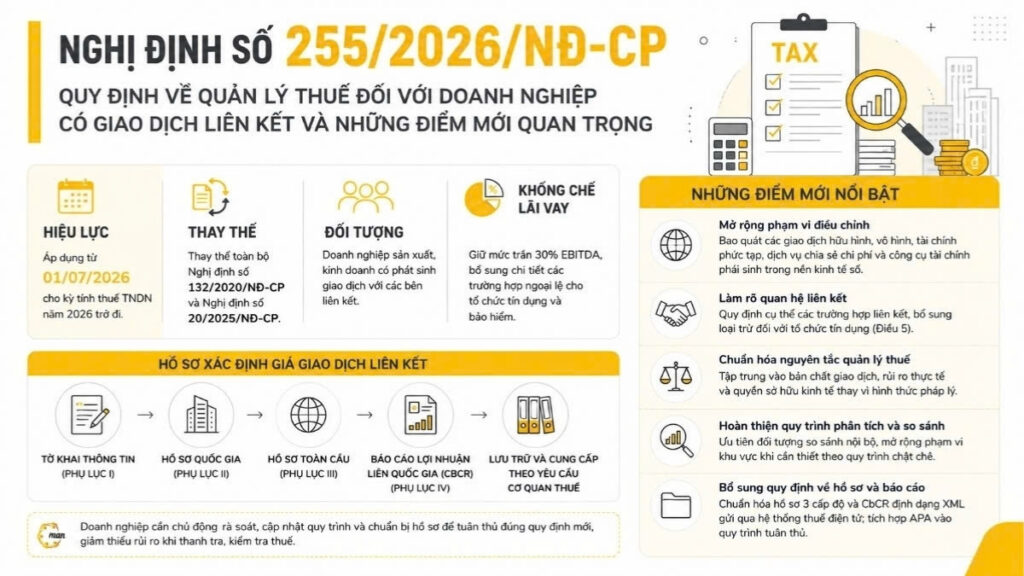
Decree 255/2026/ND-CP This is the latest legal document regulating tax management for related-party transactions of affiliated enterprises, officially effective from July 1, 2026, and applicable from the corporate income tax period of 2026. This Decree replaces... Decree 132/2020/ND-CP and Decree 20/2025/ND-CP, It also updates many important regulations on determining related-party relationships, tax management principles, methods for determining transfer pricing, documentation for determining transfer pricing, Country-by-Country Profit Reporting (CbCR), as well as the rights and obligations of taxpayers.
For businesses with related-party transactions, understanding the regulations in Decree 255/2026/ND-CP is crucial not only for fulfilling the obligations of declaring, documenting, and determining the price of related-party transactions in accordance with the law, but also for minimizing tax risks during audits and inspections. In this article, MAN – Master Accountant Network will comprehensively analyze the key contents of Decree 255/2026/ND-CP, closely adhering to current legal regulations to help businesses update and apply them correctly from the 2026 tax year.
What is Decree 255/2026/ND-CP?
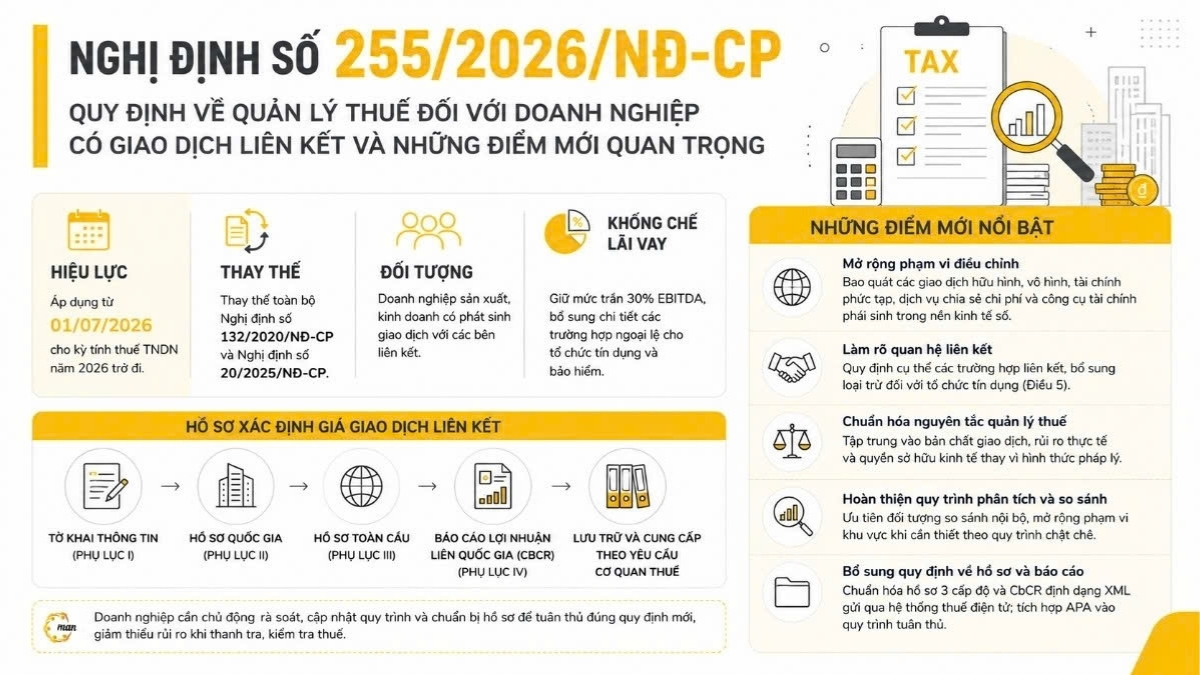
Decree 255/2026/ND-CP is a document issued by the Government on June 30, 2026, regulating tax management for related-party transactions of enterprises with affiliated relationships. The document takes effect from July 1, 2026, and applies from the corporate income tax period of 2026.
The issuance of Decree 255/2026/ND-CP aims to improve the legal framework for tax management of enterprises with related-party transactions, ensuring that tax obligations are determined in accordance with the economic nature of the transaction, and limiting profit shifting and transfer pricing through transactions between related parties. At the same time, the Decree continues to inherit the principles of tax management for related-party transactions in accordance with international practices and is consistent with the provisions of the 2025 Law on Tax Administration.
According to regulations, Decree 255/2026/ND-CP consists of 4 Chapters and 24 Articles, comprehensively regulating all aspects related to tax management of related-party transactions, including:
- Principles for applying tax management to related-party transactions of enterprises with affiliated relationships.
- Regulations concerning related parties.
- Analysis, comparison, selection of independent comparable entities, and methods for determining transfer pricing.
- Determine the costs for tax calculation purposes for businesses with related-party transactions.
- Rights and obligations of taxpayers in declaring and preparing documentation for determining transfer pricing.
- Taxpayer responsibilities related to the Country-by-Country Report (CbCR).
- The responsibilities of state agencies in tax administration towards taxpayers with related-party transactions.
One of the significant changes in Decree 255/2026/ND-CP is the official replacement of Decree 132/2020/ND-CP dated November 5, 2020, and Decree 20/2025/ND-CP dated February 10, 2025, from the date the new decree takes effect. However, for businesses subject to the transitional provisions under Article 3 of Decree 20/2025/ND-CP, the transition will continue for the remaining period as stipulated. Below is a summary table of the basic information of the Decree.
| Content | Information |
| Document number | Decree No. 255/2026/ND-CP |
| Issuing authority | Government |
| Date of issuance | 30/6/2026 |
| Effective date | 01/7/2026 |
| Applicable tax period | Starting from the corporate income tax period of 2026 |
| Scope of adjustment | Tax management for related-party transactions of affiliated businesses. |
| Replace text | Decree 132/2020/ND-CP and Decree 20/2025/ND-CP (except for transitional cases as prescribed). |
Scope of application of Decree 255/2026/ND-CP
According to Article 2 of Decree 255/2026/ND-CP, the subjects to which it applies include:
- Organizations producing and trading goods and services (collectively referred to as taxpayers) are subject to corporate income tax when transactions occur with related parties as defined in Article 5 of the decree;
- Tax authorities;
- Relevant government agencies, organizations, and individuals.
Thus, the scope of impact of Decree 255/2026/ND-CP is not limited to businesses but also binds the tax authorities and relevant parties to coordinate their responsibilities throughout the entire management process.
See also: New provisions for related-party transactions in 2026.
How are affiliated parties defined according to Decree 255/2026/ND-CP?

One of the issues that businesses are most concerned about when studying the new regulations is how to define an affiliated party. According to Article 5, affiliated parties are first and foremost determined according to the provisions of... Clause 17, Article 4 of the 2025 Law on Tax Administration. This is the original legal basis, and Decree 255/2026/ND-CP specifies the detailed cases immediately afterward.
Specific cases are considered as affiliated parties.
Specifically, Decree 255/2026/ND-CP lists the related parties as follows:
Capital ownership relationship
The first set of criteria set forth in Decree 255/2026/ND-CP to determine affiliated parties revolves around the ownership ratio of capital contributions between enterprises. Specifically, an enterprise is considered to have an affiliated relationship with another enterprise if it falls under one of the following cases:
- One business directly or indirectly holds at least 25% of the owner's equity of the other business;
- Both enterprises have at least 25% of owner's equity held directly or indirectly by a third party;
- One business is the largest shareholder in terms of owner's equity and directly or indirectly holds at least 10% of the total shares of the other business.
Guarantee and loan relationships
In addition to ownership relationships, the Decree also defines affiliations based on the degree of financial dependence between two enterprises through guarantees or loans. Specifically, this is recognized when:
An enterprise guarantees or lends capital to another enterprise in any form (including third-party loans secured by related-party financing and similar financial transactions), provided that the total outstanding debt of the borrowing enterprise to the lending or guaranteeing enterprise is at least 25% of the owner's equity of the borrowing enterprise and accounts for more than 50% of the total outstanding debt of all medium and long-term debts of the borrowing enterprise.
Notably, this regulation does not apply in the following three exceptions:
- The guarantor or lender is an economic organization operating under the Law on Credit Institutions 2025 (amended and supplemented by the amended Law on Credit Institutions 2025) and does not directly or indirectly participate in the management, control, capital contribution, or investment in the borrowing or guaranteed enterprise;
- The guarantor or lender is a credit institution as defined by the Law on Credit Institutions 2024 (amended and supplemented by the Law on Credit Institutions 2025), and the borrowing or guaranteed enterprise is not under the same management, control, capital contribution, or investment of another party;
- The creditor or guarantor is a state-owned organization with charter capital that functions in buying, selling, and handling debt, and does not directly or indirectly participate in the management, control, capital contribution, or investment in the debtor or guaranteed enterprise.
Human resources relations, management
The new regulations also define an affiliated company based on its ability to exert influence over management personnel, meaning when one company can influence the operational structure or key decisions of another company, even without holding a sufficiently large stake. Specifically, an affiliated relationship is established in the following cases:
- An enterprise may designate a member of the executive board to manage or control another enterprise, provided that the number of designated members exceeds 50% of the total number of executive board members of the second enterprise; or that a designated member has the authority to decide on the financial policies and business operations of the second enterprise;
- Two companies may have more than one 50% board member, or a board member with the authority to make financial or business policy decisions, appointed by the same third party.
Management and control relationships are exercised by individuals and their relatives.
Furthermore, the Decree also recognizes the relationship arising from personal factors and the actual degree of influence an individual has over business operations, specifically as follows:
- Two businesses are managed or controlled in terms of personnel, finance, and business operations by individuals who are related as spouses, parents and children (biological, adoptive, stepchildren, daughters-in-law, sons-in-law), siblings (either half-siblings or half-siblings), grandparents and grandchildren, aunts and uncles and nieces/nephews;
- Businesses are controlled by an individual through capital contribution or direct involvement in management.
Other cases
In addition to the aforementioned groups of relationships related to capital contributions, guarantees, loans, management personnel, and personal relationships, Decree 255/2026/ND-CP also stipulates several specific cases that businesses may easily overlook during review, including the relationship between the head office and the permanent establishment, the relationship of actual control over business operations, as well as capital and loan transactions arising with the individual managing the business. Specifically:
- The two business establishments have a relationship where the head office and the permanent establishment are, or both are permanent establishments of a foreign organization or individual;
- Businesses (including independently accounting branches that declare and pay corporate income tax) are subject to the management, control, and decision-making power of the other business regarding their production and business activities.;
- Businesses that engage in transactions involving the transfer or acquisition of at least 25% of owner's equity during the tax period; or borrow, lend, or grant loans of at least 10% of owner's equity at the time of the transaction with the individual managing or controlling the business or a relative of that individual;
- Credit institutions with their subsidiaries, controlling companies, or affiliated companies as defined in the Law on Credit Institutions 2024 (amended and supplemented by the Law on Credit Institutions 2025).
Key points regarding the determination of taxable expenses in the Decree.

Besides correctly identifying the related party, one of the primary concerns for businesses when implementing this is whether the expenses incurred from related-party transactions are deductible when determining taxable income.
This content directly impacts the amount of corporate income tax payable, so Decree 255/2026/ND-CP dedicates Article 16 to specifying three groups of issues: expenses excluded due to not being in the nature of independent transactions, conditions for the legitimate recognition of service expenses between related parties, and thresholds. controlling interest expense Deductible. Here are some points businesses need to be aware of.
Expenses are not deductible when related-party transactions are not of the correct nature.
According to Article 16 of Decree 255/2026/ND-CP, expenses of related-party transactions that are inconsistent with the nature of independent transactions, or that do not contribute to generating revenue or income for the taxpayer's business operations, will not be deductible expenses when determining taxable corporate income. Specifically, this includes:
- Payments to related parties that do not engage in any production or business activities related to the taxpayer's industry; and have no rights or responsibilities related to the assets, goods, or services provided;
- Payments made to affiliated parties that engage in production and business activities but whose asset size, number of employees, and business functions are not commensurate with the value of the transaction received;
- Payments made to related parties who are residents of a country or territory not subject to corporate income tax do not contribute to generating revenue or added value for the taxpayer.
Conditions for service fees between related parties to be considered deductible expenses.
Decree 255/2026/ND-CP stipulates that taxpayers are allowed to deduct service fees paid to related parties if they meet all the following conditions:
- The services provided have commercial, financial, and economic value and directly serve the production and business activities of the taxpayer;
- A service is defined as having been provided under similar conditions and circumstances to those paid for by independent parties;
- Service fees are paid on an arm's-length basis, and the transfer pricing method or fee allocation must be applied uniformly across the group for similar types of services;
- Taxpayers must provide contracts, documents, invoices, and information on the calculation method, allocation factors, and pricing policy of the corporation.
For centers performing specialized functions and synergistically creating added value for the group, Decree 255/2026/ND-CP requires taxpayers to determine the total value generated from these functions and determine the appropriate profit allocation based on the value contributed by the affiliated parties, after deducting the corresponding service fees for the coordinating party or service provider that is similar to an independent transaction.
Conversely, the following service fees will not be deductible when determining taxable income:
- The cost of the service is solely for the benefit or value creation of other affiliated parties;
- Services that serve the interests of the related party's shareholders;
- Double charging for services occurs when multiple parties provide the same type of service without determining the added value for the taxpayer.;
- Services are, by their very nature, benefits that taxpayers receive as a result of being members of a corporation;
- The additional cost that an affiliate adds for services provided by a third party through the affiliate's intermediary, without adding any value to the service.
Regulations regarding deductible interest expenses in related-party transactions.
This is the content that has the most direct and obvious financial impact on the business.
Accordingly, the total interest expense after deducting interest on deposits and loans incurred during the period is deductible when determining taxable income for corporate income tax purposes, provided it does not exceed 30% of the total net profit from business operations during the period, plus interest expense (after deducting interest on deposits and loans) and depreciation expense incurred during the period.
The portion of interest expense that is not deductible due to exceeding the above threshold will be carried forward to the next tax period when determining the total deductible interest expense, if the total deductible interest expense incurred in the subsequent period is lower than the prescribed level. This carry-forward period is calculated continuously for no more than 5 years from the year following the year in which the non-deductible interest expense was incurred.
The aforementioned restrictions in Decree 255/2026/ND-CP do not apply to loans from:
- The taxpayer is a credit institution as defined by the Law on Credit Institutions 2024 (amended and supplemented by the Law on Credit Institutions Amendment 2025);
- Insurance businesses are organized according to the Insurance Business Law 2022 (amended and supplemented by the amended Insurance Business Law 2025);
- Official development assistance (ODA) loans, preferential government loans in the form of government borrowing from foreign sources and then lending to businesses;
- Loans for implementing national target programs (new rural development, sustainable poverty reduction);
- Loans for investment in programs and projects implementing the State's social welfare policies (resettlement housing, housing for workers and students, social housing, and other public welfare projects).
Taxpayers are obligated to declare the interest expense ratio for the tax period according to Appendix I issued with Decree 255/2026/ND-CP.
Which documents does Decree 255/2026/ND-CP replace?
Article 23 of Decree 255/2026/ND-CP clearly stipulates:
Decree 132/2020/ND-CP dated November 5, 2020 and Decree 20/2025/ND-CP dated February 10, 2025, regulating tax management for enterprises with related-party transactions, will cease to be effective from the date Decree 255/2026/ND-CP comes into force, i.e., from July 1, 2026.
Transitional provisions for businesses subject to transition
One point businesses need to pay particular attention to: In cases where a business falls under the category eligible for transitional provisions as stipulated in Article 3 of Decree 20/2025/ND-CP, it will continue to be transitioned for the remaining period in accordance with Article 3 of Decree 20/2025/ND-CP, even if the original document has expired.
This is a mechanism to ensure the previously established rights of businesses, preventing Decree 255/2026/ND-CP from disrupting the ongoing transitional roadmaps.
What preparations do businesses need to make when the Decree officially comes into effect?

With the above changes, businesses with related-party transactions should proactively review their tax records now to avoid tax risks in the 2026 tax year.
- Review all related parties according to the 12 new criteria groups in Article 5 of Decree 255/2026/ND-CP, especially guarantee, loan, and personal relationships that are easily overlooked.
- Recalculate the interest expense ratio against the 30% EBITDA threshold, identify any excess (if any), and plan for a transition period of up to 5 years.
- Prepare all necessary contracts, documents, and invoices proving service costs between related parties that meet all four conditions for deduction as stipulated in Article 16.
- Determine whether the business falls under the transitional provisions of Article 3 of Decree 20/2025/ND-CP, in order to apply the remaining roadmap correctly instead of mistakenly applying completely new regulations.
Conclude
Proactively updating and reviewing information from the beginning of the tax period will help businesses minimize the risk of having expenses disallowed, taxes assessed incorrectly, or disputes arising with tax authorities when Decree 255/2026/ND-CP officially comes into effect for the 2026 corporate income tax settlement period.
If your business has complex related-party transactions or is unsure about classifying affiliates, consultation is recommended. related party transaction advisory services from specialized and experienced units such as MAN – Master Accountant Network to review everything. related-party transaction pricing documentation before entering the year-end settlement period.
Contact MAN – Master Accountant Network For timely support, advice, and updates!
Contact information MAN – Master Accountant Network
- Address: No. 19A, Street 43, Tan Thuan Ward, Ho Chi Minh City
- Mobile/Zalo: 0903 963 163 – 0903 428 622
- E-mail: man@man.net.vn
- Google Business Profile: View MAN – Master Accountant Network's Google Business Profile
- LinkedIn Founder: View expert Le Hoang Tuyen's LinkedIn profile.
Responsible for production and professional content review by: Mr. Le Hoang Tuyen – Founder & CEO of MAN – Master Accountant Network. He is a CPA Vietnam auditor with over 30 years of in-depth experience in accounting, auditing, taxation, and corporate legal consulting.
Frequently Asked Questions about Decree 255/2026/ND-CP
Decree 255/2026/ND-CP takes effect from July 1, 2026, and is applied immediately from the corporate income tax period of 2026. Businesses should note that all related-party transactions arising throughout 2026, including those prior to July 1, 2026, are subject to the provisions of this tax settlement period.
According to Article 23, Decree 255/2026/ND-CP simultaneously replaces Decree 132/2020/ND-CP and Decree 20/2025/ND-CP. Both of these documents officially cease to be in effect from the date Decree 255/2026/ND-CP comes into force, i.e., July 1, 2026.
Businesses subject to the transitional provisions under Article 3 of Decree 20/2025/ND-CP will continue to apply for the remaining period in accordance with the regulations in Article 3 of Decree 20/2025/ND-CP, even though the original document has expired. This transitional provision is retained by Decree 255/2026/ND-CP to ensure that the rights of businesses are not interrupted.
The total interest expense (after deducting interest on deposits and loans) deductible for corporate income tax purposes shall not exceed the 30% of the total net profit from business operations plus net interest expense and depreciation expense for the period (equivalent to the 30% EBITDA threshold). Any amount exceeding this threshold shall be carried forward to the next tax period, for a maximum of five consecutive years.
Decree 255/2026/ND-CP excludes loans from credit institutions, insurance companies, ODA funds and preferential government loans, funds for national target programs, and loans for state-funded social welfare projects (resettlement housing, worker housing, student housing, social housing, etc.) from the scope of application of the 30% threshold.
No. Service fees are only deductible if they simultaneously meet the following conditions: the service has real commercial, financial, or economic value; it is provided under conditions similar to an independent transaction; the fee is calculated according to the arm's-length principle and applied consistently within the group; and there is complete contract, documentation, and invoices to support it. Expenses solely for the benefit of shareholders, overlapping fees, or benefits inherent to membership in the group are not deductible.When does Decree 255/2026/ND-CP take effect and which tax periods does it apply to?
Which document does Decree 255/2026/ND-CP replace? Are Decrees 132/2020 and 20/2025 still in effect?
How should businesses that are currently applying the transitional regulations under Decree 20/2025/ND-CP proceed when Decree 255/2026/ND-CP comes into effect?
What is the maximum percentage of interest expense that can be deducted under the new regulations?
Which types of loans are not subject to the 30% interest expense cap?
Are service fees paid to affiliated parties always considered deductible expenses?