





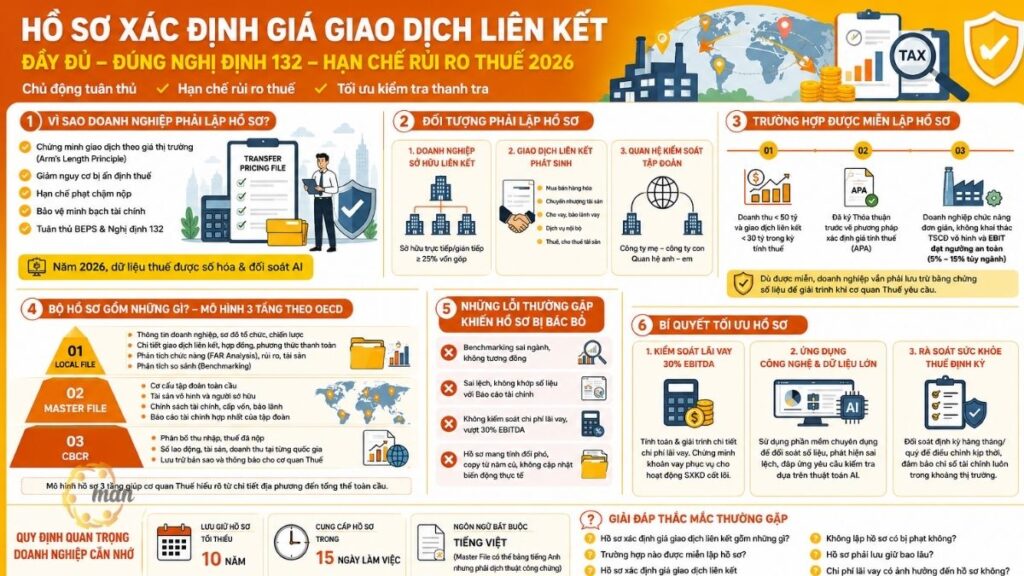
In the context of an increasingly globalized economy, cross-border and intra-corporate transactions have become an integral part of business operations. However, this is accompanied by close scrutiny from tax authorities to combat base erosion and profit shifting (BEPS). In Vietnam, the creation and maintenance of records determining transfer pricing is not only a mandatory legal obligation. Decree 132/2020/ND-CP It is also a key tool that helps businesses protect their financial transparency.
This article will provide detailed guidance on the structure of transfer pricing documentation, the entities required to prepare it, exemptions, retention periods, and important considerations to help businesses proactively prevent tax risks in 2026.
The importance of managing transfer pricing.
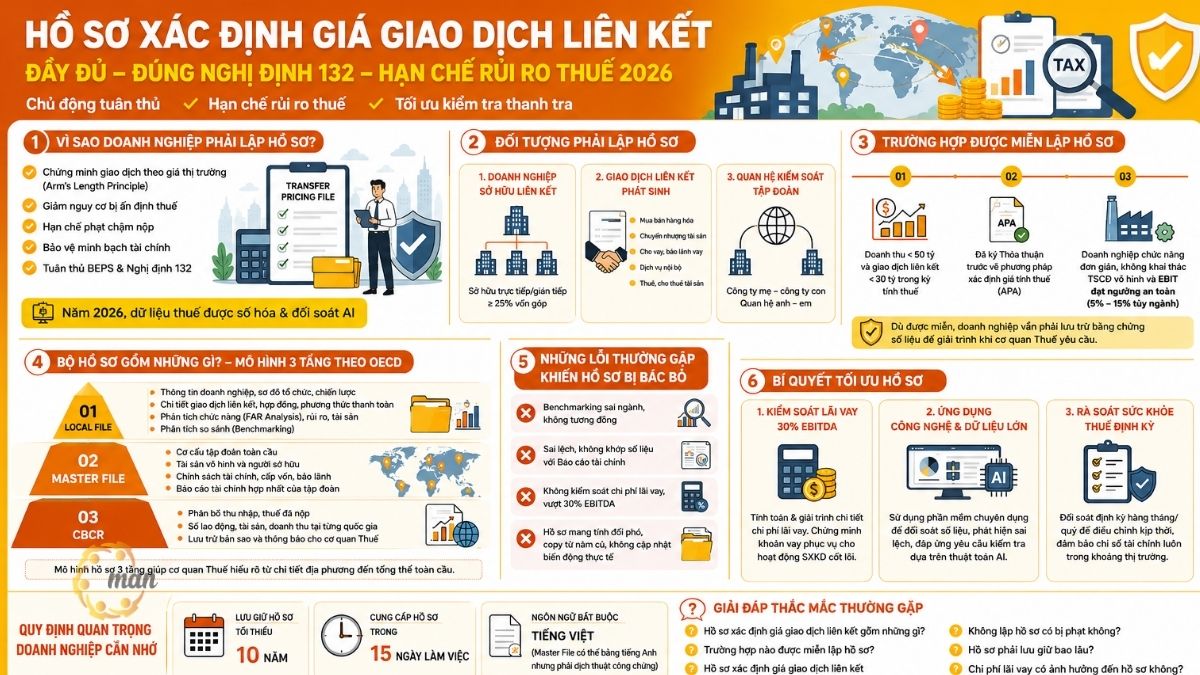
Tax management for related-party transactions has undergone a significant shift from voluntary encouragement to strict, risk-based control. Transfer pricing documentation is a collection of documents, data, and economic analysis aimed at demonstrating that transactions between related parties are conducted according to the Arm's Length Principle (ARP).
Without thorough preparation of transfer pricing documentation, businesses face the risk of tax assessments, late payment penalties, and serious damage to their reputation in the market. Especially in the 2026 tax year, when the tax authorities' data systems have been digitized and synchronized, possessing a complete and accurate transfer pricing documentation set is a prerequisite for optimizing tax costs and avoiding unnecessary penalties.
Which entities are required to prepare transfer pricing documentation?

According to Decree 132/2020/ND-CP, taxpayers with related-party transactions falling within the scope of regulation are responsible for declaring and determining the transfer pricing of these transactions and are not allowed to deduct expenses that are inconsistent with the nature of the market transaction.
Classification of businesses subject to regulation
The entities required to pay attention to the preparation of transfer pricing documentation include:
- Businesses with direct or indirect ownership relationships involving at least 25% of owner's capital contribution.
- Businesses are all under the direct or indirect control of a third party (brotherly/sister relationships within the group).
- Businesses engage in transactions involving the purchase, sale, lease, rental, and transfer of goods, services, and assets with related parties.
- In particular, loan and loan guarantee transactions between parties with management or control relationships are also subject to the requirement of preparing transfer pricing documentation.
Cases exempt from preparing documentation for determining transfer pricing.
Not all businesses with related-party transactions are required to prepare a complete set of documentation. Some cases are exempt from preparing documentation for determining transfer pricing but still have to submit the required appendices, including:
- Businesses with total revenue under VND 50 billion and total value of related-party transactions under VND 30 billion in a tax period.
- The company has signed an Advance Pricing Agreement (APA) and has submitted its annual APA report.
- Businesses that perform simple functions (distribution or contract manufacturing), do not generate revenue from the exploitation of intangible assets, and have a safe earnings before interest and taxes (EBIT) ratio ranging from 5% to 15% depending on the industry.
See details: No related-party transaction documentation is required.
Note: Even though exempt from preparation, businesses still need to retain digital evidence to explain the exemption if the tax authorities request a review of transfer pricing records at their headquarters.
What documents are included in the transfer pricing documentation list?

According to current regulations, the structure of the transfer pricing documentation is designed according to a three-tiered model to cover everything from local details to the global overview. Failure to prepare any tier may render the transfer pricing documentation invalid.
Local File
National records are the most important documents for the local tax authorities. The content of these records for determining transfer pricing at this level focuses on:
- Company Information: Detailed description of the organizational structure, management, business development strategy, and a list of key competitors in the Vietnamese market.
- Transaction details: List all related-party transactions that occurred during the year, including the transaction value, related contracts, and actual payment methods.
See details: National profile of related-party transactions.
Functional Analysis (FAR Analysis): This is considered the most important part of the transfer pricing documentation. Businesses need to demonstrate that the profits earned are commensurate with:
- Functions performed: Manufacturing, assembly, research, marketing, or technical support.
- Assets in use: Machinery, factory buildings, intellectual property, software.
- Risks incurred: Exchange rate risk, debt recovery risk, product defect risk.
Benchmarking: Identifying independent businesses with similar functions to use as benchmarks for comparing profit margins in transfer pricing analysis.
Global corporate profile (Master File)
If the business is a member of a multinational corporation, the transfer pricing documentation must include a Global Group Profile. This document provides a broader picture of:
- The ownership structure and business entities of the corporation worldwide.
- An important category of intangible assets and who owns and exploits them.
- Internal financial agreements, funding policies, and guarantees.
- Consolidated financial statements and the group's special tax agreements with other countries.
Country-by-Country Reporting (CbCR)
This report requires transparency regarding income allocation, taxes paid, and economic indicators in each country where the group operates. If the ultimate parent company abroad has submitted this report, the business in Vietnam needs to retain a copy and notify the tax authorities as part of its transfer pricing documentation.
Regulations on retaining and providing records to the Tax authorities.

To effectively manage risks, businesses need to understand the timelines related to transfer pricing documentation as stipulated in Decree 132/2020/ND-CP:
- Retention period: Similar to other important accounting documents, records of transfer pricing must be retained for a minimum of 10 years. Loss or misplacement of these records will result in significant administrative penalties.
- Deadline for submission: When a tax audit or inspection is requested, businesses only have 15 working days to provide the documentation for determining transfer pricing. This timeframe is very short if the business has not prepared in advance.
- Required language: Vietnamese law stipulates that transfer pricing documentation must be prepared in Vietnamese. Although the Master File may be prepared by the corporation in English, a certified translation must be included when submitting it to the authorities.
Reference: Related party transaction documentation service.
Common errors that lead to the rejection of transfer pricing documentation.
During on-site inspections, tax authorities often point out the following loopholes in businesses' transfer pricing documentation:
- Benchmarking: A garment manufacturing company uses the profit margin of an electronics component manufacturing company for comparison in its transfer pricing documentation.
- Omitting interest expense: According to Decree 132, the total deductible interest expense must not exceed 30% of EBITDA. Many businesses forget to separate this portion when preparing transfer pricing documentation, leading to retroactive corporate income tax collection. Businesses should refer to this information. How to calculate interest expense according to Decree 132.
- The documentation is reactive: The FAR analysis content is simply copied from year to year without updating to actual market fluctuations in 2026. This reduces the credibility of the documentation for determining transfer pricing.
- Discrepancies with financial statements: The figures for cost of goods sold and related-party transaction revenue in the documentation do not match the notes to the audited financial statements.
To completely rectify these errors, businesses should seek advice. related party transaction advisory services From professional, reputable, and experienced units to ensure accuracy and optimize tax benefits.
The secret to optimizing transfer pricing documentation.
To make the documentation for determining transfer pricing more sophisticated and professional, businesses need to adopt a proactive rather than a reactive management mindset.
Control interest expense and EBITDA
This is the most important and new point. In the transfer pricing documentation, businesses need a separate section to calculate and explain the ceiling on interest expense under 30% EBITDA. Demonstrating that related-party loans are used for core business operations will help businesses protect their deductible expenses.
Applying technology and big data
In 2026, tax authorities will use AI algorithms to scrutinize data. Therefore, businesses should also use specialized software to review records for determining transfer pricing. These tools help match data between tax returns and detect potential discrepancies before filing.
Establish a tax health review process.
Consider the creation of transfer pricing documentation as part of your monthly risk management process. Regular reconciliation helps businesses adjust costs in a timely manner, ensuring that by the end of the year, financial indicators remain within the market value range established by the transfer pricing documentation.
Conclusion and recommendations
Preparing documentation for transfer pricing is no longer an option but a requirement for all businesses that have transactions with related parties. A poorly prepared set of documents can lead to serious economic consequences, ranging from tax assessments to the need to readjust the entire accounting system.
Don't wait until you receive an audit notice to start researching transfer pricing documentation. Proactively build a solid data foundation, regularly updating yourself on tax regulations and policies regarding related-party transactions. Or consult a reputable and experienced firm like MAN – Master Accountant Network for support.
Contact MAN – Master Accountant Network For free support and advice!
Contact information for MAN – Master Accoutant Network
- Address: No. 19A, Street 43, Tan Thuan Ward, Ho Chi Minh City
- Mobile/Zalo: 0903 963 163 – 0903 428 622
- Email: man@man.net.vn
Content production by: Mr. Le Hoang Tuyen – Founder and CEO of MAN – Master Accountant Network, CPA Vietnam with over 30 years of experience in accounting, auditing, and financial consulting.
Frequently Asked Questions about Transfer Pricing Documentation
Transfer pricing documentation typically consists of three main parts: the Local File, the Master File, and the Country-by-Country Report of Profit and Loss (CbCR) if applicable. In addition, businesses must fully disclose all required related-party transaction appendices.
Some businesses are exempt from filing full records if they meet the conditions of having revenue below VND 50 billion, total related-party transactions below VND 30 billion, or are eligible for APA (Advanced Permit System) applications, or have simple functions that achieve a safe profit margin. However, they must still submit the required appendix.
Businesses must complete their tax return before the annual corporate income tax filing deadline and keep the documents readily available. When the tax authorities request an audit or inspection, the deadline for providing the documents is usually only within 15 working days.
Yes. If a business fails to prepare or prepares incomplete transfer pricing documentation, the tax authorities may determine the transfer pricing, collect back corporate income tax, calculate late payment penalties, and impose administrative tax penalties. This is one of the biggest risks in transfer pricing audits.
According to current regulations, records of transfer pricing must be retained for a minimum of 10 years, similar to important accounting documents. Complete retention allows businesses to proactively explain their positions when tax authorities review previous tax periods.
Yes. Interest expense between related parties is subject to very strict scrutiny under the 30% EBITDA limit. If it is not calculated and explained reasonably in the transfer pricing documentation, the company may have the expense disallowed and face significant tax arrears.What documents are required to determine transfer pricing?
In which cases is it waived to prepare documentation for determining transfer pricing?
When should the transfer pricing documentation be prepared?
Is there a penalty for not creating documentation to determine transfer pricing?
How long must records of transfer pricing be retained?
Does interest expense affect the valuation report?