





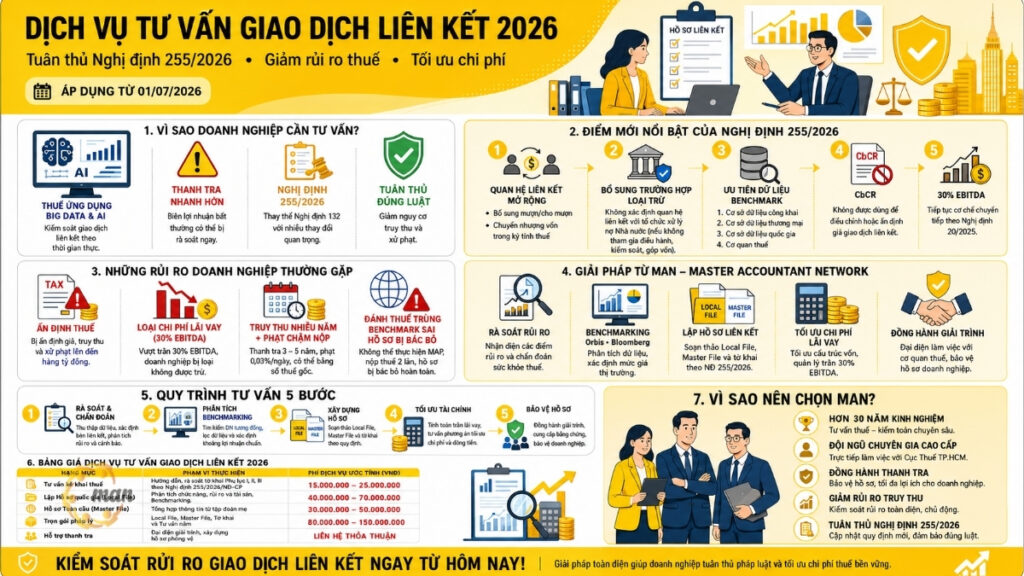
Related-party transaction advisory services are a crucial solution to help businesses avoid the risk of tax assessments, back taxes, and late payment penalties amounting to billions of dong, as tax authorities tighten control over transfer pricing. This is especially important from July 1st, 2026., Decree 255/2026/ND-CP Officially replacing Decree 132/2020/ND-CP with a series of new points regarding related-party transactions, pricing documentation, and exemption thresholds, timely updating of regulations has become a mandatory requirement for all businesses with related-party transactions.
With over 30 years of experience in tax and auditing consulting, and a team of experts working directly with the Ho Chi Minh City Tax Department, MAN – Master Accountant Network provides comprehensive solutions ranging from risk assessment and preparation of valuation documents to optimizing interest expense and protecting documents against audits, helping businesses comply with the law and optimize tax costs sustainably.
Why is affiliate marketing the focus?
Entering 2026, the Vietnamese tax authorities have completed a Big Data system combined with artificial intelligence to analyze tax risks. Transactions between related parties are no longer simply adjustments to sales prices or service fees, but have transformed into complex financial structures.
The shift from post-audit to cash flow control.
Previously, businesses would frantically prepare documents only when an inspection was imminent. Now, the Ho Chi Minh City Tax Department has implemented a real-time monitoring mechanism. Any anomaly in profit margins compared to the industry average can trigger an immediate review. This is why related-party transaction advisory services are extremely crucial for all businesses with related-party transactions.
Besides tightening risk management, Decree 255/2026 also adds regulations on the responsibility of tax authorities in managing compliance and supporting taxpayers with related-party transactions, reflecting a shift in the tax management model from risk management (focusing on detecting violations, inspection and penalties) to a compliance management and compliance support model centered on taxpayers. Specifically, tax authorities will:
- Develop a voluntary compliance support program based on risk management;
- Publish industry profit margins by sector, geographical area, or taxpayer group to assist businesses in declaring and determining prices according to the arm's length principle;
- Supporting improved compliance and reduced risks for businesses participating in the program;
- Businesses are responsible for maintaining the confidentiality of information and data they provide when participating in the program.
Key legal basis: From Decree 132/2020/ND-CP to Decree 255/2026/ND-CP
In the previous period, all review activities revolved around Decree 132/2020/ND-CP. By 2025, the Government issued Decree 20/2025/ND-CP amending and supplementing Decree 132/2020/ND-CP.
From July 1st, 2026, this legal framework will be replaced by Decree 255/2026/ND-CP, with two notable fundamental changes:
- Regarding the principles of application (Article 3): The principles of management and inspection by tax authorities regarding related-party transaction prices are amended and supplemented in accordance with the guidelines referring to the principles of application in tax administration (Clause 4, Article 6) and the principles of tax inspection (Clause 1, Article 22) of the 2025 Law on Tax Administration, in order to ensure consistency and completeness with the current law.
- Regarding the interpretation of terms (Article 4): Supplement and refine the concepts of Supreme Parent Company, Tax Agreement (referencing Resolution 107/2023/QH15 and Decree 236/2025/ND-CP on global minimum tax), and simultaneously refine the definitions of Related Party Transactions, National Profile, Global Profile, and the Status of Non-Systematic Information Exchange.
See also: New points in Decree 255/2026/ND-CP regarding related-party transactions.
Understanding Related Party Transactions and Compliance Obligations
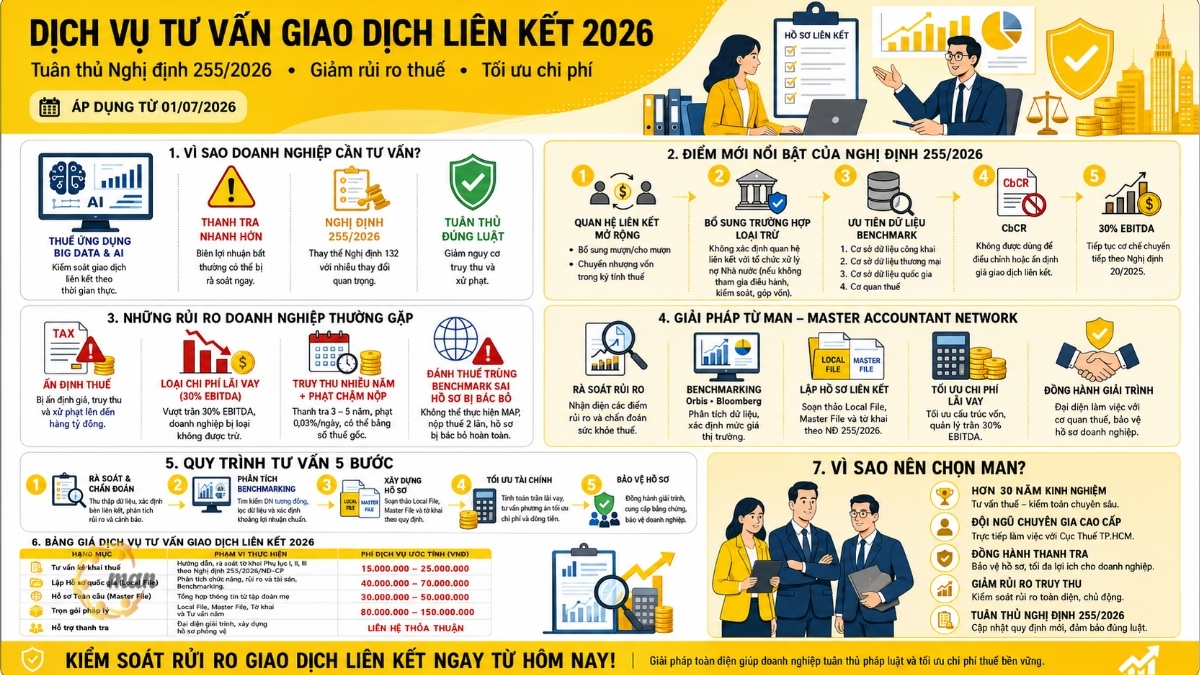
To manage risk, businesses first need to understand where they stand on the legal map.
Identify related parties
According to Article 5 of Decree 132/2020/ND-CP, related parties are those parties that have a relationship falling under one of the following cases:
- Case a: One party directly or indirectly holds at least 25% of the other party's owner's equity.
- Case b: Both parties have at least 25% of owner's equity held directly or indirectly by a third party.
- Case c: One party is the largest shareholder in terms of owner's equity of the other party and holds at least 10% of the total shares of the other party.
- Case d: One party guarantees or lends capital to the other party in any form (including third-party loans guaranteed from the financing of an affiliated party) provided that the loan amount is at least 25% of the owner's equity of the borrower and accounts for more than 50% of the total value of the borrower's medium and long-term debts.
- Case e: One party designates a member of the other party's executive or controlling board, provided that the number of members designated by the first party exceeds 50% of the total number of members of the second party's executive or controlling board; or a member designated by the first party has the authority to decide on the financial or operational policies of the second party.
- Case g: Two businesses have more than 50% members on their Board of Directors, or both have a Board member whose decision-making power regarding financial or business policies is designated by a third party.
- Case h: Two businesses are managed or controlled in terms of personnel, finance, and business operations by individuals who are closely related within the same family (spouse, biological father, adoptive father, biological mother, adoptive mother, biological child, adopted child, biological brother, biological sister, biological sibling, brother-in-law, sister-in-law, daughter-in-law, paternal grandfather, paternal grandmother, grandchild, maternal grandfather, maternal grandmother, grandchild, aunt, uncle, cousin).
- Case i: Two business entities have a relationship where their head office and permanent establishment are related, or both are permanent establishments of a foreign organization or individual.
- Case k: The business is controlled by an individual through that individual's capital contribution to the business or direct participation in the business's management.
- Case 1: Other cases in which one enterprise is subject to the actual management, control, and decision-making power over its production and business activities by another enterprise.
Important Note: The tax authorities in Ho Chi Minh City pay particular attention to case d (debt-to-equity ratio) and case h (family relationships in large private enterprises) because these are often where the most questionable transactions occur. Using related-party transaction advisory services will help businesses thoroughly review these hidden relationships to ensure complete tax declarations.
Please note that updates are based on Decree 255/2026/ND-CP.
The list of related cases mentioned above continues to be inherited, while also being supplemented with two new items:
- Expanding relationships through borrowing and lending. (Point 1, Clause 2, Article 5): Similar to the current lending and borrowing relationship, Decree 255/2026 adds a regulation that enterprises that have transactions involving the transfer or receipt of capital contributions of at least 25% of the owner's capital contribution of the enterprise in the tax period; or borrowing and lending, borrow, lend At least 10% of the owner's capital contribution at the time the transaction occurs during the tax period with the individual managing or controlling the business (or an individual with family ties as mentioned in case h) is also determined to be an affiliated relationship. Previously, Decree 132/2020/ND-CP did not regulate affiliated relationships arising from borrowing or lending between businesses and these individuals.
- Add cases for excluding (not applicable) related relationships. (Point d.3, Clause 2, Article 5): The creditor or guarantor is an organization owned by the State with charter capital, and has the function of buying, selling, and handling debt, will Are not An organization is considered to have an affiliated relationship with the debtor or the guaranteed party (according to cases a and c) if that organization does not directly or indirectly participate in the management, control, capital contribution, or investment in the debtor or guaranteed enterprise. This is a completely new regulation that helps to accurately reflect the nature of bad debt resolution transactions of state-owned organizations.
Reference: New points regarding related-party relationships and the declaration of related-party transactions.
Common types of related-party transactions in Ho Chi Minh City
Given its location as a hub for industrial parks such as Tan Thuan, Linh Trung, Hiep Phuoc, and the Saigon Hiep High-Tech Park (SHTP), transactions that are frequently scrutinized include:
- Loan transactions: Interest rates on loans from the parent company or subsidiary companies within the group.
- Management service fees: Technical support costs, corporate management fees.
- Transfer of intangible assets: Royalties, trademarks, technological know-how.
- Buying and selling raw materials and finished products: Internal import and export prices often differ from market prices.
Contact MAN – Master Accountant Network for specific support and advice to help your business clearly identify related parties and review transactions to avoid tax assessment risks.
The risks are immense when professional advice is lacking.

Being subjective or relying solely on standard accounting services to prepare related-party transaction records without consulting experts with in-depth knowledge often puts businesses in unforeseen risky situations:
Risks of tax assessment and expense disallowance.
This is a direct risk if the documentation fails to demonstrate the objectivity of the independent transaction price (Arm's Length). The tax authorities have the right to reject the price declared by the business and apply the price or profit margin from the tax department's internal database.
The regulations stipulate a ceiling on interest expense deductions under the 30% EBITDA limit. Without consulting professional related-party transactions advisors to structure capital appropriately, businesses will lose their right to deduct interest expense deductions each year.
Updated according to Decree 255/2026/ND-CP
Based on Article 21, Clause 1, Point c and Clause 3 of Article 23:
- Decree 255/2026 supplements the regulations, clearly stating that tax authorities are prohibited from using taxpayers' Country-by-Country Reports (CbCR) to adjust or fix transfer pricing. CbCRs can only be managed and used for risk management and information exchange in accordance with Vietnam's international commitments. Previously, Decree 132/2020/ND-CP only prohibited the use of CbCRs to fix transfer pricing. Now, the scope of this prohibition has been expanded to include the use of CbCRs for price adjustments.
- Regarding the ceiling on interest expense under Article 30% EBITDA: Decree 255/2026 (Clause 3, Article 23) stipulates transitional provisions. Enterprises eligible for the carry-forward of interest expense under Article 3 of Decree 20/2025/ND-CP are allowed to continue carrying forward the carry-forward for the remaining period in accordance with the provisions of Article 3 of Decree 20/2025/ND-CP, ensuring the continuity of the policy and the rights of taxpayers.
Risk of retroactive tax collection across multiple transfer pricing audits.
Unlike regular tax audits, related-party transaction audits in Ho Chi Minh City often last for several years.
- Accumulated tax collection: When a tax period is assessed based on a fixed price, the tax authorities tend to apply the same method to all remaining years in the audit cycle (usually 3-5 years).
- Late payment penalty: At a rate of 0.031 TP3T/day, the late payment penalty over 3-5 years is often approximately equal to the original tax amount being collected, creating enormous financial pressure that can cripple a business's cash flow.
Double taxation risk
When the Vietnamese tax authorities assess an increase in profits in Vietnam, the parent company abroad may have already paid taxes on that profit. Without accurate documentation and expert support, the company will be unable to complete the Mandatory Tax Adjustment Procedure (MAP) to reduce taxes in the host country. As a result, the company ends up paying taxes twice on the same profit.
Risks from benchmarking data.
Many businesses independently search for comparable data or use businesses that are dissimilar in terms of function, assets, and risks (FAR Analysis). By 2026, even a small error in selecting comparable entities (such as differences in asset size, research and development functions, or intellectual property rights) could render the entire application legally invalid, leading to its complete rejection.
Updated Article 17 of Decree 255/2026/ND-CP
Decree 255/2026 supplements and rearranges the priority order for using databases when analyzing and comparing related-party transactions in the following order:
- Prioritize databases that are publicly available;
- Commercial database;
- Finally, there is the tax authority's database (referencing Clause 2, Article 35 of the 2025 Law on Tax Administration).
At the same time, the Decree adds a national database used in declaring, determining, and managing transfer pricing, a feature not previously regulated. Establishing this priority helps minimize disputes between businesses and tax authorities when choosing benchmarking data sources.
Solutions from MAN's Master Accountant Network Affiliate Consulting Service
MAN – Master Accountant Network offers a practical consulting process, combining legal knowledge and real-world market data.
The process for providing advisory services on related-party transactions.
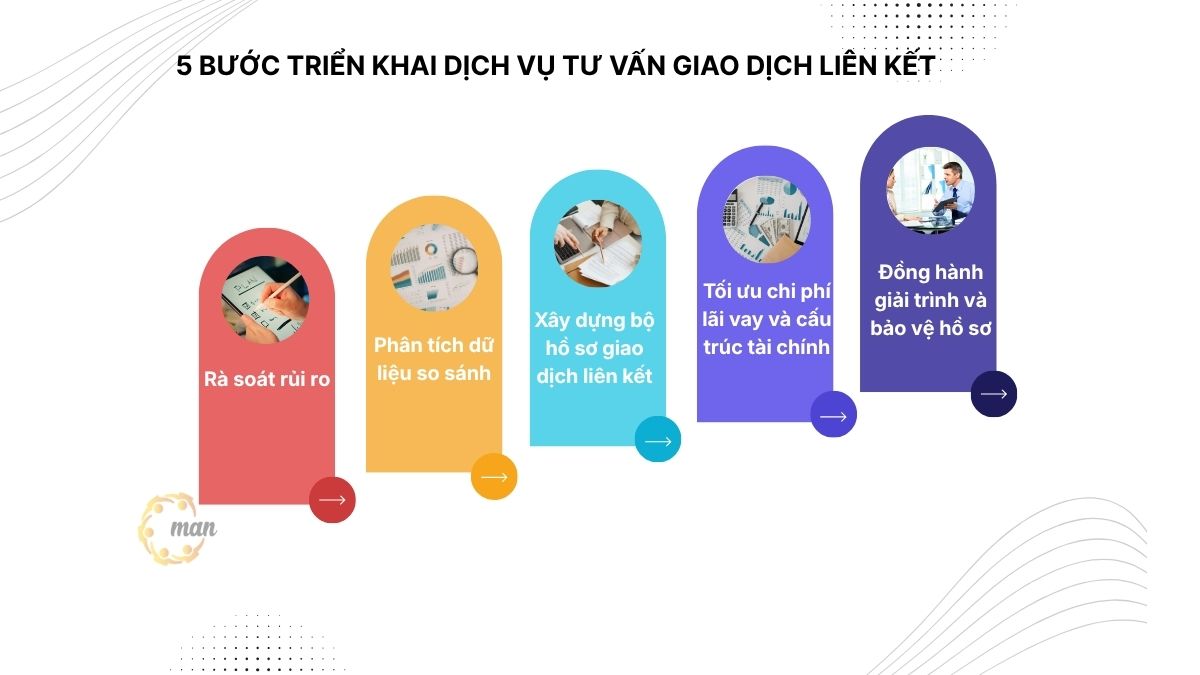
MAN implements a systematic 5-step related-party transaction advisory process, closely adhering to the latest legal framework in Decree 255/2026/ND-CP, helping businesses comprehensively control risks from the initial review stage to the completion of explanations to the tax authorities.
Step 1: Risk Assessment and Tax Health Diagnosis
This is a crucial first step to help businesses gain a comprehensive overview of their financial situation and identify legal vulnerabilities early on, before tax authorities intervene.
- Collect financial data and economic contracts for the last 3-5 years.
- Accurately identify the affiliated parties (including any newly added affiliated relationships as per Article 5 of Decree 255/2026/ND-CP).
- Analyze actual profit margins and make a preliminary comparison with industry safety thresholds to identify areas at risk of tax imposition.
Step 2: Benchmarking (Comparative Data Analysis)
To demonstrate that the transaction price is objective and adheres to market pricing principles, MAN conducts in-depth data analysis to establish a profit safety zone for the business through the following tasks:
- Develop a strategy for finding similar independent businesses.
- Use proprietary data (Orbis, Bloomberg) to filter the list of comparable companies based on function, assets, and risk (FAR analysis).,
- in accordance with the priority order of the new database as stipulated in Article 17 of Decree 255/2026/ND-CP.
- Calculate a standard price range or profit margin (Interquartile Range) as a benchmark for a company's transactions.
Step 3: Build the Related Party Transaction Profile.
This is the core document that helps businesses explain themselves to the inspection agency, including the following detailed items:
- Drafting the Local File issued with Decree 255/2026/ND-CP: Detailing the organizational chart, business strategy, and pricing methodology.
- Drafting the Global Master File issued with Decree 255/2026/ND-CP: Describing the parent company's global supply chain.
- Assistance in preparing forms 01, 02, 03, and 04 to be submitted with the annual corporate income tax return.
Step 4: Optimize interest costs and financial structure.
Besides determining the purchase and sale prices of goods, managing internal loan cash flow is the biggest challenge for most FDI enterprises. To overcome the barrier from regulations capping loan interest rates under Decree 132/2020/ND-CP:
- Analyze EBITDA and calculate the 30% interest expense ceiling to provide early warnings about non-deductible expenses.
- We advise on options for converting loan capital into equity (Debt-to-Equity) or adjusting loan terms to take advantage of the right to carry forward interest expenses to subsequent financial years.
Important Note: The portion of interest expense carried forward under Article 3 of Decree 20/2025/ND-CP continues to be retained according to the transitional provisions in Clause 3, Article 23 of Decree 255/2026..
Step 5: Assisting in explaining and defending the case file.
To ensure maximum benefit for businesses during the inspection period, MAN will:
- Working directly with the inspection team from the Ho Chi Minh City Tax Department to defend the methods used in selecting comparable companies.
- Provide additional evidence and economic arguments to counter the assumptions used in tax assessment.
Price list for related party transaction advisory services 2026
To help businesses easily visualize costs and implementation scope, we have developed a pricing table for related-party transaction consulting services based on specific needs, from basic declaration to in-depth documentation and audit support. Fees are designed to be flexible according to the complexity of the transaction and the size of the business. Below is a detailed table of service packages and estimated costs for 2026:
| Service categories | Reference fee (VNĐ) | Describe |
| Prepare a related party transaction declaration. | Starting at 15,000,000 | Declaration of related party relationships and related-party transactions (including Sections I, II, III, and IV). |
| Prepare a dossier to determine the price of related transactions | Ranges from 45,000,000 to 120,000,000 | Prepare a complete Local File, Master File, and Transfer Pricing Report (if applicable). |
Please note that fees will vary depending on:
- Revenue scale;
- Occupation, field of activity;
- Net profit margin;
- Related party relationships and related-party transactions arise.
Conclusion: Don't let affiliate transactions become a barrier to growth.
Proactively building a related-party transaction profile is not only a way to cope with inspections, but also an opportunity for management to review the operational structure, thereby optimizing cash flow and increasing competitiveness in the international market. With Decree 255/2026/ND-CP officially replacing the old legal framework from July 1, 2026, businesses need to update their information promptly to avoid compliance risks.
In Ho Chi Minh City, MAN – Master Accountant Network proudly serves as a trusted partner, with over 30 years of experience in the field, helping hundreds of FDI businesses and multinational corporations transform tax risks into strategic advantages.
Contact MAN – Master Accountant Network For free support and advice!
Contact information MAN – Master Accountant Network
- Address: No. 19A, Street 43, Tan Thuan Ward, Ho Chi Minh City
- Mobile/Zalo: 0903 963 163 – 0903 428 622
- Email: man@man.net.vn
Content is moderated by: Mr. Le Hoang Tuyen – Founder & CEO of Man, CPA Vietnam Auditor with over 30 years of experience in Accounting, Auditing and Financial Consulting.
Frequently Asked Questions about Affiliate Market Advisory Services
Businesses that have transactions with related parties as defined by tax management laws are required to declare and file such transactions. However, some cases are exempt from filing but still require the declaration in the Appendix issued with Decree 255/2026/ND-CP.
Businesses eligible for the carry-forward of interest expense under Article 3 of Decree 20/2025/ND-CP shall continue to carry forward the expense for the remaining period as stipulated in Article 3 of Decree 20/2025/ND-CP, ensuring continuity in policy implementation.
Yes, if related-party transactions occur. Even small businesses can be subject to scrutiny if there are signs of risk (continuous losses, unusually low profit margins, etc.). Using professional services helps minimize errors from the outset, especially in reviewing the new related-party relationships added in Decree 255/2026 (such as lending and borrowing relationships with individuals managing or controlling businesses).
This is crucial. It forms the core basis for demonstrating that the transaction price adheres to market principles. If the comparative data is inaccurate, the entire dossier may be rejected. From July 1, 2026, the selection of comparative data sources must also adhere to the priority order of the new databases stipulated in Article 17 of Decree 255/2026/ND-CP.
In principle, from July 1, 2026, the declaration, valuation, and documentation of related-party transactions must comply with the new regulations in Decree 255/2026/ND-CP (including the new Appendices I, II, III, and IV). Regarding the portion of interest expense carried forward under Article 3 of Decree 20/2025/ND-CP, Decree 255/2026 includes a transitional provision allowing businesses to continue carrying it forward for the remaining period according to the old regulations, without having to start over, thus ensuring the rights of taxpayers already incurred.Which businesses are required to create related-party transaction records?
Can interest expenses exceeding 30% EBITDA be carried forward to the following year?
Do small businesses need to use related-party transaction advisory services?
Is benchmarking (independent comparison) really that important?
Do businesses currently applying Decree 132/2020/ND-CP need to resubmit their applications according to Decree 255/2026?