





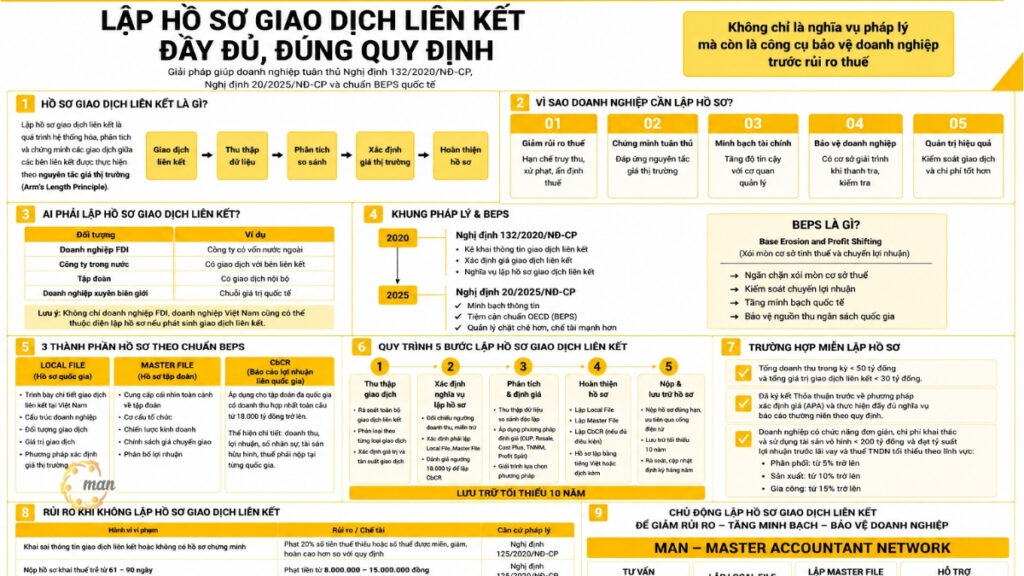
Filing related-party transaction records is not only a legal obligation but also a crucial strategy for businesses to protect their reputation, ensure financial transparency, and maintain stable growth. Decree No. 132/2020/ND-CP According to the Government's regulations, enterprises are obliged to declare information on related relationships and related transactions when transactions arise with related parties.
Preparing complete and accurate documentation from the outset not only saves costs but also minimizes the risk of errors during tax audits and inspections. According to Article 19 of Decree 132, taxpayers may be exempt from preparing documentation to identify related-party transactions in certain cases. Let's explore this further with MAN – Master Accountant Network.
What does it mean to create a related-party transaction record?
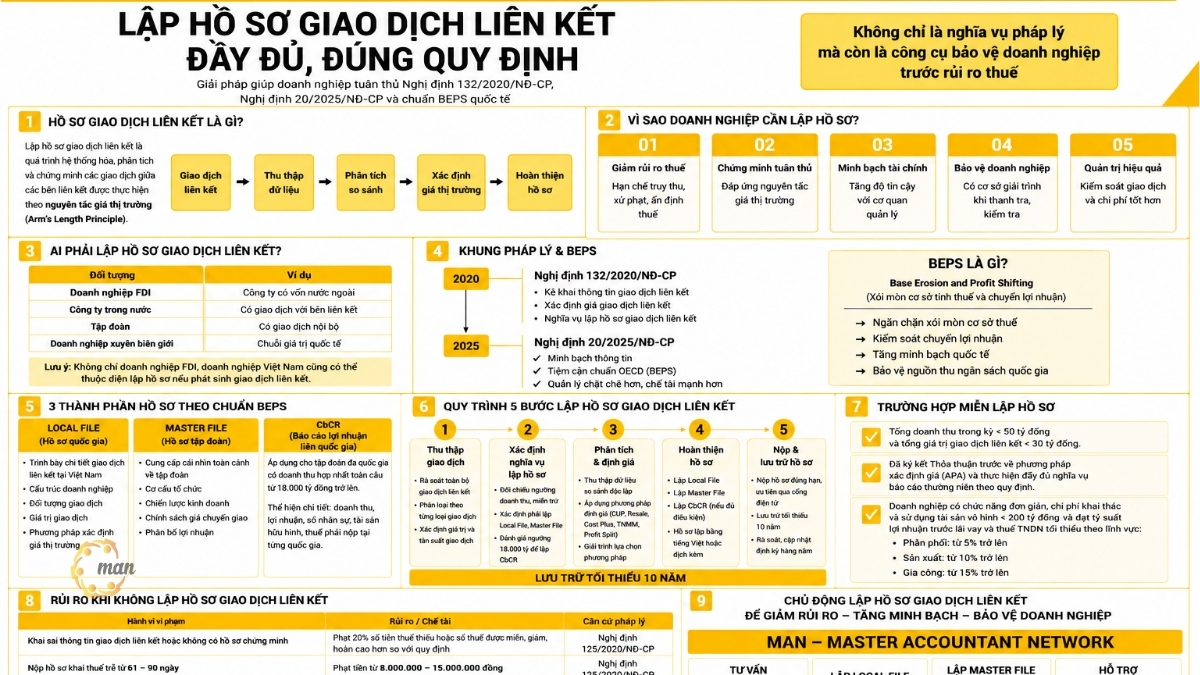
The process of documenting related-party transactions is the systematic recording and analysis of all transactions between related parties to demonstrate that those transactions were conducted according to the Arm's Length principle. The goal of documenting related-party transactions is not only a mandatory legal obligation under Decree 132/2020/ND-CP, but also a crucial professional basis for protecting businesses from tax audits and providing transparent evidence when explaining matters to shareholders, partners, or other stakeholders.
The importance of documenting related-party transactions.
Filing related-party transaction records today is not only a legal obligation but also a key tool that helps businesses:
- Minimizing tax risks: Reducing the risk of being subject to tax audits, administrative penalties, or tax assessments due to errors in tax declarations. declaration of related party transactions.
- Demonstrating compliance with international standards: Comparative analysis with independent market data, demonstrating the correct application of the Arm's Length Principle.
- Enhancing financial transparency: Complete documentation, pricing methods appropriate to the company's industry, benchmarking data from 3-5 similar companies in the same industry, and documentation proving the authenticity of the transaction will make the company's related-party transaction documentation highly convincing.
- Enhancing credibility with regulators and partners: A well-prepared related-party transaction dossier will build trust and credibility with tax authorities, investors, and stakeholders.
- Proactive dispute prevention: Reduces the likelihood of being suspected of transfer pricing or fraud, while supporting businesses during tax audits and inspections.
Which entities are required to create related-party transaction records?
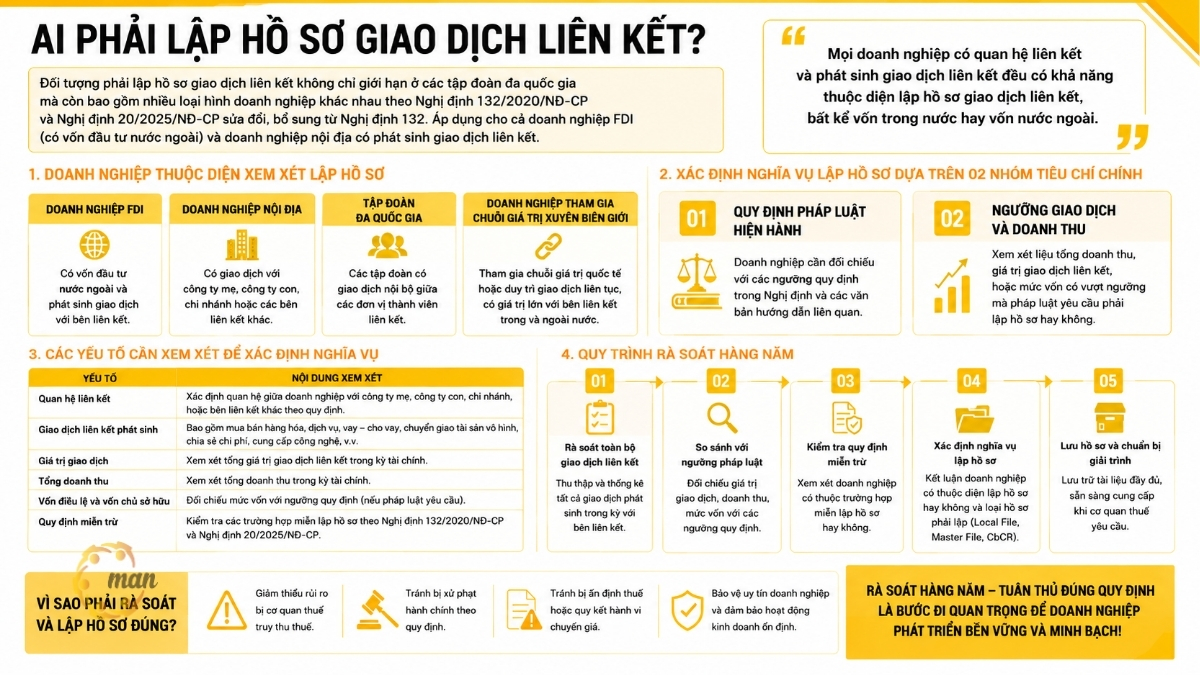
The entities required to prepare related-party transaction documents are not limited to multinational corporations but also include many other types of businesses. This is in accordance with the regulations of Decree 132/2020/ND-CP and... Decree 20/2025/ND-CP Amendments and additions to Decree 132. Businesses that have transactions with parent companies, subsidiaries, branches, or other affiliated parties are subject to review. This applies to both FDI (foreign direct investment) enterprises and domestic enterprises participating in cross-border value chains or maintaining continuous, high-value transactions.
In fact, many Vietnamese businesses often mistakenly believe that only companies with foreign capital need to prepare related-party transaction documents. However, the tax authorities have made it very clear:
“"Any business with related-party relationships and related-party transactions is potentially subject to the requirement of filing related-party transaction documents, regardless of whether it has domestic or foreign capital."”
Determining who needs to file a related-party transaction report depends on two main sets of criteria:
- Current legal regulations: Businesses need to compare their current practices with the thresholds stipulated in the Decree and related guiding documents.
- Transaction and turnover thresholds. For example, businesses must consider whether total turnover, value of related-party transactions, or capital levels exceed thresholds that require filing by law.
Therefore, each fiscal year, businesses need to review all transactions, compare with legal thresholds and exemption regulations to determine their responsibilities. This is an important step to minimize the risk of being collected, fined or accused of transfer pricing by tax authorities.
Benefits of filing related party transaction records
Properly documenting related-party transactions not only helps businesses meet legal requirements but also brings many practical benefits in financial management and tax risk control. Specifically, complete and transparent related-party transaction documentation will support businesses in the following ways:
- Protecting businesses from audit and inspection risks: Properly prepared related-party transaction documents help demonstrate the reasonableness of transaction prices. Businesses have a solid legal basis when explaining transactions to tax authorities.
- Optimizing tax strategy within legal limits: Minimizing the risk of being accused of transfer pricing. Ensuring effective utilization of incentives, exemptions, and filing waivers (if eligible).
- Increased transparency in internal governance: Clear reporting systems help management better control costs and revenue.
- Supporting risk management decision-making: Businesses can easily identify transactions with potential tax risks. A database is available for long-term strategic planning, minimizing disputes.
Legal framework for filing related-party transactions.
To ensure transparency and combat tax evasion through transfer pricing, Vietnamese law has enacted specific regulations. Currently, the main legal framework is built upon: Decree 132/2020/ND-CP. According to Article 18 of Decree 132/2020/ND-CP:
“ Taxpayers with related-party transactions within the scope of this Decree are responsible for declaring and determining the price of related-party transactions, without reducing the corporate income tax obligation to be paid in Vietnam according to the provisions of this Decree.
Taxpayers are responsible for demonstrating the implementation of analysis, comparison and selection of transfer pricing methods as prescribed in this Decree when requested by competent authorities.
Taxpayers with related-party transactions within the scope of this Decree are responsible for declaring information on related-party relationships and related-party transactions according to Appendix I, Appendix II, Appendix III issued with this Decree and submitting it together with the Corporate Income Tax Finalization Declaration.”
Based on Decree 132/2020/ND-CP, all businesses with related-party transactions are responsible for declaring them and, in many cases, must prepare related-party transaction records to provide to the tax authorities upon request. This regulation aims not only to manage effectively but also to create a legal framework for businesses to operate more transparently.
Changes and supplements from Decree 20/2025/ND-CP and according to BEPS standards
Changes in related-party transaction management policies not only represent legal adjustments but also reflect a trend toward integration with international tax standards, particularly the OECD's BEPS framework. To better understand these impacts, businesses need to grasp the nature of the BEPS standard, the key amendments in the new regulations, and how to prepare related-party transaction documentation in a way that aligns with international practices.
What is the BEPS standard?
The BEPS (Base Erosion and Profit Shifting) standard is a policy framework developed by the Organization for Economic Cooperation and Development (OECD) and the G20 to address the situation where multinational corporations take advantage of legal loopholes to shift profits to countries with low or no tax rates.
The BEPS standard is not only a set of international tax rules, but also a global system of recommendations, designed to:
- Preventing cross-border transfer pricing and tax evasion: Reducing the practice of businesses declaring profits in tax-incentive locations instead of where business activities actually take place.
- Increase transparency in financial reporting: Require multinational corporations to provide reports on profits, revenue, and operations in each country.
- Establishing international tax management standards: Introducing the Arm's Length Principle to ensure that related-party transactions are determined fairly.
- Protecting national revenue sources: This helps countries limit tax revenue losses, especially in the context of globalization and the rapid development of cross-border trade.
Amendments and supplements to Decree 20/2025/ND-CP
The promulgation of Decree 20/2025/ND-CP marks an important step in perfecting the legal framework for related-party transactions, amending and supplementing the old regulations in Decree 132/2020/ND-CP. The highlight of this decree is... Decree 20 on related-party transactions The new approach lies in enhancing transparency, standardizing information, and aligning more closely with the OECD's international standards on combating base erosion and profit shifting (BEPS).
Compared to Decree 132/2020/ND-CP, Decree 20/2025/ND-CP has added many important new points that directly impact the documentation obligations of businesses. These changes not only expand the scope of regulated entities but also adjust the exemption threshold, standardize the transaction price comparison method, apply digital technology in declaration, and tighten penalties. The table below will help businesses easily compare and identify the differences between the two decrees:
| Content | Decree 132/2020/ND-CP | Decree 20/2025/ND-CP |
| Subject to regulation. | Mainly applicable to FDI enterprises with related transactions. | Expand to domestic corporations and companies that have related party transactions. All must prepare related party transaction records. |
| Revenue thresholds and exemptions. | There are no clear regulations on exemptions for small and micro enterprises. | Add exemptions for small and micro enterprises, reduce administrative procedures but still monitor large, high-risk enterprises. |
| Transaction price comparison method. | Focus on domestic data, not much expansion. | Standardization based on market price principles. Expanding the scope of comparable data. |
| Sanctions. | Administrative penalties for late submission, incorrect submission or failure to submit documents. | Tighter: Businesses that pay late, underpay or commit fraud may be subject to severe penalties and in-depth inspections. |
The new provisions in Decree 20/2025/ND-CP create a more stringent and transparent legal framework than before. Businesses, especially large corporations or those with numerous transactions with related parties, need to proactively update their regulations to ensure complete and accurate documentation of related-party transactions. Timely updating not only helps minimize the risk of penalties but also ensures credibility and sustainability in business operations in Vietnam.
Create related party transaction records according to BEPS standards.
A key highlight of Decree 20/2025/ND-CP is its alignment with the OECD's BEPS standard, particularly regarding reporting obligations. Businesses with related-party transactions must prepare three main types of documents:
- Local File: Presents details of related party transactions in Vietnam, including: business structure, transaction subjects, transaction value and method of determining market price.
- Master File: Provides a comprehensive view of the group's global operations, organizational structure, business strategy, transfer pricing policies and profit allocation.
- Country by Country Report (CbCR): Required for multinational corporations with global consolidated revenue of VND 18,000 billion or more, showing details of revenue, profit, number of employees, tangible assets, and taxes payable in each country in which the corporation operates.
Complying with BEPS reporting obligations is not only a legal requirement but also a demonstration of transparency, helping businesses reduce the risk of being subject to back taxes or tax assessments.
The standard procedure for preparing related-party transaction documents.
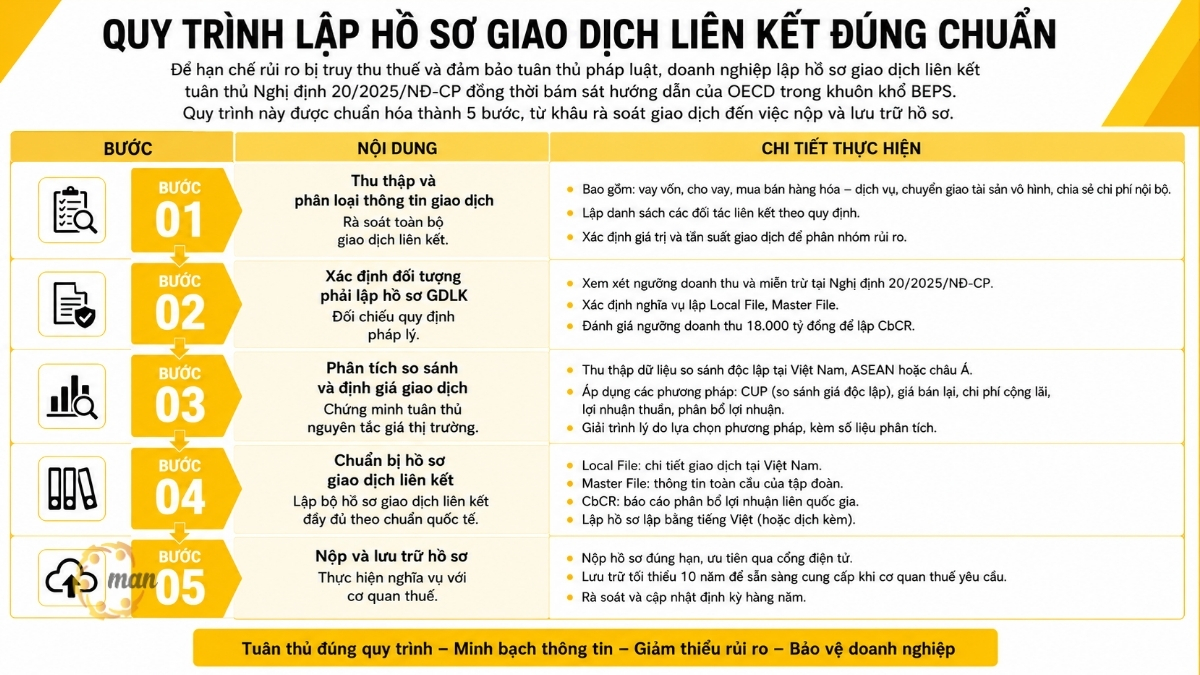
To mitigate the risk of tax arrears and ensure legal compliance, businesses prepare related-party transaction documentation in accordance with Decree 20/2025/ND-CP while also adhering to OECD guidelines within the BEPS framework. This process is standardized into five steps, from transaction review to submission and archiving of documents.
| Step | Content | Implementation details |
| Step 1: Collect and classify transaction information. | Review all related transactions. | Including: borrowing, lending, buying and selling goods and services, transferring intangible assets, sharing internal costs. Make a list of affiliate partners as prescribed. Determine transaction value and frequency to group risks. |
| Step 2: Identify the subjects that must prepare a GDLK profile. | Compare legal regulations. | Review revenue thresholds and exemptions in Decree 20/2025/ND-CP. Determine the obligation to create Local File and Master File. Assess the revenue threshold of VND 18,000 billion to establish CbCR. |
| Step 3: Compare analysis and transaction valuation. | Demonstrate compliance with market price principles. | Collect independent comparative data in Vietnam, ASEAN or Asia. Apply methods: CUP (comparable independent prices), resale price, cost plus profit, net profit, profit allocation. Explain the reasons for choosing the method, with analytical data. |
| Step 4: Prepare the related party transaction documents. | Prepare a complete set of related-party transaction documentation in accordance with international standards. | Local File: transaction details in Vietnam. Master File: global corporate information. CbCR: cross-country profit allocation report. Prepare documents in Vietnamese (or with translation). |
| Step 5: Submit and save your documents. | Fulfill obligations to tax authorities. | Submit application on time, priority given via electronic portal. Store for a minimum of 10 years to be available upon request by tax authorities. Review and update periodically, on an annual basis. |
Adhering to proper documentation procedures not only helps businesses fulfill their legal obligations but also minimizes the risk of tax arrears, penalties, or in-depth inspections. Being proactive, transparent, and regularly updating information also enhances credibility, strengthens trust with partners and regulatory agencies, and creates a solid foundation for the sustainable development of the business.
Cases where documentation for related-party transactions is not required.
Taxpayers are exempt from filing in the following cases, provided they meet the corresponding conditions:
- If the total revenue in the tax period is less than 50 billion VND and the total value of related transactions arising in the period is less than 30 billion VND.
- If signed advance pricing agreement (APA) and fulfill annual reporting obligations as required by law.
- If the enterprise only operates with basic functions, the cost of exploiting and using intangible assets is under 200 billion VND, and at the same time achieves the minimum profit margin before interest and corporate income tax in each field: distribution from 5% or more, production from 10% or more, processing from 15% or more.
See also: No related-party transaction documentation is required.
Penalties for failing to create related-party transaction records.
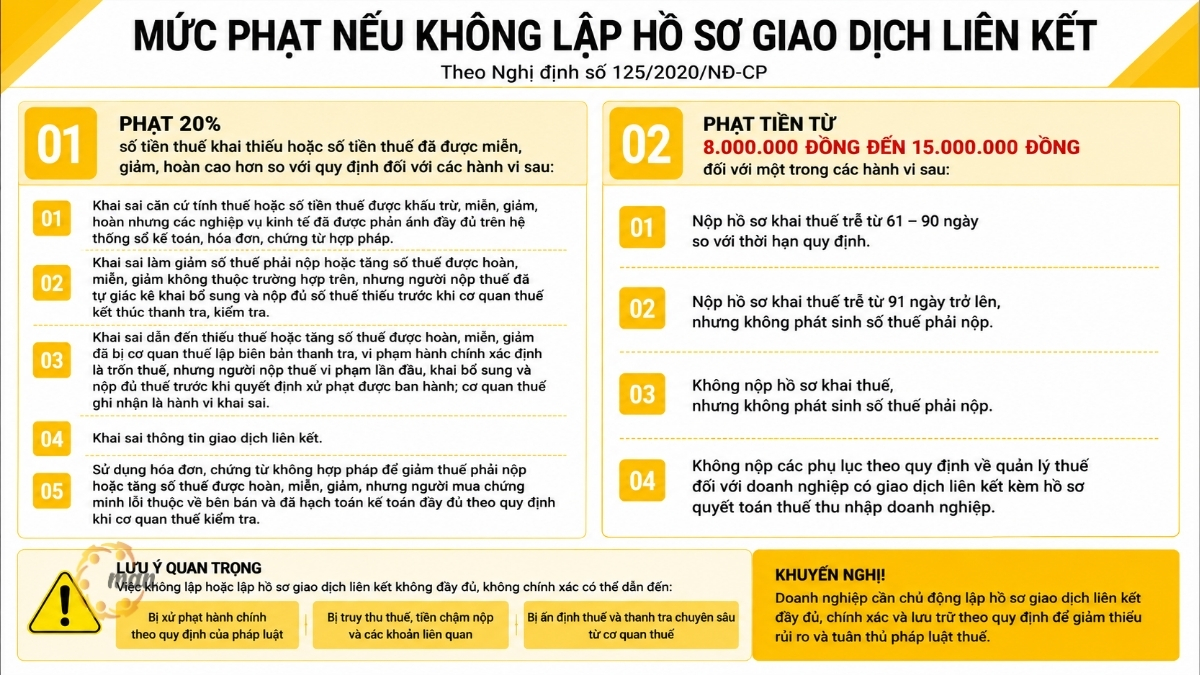
Decree No. 125/2020/ND-CP regulations The penalties for these violations are as follows:
Fine 20% for under-declared tax amount or tax amount exempted, reduced, or refunded higher than prescribed for one of the following acts:
- Falsely declaring the tax basis or the amount of tax deducted, exempted, reduced or refunded, but the economic transactions have been fully reflected in the accounting system, invoices and legal documents.
- False declaration that reduces the amount of tax payable or increases the amount of tax to be refunded, exempted, or reduced does not fall under the above cases, but the taxpayer has voluntarily made a supplementary declaration and paid the full amount of tax owed before the tax authority finishes the inspection or examination.
- False declaration leading to tax underpayment or increased tax refund, exemption, or reduction has been recorded by the tax authority in an inspection or administrative violation record and determined to be tax evasion, but the taxpayer commits the violation for the first time, makes additional declarations, and pays the full tax before the penalty decision is issued; the tax authority records it as false declaration.
- Providing false information regarding related-party transactions.
- Using illegal invoices and documents to reduce tax payable or increase the amount of tax refunded, exempted, or reduced, but the buyer proves that the fault lies with the seller and has fully accounted for the accounting according to regulations when the tax authority inspects.
A fine of from VND 8,000,000 to VND 15,000,000 shall be imposed for one of the following acts:
- Filing tax returns 61-90 days late compared to the deadline.
- Late submission of tax return of 91 days or more, but no tax payable arises.
- No tax return filed, but no tax payable.
- Failure to submit appendices as prescribed in tax management regulations for enterprises with related transactions attached to corporate income tax settlement dossiers
The risks and penalties for failing to file tax returns demonstrate that compliance with tax laws is a mandatory requirement. This ranges from late filing to non-filing. related party transaction appendix, Businesses may face administrative penalties, tax arrears, and even tax assessments. Understanding these risks is crucial for businesses to prepare all necessary documents fully, transparently, and promptly.
Frequently Asked Questions when creating a related party transaction profile
Not all small businesses are exempt from filing related-party transaction records. Exemption depends on specific conditions regarding revenue and the value of related-party transactions as stipulated in Decree 132.
BEPS is a framework developed by the OECD and G20 to limit the exploitation of cross-border transactions by businesses to shift profits to locations with low tax rates. In the area of related-party transactions, BEPS promotes transparency, requires businesses to demonstrate that transactions were conducted at market prices, and increases accountability regarding the allocation of profits among countries.
Businesses need to maintain records and documents proving related-party transactions so they can readily provide them when requested by tax authorities, in accordance with regulations on tax management and accounting document retention. Complete record keeping helps businesses proactively handle audits and inspections, and reduces the risk of lacking sufficient evidence for explanations.
Because related-party transaction documentation requires in-depth knowledge of tax, finance, comparative data analysis, and international regulations, many businesses choose to use professional services to ensure accuracy and reduce risk. Experienced consulting firms can assist businesses in reviewing related-party transactions, identifying documentation obligations, developing appropriate pricing methodologies, and preparing explanatory documents when necessary.
Businesses that engage in transactions with related parties falling under the scope of the law on related-party transactions may be required to declare and document these transactions. This includes not only FDI enterprises but also domestic enterprises that transact with parent companies, subsidiaries, branches, affiliated units, or parties with controlling or dominant relationships. Therefore, businesses need to review their transactions annually to determine their documentation obligations.Do small businesses need to file related-party transaction records?
What is BEPS related to related-party transaction records?
How long should related-party transaction records be stored?
Should you hire a service to prepare related-party transaction documentation?
Which businesses are required to file related-party transaction records?
Conclude
Properly documenting related-party transactions is not only a legal obligation but also helps businesses manage tax risks and ensure transparency in their operations. Proactively preparing and thoroughly reviewing related-party transactions throughout the year helps businesses:
- Ensure compliance with international laws and standards.
- Optimize affiliate transaction management, transparent profits and costs.
- Enhance reputation with partners, regulators and shareholders.
For specific advice, businesses Please contact MAN – Master Accountant Network:
Contact information MAN – Master Accountant Network
- Address: No. 19A, Street 43, Tan Thuan Ward, Ho Chi Minh City
- Mobile/Zalo: 0903 963 163 – 0903 428 622
- E-mail: man@man.net.vn
- Google Business Profile: View MAN – Master Accountant Network's Google Business Profile
- LinkedIn Founder: View expert Le Hoang Tuyen's LinkedIn profile.
Responsible for production and professional content review by: Grandfather Le Hoang Tuyen – Founder & CEO of MAN – Master Accountant Network. He is a CPA Vietnam auditor with over 30 years of in-depth experience in accounting, auditing, taxation, and corporate legal consulting.