





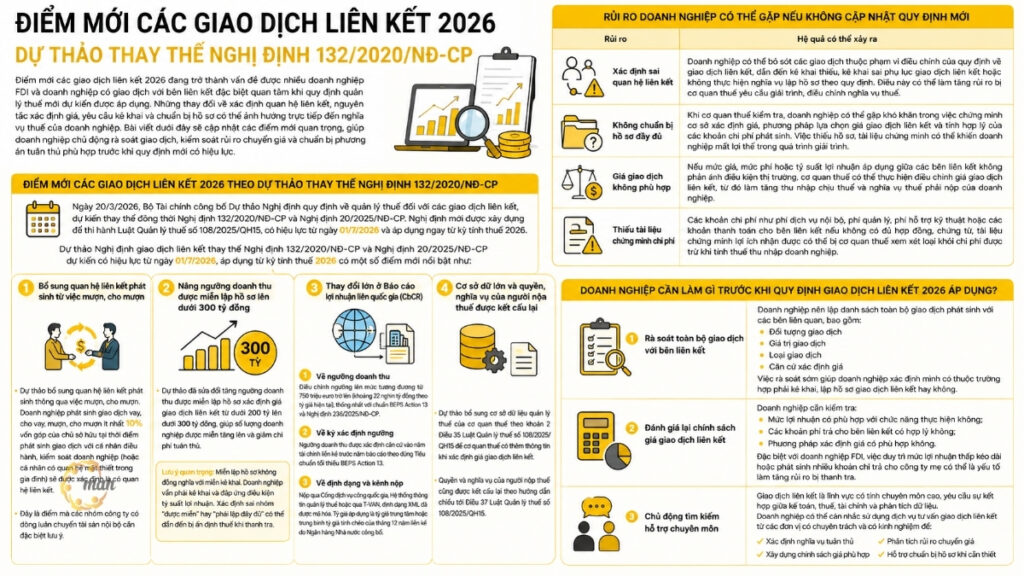
New regulations on related-party transactions in 2026 are becoming a major concern for many FDI businesses and businesses with related-party transactions, especially as the new tax management regulations are expected to be implemented. Changes in defining related-party relationships, pricing principles, declaration requirements, and documentation preparation could directly impact a business's tax obligations. This article will update the key new points, helping businesses proactively review transactions, control transfer pricing risks, and prepare appropriate compliance plans before the new regulations take effect.
New provisions on related-party transactions in 2026 according to the draft replacing Decree 132/2020/ND-CP.
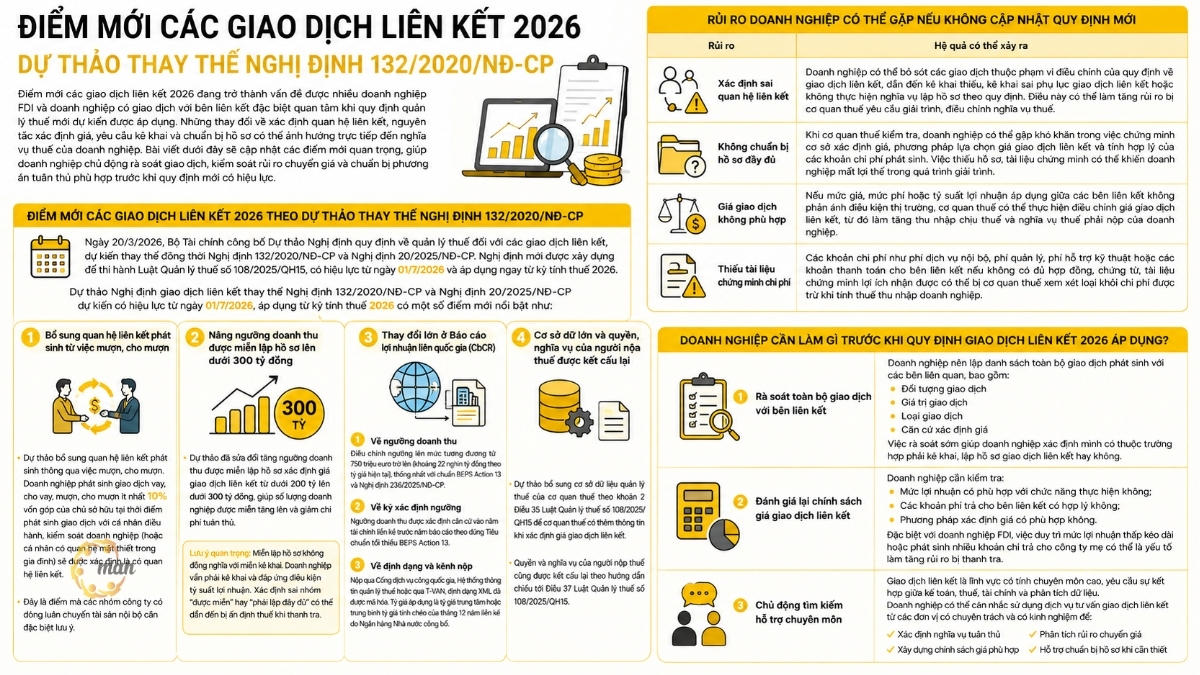
On March 20, 2026, the Ministry of Finance announced the Draft Decree regulating tax management for related-party transactions, which is expected to replace both Decree 132/2020/ND-CP and Decree 20/2025/ND-CP. The new Decree is being developed to implement the Law on Tax Administration No. 108/2025/QH15, which takes effect from July 1, 2026, and will apply immediately from the 2026 tax year.
Draft Decree on related-party transactions to replace previous regulations. Decree 132/2020/ND-CP and Decree 20/2025/ND-CP Expected to take effect from July 1, 2026, and applicable from the 2026 tax year, it has several notable new features such as:
Adding to the relationship arising from borrowing and lending.
According to current regulations, two businesses are considered to be related through lending and borrowing activities. However, while the Decree stipulates that parties are related through lending and borrowing, it does not yet regulate related relationships through borrowing and lending, creating a loophole that many businesses have exploited.
The draft adds a new category of related-party transactions arising from borrowing and lending. Specifically, businesses that engage in borrowing, lending, or lending transactions involving at least 10% of owner's equity at the time of the transaction with an individual managing or controlling the business (or an individual with a close family relationship) will be considered to have a related-party relationship. This is a point that groups of companies with internal asset flows need to pay particular attention to.
Raise the revenue threshold for exemption from filing requirements to below 300 billion VND.
This is good news for medium-sized businesses. According to point c, clause 2, Article 19 of Decree 132/2020/ND-CP, taxpayers performing simple business functions, not exploiting intangible assets, and with revenue under 200 billion VND are exempt from filing tax returns.
The revised draft increases the revenue threshold for exemption from transfer pricing documentation from under 200 billion VND to under 300 billion VND, helping to increase the number of exempted businesses and reduce compliance costs.
Important Note: Exemption from filing does not mean exemption from tax declaration. Businesses must still declare and meet profit margin requirements. Incorrectly identifying which group is "exempt" or "requires full filing" can lead to tax assessments during audits.
Major changes in the Country-Based Earnings Report (CbCR)
This new provision directly affects multinational corporations with their ultimate parent company in Vietnam, with three changes occurring simultaneously:
- Regarding revenue thresholds: Current regulations set a fixed threshold of 18 trillion VND. The draft proposes adjusting the threshold to the equivalent of 750 million euros or more (approximately 22 trillion VND at the current exchange rate), consistent with BEPS Action 13 standards and Decree 236/2025/ND-CP. Therefore, the current regulation stipulating that taxpayers who are the ultimate parent company in Vietnam with consolidated global revenue of 18 trillion VND or more in the tax period are responsible for preparing and submitting the Country-by-Country Report in the Transfer Pricing Documentation is no longer appropriate for the present time.
- Regarding the threshold determination period: Instead of the current tax period, the revenue threshold is determined based on the fiscal year immediately preceding the reporting year, in accordance with BEPS Action 13 Minimum Standard.
- Regarding format and submission channel: The CbCR report is submitted to the tax authority via the National Public Service Portal or the Tax Management Information System or through a T-VAN service provider in encrypted XML format. The applicable exchange rate is the central exchange rate or the average cross-exchange rate for December of the following year as published by the State Bank of Vietnam. This is a technical aspect that internal accounting personnel often lack experience in handling.
The database and the rights and obligations of taxpayers have been restructured.
The draft supplements the tax management database of the tax authority according to Clause 2, Article 35. Law on Tax Administration No. 108/2025/QH15 so that the tax authorities have more information when xtransfer pricing. In other words, tax authorities have increasingly more data to compare with the figures self-declared by businesses. The rights and obligations of taxpayers are also restructured according to the guidelines in Article 37 of the Tax Administration Law No. 108/2025/QH15.
Risks businesses may face if they do not update the rules on related-party transactions in 2026.

Given the changes in tax regulations regarding related-party transactions, businesses need to proactively review their transactions, pricing policies, and related supporting documents. Failure to update or comply with requirements can expose businesses to numerous risks related to tax declarations, deductible expenses, and the ability to explain their actions during tax audits and inspections. Some common risks businesses may encounter include:
| Risk | Possible consequences |
| Incorrect identification of the relationship | Businesses may overlook transactions that fall under the scope of regulations on related-party transactions, leading to under-declaration, incorrect declaration of related-party transaction appendices, or failure to fulfill the obligation to prepare documentation as required. This can increase the risk of being required to explain or adjust tax obligations by the tax authorities. |
| Incomplete documentation | During tax audits, businesses may face difficulties in demonstrating the basis for determining transfer pricing, the method used to select transfer pricing, and the reasonableness of incurred expenses. A lack of supporting documentation can put businesses at a disadvantage during the explanation process. |
| The transaction price is inappropriate. | If the prices, fees, or profit margins applied between related parties do not reflect market conditions, the tax authorities may adjust the related-party transaction prices, thereby increasing the taxable income and tax liability of the business. |
| Lack of documentation proving expenses | Expenses such as internal service fees, management fees, technical support fees, or payments to affiliated parties may be excluded from deductible expenses when calculating corporate income tax if there are insufficient contracts, documents, or evidence to prove the benefits received. |
What should businesses do before the new regulations on related-party transactions in 2026 come into effect?

To mitigate the risk of tax adjustments and ensure compliance when new regulations officially take effect, businesses need to proactively review all activities related to related-party transactions. Preparation should not only involve checking existing records but also reassessing pricing policies, internal control processes, and the ability to meet accountability requirements for tax authorities. Some key tasks that businesses should prioritize include:
Review all transactions with related parties.
Businesses should create a complete list of all transactions with related parties, including:
- The subject of the transaction;
- Transaction value;
- Type of transaction;
- Basis for determining price.
Early review helps businesses determine whether they are required to declare and document related-party transactions.
Re-evaluate the transfer pricing policy.
Businesses need to check:
- Is the profit margin commensurate with the function performed?;
- Are the fees paid to affiliates reasonable?;
- Is the pricing method appropriate?.
Particularly for FDI businesses, maintaining low profit margins for an extended period or incurring numerous payments to the parent company can increase the risk of being audited.
Proactively seek professional support.
Related-party transactions are a highly specialized field, requiring a combination of accounting, tax, finance, and data analysis expertise.
Businesses may consider using related party transaction advisory services from specialized and experienced units such as MAN – Master Accountant Network to:
- Identify compliance obligations;
- Analysis of transfer pricing risks;
- Develop appropriate pricing policies;
- Provide assistance in preparing documents when needed.
Conclude
The new provisions on related-party transactions in 2026 show a trend in tax administration focusing more on transparency, pricing bases, and the ability of businesses to prove their claims.
Particularly for FDI businesses or businesses with cross-border transactions, proactively reviewing transactions, updating internal policies, and preparing complete documentation will help minimize tax risks.
In cases where internal resources lack sufficient expertise, businesses can Contact MAN – Master Accountant Network To receive support in assessing, monitoring, and ensuring compliance requirements are met when new regulations are implemented.
Contact information MAN – Master Accountant Network
- Address: No. 19A, Street 43, Tan Thuan Ward, Ho Chi Minh City
- Mobile/Zalo: 0903 963 163 – 0903 428 622
- E-mail: man@man.net.vn
- Google Business Profile: View MAN – Master Accountant Network's Google Business Profile
- LinkedIn Founder: View expert Le Hoang Tuyen's LinkedIn profile.
Responsible for production and professional content review by: Mr. Le Hoang Tuyen – Founder & CEO of MAN – Master Accountant Network. He is a CPA Vietnam auditor with over 30 years of in-depth experience in accounting, auditing, taxation, and corporate legal consulting.
Frequently Asked Questions about the new features of affiliate transactions in 2026
According to the draft, the definition of related-party transactions is expanded to include borrowing and lending (previously only lending and borrowing were regulated). Therefore, transactions involving the transfer of assets and finances within a group of companies, which were previously considered safe, may now give rise to related-party transactions and declaration obligations. Businesses should review all internal transactions according to the new definition.
This is possible. When the new regulations are implemented, businesses need to review their current transfer pricing policies to ensure compliance with the arm's-length principle. In particular, businesses with transactions such as internal service fees, management fees, loans from related parties, or cross-border trade need to reassess the basis for determining prices, calculation methods, and supporting documentation.
There are three changes simultaneously: The threshold has shifted from 18 trillion VND to the equivalent of 750 million EUR (approximately 22 trillion VND); the threshold is determined by the fiscal year immediately preceding the reporting year; and the report must be submitted in encrypted XML format via the National Public Service Portal, the Tax Management Information System, or a T-VAN service provider.Do internal transactions involving borrowing and lending of assets now need to be declared?
Will the new regulations on related-party transactions in 2026 affect businesses currently applying their existing pricing policies?
What should the parent company in Vietnam be aware of regarding the Country-by-Country Report of Profit and Loss (CbCR)?