





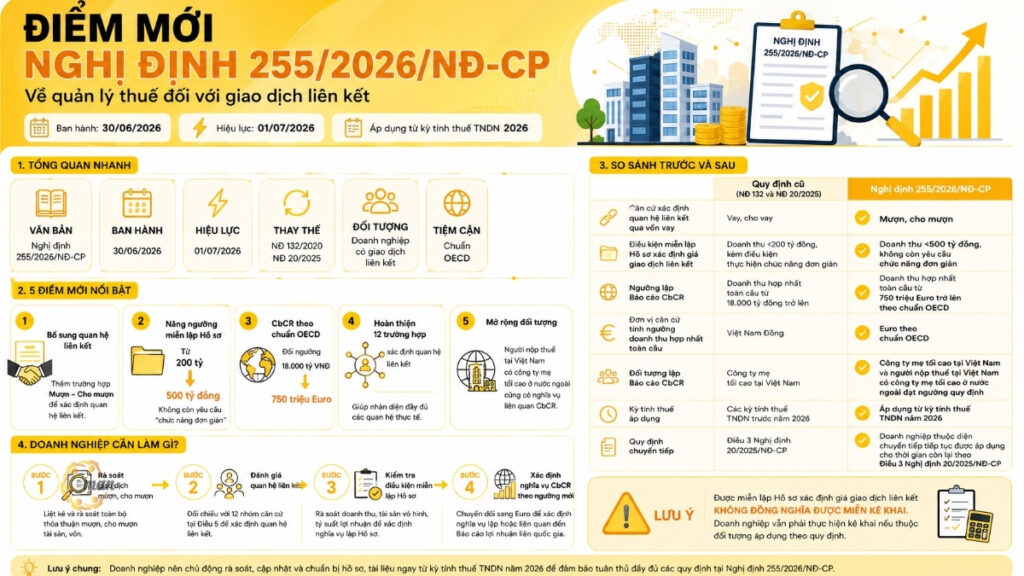
New features Decree 255/2026/ND-CP This is a matter of great interest to many businesses with related-party transactions, following the Government's issuance of Decree No. 255/2026/ND-CP dated June 30, 2026, regulating tax management for related-party transactions. The Decree takes effect from July 1, 2026, applies from the 2026 corporate income tax period, and replaces Decree 132/2020/ND-CP and Decree 20/2025/ND-CP. Compared to previous regulations, the new Decree adds many important provisions related to determining related-party relationships, exemption from preparing Transfer Pricing Documents, Country-by-Country Profit Reporting (CbCR), and several regulations aimed at aligning with international practices. This article will summarize the new points of Decree 255/2026/ND-CP and analyze the content that businesses need to pay attention to when implementing it.
Summary of key new points in Decree 255/2026/ND-CP
To help businesses quickly grasp important information, the table below summarizes the basic contents of Decree 255/2026/ND-CP, including the date of issuance, effective date, scope of application, subjects of application, and superseded documents. This information should be noted before delving into the details of the new provisions of Decree 255/2026/ND-CP.
| Content | Main information |
| Document title | Decree 255/2026/ND-CP regulates tax management for related-party transactions. |
| Date of issuance | 30/6/2026 |
| Effective date | 01/7/2026 |
| Applicable tax period | Starting from the corporate income tax period of 2026. |
| Replace text | Decree 132/2020/ND-CP and Decree 20/2025/ND-CP |
| Transitional provisions | Businesses subject to the transitional provisions under Article 3 of Decree 20/2025/ND-CP will continue to be subject to the regulations for the remaining period. |
| Scope of adjustment | Regulations on tax management for related-party transactions of enterprises with affiliated relationships. |
| Content adjustments | Regulations on related-party relationships, related-party transactions, principles for determining transfer pricing, declaration of related-party transaction information, documentation for determining transfer pricing, country-by-country profit reporting (CbCR), and the rights and responsibilities of taxpayers. |
| Applicable objects | Businesses with related-party transactions and organizations and individuals involved in the tax management of related-party transactions are subject to the provisions of the law. |
Note: Businesses should review their related-party relationships, transactions, and declaration obligations starting from the 2026 tax year to ensure compliance with the regulations in Decree 255/2026/ND-CP.
See also: Full text of Decree 255/2026/ND-CP.
These changes have a direct impact on the business.

Compared to the previous decree, the new decree contains many provisions that affect the tax management process of businesses, most notably:
- Add a case for identifying the relationship through borrow, lend.
- Adjusting the revenue threshold for exemption from preparing Transfer Pricing Documentation.
- Changes to the criteria for determining the obligation to prepare and submit the Country-by-Country Report according to OECD standards.
- Refine the cases for determining affiliated relationships to more fully reflect the actual relationships between businesses.
These changes require businesses to review their ownership structure, financial transactions, capital transactions, and related-party transactions to ensure compliance with regulations.
Note: Being exempt from preparing a Transfer Pricing Documentation does not mean being exempt from the obligation to declare related-party transaction information. Taxpayers are still required to declare information as prescribed if they fall under the scope of the Decree.
The group of businesses most affected
Although the Decree applies to all businesses with related-party transactions, certain groups of businesses will be more significantly impacted when the new regulations come into effect, including:
- A business has a parent company, subsidiaries, or affiliated companies.
- Businesses that engage in borrowing, lending, guaranteeing, or other financial transactions with related parties.
- Businesses engage in transactions involving the transfer of capital, sharing of costs, or utilization of intangible assets.
- Businesses belonging to multinational corporations have obligations related to the Country-by-Country Report (CbCR).
- Businesses with revenue falling within the threshold for exemption from preparing Transfer Pricing Documentation.
For these businesses, updating the new provisions of Decree 255/2026/ND-CP will help them proactively assess the impact and prepare appropriate documents and records starting from the 2026 tax year.
Summary of new points in Decree 255/2026/ND-CP
Compared to Decree 132/2020/ND-CP and Decree 20/2025/ND-CP, the new points in Decree 255/2026/ND-CP focus on perfecting regulations on tax management for related-party transactions, while also updating some content in accordance with international practices.
Notable changes include:
- Add a case for determining the relationship through borrowing and lending.
- Complete the cases for determining the relationship between the parties.
- Raise the revenue threshold for exemption from preparing Transfer Pricing Documentation.
- Change the revenue threshold for reporting country-by-country profits to 750 million Euros, in accordance with OECD standards.
- Clarify the scope of related-party transactions and the entities to which they apply.
A new point in Decree 255/2026/ND-CP is the addition of linkage relationships through borrowing and lending.

One of the most notable new points in Decree 255/2026/ND-CP lies in the way related parties are determined, as stipulated in Clause 2, Article 5. Accordingly, parties considered to have a related relationship include 12 groups of cases:
- One business directly or indirectly holds at least 25% of the owner's equity of the other business;
- Both enterprises have at least 25% of owner's equity held directly or indirectly by a third party;
- One enterprise is the largest shareholder in terms of equity and directly or indirectly holds at least 10% of the total shares of the other enterprise;
- A business entity guarantees or lends capital to another business entity in any form (including third-party loans secured by related-party financing and similar financial transactions), provided that the total outstanding balance of loans is at least 25% of the owner's equity of the borrowing business and accounts for over 50% of the total outstanding balance of all medium and long-term debts of the borrowing business (with exceptions for credit institutions operating under the Law on Credit Institutions 2024, as amended and supplemented). Law No. 96/2025/QH15, not involved in the management, control, or capital contribution of the borrower or the guaranteed party);
- A business may appoint a member of the executive board to manage or control another business, provided that the number of appointed members exceeds 50% of the total number of executive board members, or that a appointed member has the authority to decide on the financial and business policies of the other business;
- Two companies may have more than 50% members on their board of directors, or may have a board member with the authority to make financial and business policy decisions, appointed by a third party;
- Two businesses are managed or controlled in terms of personnel, finance, and business operations by individuals with family relationships (spouses, parents and children, siblings, grandparents and grandchildren, aunts and uncles and nieces/nephews, etc.);
- The two business establishments have a head office-permanent establishment relationship, or both are permanent establishments of a foreign organization or individual;
- Businesses are controlled by an individual through capital contribution or direct involvement in management;
- Other cases where a business (including independently accounting branches that declare and pay corporate income tax) is subject to the management, control, and decision-making power of another business regarding its production and business activities;
- Businesses that have transactions involving the transfer of capital contributions of at least 25%, or borrowing, lending, or lending of at least 10% of the owner's capital contributions at the time of the transaction, with individuals managing or controlling the business or individuals with family relationships as prescribed;
- Credit institutions with their subsidiaries, controlling companies, or affiliated companies as follows: Law on Credit Institutions 2024 (amended and supplemented by Law No. 96/2025/QH15).
The core difference compared to the old regulations lies in the addition of a new format. “"borrow, lend"” Based on the criteria for determining the relationship between the parties involved. Previously, Decree 132/2020/ND-CP only stipulated that parties had a relationship through "borrowing and lending," and did not address the form of borrowing and lending.
The new regulations have supplemented and filled this legal gap, helping to narrow the scope of inter-corporation transactions that can circumvent the definition of related-party relationships under the guise of borrowing assets or capital instead of conventional loans.
For businesses, this is a new point in Decree 255/2026/ND-CP, requiring accounting departments to review all contracts and agreements for borrowing and lending assets and capital between units within the same system, to accurately determine whether the business has developed any new related-party relationships as stipulated.
Raising the revenue threshold for exemption from preparing Transfer Pricing Documentation.

One new point in Decree 255/2026/ND-CP that has a practical impact on the majority of small and medium-sized enterprises is the raising of the revenue threshold for exemption from preparing Transfer Pricing Documentation.
According to the old regulations at point c, clause 2, Article 19 of Decree 132/2020/ND-CP:
Taxpayers are responsible for declaring and determining transfer pricing according to Appendix I, but are exempt from preparing a Transfer Pricing Documentation File if they simultaneously meet the following conditions: conducting business with simple functions, not generating revenue or expenses from the exploitation or use of intangible assets, having revenue under VND 200 billion, and applying the prescribed ratio of net profit before deducting interest expenses and corporate income tax (excluding the difference between revenue and expenses of financial activities).
New regulations are stipulated in point c, clause 2, Article 20 of Decree 255/2026/ND-CP:
The revenue threshold for exemption from preparing Transfer Pricing Documentation has been raised to below VND 500 billion, and the requirement for simplified functions as before has been removed. Businesses must still meet the condition of not generating revenue or expenses from the exploitation and use of intangible assets and applying the prescribed net profit margin on net revenue.
Raising the revenue threshold from VND 200 billion to VND 500 billion is a landmark change, allowing a significant number of medium-sized enterprises, which previously had to prepare complete Transfer Pricing Documentation, to be exempt from this obligation, significantly reducing the administrative compliance burden and the cost of hiring consultants to prepare the documentation.
New regulations on global consolidated revenue thresholds requiring the establishment of a Consolidated Revenue Record (CbCR).

The third new point in Decree 255/2026/ND-CP relates to the obligation to prepare Country-by-Country Reports, which previously only applied to corporations with large global consolidated revenue.
According to the previous regulations at point a, clause 5, Article 18 of Decree 132/2020/ND-CP:
In cases where the taxpayer is the ultimate parent company in Vietnam with consolidated global revenue of VND 18,000 billion or more during the tax period, it is responsible for preparing a Country-by-Country Report in the Transfer Pricing Documentation as per Appendix IV issued with Decree 132/2020/ND-CP. The deadline for submitting the report is no later than 12 months after the end of the ultimate parent company's fiscal year.
Decree 255/2026/ND-CP has revised the regulations to align with international standards:
Taxpayers that are the ultimate parent company in Vietnam with consolidated global revenue in the fiscal year immediately preceding the reporting year equivalent to €750 million or more must prepare and submit a Country-by-Country Report in accordance with Appendix IV issued with Decree 255/2026/ND-CP to the tax authorities. Similarly, taxpayers in Vietnam whose ultimate parent company abroad reaches the threshold of consolidated global revenue equivalent to €750 million or more also have obligations related to the Country-by-Country Report.
The new regulations have shifted entirely to using the 750 million Euro threshold according to OECD standards, a threshold uniformly applied by many member countries of the BEPS framework, helping to increase transparency and the ability to exchange cross-border tax information between Vietnam and partner countries.
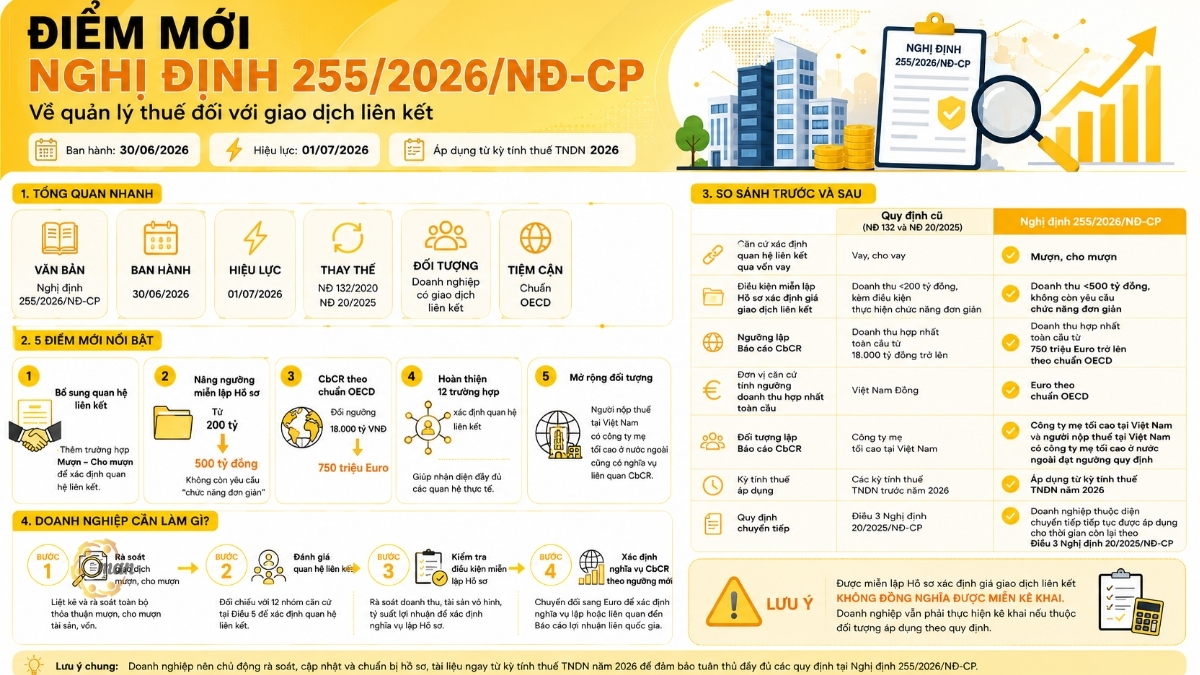
A comprehensive comparison table between the new points of Decree 255/2026/ND-CP and the old regulations.
To make it easier for businesses to compare, here is a summary table comparing the amendments with the regulations in the two preceding documents:
| Criteria | Decree 132 and Decree 20/2025/ND-CP | Decree 255/2026/ND-CP |
| Basis for determining the relationship of association through loan capital | The regulations only cover relationships through lending and borrowing. | Add the borrowing and lending option. |
| Conditions for exemption from preparing Transfer Pricing Documentation | Revenue below 200 billion VND, with the condition that the functions performed are simple. | For revenues below 500 billion VND, the requirement to perform simple functions is no longer necessary. |
| CbCR Report generation threshold | Global consolidated revenue of VND 18 trillion or more. | Global consolidated revenue of €750 million or more, according to OECD standards. |
| The basis for calculating the consolidated revenue threshold globally. | Vietnamese Dong | Use the Euro as the unit of measurement according to OECD standards. |
| The entity that prepares the CbCR report | The ultimate parent company in Vietnam | The ultimate parent company in Vietnam and taxpayers in Vietnam with an ultimate parent company abroad meet the prescribed threshold. |
| Effective date | Expired on July 1, 2026 | Officially effective from July 1, 2026 |
| Applicable tax period | Corporate income tax periods prior to 2026 | Applicable from the corporate income tax period of 2026 |
| Transitional provisions | Article 3 of Decree 20/2025/ND-CP | Businesses subject to the transition period will continue to be subject to the provisions of Article 3 of Decree 20/2025/ND-CP. |
The comparison table above shows that the new aspect of Decree 255/2026/ND-CP is not simply an adjustment of threshold figures, but also reflects a change in management thinking. From rigid regulations in the domestic currency to approaching international standards such as OECD, while expanding the scope of identifying related-party relationships to limit transfer pricing through non-traditional transaction forms such as borrowing and lending of assets and capital.
What steps do businesses need to take to comply with the new provisions of Decree 255/2026/ND-CP?
After understanding the core amendments, businesses need to proactively implement specific tasks to ensure full compliance with the new provisions of Decree 255/2026/ND-CP starting from the corporate income tax period of 2026.
In many complex situations, businesses should consider seeking assistance. related party transaction advisory services For professional, reputable, and experienced support, consult a firm like MAN – Master Accountant Networkd for a comprehensive review to avoid overlooking any declaration obligations under the new regulations.
Review all borrowing and lending transactions to identify any related-party relationships.
Businesses need to list all agreements for borrowing and lending assets and capital between entities within the same system, with the same shareholders, or with individuals who manage or control the business.
Compare these transactions with the 12 criteria for determining related-party relationships in Clause 2, Article 5 of Decree 255/2026/ND-CP to accurately determine whether these transactions give rise to new related-party relationships, thereby enabling appropriate tax declaration planning from the beginning of the tax period.
Compare revenue to determine the obligation to prepare pricing documentation.
With the threshold for exemption from preparing valuation documents raised to VND 500 billion, businesses need to review their actual revenue, compare it with other conditions regarding the exploitation and use of intangible assets and the net profit margin as stipulated in point c, clause 2, Article 20 of Decree 255/2026/ND-CP, to accurately determine whether the business is eligible for exemption from preparing the documents.
For cases that still require documentation, businesses can refer to the following: related party transaction documentation service To ensure that the documentation is complete, complies with regulations, and minimizes risks during tax audits and inspections.
Review the obligation to prepare Country-by-Country Profit and Loss Reports under the new thresholds.
For large corporations, especially those with a parent company located abroad, accountants need to convert the global consolidated revenue threshold to Euros at the prescribed exchange rate to accurately determine whether the enterprise is required to prepare, or has obligations related to, the Country-by-Country Profit Reporting as stipulated in Appendix IV of Decree 255/2026/ND-CP.
Conclude
With the new provisions of Decree 255/2026/ND-CP taking effect from the 2026 corporate income tax period, businesses need to proactively update themselves on the new points as soon as possible, review all transactions with related parties, compare revenue thresholds and corresponding reporting obligations, in order to ensure full compliance with legal regulations and minimize the risk of being subjected to transfer pricing by the tax authorities, corporate income tax arrears, administrative penalties for tax violations, and late payment fees.
Contact MAN – Master Accountant Network For free support and advice!
Contact information MAN – Master Accountant Network
- Address: No. 19A, Street 43, Tan Thuan Ward, Ho Chi Minh City
- Mobile/Zalo: 0903 963 163 – 0903 428 622
- E-mail: man@man.net.vn
- Google Business Profile: View MAN – Master Accountant Network's Google Business Profile
- LinkedIn Founder: View expert Le Hoang Tuyen's LinkedIn profile.
Responsible for production and professional content review by: Mr. Le Hoang Tuyen – Founder & CEO of MAN – Master Accountant Network. He is a CPA Vietnam auditor with over 30 years of in-depth experience in accounting, auditing, taxation, and corporate legal consulting.
Frequently Asked Questions about the New Points in Decree 255/2026/ND-CP
Some notable new points include: Adding a case for determining related-party relationships through borrowing and lending; Raising the revenue threshold for exemption from preparing Transfer Pricing Documentation from under VND 200 billion to under VND 500 billion; Changing the revenue threshold for preparing Country-by-Country Profit Reporting (CbCR) to 750 million Euro according to OECD standards; and Refining the cases for determining related-party relationships and the scope of related-party transactions.
Not all cases are exempt. According to point c, clause 2, Article 20 of Decree 255/2026/ND-CP, in addition to the condition of revenue below VND 500 billion, enterprises must also meet other conditions as prescribed, including not generating revenue or expenses from the exploitation and use of intangible assets and applying the prescribed profit margin.
According to the new regulations, taxpayers that are the ultimate parent company in Vietnam with consolidated global revenue in the fiscal year immediately preceding the reporting year equivalent to 750 million Euros or more must prepare and submit a Country-by-Country Report as required.
No. Article 23 of Decree 255/2026/ND-CP clearly stipulates that enterprises subject to transitional provisions under Article 3 of Decree 20/2025/ND-CP will continue to be subject to the transitional provisions for the remaining period as prescribed in Decree 20/2025/ND-CP. This regulation aims to ensure continuity in the fulfillment of tax obligations by enterprises.What is the most notable new feature of Decree 255/2026/ND-CP?
Are businesses with revenue under VND 500 billion exempt from preparing Transfer Pricing Documentation?
What is the revenue threshold for preparing a Country-by-Country Report according to Decree 255/2026/ND-CP?
Will businesses currently applying the transitional regulations under Decree 20/2025 have their regulations terminated when Decree 255/2026/ND-CP comes into effect?