





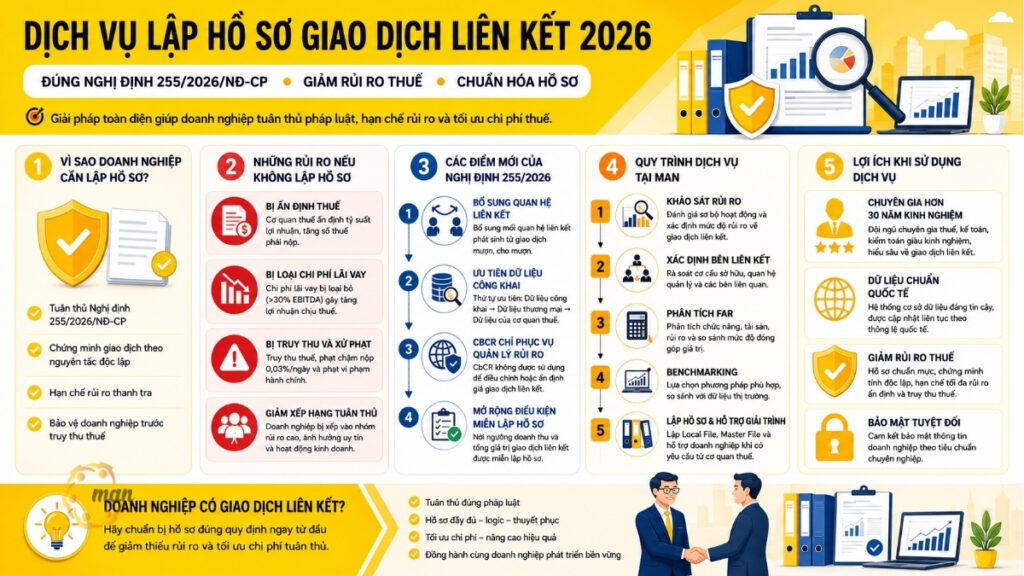
The service of preparing related-party transaction documents is a mandatory step for all businesses with related-party transactions, especially when... Decree 255/2026/ND-CP Recently, the Ministry of Finance has changed a series of exemption thresholds, methods for determining related party relationships, and CbCR reporting obligations. With over 30 years of experience in tax, accounting, and auditing consulting for domestic and international businesses, the MAN – Master Accountant Network team directly updates the latest regulations from the Ministry of Finance to create accurate Local File and Master File, helping businesses avoid unfair tax assessments and disallowances of interest expense deductions.
Controlling related-party transactions: Tightening management with digital data.
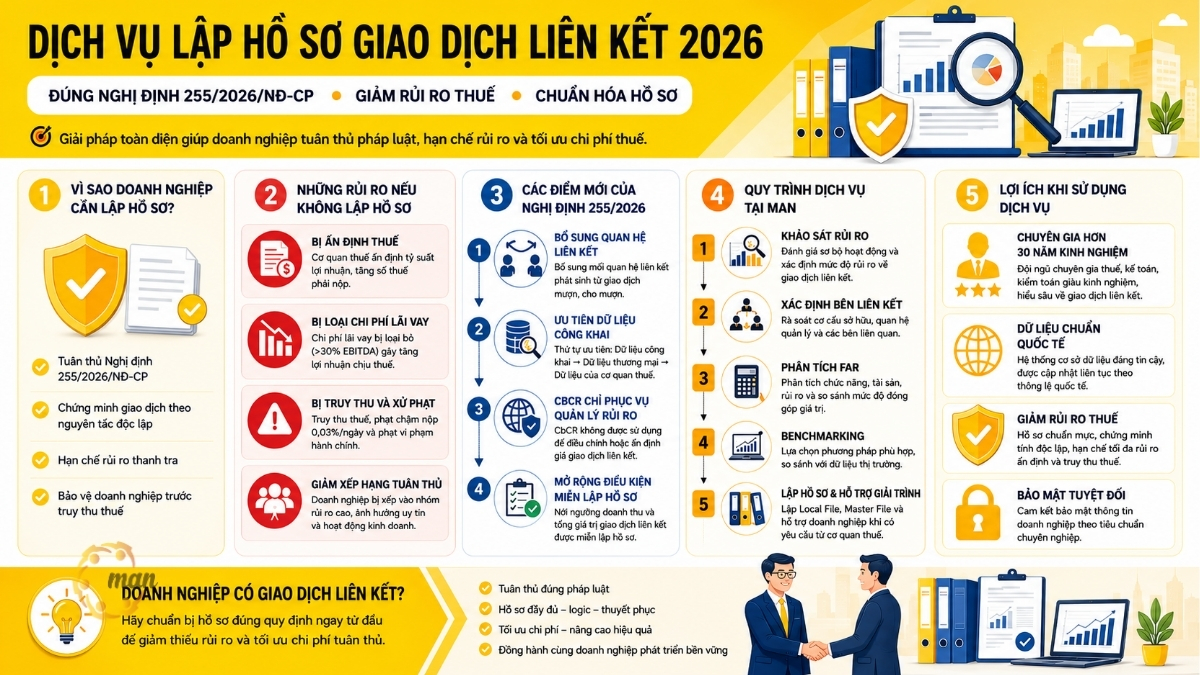
Entering 2026, the Vietnamese tax sector has made significant progress in controlling cross-border and domestic transactions between related parties. In particular, since the effective date of Decree 255/2026/ND-CP, the principles for managing and inspecting related-party transaction prices by tax authorities have been uniformly referenced according to the principles applied in tax management and tax inspection as stipulated in the Decree. Tax Administration Law 2025 (Law No. 108/2025/QH15), instead of being applied independently as before.
Tightening of big data management systems
The tax authorities now rely not only on business reports but also connect data directly with customs systems, banks, and member countries of the BEPS Cooperation Forum. Decree 255/2026/ND-CP further adds regulations on the priority order of using databases when analyzing and comparing related-party transactions, prioritizing publicly available databases, followed by commercial databases, and finally using the tax authority's database. Using a service to prepare related-party transaction documentation now acts as a protective shield, helping businesses compare internal data according to the aforementioned priority order before submitting official reports. Experts from related party transaction advisory services This will help businesses review even the smallest discrepancies before authorities get involved.
Impact of the Global Minimum Tax (Pillar 2)
With the implementation of the Global Minimum Tax, multinational corporations with consolidated revenues equivalent to €750 million or more are facing new challenges. Transfer pricing regulations in Vietnam, under Decree 255/2026/ND-CP, have been refined to align with this rule, with the concepts of “Supreme Parent Company” and “Tax Agreement” perfected in accordance with the guidelines in Resolution 107/2023/QH15 and Decree 236/2025/ND-CP on supplementary corporate income tax under the global anti-base erosion mechanism. This requires service providers of related-party transaction documentation to have an international perspective and a deep understanding of cross-country profit reporting (CbCR). A reputable related-party transaction documentation service from MAN – Master Accountant Network will ensure the consistency of the company's reporting globally.
Risks when businesses neglect to create a record

Many businesses mistakenly believe that simply submitting the tax appendix is sufficient. However, without expert advice from a related-party transaction documentation service, deficiencies in supporting documents (Local File and Master File) can lead to extremely serious consequences.
- Subjective tax assessment: If the documentation is incomplete or fails to demonstrate objectivity (Arm's Length Principle), the Tax Authority has the right to use its database to determine the profit margin. Notably, Decree 255/2026/ND-CP adds a clear regulation: The country-by-country report (CbCR) of taxpayers can only be used for risk management and information exchange in accordance with Vietnam's international commitments, and cannot be used to adjust or determine the price of related-party transactions. Nevertheless, the role of related-party transaction documentation preparation services remains extremely important in explaining material differences between the national and global documentation.
- Risk of disallowing interest expense: This is the most common risk. The total deductible interest expense incurred does not exceed 30% EBITDA. Businesses subject to the transitional provisions on interest expense under Article 3 of Decree 20/2025/ND-CP will continue to apply the remaining transitional period as stipulated in the transitional provisions of Decree 255/2026/ND-CP. Without in-depth expertise from the service provider preparing the related party transaction documentation to create a detailed explanation, businesses are very likely to have billions of VND in legitimate expenses disallowed.
- Administrative penalties and tax arrears: In addition to the tax arrears, businesses face a late payment penalty of 0.031 TP3T/day. A professional and experienced service provider specializing in preparing related party transaction documents will help businesses minimize errors leading to these penalties.
- Consequences for reputation and compliance rating: A business found to be in violation of transfer pricing regulations will be classified as "High Risk". Investing in transfer pricing documentation services is essential to protect the safety, interests, and transparency of the business.
Core legal basis and regulations regarding related-party transaction documents.

To provide accurate related-party transaction documentation services, MAN – Master Accountant Network always adheres to the current legal framework:
Decree 255/2026/ND-CP on related-party transactions
This is the current guiding document regulating tax management for enterprises with related-party transactions, replacing Decree 132/2020/ND-CP and Decree 20/2025/ND-CP. Key points include:
- Article 5: The regulations concerning related parties include an additional category of related parties arising from borrowing or lending between a business and individuals managing or controlling the business, or individuals related to those managers (similar to loan relationships). Simultaneously, the Decree also adds a provision excluding related parties from creditors and guarantors that are state-owned organizations with charter capital, whose functions include buying, selling, and handling debt, and which do not directly or indirectly manage, control, contribute capital to, or invest in the debtor or guaranteed business.
- Article 17: Regulations on the databases used in declaring, determining, and managing related-party transaction prices, supplementing the national database, and the priority order for using databases (public → commercial → tax authorities).
- Article 18: Regulations on the rights and obligations of taxpayers in declaring and determining transfer pricing, referencing the 2025 Tax Administration Law.
- Article 19: Regulations on Country-by-Country Profit Reporting (CbCR) stipulate a global consolidated revenue threshold adjusted to the equivalent of 750 million Euros (based on revenue from the fiscal year immediately preceding the reporting year, converted using the central exchange rate or the December cross-exchange rate published by the State Bank of Vietnam).
- Article 20: Regulations regarding cases exempt from preparing Transfer Pricing Documentation.
- Article 21: Regulations on the responsibilities and powers of tax authorities include the principle of not using CbCR to adjust or fix transfer pricing and the addition of a program to support taxpayers' voluntary compliance.
- Appendices I, II, III, IV: The required forms to be submitted with tax returns include: related party information, country records, global records, and country-by-country profit reports. A professional related party record preparation service will complete these appendices based on the actual data from the supporting documents.
See also: New points in Decree 255/2026/ND-CP regarding related-party transactions.
Law on Tax Administration No. 108/2025/QH15
The new Tax Administration Law, effective from 2025-2026 and serving as the overarching reference for Decree 255/2026/ND-CP, has added stringent regulations to combat tax evasion through transfer pricing. Specifically:
- Database access rights: The law empowers the Tax Authority to fully utilize the global automated information exchange system. This means that all data on the profits, assets, and personnel of the parent company abroad is under the control of the local tax authority.
- Comparative data requirements: The new law emphasizes the timeliness and reliability of data. Businesses are required to use copyrighted and internationally recognized commercial data sources for benchmarking, in conjunction with the new database priority order as stipulated in Decree 255/2026/ND-CP.
- Accountability: Strengthen post-audit mechanisms. If the data in the file does not match the industry data held by the tax authorities, the business will be required to provide an explanation immediately.
Therefore, a quality related-party transaction documentation service must possess data analysis tools equivalent to those of the Tax Authority to counterbalance and protect the legitimate rights of businesses. Because of the complexity in identifying transactions and related parties, businesses should consult with a professional firm. Transfer pricing consultancy Reputation and experience are essential to avoid unnecessary risks.
Entities required to prepare related-party transaction records and exemption conditions.
Businesses need to clearly define their position before seeking services to prepare related-party transaction documents.
Required subjects
Accurately identifying related parties is fundamental to tax law compliance. According to Article 5 of Decree 255/2026/ND-CP, related parties are those with a relationship falling under one of the following cases:
- Ownership of capital (Direct or Indirect): One party holds at least 25% of the other party's owner's equity.
- Same owner: Both sides have at least 25% capital contributions held directly or indirectly by a third party.
- Largest shareholder: One party is the largest shareholder in terms of owner's equity and directly or indirectly holds at least 10% of the other party's total shares.
- Large loan guarantees/loans: One party guarantees or lends capital to the other party on the condition that the loan amount is at least equal to 25% of the borrower's owner's equity and accounts for more than 50% of the total value of the borrower's medium and long-term debts. Decree 255/2026/ND-CP notes that it excludes cases where the creditor or guarantor is a state-owned organization with the function of buying, selling, and handling debt and does not participate in the management, control, capital contribution, or investment in the borrower/guarantee.
- Authority to manage the Supervisory Board: One party has the right to directly or indirectly designate, on the 50%, a number of executive board members, or one executive board member has the right to determine the financial policy of the other party.
- Together with the Executive Board: Both parties have more than 50% members on their executive board, or both have an executive board member with the authority to decide on financial policy designated by a third party.
- General management by family members: Both sides are run by individuals who are closely related within the family (spouse, biological father, adoptive father, biological mother, adoptive mother, biological child, adopted child, siblings).
- Exclusive business partnership: One party engages in franchise transactions, providing business know-how that accounts for over 50% of the other party's total input/output value.
- Actual control: One party directly or indirectly controls the other through various means.
- Individual transaction management: Businesses that have transactions involving the transfer or acquisition of capital contributions of at least 25% of owner's capital contributions, or transactions borrow, lend, take out, give away At least 10% of the owner's equity at the time the transaction occurs, with the individual managing or controlling the business or an individual with a family relationship to that manager.
- Other dependency relationships: These situations involve a real-world relationship that allows one party to potentially manage the other party's business.
Important note: A new feature of Decree 255/2026/ND-CP is the addition of the previously existing "borrowing and lending" form to the existing regulations.
Cases exempt from preparing Related Party Transaction Documents.
Decree 255/2026/ND-CP specifies the cases where enterprises have related-party transactions but are exempt from preparing a Transfer Pricing Documentation (although they still need to declare the Appendix). Using a Transfer Pricing Documentation preparation service helps you accurately determine the following exemption benefits:
- Businesses with total revenue generated during the tax period below VND 50 billion and total value of related-party transactions generated during the tax period below VND 30 billion.
- The company has signed an Advance Pricing Agreement (APA) and submitted its Annual Report as required.
- The business only conducts transactions with related parties that are subject to corporate income tax in Vietnam, applying the same tax rate, and none of these parties are entitled to corporate income tax incentives during the tax period.
- Businesses that do not generate revenue or expenses from the exploitation or use of intangible assets, but do have revenue. under 500 billion VND, applying the net profit margin (EBIT) before deducting interest expenses and corporate income tax to net revenue according to the following sectors: Distribution from 5% onwards, Manufacturing from 10% onwards, and Processing from 15% onwards.
Important Note: Compared to previous regulations, Decree 255/2026/ND-CP has raised the revenue threshold for the fourth exemption case from under VND 200 billion to under VND 500 billion, while removing the criterion of "business with simple functions," which previously had to be met along with the other three criteria. As a result, the scope of businesses with low tax risk that are exempt from preparing Transfer Pricing Documentation has been expanded, and the application conditions have been simplified, helping businesses reduce compliance costs.
Although exempt from filing, businesses are still required to correctly declare Appendices I, II, and III along with their tax return. A small oversight in the declaration can lead to the loss of exemption and tax assessment. Therefore, assistance from a related-party transaction documentation service to review exemption conditions is extremely necessary.
The process for implementing the Related Party Transaction Documentation service at MAN – Master Accountant Network.
MAN applies a five-step international standard process to its Related Party Transaction Documentation service package to ensure the highest level of legal compliance:
- Risk assessment: MAN conducts a review of past data and identifies risk zones.
- Identifying related parties: Carefully review each transaction that may constitute a related-party transaction. Identify and clarify related parties in accordance with Decree 255/2026/ND-CP, including newly added related-party relationships such as borrowing and lending transactions with individual executives.
- Functional, Asset, and Risk Analysis (FAR Analysis): Understanding the roles, responsibilities, and risks involved. Simultaneously examining the economic nature of the business's transactions and operations.
- Choosing a pricing method: Select the method that best suits the industry in which your business operates. Provide a logical justification for choosing this method.
- Benchmarking: To confirm that prices in related-party transactions are reasonable, objective, and consistent with the arm's length principle, MAN implements an in-depth data analysis process following the priority order of the new databases in Decree 255/2026/ND-CP (public data, commercial data, and then tax authority data). Through this process, businesses can determine a safe profit margin or benchmark profit rate based on market comparison data, with key steps such as searching for comparable independent businesses and utilizing proprietary data (Orbis, Bloomberg).
- Support in explaining and clarifying: We accompany businesses that have hired a related-party transaction consultant throughout all their meetings with the tax authorities.
Latest price list for related party transaction documentation services in 2026.
The cost of preparing a Related Party Transaction Documentation (IPD) in 2026 is not fixed but will depend on the size of the business, the number of related-party transactions, the complexity of the documentation, and the requirements for international comparative data. For domestic businesses with only simple transactions, the scope of work usually stops at preparing the Local File and mandatory appendices. Meanwhile, FDI businesses or multinational corporations will need additional Master File, country-by-country profit reporting, and in-depth analysis of intangible assets, functions, and risks. Below is a reference price list for IPD preparation services by group.
| Service package | Object | Job details | Estimated fee (VND) |
| Standard package | The business has simple transactions. | Prepare Appendices I, II, III and the Local File. | 45,000,000 – 80,000,000 |
| Advanced Package | Foreign direct investment (FDI) enterprises possess intangible assets. | Local File, Master File, and international data processing. | 90,000,000 – 180,000,000 |
| Special Package | A large multinational corporation. | Complete set of 3 levels of documentation for determining transfer pricing (including Country-by-County Report if required). | 200,000,000 – 350,000,000 |
| Review and support for audit explanations | The business is currently under investigation. | Reviewing data and assisting in explaining and defending the accuracy of records. | Contact for agreement |
The service fee for preparing related-party transaction documentation is for reference only and will be adjusted depending on the number of related-party transactions, the complexity of the ownership structure, requirements for Master File and CbCR, as well as the current status of the company's documentation. For companies undergoing audits or with high risks related to interest expenses, transfer pricing, loan transactions, or intangible assets, additional costs may arise due to the need for in-depth data analysis and the development of a separate justification plan. Therefore, to receive the most accurate and suitable quote, please contact MAN – Master Accountant Network!
Benefits of using a Related Party Transaction Profile preparation service.

Using a reputable and professional agency like MAN to prepare your Related Party Transaction Documents will provide value that far exceeds the cost:
- Specialization: Our team possesses in-depth knowledge of inspection practices and is continuously updated on new regulations according to Decree 255/2026/ND-CP. We guarantee high-quality output for our related-party transaction documentation services.
- Technology and Data: Accessing global financial data and prioritizing new databases helps in finding compelling evidence.
- Tax optimization: Transaction structure consulting helps keep profit margins within a safe range through the preparation of related-party transaction documents.
- Absolute data security: All strategic data is guaranteed to be kept confidential.
Conclusion: The Importance of Related Party Transaction Documentation Services
Investing in a professional related-party transaction documentation service right from the tax planning stage is a strategic move, especially in light of Decree 255/2026/ND-CP, which recently introduced significant changes to exemption thresholds, databases, and CbCR reporting obligations. A well-prepared documentation not only helps businesses avoid substantial penalties but also builds credibility with regulatory authorities. In 2026, the partnership of a professional related-party transaction documentation service provider will be key to successfully passing any audit.
Contact MAN – Master Accountant Network For free support and advice!
Contact information MAN – Master Accountant Network
- Address: No. 19A, Street 43, Tan Thuan Ward, Ho Chi Minh City
- Mobile/Zalo: 0903 963 163 – 0903 428 622
- E-mail: man@man.net.vn
- Google Business Profile: View MAN – Master Accountant Network's Google Business Profile
- LinkedIn Founder: View expert Le Hoang Tuyen's LinkedIn profile.
Responsible for production and professional content review by: Mr. Le Hoang Tuyen – Founder & CEO of MAN – Master Accountant Network. He is a CPA Vietnam auditor with over 30 years of in-depth experience in accounting, auditing, taxation, and corporate legal consulting.
Frequently Asked Questions about the Related Party Transaction Documentation Service
The related-party transaction appendix must be submitted at the same time as the Corporate Income Tax Return (usually the last day of the third month from the end of the fiscal year). Supporting documents (Local/Master File) must be kept readily available at the company's headquarters. When requested for tax audits or inspections, the company must provide them within 15 working days. Regarding the Country-by-Country Profit Report (CbCR), according to Decree 255/2026/ND-CP, the deadline for submission is no later than 12 months from the end of the fiscal year of the parent company of the reporting year.
Yes. Although data can be inherited from the corporation, the Master File needs to be translated into Vietnamese and adapted to the actual operations in Vietnam according to Decree 255/2026/ND-CP. In particular, the Local File must be prepared by a legal entity in Vietnam based on domestic accounting data.
Based on benchmarking results from specialized databases, following the priority order of the new databases stipulated in Decree 255/2026/ND-CP, the Related Party Transaction Documentation service will help you determine the range of independent transaction values (usually from the 35th to the 75th percentile). If a company's profits fall outside this range without justifiable reason, the risk of being subject to tax assessment is very high.
According to current regulations, the portion of interest expense exceeding the limit is carried forward to the next tax period when determining the total deductible interest expense within a period not exceeding 5 consecutive years. Enterprises subject to the transitional provisions under Article 3 of Decree 20/2025/ND-CP continue to carry forward for the remaining period as stipulated in the transitional provisions of Decree 255/2026/ND-CP.What is the deadline for submitting the Related Party Transaction Document and its accompanying appendices?
If the parent company overseas has already created a Master File, do I still need to use a Transfer of Interest Documentation service in Vietnam?
How can I tell if my company's profit margin is within a safe range?
Can disallowed interest expense (exceeding 30% EBITDA) be carried forward to the following year?