





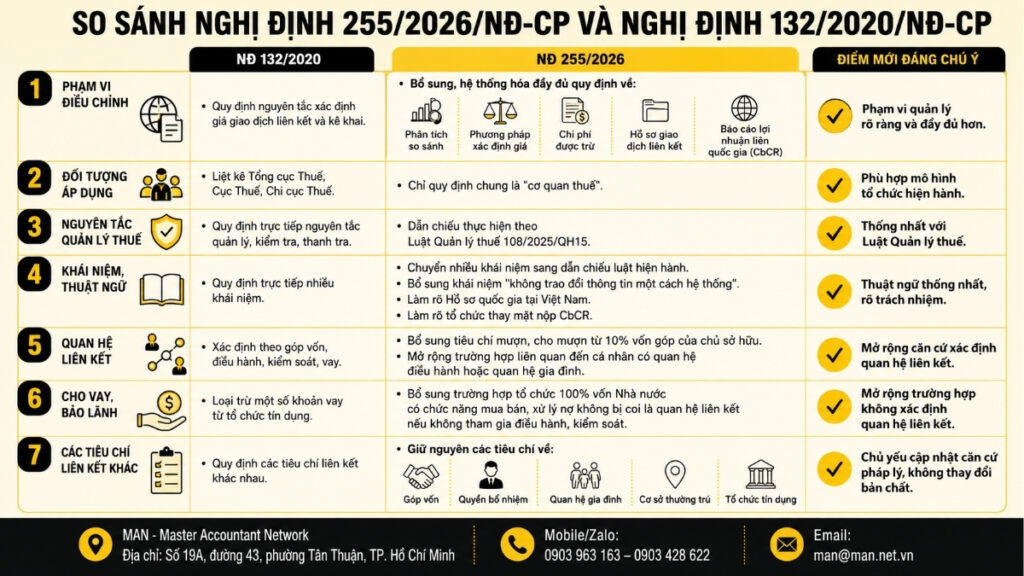
Comparing Decree 255/2026 with Decree 132/2020 is an urgent task that all businesses, accountants, and tax consultants need to undertake immediately, as the new document officially replaces the old regulations on tax management for related-party transactions. From the scope of application and the concept of related parties to the obligation to prepare the Country-by-Country Report, a series of contents have been adjusted and referenced consistently with the new Decree 255/2026. Law on Tax Administration No. 108/2025/QH15. This article provides a comprehensive and accurate summary of each change through a visual comparison table, helping businesses to promptly understand and apply the changes correctly from the outset, avoiding unnecessary risks of retroactive tax collection and penalties.
Why is it necessary to compare Decree 255/2026 with Decree 132/2020 right now?

Tax management for related-party transactions is a highly technical field, directly involving declaration obligations, determination of deductible expenses, and the risk of tax arrears and penalties if businesses apply regulations incorrectly. When Decree 255/2026/ND-CP officially replaced Decree 132/2020/ND-CP, a series of concepts, criteria, and management principles were adjusted to align with Law No. 108/2025/QH15 on Tax Administration and other recently issued tax laws.
Comparing Decree 255/2026 with Decree 132/2020 therefore becomes a mandatory step for:
- Businesses that engage in related-party transactions, especially foreign-invested enterprises (FDI) and multinational corporations operating in Vietnam.
- The company's accounting, tax, and legal departments need to update their internal procedures.
- Tax firms, auditors, and lawyers regularly advise clients on transfer pricing.
- Tax authorities and researchers who update tax laws and policies.
The following sections of this article will delve into specific details, helping businesses gain a comprehensive understanding when comparing these two documents.
An overview of the two texts before a detailed comparison.
Before delving into the detailed comparison table, let's briefly review the context and direction of each document. This will provide a foundation for understanding the reasons behind the changes presented later:
Decree 132/2020/ND-CP: Platform for managing tax on related-party transactions
Decree 132/2020/ND-CP has historically been the document regulating the principles, methods, and procedures for determining the factors forming the price of related-party transactions, as well as the rights and obligations of taxpayers in determining and declaring prices. This document specifically lists the levels of tax authorities with management authority, including the General Department of Taxation, the Tax Department, and the Tax Sub-department, and also provides detailed regulations on many fundamental concepts such as related-party transactions, tax agreements, ultimate parent companies, and related parties.
Decree 255/2026/ND-CP: New legal framework, updated according to Law on Tax Administration 108/2025/QH15
Meanwhile, Decree 255/2026/ND-CP The Decree provides more specific and systematic regulations on tax management principles, related parties, comparative analysis, pricing methods, determination of deductible expenses, declaration and documentation of related-party transactions, and country-by-country profit reporting. The biggest difference is that many concepts are no longer explained directly in the Decree but are referred to in other currently effective legal documents, ensuring consistency throughout the entire tax legal system.
This is the key point that anyone comparing Decree 255/2026 with Decree 132/2020 needs to note: the new document's approach leans towards referencing and systematizing, rather than independent regulation as before.
Comparison table of Decree 255/2026 and Decree 132/2020 by content
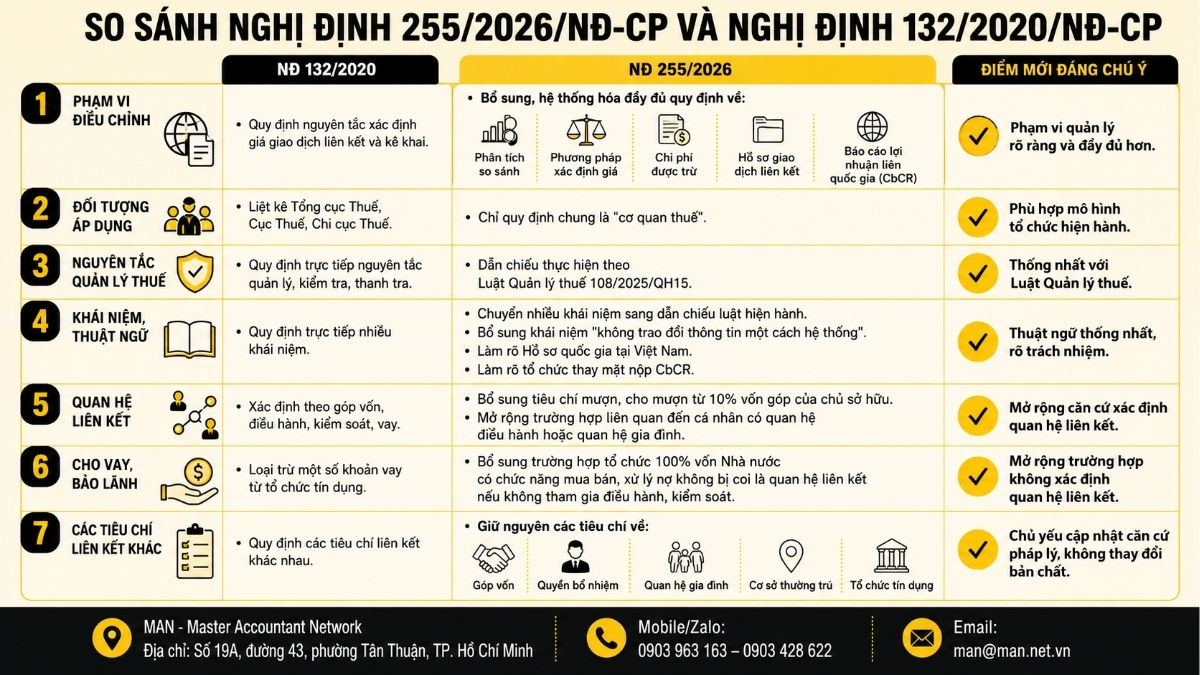
Below is a detailed comparison table, structured according to specific criteria, to help businesses easily look up applicable regulations when needed.
| Criteria | Decree 132/2020/ND-CP | New regulations in Decree 255/2026/ND-CP | Notable new features |
| Scope of adjustment | Regulations specify the principles, methods, and procedures for determining the factors that form the price of related-party transactions; and the rights and obligations of taxpayers in price determination and declaration. | More specific regulations on tax management principles, related parties, comparative analysis, pricing methods, determination of deductible expenses, declaration and documentation of related-party transactions, and country-by-country profit reporting. | Clarify and fully systematize the tax management contents for related-party transactions; emphasize the obligation to declare and document the determination of transfer pricing. |
| Applicable objects | List the tax authorities, including the General Department of Taxation, the Provincial Tax Department, and the District Tax Office. | The only general regulation is the Tax Authority. | The specific levels of tax authorities are no longer listed, in accordance with the current organizational structure and regulations. |
It can be seen that a comparison of Decree 255/2026 with Decree 132/2020 reveals a trend towards streamlining and generalizing regulations on the scope of application, instead of listing details as before.
Principles for taxpayers and principles of management and inspection by tax authorities.
Having understood the scope of regulation and the subjects of application, the next step in comparing Decree 255/2026 with Decree 132/2020 is to consider two core groups of principles:
- Principles that taxpayers must adhere to.
- And these are the principles that tax authorities apply when managing and inspecting.
This content directly impacts how businesses determine their tax obligations, as well as how tax authorities conduct subsequent reviews and verifications.
| Criteria | Decree 132 | Decree 255 | New points to note |
| Principles for taxpayers | Taxpayers must exclude factors that reduce their tax liability due to related-party relationships. | Continue to uphold this principle. | The basic obligations of taxpayers in determining transfer pricing remain unchanged. |
| Principles of management and inspection by tax authorities. | The regulations specify that tax authorities manage, inspect, and audit transactions based on the principles of independent accounting and the nature of the transactions. | This is based on the principles of tax administration and tax inspection as stipulated in the Law on Tax Administration No. 108/2025/QH15. | Remove the word "inspection" and no longer list detailed principles in the Decree; instead, refer to the Law on Tax Administration to ensure consistency. |
It is noteworthy that the core obligations of taxpayers remain unchanged, but the tax authority's management and inspection mechanisms have been referenced to the Tax Administration Law No. 108/2025/QH15 instead of being independently regulated in the Decree.
The concept of related-party transactions, tax agreements, and the ultimate parent company.
Beyond just management principles, a further comparison of Decree 255/2026 with Decree 132/2020 reveals significant adjustments in the presentation of concepts such as related-party transaction platforms, tax agreements, and supreme parent companies. These are terms that anyone working in the field of related-party transaction pricing needs to understand accurately, as they form the basis for determining the scope of application of the entire regulation.
| Criteria | Old regulations | New regulations | Key new points |
| The concept of related party transactions | As stipulated in the section on the scope of application of the Decree. | By including Article 4 on the definition of terms, the basic content remains unchanged. | Rearranging the order of transactions does not alter the scope of related-party transactions. |
| The concept of a tax agreement. | A direct explanation is the agreement to avoid double taxation and prevent tax evasion signed between Vietnam and other countries and territories. | Refer to the definition in Decree 236/2025/ND-CP. | Switch from direct explanation to referencing existing regulations. |
| The concept of the ultimate parent company | Provide a detailed explanation of the ownership structure and consolidated financial reporting characteristics of the ultimate parent company. | Refer to Clause 4, Article 3 of Resolution 107/2023/QH15. | The concept should be aligned with the regulations on supplementary corporate income tax under the global anti-base erosion mechanism. |
When comparing Decree 255/2026 with Decree 132/2020 in this conceptual group, it is clear that there is a consistent approach to legal terminology throughout the system of documents, especially in connection with the global minimum tax mechanism (Resolution 107/2023/QH15), a content that businesses with a parent company subject to its application need to pay particular attention to.
Regulations regarding organizations that submit the Country-by-Country Report on behalf of others.

For multinational corporations with many members operating in multiple countries, a crucial question that always arises is:
Who is responsible for preparing and submitting the Country-by-Country Report of Profits, and where should it be submitted?
When comparing Decree 255/2026 with Decree 132/2020, it can be seen that this content has been significantly clarified, helping businesses correctly identify their responsibilities right from the document preparation stage.
| Criteria | Old regulations | New regulations | New features |
| The organization submits the Country-by-Country Report on behalf of the organization. | It is an organization authorized by the ultimate parent company to submit reports to the tax authorities. | As a member of a multinational corporation, it is designated by the ultimate parent company to prepare and submit reports in the country or territory where that member is a tax resident. | Clarify the designated entity, scope of responsibilities, and submission location for the Country-by-Country Report. |
This is one of the changes with significant practical implications for multinational corporations with many members operating in different countries, because the new regulations more clearly define who is responsible for preparing and submitting reports, as well as where those reports should be submitted.
See also: Limitations on the use of CbCR reports.
National profiles and status do not exchange information systematically.

Besides clarifying the responsibility for submitting the Country-by-Country Report, another point to consider when comparing Decree 255/2026 with Decree 132/2020 is the scope of information in the national file and a completely new concept related to the exchange of information between countries. This is an important legal basis for determining the obligations of enterprises in cases where the Country-by-Country Report does not reach the Vietnamese tax authorities.
| Criteria | Old regulations | New regulations | New features |
| National profile | This includes information about related-party transactions, policies, and pricing methods used by the taxpayer. | This information is identified as belonging to a taxpayer in Vietnam. | Adding the phrase "in Vietnam" clarifies the scope of information that must be included in the National File. |
| The situation of not exchanging information systematically. | There is no specific concept yet. | The concept of cases where a country or territory temporarily suspends or continuously fails to exchange Country-by-Country Profit Reporting is added, resulting in the Vietnamese tax authorities not receiving the reports. | New terminology has been added to establish the basis for defining obligations related to the Country-by-Country Report. |
The addition of the concept of "systematic information exchange" is a completely new point compared to Decree 132/2020/ND-CP, creating a clear legal basis for cases where Vietnamese tax authorities do not receive the Country-by-Country Profit Report because the partner country does not exchange information.
The concept of related parties: The most notable change.
In the overall comparison of Decree 255/2026 with Decree 132/2020, this can be considered the most fundamental change, because the concept of related parties is the basic basis for determining whether a transaction falls within the scope of transfer pricing regulations. Any change in this concept will have a ripple effect on all declaration and documentation obligations of enterprises.
| Criteria | Old regulations | New regulations | New features |
| The concept of related parties | The decree directly regulates two groups of relationships: One party participates in the management, control, capital contribution, or investment of the other party, or both parties are subject to the control of another party. | Refer to Clause 17, Article 4 of the Law on Tax Administration No. 108/2025/QH15. | The concept is no longer redefined in the Decree, ensuring consistency with the Law on Tax Administration. |
Besides the criteria for determining affiliated relationships, the Decree also stipulates several exceptions, meaning that even if lending or guarantee transactions occur, they are not considered affiliated. When comparing Decree 255/2026 with Decree 132/2020 on this matter, businesses operating in the credit and debt restructuring sectors should pay particular attention to how the scope of exclusions has been expanded.
In cases of loans or guarantees where the affiliated relationship is not established...
Besides the criteria for determining affiliated relationships, the Decree also stipulates several exceptions, meaning that even if lending or guarantee transactions occur, they are not considered affiliated. When comparing Decree 255/2026 with Decree 132/2020 on this matter, businesses operating in the credit and debt restructuring sectors should pay particular attention to how the scope of exclusions has been expanded.
| Criteria | Decree 132 | Decree 255 | New features |
| In cases of loans or guarantees where the affiliated relationship is not established... | Excluding certain cases where the lender or guarantor is an organization operating under the Law on Credit Institutions and does not participate in management, control, capital contribution, or investment. | Continue to maintain the exclusions and add cases where the creditor or guarantor is a state-owned organization with charter capital, whose function is to buy, sell, and process debt, and which does not participate in the management, control, capital contribution, or investment of the debtor. | Expanding the scope of cases where the criteria for determining affiliated relationships do not apply to lending and guarantee activities of state-owned debt resolution organizations with registered capital 100%. |
Relationships formed through borrowing and lending transactions.
Besides the familiar criteria for borrowing and lending, one of the issues that businesses are most concerned about when comparing Decree 255/2026 with Decree 132/2020 is the expansion of the scope of defining related-party relationships to include borrowing and lending transactions. This change may require many transactions that were previously not subject to regulation to be reviewed.
| Criteria | Old regulations | New regulations | Update Point |
| Relationships formed through borrowing and lending. | The regulations only stipulate that loan and borrowing transactions must have a value at least equal to 10% of the owner's contributed capital. | Additional borrowing and lending transactions must have a value of at least 10% of the owner's contributed capital at the time the transaction occurs. | Expand the scope of defining affiliated relationships to include borrowing and lending transactions with individuals who have managerial, controlling, or family relationships as defined by regulations. |
See also: New points regarding linking and declaration relationships.
Other linking criteria
Essentially, the criteria remain the same:
- Regarding capital contributions;
- The right to appoint leaders and exercise control;
- Family relationships;
- Head office and permanent establishment;
- Credit institutions with their subsidiaries, controlling companies, and affiliated companies.
Decree 255/2026/ND-CP, in general, does not contain significant changes, mainly updating the basis for referencing the current Law on Credit Institutions.
Reference: How to calculate interest expense according to Decree 255.
Here are 5 key new points when comparing Decree 255/2026 with Decree 132/2020.
In summary, the following five key new points can be identified when comparing Decree 255/2026 with Decree 132/2020:
- Change from independent regulation to reference: Many core concepts such as related parties, tax agreements, supreme parent companies, and principles of tax administration and inspection are now referenced to Law No. 108/2025/QH15 on Tax Administration and related documents, instead of being regulated separately as before.
- Expand the exclusion of related-party relationships to include lending and guarantee activities: Add the state-owned debt resolution organization 100% with registered capital to the group of excluded entities.
- Add borrowing and lending transactions to the criteria for determining related-party relationships: The scope has been expanded beyond simply regulating lending and borrowing transactions as before.
- Clarifying responsibilities related to the Country-by-Country Report: Specifically define the designated entity responsible for preparing and submitting the report, as well as the submission location, and add a definition of a situation where information is not exchanged systematically.
- Unify the concept of the ultimate parent company with a global minimum tax mechanism: Directly linked to Resolution 107/2023/QH15 on supplementary corporate income tax under the global anti-base erosion mechanism.
What preparations do businesses need to make after comparing Decree 255/2026 with Decree 132/2020?
After understanding all the comparative information, the next question businesses need to answer is:
What steps need to be taken to adapt to the new regulations in a timely manner?
To answer this question, businesses should do the following:
- Review current transfer pricing records.
- Review the borrowing and lending transactions to see if they involve any related parties.
- Updated procedures for preparing and submitting the Country-by-Country Report.
Proactively reviewing these regulations not only helps businesses comply with the law but also significantly reduces the risk of being subject to tax arrears or administrative penalties due to the incorrect application of outdated regulations.
If a business lacks sufficient internal resources to independently review all records and transactions according to the new regulations, it may consider using a third-party service. related party transaction advisory services Seeking support from specialized and experienced units like MAN – Master Accountant Network to accurately verify each detail, thereby developing a compliance plan tailored to the company's operational realities.
Conclude
When Decree 255/2026/ND-CP officially comes into effect, businesses will not have much time to delay updating. Proactively reviewing and comparing each item with the comparison table above will help businesses, accountants, and consulting organizations avoid unnecessary errors and better prepare for upcoming related-party transaction declarations and documentation.
Contact MAN – Master Accountant Network For free support and advice!
Contact information MAN – Master Accountant Network
- Address: No. 19A, Street 43, Tan Thuan Ward, Ho Chi Minh City
- Mobile/Zalo: 0903 963 163 – 0903 428 622
- E-mail: man@man.net.vn
- Google Business Profile: View MAN – Master Accountant Network's Google Business Profile
- LinkedIn Founder: View expert Le Hoang Tuyen's LinkedIn profile.
Responsible for production and professional content review by: Mr. Le Hoang Tuyen – Founder & CEO of MAN – Master Accountant Network. He is a CPA Vietnam auditor with over 30 years of in-depth experience in accounting, auditing, taxation, and corporate legal consulting.