





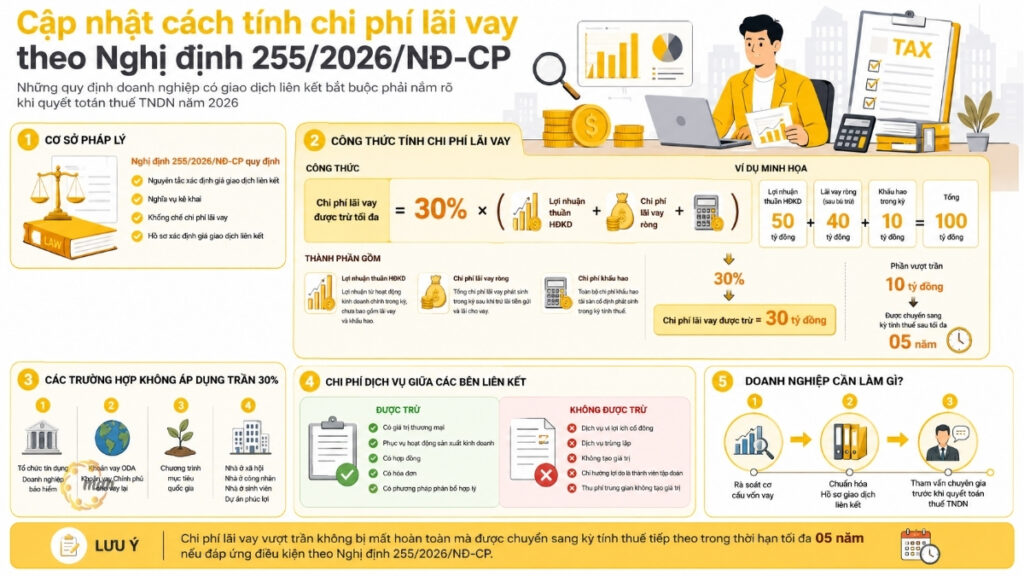
How to calculate interest expense Decree 255/2026/ND-CP This is a regulation that all businesses with related-party transactions must understand before settling their corporate income tax for 2026. According to Clause 3, Article 16 of this Decree, deductible interest expenses are capped at a maximum of 30% on total net profit plus net interest expense and depreciation expense, a threshold where incorrect calculation could lead to the risk of tax arrears and penalties during a tax audit.
This article will systematize all relevant legal regulations, from the formula for determining the ceiling on deductible interest expenses, cases excluded from the control regulations, to the obligation to declare and maintain records of transfer pricing that businesses are required to comply with.
The legal basis for calculating interest expense is Decree 255.

Before delving into the details of the formula, businesses need to clearly understand the legal basis upon which it is derived, as this is crucial to avoid misapplication in conjunction with previous legal regulations.
What does Decree 255/2026/ND-CP stipulate regarding related-party transactions?
Decree 255/2026/ND-CP is a comprehensive legal document regulating all issues related to related-party transactions, including the principles for determining transfer pricing, the declaration obligations of taxpayers, and especially the regulations on limiting deductible interest expenses for related-party enterprises. This is a document that any enterprise with transactions with related parties, whether domestic or cross-border, needs to carefully review to ensure full compliance.
Clause 3 of Article 16 provides the core provisions regarding deductible interest expenses.
The core provisions governing the calculation of deductible interest expenses in related-party transactions in 2026 are specifically stipulated in Clause 3, Article 16 of Decree 255/2026/ND-CP. This is a provision that all businesses with related-party transactions incurring interest expenses must refer to when preparing financial statements and corporate income tax returns.
Essentially, this regulation continues the spirit of controlling the phenomenon of businesses exploiting inter-party loans, often borrowed from parent companies abroad or companies within the same group, to unreasonably inflate interest expenses, thereby reducing taxable profits in Vietnam. By establishing a ceiling based on the internal financial indicators of the business, tax authorities can better control the phenomenon of "base erosion" through the borrowing channel.
Compared to previous regulations, the principle of capping interest expense as a percentage of financial indicators remains unchanged, but Decree 255/2026/ND-CP has updated the scope of exclusions and clarified the mechanism for carrying forward uncredited interest expense to subsequent tax periods. This is a point that businesses need to pay special attention to when reviewing their tax records.
See also: New points in Decree 255/2026/ND-CP.
How to calculate interest expense according to Decree 255
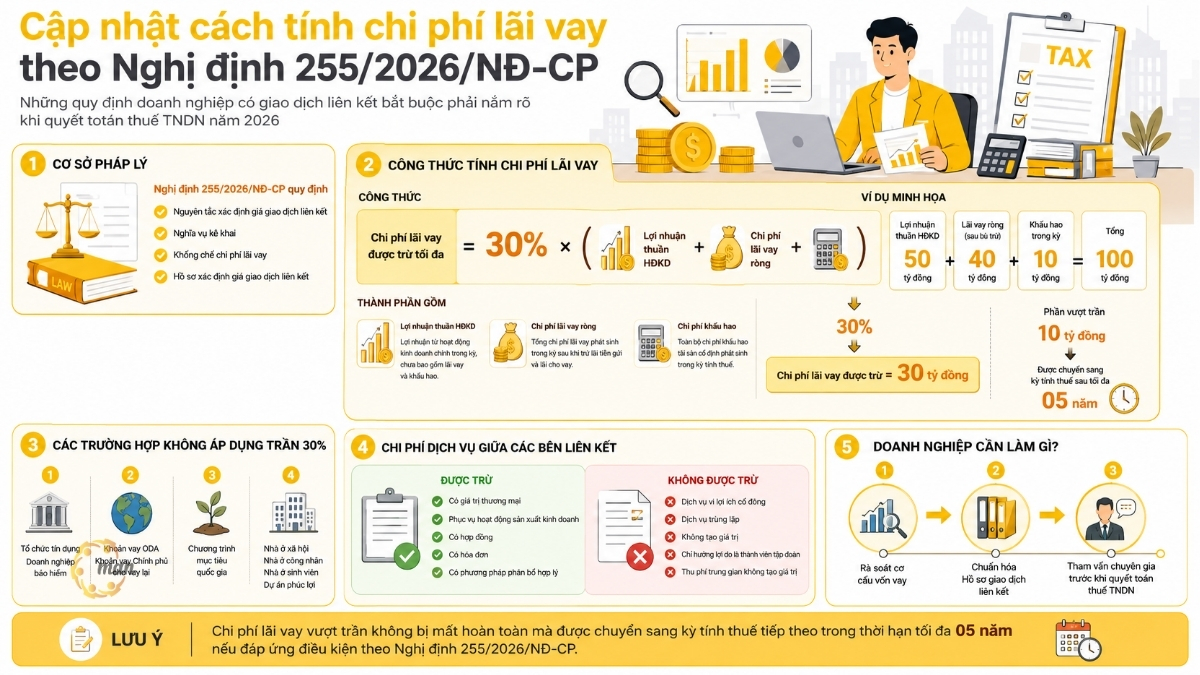
This is a crucial aspect that any business with related-party transactions needs to understand thoroughly, as the calculation method directly determines the amount of interest expense that can be recognized as legitimate when calculating corporate income tax.
Formula for determining deductible interest expense
According to Clause 3, Point 1, Article 16 of Decree 255/2026/ND-CP, the total interest expense after deducting interest on deposits and loans incurred during the period of the taxpayer is deductible when determining taxable corporate income, provided it does not exceed 30%.
The formula is defined as follows:
Deductible interest expense = Total operating profit for the period + Interest expense after deducting interest and loan interest incurred during the period + Depreciation expense |
In other words, the formula for calculating interest expense under Decree 255 can be interpreted according to the familiar structure in international standards on combating tax base erosion (similar to the EBITDA principle):
Maximum deductible net interest expense = 30% x (Net profit from business operations + Net interest expense + Depreciation expense) |
Each component should be understood as follows:
- Net interest expense: This is the total interest expense incurred during the period, after offsetting it against interest received from deposits and loans. This is not the total gross interest expense.
- Net profit from business operations: This is a core profit indicator reflecting the main business performance of the enterprise during the period, excluding interest expenses and depreciation that are added back to the profit.
- Depreciation expense: This refers to all depreciation costs of fixed assets incurred during the tax period.
Understanding this formula correctly is a prerequisite for businesses to determine their own deductible interest expense, avoiding over-declaration which can lead to adjustments during tax audits and inspections.
See details: The Formula for Calculating EBITDA and How to Distinguish It from EBIT.
Example illustrating how to calculate interest expense according to Decree 255.
To better understand how interest expense calculation under Decree 255 is calculated in practice, consider a hypothetical example (the data below is for illustrative purposes only and is not a quotation from the legal document):
Let's assume that during the tax period, Company A has the following financial indicators:
- Net profit from business operations: 50 billion VND
- Net interest expense (after deducting interest on deposits and loans): VND 40 billion
- Depreciation expense for the period: 10 billion VND
Apply the 30% ceiling formula:
The total of the three indicators = 50 + 40 + 10 = 100 billion VND |
The maximum amount of deductible interest expense is determined as follows:
The ceiling for deductible interest expense = 30% x 100 = 30 billion VND |
Therefore, although Company A incurred net interest expense of VND 40 billion during the period, only a maximum of VND 30 billion can be recognized as deductible expenses when calculating corporate income tax. The remaining VND 10 billion difference will not be deductible immediately in this period; the company still has the opportunity to treat this expense in subsequent periods, according to the carry-forward mechanism presented below.
Regulations regarding the carry-forward of interest expense to the next tax period.
One crucial point that businesses should not overlook is the mechanism for carrying forward any remaining interest expense that has not been fully deducted.
According to Point 2, Clause 3, Article 16 of Decree 255/2026/ND-CP, the portion of interest expense not deductible under the 30% ceiling will be carried forward to the next tax period when determining the total deductible interest expense, provided that the total deductible interest expense incurred in the next tax period is lower than the 30% ceiling. The carry-forward period for interest expense is continuous but not exceeding 5 years, starting from the year following the year in which the non-deductible interest expense was incurred.
Returning to the example above, Company A's 10 billion VND in undeductible interest expense will be allowed to be carried forward to subsequent tax periods, provided that in those years, the total interest expense incurred is lower than the ceiling allowed under Circular 30%, and the carry-forward period does not exceed 5 consecutive years.
This loophole prevents businesses from being completely deprived of their right to deduct expenses, but it also requires the tax accounting department to closely monitor the data carried over from year to year to avoid omissions or miscalculations of deadlines.
Cases where the interest expense ceiling does not apply according to Decree 255/2026/ND-CP.

Not all loans are subject to the aforementioned 30% limitation formula. According to Point 3, Clause 3, Article 16 of Decree 255/2026/ND-CP, the regulation on interest expense limits does not apply to the following groups of borrowers and loan types:
Credit institutions, insurance companies
Loans of taxpayers that are credit institutions operating under the Law on Credit Institutions No. 32/2024/QH15 (amended and supplemented by...) Law No. 96/2025/QH15) is not subject to the regulations controlling interest rate caps. Similarly, insurance businesses operating under the Law on Insurance Business No. 08/2022/QH15 (amended and supplemented by...) Law No. 139/2025/QH15These entities are also excluded from the scope of application. This stems from the specific business model of these organizations, which relies on fundraising and lending as a core function.
ODA loans, preferential loans that the Government then relends.
Official Development Assistance (ODA) loans and preferential government loans implemented through the method of the government borrowing from foreign sources and then lending to enterprises are also not subject to the 30% ceiling. These are policy-related loans serving socio-economic development goals, and are not tools for transfer pricing.
Loans for implementing national target programs
Loans for national target programs, specifically the new rural development program and sustainable poverty reduction program, are also exempt from the regulations on interest expense limits.
Loans for investment in social welfare projects.
The final group excluded are loans for investment programs and projects implementing the State's social welfare policies, including:
- Resettlement housing
- Workers' housing
- Student housing
- Social housing
- Other public welfare projects.
Accurately determining whether your business falls into one of the four aforementioned exclusion groups is crucial. If it is excluded, all interest expenses arising from these loans will not be subject to the 30% ceiling, helping businesses avoid miscalculations and minimize risks during tax settlement.
Furthermore, according to regulations, taxpayers are obligated to declare the ratio of interest expense in the tax period using the form in Appendix I issued with Decree 255/2026/ND-CP, regardless of whether the enterprise is subject to the interest expense ceiling.
Service fees between affiliated parties

Besides the content regarding interest expense, businesses with related-party transactions also need to pay attention to a closely related issue: regulations on service fees between related parties, as stipulated in Clause 2, Article 16 of Decree 255/2026/ND-CP. This is an expense area that often accompanies interest expense in inter-group transactions and is also subject to equally rigorous scrutiny by tax authorities.
Conditions for deductible affiliate service fees
Taxpayers are allowed to deduct service fees from their taxable expenses for the period if they meet the following conditions:
- The services provided have commercial, financial, and economic value and directly serve the production and business activities of the taxpayer;
- Services from affiliated parties are defined as those provided under similar conditions and circumstances as those paid for by independent parties;
- Service fees are paid on an arm's-length basis, and the transfer pricing method, or the allocation of service fees among related parties, must be applied uniformly across the group for similar types of services;
- Taxpayers must provide contracts, documents, invoices, and information regarding the calculation method, allocation factors, and pricing policy of the corporation for the services provided.
In cases involving centers that perform specialized functions and synergistically create added value for the group, taxpayers must also determine the total value generated from these functions, and determine the appropriate profit allocation based on the value contributed by the affiliated parties, after deducting the corresponding service fees for the affiliated parties performing coordination and service provision functions of independent transactions of a similar nature.
Service fees are not deductible when determining taxable income.
Conversely, certain service fees will not be deductible when determining taxable income, including:
- Costs incurred from services provided are solely for the benefit or value creation of other related parties;
- Services that serve the interests of the related party's shareholders;
- Double-charge services are those where multiple parties provide the same type of service, without determining the added value for the taxpayer.;
- Services are essentially benefits that taxpayers receive as a result of being members of a corporation;
- The additional cost that an affiliate adds for services provided by a third party through the affiliate's intermediary, but which does not add value to the service.
Understanding the line between deductible and non-deductible service expenses will help businesses avoid having both interest expenses and service expenses disallowed during a tax audit. This is a double risk that many businesses with related-party transactions are facing.
Declaration obligations when applying the method of calculating interest expense as stipulated in Decree 255.
After understanding the above calculation formula, businesses need to fully fulfill their obligations to declare and maintain records as stipulated in Clause 2, Article 18 of Decree 255/2026/ND-CP.
Declarations must be made according to Appendices I, II, and III of Decree 255/2026/ND-CP.
The taxpayer's obligations in declaring and determining transfer pricing are governed by Clause 2, Article 37 of the Law on Tax Administration No. 108/2025/QH15, along with the following specific provisions:
- The declaration and determination of transfer pricing must not reduce the corporate income tax liability payable in Vietnam;
- Businesses must demonstrate that they have conducted an analysis, comparison, and selection of a method for determining transfer pricing.;
- Businesses must declare information on related-party relationships and related-party transactions according to Appendix I, Appendix II, and Appendix III issued with Decree 255/2026/ND-CP, and submit them together with the Corporate Income Tax Return.
What documents are needed to record transfer pricing information?
Businesses are obligated to create, maintain, and provide Transfer Pricing Records, including the following information, records, documents, data, and vouchers:
- Information on related party relationships and related party transactions is provided in Appendix I issued with Decree 255/2026/ND-CP;
- National dossiers are categorized according to the information and document contents specified in Appendix II issued with Decree 255/2026/ND-CP;
- Global dossiers are categorized according to the information and document content specified in Appendix III issued with Decree 255/2026/ND-CP;
- The Country-by-Country Report (CbCR) of the ultimate parent company is regulated by Article 19 and Appendix IV issued with Decree 255/2026/ND-CP.
See also: Limitations on the use of CbCR reports as stipulated in Decree 255/2026/ND-CP.
What should businesses do to correctly apply the method of calculating interest expense as stipulated in Decree 255?
Having understood the entire legal framework, the question is:
What specific actions should businesses take to ensure compliance with regulations from the beginning of the 2026 tax year, instead of discovering errors only during the final tax settlement?
Review the debt structure and internal EBITDA ratio.
First, the finance and accounting department needs to review all existing loans with related parties, clearly classifying which loans are subject to the 30% ceiling and which are excluded (credit institutions, insurance, ODA loans, national target program loans, social welfare project loans). Simultaneously, the enterprise should proactively calculate the ratio of net interest expense to net profit plus depreciation to predict the possibility of exceeding the ceiling and develop a plan to adjust the debt-equity capital structure accordingly.
Standardize documentation for determining transfer pricing.
Instead of waiting until tax settlement time to start compiling documents, businesses should establish a standardized process for preparing National Filings, Global Filings, and accompanying declarations from the beginning of the fiscal year. This helps reduce time pressure and ensures consistency between accounting data, tax declaration data, and other relevant information. related-party transaction pricing documentation.
Businesses should seek advice from experts on related-party transactions.
For businesses with complex loan structures, multiple layers of cross-border related-party transactions, or the emergence of specialized functional centers within the group, self-applying the above-mentioned interest rate control formula may carry the risk of misinterpretation.
In these cases, consultation is necessary. Seek expert advice on tax and transfer pricing from specialized and experienced firms like MAN – Master Accountant Network, especially before key milestones such as internal loan planning or preparing explanatory documents for tax audits.
Conclude
As can be seen, the method of calculating interest expense under Decree 255 is based on the principle of controlling the 30% ratio on the foundation of the enterprise's core financial indicators, accompanied by a flexible transition mechanism for up to 5 years and a clear exclusion list for specific groups of entities.
This regulation directly impacts the corporate income tax payable by all businesses with related-party transactions that generate interest expenses, and is also linked to the obligation to declare and maintain records of transfer pricing according to the four appendices mentioned.
Proactively updating and correctly applying the method of calculating interest expense according to Decree 255 right from the beginning of the 2026 tax period will not only help businesses avoid the risk of being subject to tax audits and penalties, but also serve as a foundation for building a sustainable financial and tax strategy in the context of increasingly strict control over related-party transactions by regulatory authorities.
Contact MAN – Master Accountant Network For expert support and advice!
Contact information MAN – Master Accountant Network
- Address: No. 19A, Street 43, Tan Thuan Ward, Ho Chi Minh City
- Mobile/Zalo: 0903 963 163 – 0903 428 622
- E-mail: man@man.net.vn
- Google Business Profile: View MAN – Master Accountant Network's Google Business Profile
- LinkedIn Founder: View expert Le Hoang Tuyen's LinkedIn profile.
Responsible for production and professional content review by: Mr. Le Hoang Tuyen – Founder & CEO of MAN – Master Accountant Network. He is a CPA Vietnam auditor with over 30 years of in-depth experience in accounting, auditing, taxation, and corporate legal consulting.
Frequently Asked Questions about Calculating Interest Expense under Decree 255
According to Clause 3, Article 16 of Decree 255/2026/ND-CP, the total deductible net interest expense is limited to a maximum of 30% of the total net profit from business operations plus net interest expense plus depreciation expense incurred during the period.
The four excluded groups include: credit institutions, insurance companies, ODA loans or preferential government loans, loans for national target programs (new rural development, sustainable poverty reduction), and loans for state-funded social welfare projects.
Yes. The portion of non-deductible interest expense may be carried forward to the next tax period if the interest expense incurred in that period is lower than the prescribed ceiling. The continuous carry-forward period shall not exceed 5 years from the year following the year in which the non-deductible interest expense was incurred.
Businesses declare the interest expense ratio using the form in Appendix I issued with Decree 255/2026/ND-CP and submit it together with the Corporate Income Tax Return.What is the maximum percentage of interest expense that can be deducted according to Decree 255?
Which businesses are exempt from the interest expense cap under Decree 255?
Can non-deductible interest expenses be carried forward to the following year, and for a maximum period?
Where should businesses declare interest expense?