





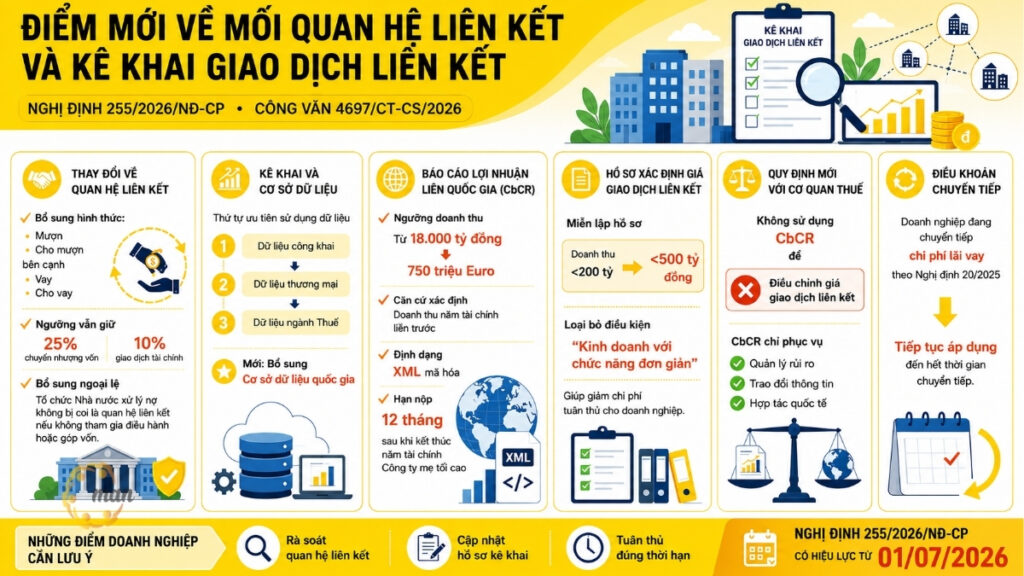
New regulations regarding related-party relationships and the declaration of related-party transactions have just been officially announced by the Tax Department. Official Document 4697/CT-CS On July 9, 2026, we introduce all 10 key changes. Decree 255/2026/ND-CP, This document replaces Decree 20/2025/ND-CP. From criteria for determining related-party relationships and thresholds for exemption from price determination documentation, to new regulations on Country-by-Country Profit Reporting (CbCR), this article comprehensively and accurately systematizes the legal provisions verbatim, enabling businesses to proactively review and comply within the deadline.
Overview of Decree 255/2026 and the reasons for updating the points regarding related party relationships and declaration of related party transactions.

Before delving into the details of each amendment, businesses need to understand the context and scope of Decree 255/2026/ND-CP. The legal basis for all the new points regarding related-party relationships and the declaration of related-party transactions will be analyzed throughout this article. From identifying which regulations this document replaces, the reason why the Tax Department had to issue a separate guidance document, to fundamental changes in the principles of application and the interpretation of legal terms, everything will be clarified below.
Which document does Decree 255/2026/ND-CP replace?
Decree 255/2026/ND-CP is a new legal document regulating tax management for related-party transactions, issued to replace Decree 20/2025/ND-CP dated February 10, 2025. The promulgation of this new Decree is the next step in the reform of tax management for related-party transactions in Vietnam, aiming to keep pace with international standards and align with the current tax legal system, especially... Tax Administration Law 2025 It has just come into effect.
Why did the Tax Department have to issue Official Letter 4697/CT-CS to introduce 10 new points?
Given the relatively large volume of changes directly affecting the declaration obligations of numerous businesses, the Tax Department proactively issued Official Letter 4697/CT-CS/2026 to systematize and clearly explain 10 key new points. This document is considered to help businesses, accountants, and tax consulting firms quickly grasp the entire content of the amendments without having to manually compare each clause between the old and new decrees.
New application principles according to Article 3 of Decree 255/2026/ND-CP
One of the fundamental changes is the amendment and supplementation of the principles applied in Article 3. Accordingly, the principle that tax authorities manage and inspect transfer pricing is now directly referenced to the principles applied in tax administration stipulated in Clause 4, Article 6, and the principles of tax inspection stipulated in Clause 1, Article 22 of the 2025 Law on Tax Administration.
This reference helps ensure consistency and avoid overlap between specialized decrees on related-party transactions and the original law, while also creating a clearer legal framework for both tax authorities and taxpayers during application.
Complete the explanation of the terms.
Decree 255/2026/ND-CP also supplements and refines a series of important definitions. The terms "Supreme Parent Company" and "Tax Agreement" are now explained in accordance with the guidance referring to Resolution 107/2023/QH15 on supplementary corporate income tax under the global tax base erosion prevention provisions, and Decree 236/2025/ND-CP guiding the implementation of this resolution.
Simultaneously, the concepts of "related-party transactions," "national profiles," "global profiles," and "non-systematic information exchange" have also been clarified. The goal of refining this terminology is to ensure consistency among relevant legal documents and minimize divergence in interpretation when applied in practice.
New points regarding related-party relationships and declaration of related-party transactions under Decree 255.
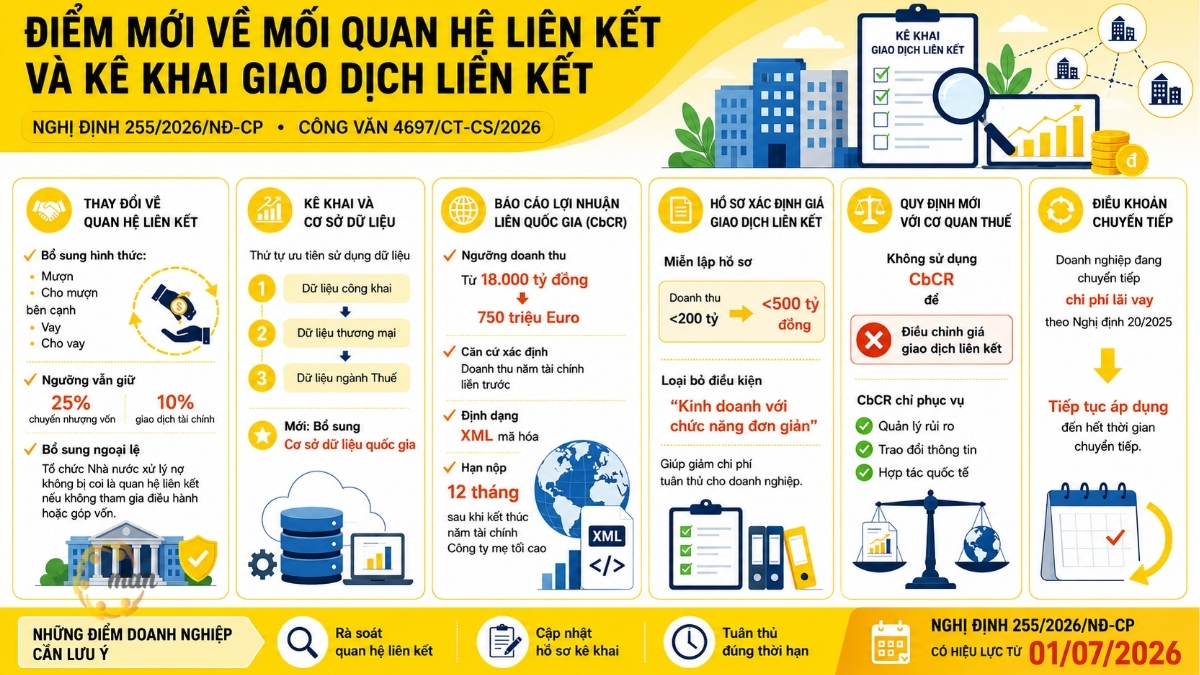
In this section, two key changes that deserve special attention are the expansion of the types of financial transactions considered as the basis for establishing a linkage relationship and the addition of an exception specifically for state debt resolution organizations, both of which are detailed below.
Strengthening relationships through borrowing and lending.
Previously, Decree 20/2025/ND-CP only recognized related-party relationships arising from lending and borrowing activities between enterprises and individuals managing or controlling those enterprises, but did not address the form of borrowing and lending. This is one of the most noteworthy new points regarding related-party relationships and the declaration of related-party transactions in Decree 255/2026/ND-CP.
Specifically, point b, clause 2, Article 5 of the new regulation states:
An enterprise is determined to have an affiliated relationship when a transaction involving the transfer or acquisition of capital contributions from 25% or more of the owner's capital contributions occurs during the tax period, or when a loan, lending, borrowing, or lending transaction from 10% or more of the owner's capital contributions occurs at the time of the transaction, with an individual managing or controlling the enterprise or with an individual with a close relationship as stipulated.
The addition of the terms "borrowing" alongside "lending" stems from the fact that many transactions with a similar financial nature to borrowing are given different names by the parties involved to avoid being identified as related parties. The new regulation helps tax authorities correctly identify the nature of transactions and avoid overlooking entities that need to be managed.
See also: New points in Decree 255/2026/ND-CP regarding related-party transactions.
Add cases where the association relationship does not apply.
Besides expanding the scope of defining related-party relationships, Decree 255/2026/ND-CP also adds an important exception at point d.3, clause 2, Article 5:
Accordingly, if the creditor or guarantor is a state-owned organization with charter capital, whose function is to buy, sell, and process debt, and which does not directly or indirectly participate in the management, control, capital contribution, or investment in the debtor or guaranteed enterprise, then it will not be considered to have an affiliated relationship with that enterprise.
This regulation helps to accurately reflect the economic nature of state debt resolution organizations, avoiding the mechanical application of regulations on linkage relationships to cases where there is no real mutual control.
Quick comparison: Old and new rules regarding affiliations
To better visualize the extent of the changes, you can directly compare the two regulations using the summary table below:
| Criteria | Decree 20/2025 | Decree 255/2026 |
| This form of financial transaction establishes an affiliated relationship. | It's all about borrowing and lending. | Add borrowing and lending. |
| Capital contribution transaction threshold | From 25% (capital transfer), 10% (loan) | Keep the threshold the same, expand the types of borrowing available. |
| Organization for handling state debt | There are no exclusion clauses. | Add cases where the affiliation relationship does not apply. |
Understanding these two changes is the first and most important step for businesses to accurately determine whether they are subject to the new regulations on declaring related-party transactions.
Database and taxpayer obligations in declaring related-party transactions.
In addition to changes in the subjects and criteria for determining related-party relationships, Decree 255/2026/ND-CP also tightens transparency in the declaration and pricing process by clearly defining the data sources permitted for use and the order of priority for application. This is an important basis for businesses to prepare the correct documentation from the outset, limiting disputes during inspections and audits.
The order of priority for using databases when declaring and determining prices.
A completely new provision in Article 17 of Decree 255/2026/ND-CP is the regulation on the order of priority when using databases to analyze and compare related-party transactions.
Previously, the law did not have specific regulations on this order, leading to differences in how data was selected among businesses, as well as between businesses and tax authorities during inspections and audits.
Currently, the order of priority is clearly established in three levels: first, publicly available databases; next, commercial databases; and finally, tax authority databases. Transparently defining the order of data usage not only helps minimize disputes between businesses and tax authorities but also creates fairness and consistency throughout the entire comparative analysis process.
Supplementing the National Database
In addition to the familiar publicly available data, trade data, and tax industry data, Decree 255/2026/ND-CP adds the National Database to the list of data permitted for use in declaring, determining, and managing transfer pricing. This is a completely new data source compared to previous regulations, expanding the scope of searches and increasing reliability for both taxpayers and management agencies.
Rights and obligations of taxpayers
Article 18, which regulates the rights and obligations of taxpayers in declaring and determining transfer pricing, has also been amended to directly refer to Clauses 1 and 2 of Article 37 of the 2025 Tax Administration Law, instead of being a separate regulation as before. At the same time, a noteworthy point is that the phrase "business company handling tax procedures" has been replaced with "business organization handling tax procedures" when referring to the entity representing the taxpayer in preparing the Transfer Pricing Documentation, a minor adjustment in wording but significant in expanding the scope of entities permitted to provide this service.
New points regarding the Country-by-County Profit Reporting in the declaration of related-party transactions.

The Country-by-Country Report (CbCR) continues to be the most frequently revised content in Decree 255/2026/ND-CP, clearly demonstrating Vietnam's gradual approach to OECD standards in BEPS Action 13.
From the basis for determining revenue thresholds, specific threshold levels, exemptions or mandatory reporting requirements, to reporting formats and deadlines, all have undergone significant adjustments that multinational corporations need to update immediately.
Changes to the basis for determining the global consolidated revenue threshold.
Previously, the global consolidated revenue threshold for determining the obligation to prepare a Consolidated Global Revenue Record (CbCR) was based on the global consolidated revenue generated during that tax period. According to Decree 255/2026/ND-CP, this basis has been amended to the revenue of the fiscal year immediately preceding the reporting year. This change aims to ensure compliance with OECD guidelines, allowing businesses to proactively determine their reporting obligations early on, rather than waiting until the end of the current tax period.
See also: Limitations on the use of CbCR reports.
Adjust the revenue threshold for establishing a Credit Contribution Margin (CbCR).
The revenue threshold for incurring the obligation to prepare the CbCR Report has also been adjusted from a fixed level of VND 18,000 billion to the equivalent of €750 million, converted using the central exchange rate or the average cross-exchange rate for December of each year as published by the State Bank of Vietnam. This calculation method ensures that the revenue threshold always closely reflects actual exchange rate fluctuations, while also being consistent with the approach in Decree 236/2025/ND-CP on global minimum tax rates.
Cases where a Certificate of Eligibility (CbCR) is not required in Vietnam.
The new decree clarifies the cases in which businesses are not required to submit the CbCR Report in Vietnam, including:
- The report has been automatically exchanged with the Vietnamese tax authorities in accordance with the Agreement of the Competent Authorities;
- In cases where an organization is designated to submit the report on behalf of the applicant (subject to specific conditions);
- And in cases where differences arise regarding revenue thresholds, exchange rates, or revenue determination principles between countries or territories.
These additions significantly reduce the number of duplicate reports businesses have to submit in multiple countries.
Cases where the obligation to submit CbCR arises in Vietnam.
Decree 255/2026/ND-CP also adds cases where businesses in Vietnam are required to submit Certificates of Conformity (CbCR), specifically:
- The ultimate parent company is not obligated to prepare and submit reports in its country of residence;
- The conditions for applying for the mechanism of having an organization submit reports on behalf of the applicant are not met.;
- Or when there is a lack of systematic information exchange, and this situation has been officially notified to the taxpayer.
Notably, the Decree also adds the following principle:
Taxpayers are only required to submit CbCRs in Vietnam when Vietnam fully meets the requirements for information security, consistency, and proper use, and the tax authorities are responsible for publicly disclosing compliance with these conditions on the Tax Department's website.
Format, submission deadline, and template for the CbCR notification.
Technically, the CbCR report must now be submitted in encrypted XML format, through the Tax Management Information System – in accordance with the standards of BEPS Action 13.
The deadline for submitting the report is no later than 12 months from the end of the fiscal year of the parent company of the reporting year. In addition, Decree 255/2026/ND-CP, along with Form No. 01/TB-BCLN, is used to notify the entities required to pay the CbCR. This notification form only needs to be submitted once when the obligation first arises (from the date the Decree takes effect), no later than the end of the fiscal year of the parent company of the reporting year.
If there are any changes to the information compared to the most recent notification, including cases where the obligation to submit CbCR has been terminated, the business must submit an updated notification no later than 90 days from the date the change occurs.
New points regarding the price determination dossier and the responsibilities of the Tax Authority.
Alongside tightening the compliance requirements for large corporations, Decree 255/2026/ND-CP significantly relaxes the exemption conditions for low-risk businesses and clarifies the limits of tax authorities' authority when using compliance data. These are two-way changes that both reduce the compliance burden and increase transparency in management.
Raise the revenue threshold for exemption from price determination documentation to below 500 billion VND.
This can be considered one of the most practical new points regarding related-party transactions and their declaration, benefiting small and medium-sized enterprises (SMEs). Previously, to be exempt from preparing a related-party transaction pricing report, businesses had to simultaneously meet four criteria: operating with a simple function; not generating revenue or expenses from intangible assets; having revenue below VND 200 billion; and achieving a net profit margin specific to each sector.
According to Decree 255/2026/ND-CP, the revenue threshold has been raised to below VND 500 billion, and the criterion of "business with simple functions" has been completely removed. This adjustment significantly expands the group of low-risk businesses exempt from filing tax returns, thereby simplifying application conditions and reducing compliance costs for taxpayers.
Do not use CbCR to adjust related-party transaction prices.
Article 21 of the Decree adds a principle: tax authorities are not allowed to use taxpayers' CbCR reports to adjust related-party transaction prices. Previously, the regulation only limited the use of CbCRs to price fixing; now it is expanded to include price adjustments. This principle clearly affirms that CbCRs only serve the purpose of risk management and information exchange in accordance with Vietnam's international commitments, and are not a direct basis for tax authorities to determine or adjust the tax obligations of enterprises.
Interest expense carryforward clauses: What should businesses be aware of?
For businesses subject to the transitional provisions regarding interest expense under Article 3 of Decree 20/2025/ND-CP, Clause 3 of Article 23 of Decree 255/2026/ND-CP clearly stipulates:
These businesses will continue to be subject to the transitional provisions for the remaining period, in accordance with Article 3 of Decree 20/2025/ND-CP.
In other words, the issuance of the new decree does not interrupt or eliminate the transitional benefits that businesses have been enjoying, ensuring the continuity of policy and the legitimate rights of taxpayers during the transition period between the two documents.
Reference: How to calculate interest expense according to Decree 255.
Conclude
Proactively grasping the new regulations on related-party transactions and their declaration not only helps businesses avoid the risk of back taxes and penalties due to incorrect or incomplete declarations, but also provides an opportunity to optimize tax compliance processes in the context of tax authorities shifting towards a model of partnership and support for taxpayers to voluntarily comply.
If a business needs to conduct a thorough review or standardize all its records according to the new regulations, it should consider consulting [the relevant resources/information]. related party transaction advisory services Seek support from specialized and experienced organizations like MAN – Master Accountant Network to ensure proper procedures and timely delivery.
Contact MAN – Master Accountant Network For expert support and advice!
Contact information MAN – Master Accountant Network
- Address: No. 19A, Street 43, Tan Thuan Ward, Ho Chi Minh City
- Mobile/Zalo: 0903 963 163 – 0903 428 622
- E-mail: man@man.net.vn
- Google Business Profile: View MAN – Master Accountant Network's Google Business Profile
- LinkedIn Founder: View expert Le Hoang Tuyen's LinkedIn profile.
Responsible for production and professional content review by: Mr. Le Hoang Tuyen – Founder & CEO of MAN – Master Accountant Network. He is a CPA Vietnam auditor with over 30 years of in-depth experience in accounting, auditing, taxation, and corporate legal consulting.
Frequently Asked Questions regarding the application of the new provisions on related party relationships and the declaration of related party transactions.
Decree 255/2026/ND-CP regulates tax management for related-party transactions, replacing Decree 20/2025/ND-CP, and also includes a separate transitional provision for cases currently subject to regulations on interest expense deductions.
According to the new regulations, businesses with revenue under VND 500 billion (instead of VND 200 billion as before) and meeting the remaining criteria will be exempt from preparing Transfer Pricing Documentation; the criterion for businesses with simple functions has been abolished.
Businesses must submit a CbCR when the ultimate parent company is not obligated to prepare the report in its country of residence, does not meet the conditions for applying for a reporting mechanism on its behalf, or when there is a formally notified lack of systematic information exchange.
A business is considered to have an affiliated relationship when it engages in lending, borrowing, or lending transactions involving capital contributions from the owner or more at the time of the transaction, with an individual managing or controlling the business, or an individual with a close relationship as defined by regulations.
No. Businesses subject to the transitional provisions on interest expense under Article 3 of Decree 20/2025/ND-CP will continue to be subject to the transitional provisions for the remaining period, ensuring the continuity of the policy.Which document does Decree 255/2026/ND-CP replace?
What is the latest revenue threshold for exempting transfer pricing documentation?
Which businesses in Vietnam are required to submit CbCR reports under the new regulations?
How are relationships formed through borrowing and lending defined?
Will businesses currently applying the carry-forward of interest expense under Decree 20/2025/ND-CP be affected?