





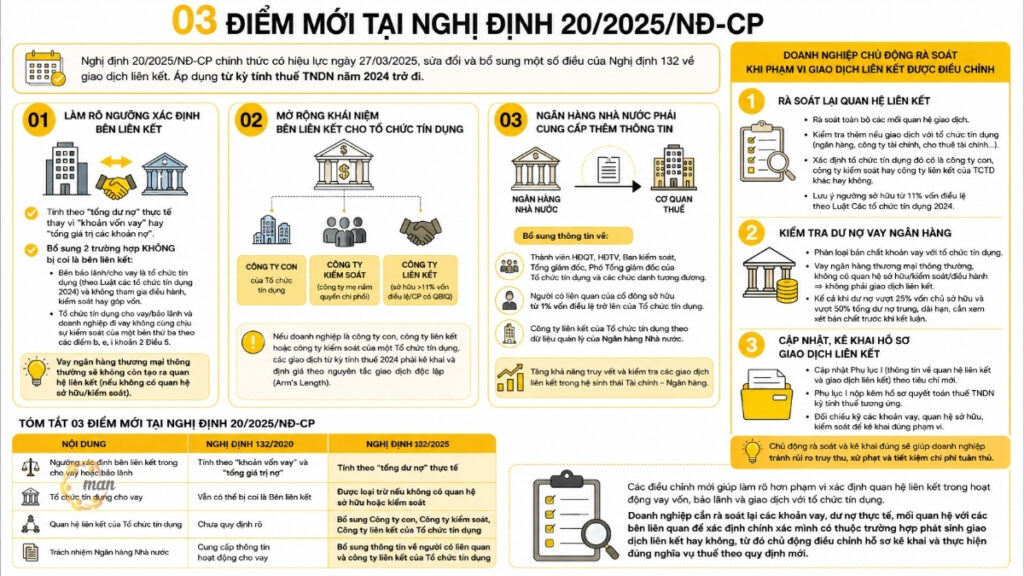
Decree 20/2025/ND-CP Officially effective on March 27, 2025, amending and supplementing several articles of Decree 132 on related-party transactions. This is the first significant update since Decree 132/2020/ND-CP was issued, directly impacting how related-party relationships are determined, tax declaration obligations, and the responsibility for information coordination among state agencies.
If your business has transactions with related parties, whether parent companies, subsidiaries, or lenders, the following three changes will directly affect your corporate income tax (CIT) calculation period from 2024 onwards.
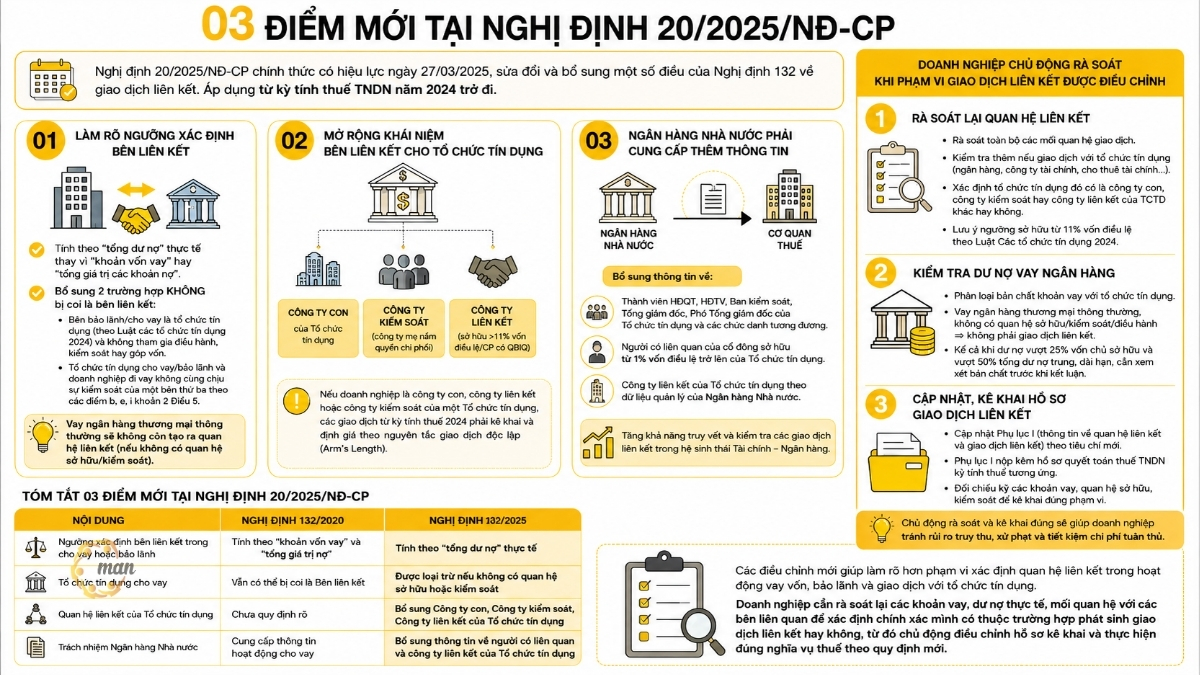
Decree 20/2025/ND-CP clarifies the threshold for determining the Affiliated Party.

Previously, according to point d, clause 2, Article 5 Decree 132/2020/ND-CP:
A business that guarantees or lends capital to another business is considered an affiliated party when the loan amount is at least 25% of the owner's equity and accounts for more than 50% of the total value of medium and long-term debt.
Decree 20 amends the key phrase, replacing the calculation based on "loan amount" or "total value of debts," with the new regulation using the concept of "total outstanding debt," which is the total actual amount still owed at the time of determination, not the value of the original loan contract.
This helps to more accurately reflect the actual outstanding debt of the business, avoiding disputes over calculation methods when the outstanding debt has decreased significantly compared to the original contract.
More importantly, Decree 20 adds two cases where an entity is not considered an affiliated party even if it meets the threshold of 25% equity capital and 50% total value of medium and long-term debt, specifically:
- The guarantor or lender is a credit institution as defined by the Law on Credit Institutions 2024 and does not participate in the management, control, or capital contribution of the borrowing enterprise.
- The lending or guaranteeing credit institution and the borrowing enterprise are not jointly controlled by a third party as stipulated in points b, e, and i of Clause 2, Article 5.
Simply put, borrowing from a commercial bank will no longer create a related-party relationship, as long as that bank does not have an ownership or control relationship with the business. This is a significant relief for many businesses that were previously burdened with the obligation to declare related-party relationships simply because of large outstanding bank loans.
Expanding the concept of Affiliated Parties to Credit Institutions

The Law on Credit Institutions defines the concepts of subsidiary companies, controlling companies, and affiliated companies. These regulations are intended to control credit institutions and do not serve the purpose of tax management.
However, to ensure consistency in regulations regarding subsidiaries, controlling companies, and affiliated companies of credit institutions under the Law on Credit Institutions and the regulations on affiliated parties in Decree 132/2020/ND-CP and the spirit of Resolution No. 01/NQ-CP, the Government has added point m to Clause 2, Article 5 of Decree 132/2020/ND-CP regulating affiliated parties.
Decree 20 adds point m to Clause 2, Article 5 of Decree 132, clearly stipulating that a credit institution has an affiliated relationship with:
- A subsidiary of that credit institution.
- The controlling company (i.e., the parent company that holds controlling power over the credit institution).
- An affiliated company as defined by the Law on Credit Institutions.
Specifically, the three types of entities added to the linkage relationship as mentioned above are all defined in clauses 9, 10, and 11 of Article 4. Law No. 32/2024/QH15. Specifically:
- A subsidiary of a credit institution is a company in which the credit institution, or the credit institution together with directly or indirectly related parties, controls the adoption of resolutions and decisions of the General Meeting of Shareholders, the Board of Directors, or the Board of Members of that company.
- A controlling company is a company that directly or indirectly owns more than 20% of the charter capital of a commercial bank, or a company that holds controlling power over a commercial bank, or a commercial bank that has a subsidiary or affiliated company.
- An affiliated company of a credit institution is a company in which the credit institution or the credit institution together with related parties owns more than 11% of the charter capital or more than 11% of the voting shares, but is not a subsidiary of that credit institution.
Important Note: If your business is a subsidiary, associate, or controlling entity of a credit institution, then commercial, financial, and service transactions between the two parties from the 2024 tax year onwards must be declared and valued according to the arm's length principle. This is an unavoidable requirement and is why businesses should utilize arm's length. related party transaction advisory services To ensure compliance with regulations.
The State Bank of Vietnam must provide more information to the Tax Authority.

The third new point relates to the mechanism for coordinating information between the State Bank of Vietnam and the tax authorities.
Previously, the State Bank of Vietnam was only obligated to provide information on foreign loans and debt repayments of enterprises when requested by the tax authorities. Decree 20 expands the scope, requiring the State Bank of Vietnam to cooperate in providing additional information on related parties within the credit institution system, including:
- Members of the Board of Directors, Board of Trustees, Supervisory Board, General Director, Deputy General Director of credit institutions and equivalent positions.
- Related parties of shareholders owning 1% or more of the charter capital of a credit institution.
- Affiliated companies of credit institutions according to management data from the State Bank of Vietnam.
This indicates that the General Department of Taxation will have additional tools to track and inspect related-party transactions within the banking and finance ecosystem, especially for corporations with subsidiary companies operating in the credit sector.
Businesses should proactively review their related-party transactions when the scope of those transactions is adjusted.
Decree 20 will be applied immediately from the 2024 corporate income tax period, meaning it will affect tax return filings that many businesses are currently submitting or are about to submit. Below are three steps to take immediately to avoid the risk of back taxes or penalties.
Review the relationships
Businesses need to proactively review all transaction relationships to accurately determine the scope of related parties according to the new regulations. If a business has transactions with credit institutions such as banks, finance companies, or leasing companies, it is necessary to further check whether that credit institution is a subsidiary, controlling company, or affiliated company of another credit institution.
If the credit institution is part of a related ownership or control chain, the business needs to further verify whether it falls within the scope of influence of this relationship. This is a point that needs special attention because the new related-party relationship, added under point m, clause 2, Article 5, expands the scope of defining related parties compared to previous regulations.
Furthermore, when a credit institution is found to be involved in the related-party transaction chain, the enterprise needs to conduct a thorough review of the list of subsidiaries, controlling companies, and affiliated companies of that credit institution to fully assess the relevant relationships. In particular, the threshold for determining related-party transactions under the Law on Credit Institutions 2024 may arise when the ownership ratio exceeds 111% of the charter capital, significantly lower than the 25% threshold commonly applied in many cases of determining related-party transactions. Therefore, carefully reviewing the ownership structure and control is a crucial step to help enterprises avoid omitting their obligation to declare related-party transactions.
Check your bank loan balance.
Besides reviewing the structure of related-party relationships, businesses also need to re-examine the nature of existing loans with credit institutions to determine whether those loans actually give rise to related-party relationships under the new regulations. Correct classification helps businesses avoid having to create related-party transaction documents for loans that do not fall within the scope of regulation.
In cases where a business borrows capital from a commercial bank in the usual manner, where the bank does not own shares in the business, does not participate in management, and does not have a controlling or cross-ownership relationship, this loan is considered an independent loan relationship. According to Decree 20/2025/ND-CP, this type of loan transaction is no longer classified as a related-party transaction simply because the business exceeds the previously stipulated loan balance limit.
This means that even if the outstanding loan balance exceeds 25% of equity and 50% of total medium and long-term debt, the enterprise still needs to consider the nature of the relationship between the parties before concluding on related-party transaction obligations. This is a crucial step, helping enterprises determine the correct scope of application, limit unnecessary documentation, and ensure clear confirmation before declaring and filing related-party transaction documents.
Update and declare related-party transaction records.
After completing the review of related-party transactions and redefining the scope of application according to Decree 20/2025/ND-CP, businesses need to update the information on their related-party transaction declaration files to ensure that the data accurately reflects the actual situation.
Specifically, businesses need to review and revise Appendix I regarding information on related-party relationships and related-party transactions according to the new criteria, including information on related parties, types of transactions, transaction values, and content related to determining declaration obligations. This Appendix is prepared and submitted along with the corporate income tax return for the corresponding tax period.
The update to Appendix I is not just a change in form but is also directly related to businesses correctly identifying the entities required to declare related-party transactions. Therefore, before preparing the documentation, businesses need to review loans, transactions with credit institutions, ownership and control relationships, and related parties to avoid under-declaring or misidentifying the scope of related-party transactions according to the new regulations.
If internal staff lack experience in handling this, now is the time to consider using it. related party transaction documentation service from professional and experienced units such as MAN – Master Accountant Network To ensure all declared figures are accurate before the tax authorities request clarification.
Summary of 3 new points in Decree 20/2025/ND-CP
Changes in regulations regarding the determination of related-party relationships could directly affect how businesses assess their obligation to declare related-party transactions, especially in cases involving borrowing, guarantees, or activities related to credit institutions.
Compared to the previous regulations in Decree 132, Decree 20 has adjusted the threshold for determining related parties, the scope of application to credit institutions, and the responsibility for providing information. Three main differences are shown in the comparison table below:
| Content | Decree 132/2020 | Decree 20/2025 |
| The threshold for determining a related party in lending or guaranteeing. | Calculated based on "loan amount" and "total debt value"“ | Calculated based on actual "total outstanding debt". |
| Lending institution | It may still be considered an Affiliated Party. | Excluded if there is no ownership or control relationship. |
| Credit institution's affiliated relationships | Not yet clearly defined | Addition of Subsidiaries, Controlling Companies, and Affiliated Companies of Credit Institutions |
| Responsibilities of the State Bank of Vietnam | Providing information on lending activities. | Add information about related parties and affiliated companies of the credit institution. |
Overall, the new adjustments help to clarify the scope of defining related-party relationships in borrowing, guarantees, and transactions with credit institutions. Businesses need to review their loans, actual outstanding balances, and relationships with related parties to accurately determine whether they fall under the category of related-party transactions, thereby proactively adjusting their tax declarations and fulfilling their tax obligations according to the new regulations.
Conclude
Changes in the definition of related-party relationships in lending, guarantees, and transactions with credit institutions will directly impact many businesses, especially those with large loans or transactions with parties in the supply chain. Businesses need to proactively review their ownership structure, loans, outstanding balances, and list of transacting parties to correctly determine the scope of application of the new regulations.
In addition, it is necessary to update the related party transaction records, declaration appendices, and related-party transaction pricing documentation This is an important step to mitigate the risk of under-declaring, providing incorrect information, or incurring unexpected tax liabilities.
Contact MAN – Master Accountant Network For free support and advice!
Contact information MAN – Master Accountant Network
- Address: No. 19A, Street 43, Tan Thuan Ward, Ho Chi Minh City
- Mobile/Zalo: 0903 963 163 – 0903 428 622
- E-mail: man@man.net.vn
- Google Business Profile: View MAN – Master Accountant Network's Google Business Profile
- LinkedIn Founder: View expert Le Hoang Tuyen's LinkedIn profile.
Responsible for production and professional content review by: Mr. Le Hoang Tuyen – Founder & CEO of MAN – Master Accountant Network. He is a CPA Vietnam auditor with over 30 years of in-depth experience in accounting, auditing, taxation, and corporate legal consulting.
Frequently Asked Questions about Decree 20/2025/ND-CP
Decree 20/2025/ND-CP takes effect from March 27, 2025 and applies from the corporate income tax period of 2024.
No, if the bank does not have an ownership, control, or equity relationship with the borrowing enterprise. This is a key new point in Decree 20. Previously, many enterprises were identified as affiliated parties simply because of their large outstanding bank loans, even without any ownership relationship.
Yes, and this is the group most directly affected. According to the newly added point m, all transactions between a credit institution and its subsidiaries, controlling companies, and associated companies fall under the scope of related-party transactions. If a business is within the ecosystem of a bank or financial company, all inter-group transactions need to be reviewed.From which tax period does Decree 20 apply?
Are businesses that borrow from commercial banks still considered affiliated parties?
If a business is a subsidiary of a bank, will it be affected by Decree 20?