





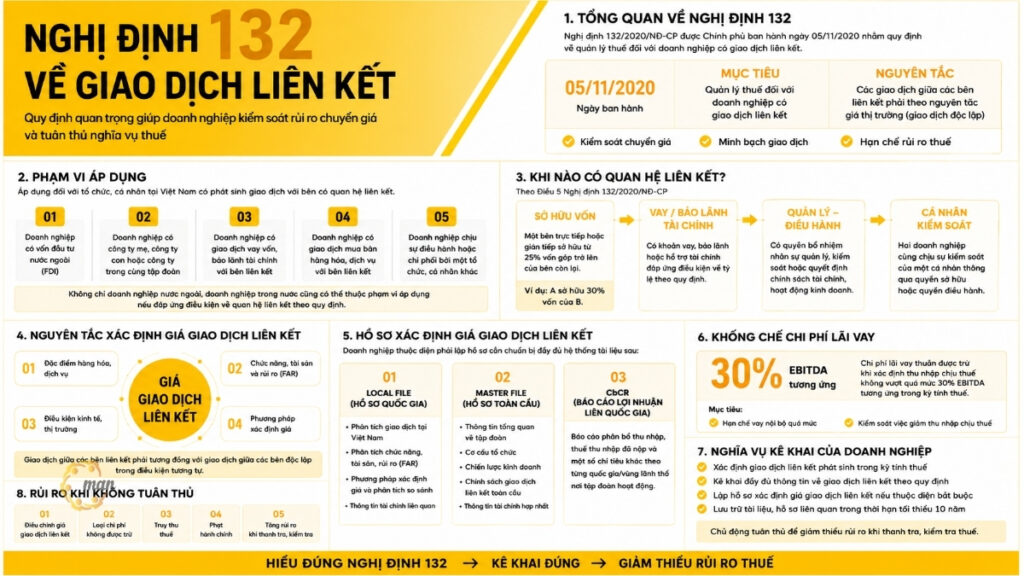
Decree 132 on related-party transactions is one of the important legal documents in the field of tax management in Vietnam, especially for businesses that have transactions with related parties. This regulation helps tax authorities control transfer pricing risks, ensure transactions are conducted according to market price principles, and enhance transparency in business operations.
In the context of international economic integration, many Vietnamese businesses, especially FDI enterprises, multinational corporations, or businesses with a parent-subsidiary model, often engage in related-party transactions such as buying and selling goods, providing services, borrowing capital, transferring technology, or allocating internal costs. Therefore, a thorough understanding of Decree 132 on related-party transactions helps businesses proactively comply with tax obligations and minimize the risk of being subject to tax audits or penalties during tax inspections.
Overview of Decree 132 on related-party transactions
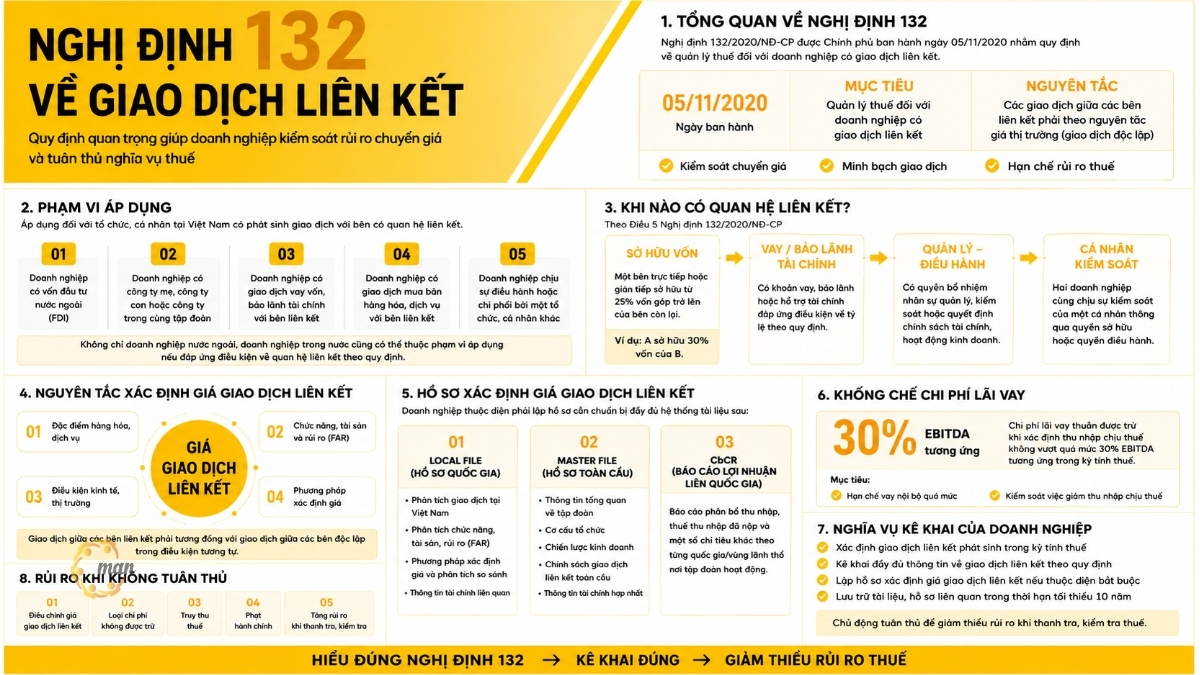
Decree 132/2020/ND-CP Issued by the Government on November 5, 2020, this document regulates tax management for enterprises with related-party transactions. It replaces previous regulations on managing related-party transactions and refines the transfer pricing control mechanism to align with international practices and OECD recommendations on combating base erosion and profit shifting (BEPS).
The main objective of Decree 132 on related-party transactions is to ensure that transactions between related parties are determined according to the principle of independence, meaning that the transaction conditions must be equivalent to those of transactions between unrelated parties.
This helps:
- Preventing the transfer of profits between businesses with controlling relationships.
- Limit the practice of declaring inappropriate expenses in order to reduce tax obligations.
- Creating a legal framework for businesses to develop transparent transaction pricing policies.
- Assisting tax authorities in risk analysis and more effective tax administration.
Scope of application of Decree 132 on related-party transactions
According to regulations, Decree 132 on related-party transactions applies to organizations and individuals engaged in production and business activities in Vietnam that have transactions with related parties during the tax period. The scope of regulation includes determining the relationship between related parties, determining the transfer pricing, declaring information, and preparing and maintaining records of transfer pricing.
The business groups that typically fall within the scope of application include:
- Foreign direct investment (FDI) enterprises.
- A business has a parent company, subsidiaries, or companies within the same group.
- The company has loan and financial guarantee transactions with related parties.
- Businesses that engage in transactions involving the purchase and sale of goods and services with parties that have a controlling relationship with the business.
- A business is managed or controlled by another organization or individual.
Not only foreign businesses, but also domestic businesses may be eligible if they meet the conditions regarding related-party relationships as stipulated.
What does Decree 132 on related-party transactions stipulate regarding related-party relationships?

One of the most important aspects of Decree 132 on related-party transactions is determining whether a business falls under the category of having related-party relationships.
According to Article 5 of Decree 132/2020/ND-CP, an affiliated relationship is defined when one party directly or indirectly participates in the management, control, capital contribution, or investment in the other party; or when both parties are under the control, management, or influence of a third party.
Here are some specific common cases:
Linking through equity ownership
Businesses are considered to be related when one party directly or indirectly owns 25% or more of the capital contribution of the other party.
For example: If Company A owns 30% of the charter capital of Company B, then these two businesses are considered to have an affiliated relationship.
Additionally, a situation where two businesses are jointly owned by a third party with a capital ratio meeting a specified level is also considered an affiliated relationship.
Linking through loans or financial guarantees.
Related parties may arise when one business provides loans, guarantees, or financial support to another business, provided they meet the requirements regarding the loan-to-equity ratio and total outstanding debt as stipulated by regulations.
This is a common scenario in businesses with a corporate structure or where the parent company provides capital support to its subsidiaries.
Linking through management and operational authority.
If one business has the right to appoint management personnel, control or participate in making decisions regarding the financial policies or business operations of another business, then an affiliated relationship may arise.
Linking through individual control
Businesses that are controlled by a single individual through ownership or management rights can also be considered affiliated parties.
Accurately identifying related-party relationships is crucial because it forms the basis for businesses to determine their reporting obligations, prepare documentation, and comply with regulations on related-party transactions.
See also: Forms of related-party transactions.
Regulations on the principles for determining transfer pricing in Decree 132
A key point of Decree 132 on related-party transactions is the requirement for businesses to determine transaction prices according to the arm's length principle.
Accordingly, the price or terms of transactions between related parties must be considered comparable to transactions between independent parties under similar conditions.
Businesses need to conduct the following analysis:
- Characteristics of goods and services.
- The functions, assets, and risks of each party involved in the transaction.
- Economic and market conditions.
- Methods for determining appropriate pricing.
This analysis helps demonstrate that related-party transactions are conducted in accordance with their economic nature, avoiding situations where tax authorities may adjust prices or reassess tax obligations.
Documents for determining transfer pricing under Decree 132
According to Decree 132 on related-party transactions, enterprises that fall under this category must... Create related party transaction records A system of documents proving the legality of the transaction needs to be prepared.
The documentation for determining transfer pricing will include:
Local File
This document describes related-party transactions arising in Vietnamese businesses, including functional, asset, and risk analysis (FAR Analysis), and valuation methods.
Master File
This document provides an overview of the corporation, its operating model, business strategy, and related-party transaction policies globally.
Country-by-Country Reporting (CbCR)
This applies to certain cases of businesses belonging to multinational corporations that meet the specified conditions.
However, building a related-party transaction profile requires businesses to properly assess the nature of the transaction, choose an appropriate pricing method, and ensure consistency between tax records, financial statements, and actual operating data. In cases where a business does not have a dedicated department for this task, consulting with relevant professionals is recommended. related party transaction advisory services This solution helps to assess risks, support documentation, and ensure compliance with the requirements of Decree 132 on related-party transactions.
Regulations on limiting interest expense deductions in Decree 132 on related-party transactions.

One aspect of Decree 132 on related-party transactions that many businesses are interested in is the regulation limiting the deductible interest expense when determining taxable income.
Accordingly, the total net interest expense incurred during the period that is deductible shall not exceed 30% of the total net profit from business operations plus net interest expense and depreciation expense during the period (similar to EBITDA).
Any interest expense exceeding the prescribed limit may be carried forward to subsequent tax periods, provided that legal requirements are met.
This regulation aims to curb the practice of businesses using excessively large internal loans to increase financial costs and reduce taxable income.
The obligation of enterprises to declare related-party transactions.
Businesses with related-party transactions must declare the information using the prescribed form when settling corporate income tax.
Some points to note:
- Determine whether a business falls under the category of related-party transactions.
- Provide complete information about all affiliated parties.
- Determine the obligation to prepare documentation for determining transfer pricing.
- Retain supporting documents for the prescribed period.
To ensure compliance with regulations and minimize errors during the declaration process, businesses can refer to the detailed guidelines on Declare related-party transactions on HTKK., This includes everything from determining which cases require declaration to the process of preparing related-party transaction appendices as required by the tax authorities. Accurate implementation right from the declaration stage helps businesses minimize the risk of being asked to provide explanations or being penalized due to insufficient information.
Risks when businesses do not comply with Decree 132 on related-party transactions.

Failure to comply with regulations regarding related-party transactions can lead to several consequences, such as:
- The transaction price has been reset.
- The deductible expenses have been adjusted.
- They were ordered to pay back taxes and charged late payment penalties.
- Subject to administrative penalties for tax violations.
In particular, for businesses with cross-border transactions, a lack of documentation or inability to demonstrate market pricing principles can significantly increase the risk during tax audits.
Consequences of non-compliance with Decree 132 on related-party transactions.
Businesses with related-party transactions need to pay special attention to their obligation to declare and submit documents on time as prescribed. Late submission of tax returns, missing appendices, or failure to fully comply with declaration obligations can lead to various administrative penalties. According to Decree 132 on related-party transactions, businesses should proactively check declaration deadlines and prepare complete documentation for determining transfer pricing and related appendices to minimize the risk of penalties.
| Time limit/Violation | The corresponding penalty will apply. |
| Filing tax returns late by 1 to 5 days and having mitigating circumstances. | A warning penalty will be issued for late submission of tax returns. |
| Filing tax returns more than 1 to 30 days after the deadline (except in cases of a warning penalty) | A fine of between 2,000,000 VND and 5,000,000 VND will be imposed. |
| Filing tax returns more than 31 days after the deadline is prohibited. | A fine of between 5,000,000 VND and 8,000,000 VND will be imposed. |
| Filing tax returns between 61 and 90 days after the deadline. | A fine of between 8,000,000 VND and 15,000,000 VND will be imposed. |
| Filing tax returns more than 91 days after the deadline but without incurring any tax liability. | A fine of between 8,000,000 VND and 15,000,000 VND will be imposed. |
| No tax return was filed, but no tax liability arose. | A fine of between 8,000,000 VND and 15,000,000 VND will be imposed. |
| Failure to submit the required appendices on tax management for enterprises with related-party transactions along with the corporate income tax return. | A fine of between 8,000,000 VND and 15,000,000 VND will be imposed. |
Therefore, according to Decree 132 on related-party transactions, businesses not only need to pay attention to declaring related-party transactions but also must ensure that all accompanying documents and appendices are submitted on time. Late submission or missing documents can lead to penalties and increased risks during tax audits and inspections.
Frequently Asked Questions about Decree 132 on Related-Party Transactions
Decree 132 on related-party transactions applies to organizations and individuals producing and trading in Vietnam that have transactions with related parties during the tax period. Common subjects include FDI enterprises, subsidiaries of foreign corporations, and enterprises with transactions involving borrowing, buying and selling goods, providing services, or transferring assets with parties that have controlling or dominating relationships. Besides enterprises with foreign elements, domestic enterprises may also fall under the scope of this decree if related-party transactions arise according to the specified criteria.
Not all businesses with related-party transactions are required to prepare transfer pricing documentation. According to Decree 132 on related-party transactions, businesses need to assess eligibility for exemption from documentation before determining their obligations.
According to tax regulations, businesses need to retain records and documents related to related-party transactions to facilitate explanations, audits, and tax inspections, in accordance with the current tax law and accounting record retention periods. Businesses should establish a comprehensive record-keeping system including: price determination records, transaction contracts with related parties, FAR analysis documents, and comparative analysis reports and reference data.Which businesses are subject to Decree 132 on related-party transactions?
Are businesses with related-party transactions required to prepare documentation to determine transfer pricing?
How long should records of transfer pricing be retained?
Conclude
Decree 132 on related-party transactions plays a crucial role in building a transparent business environment, controlling transfer pricing activities, and ensuring businesses fulfill their tax obligations. A proper understanding of the regulations not only helps businesses avoid legal risks but also supports the development of effective tax management strategies.
In reality, each business has a different operating model, capital structure, and type of transaction. Therefore, assessing related-party relationships, selecting appropriate valuation methods, and preparing suitable documentation must be based on the specific characteristics of each business.
Contact MAN – Master Accountant Network For free support and advice!
Contact information MAN – Master Accountant Network
- Address: No. 19A, Street 43, Tan Thuan Ward, Ho Chi Minh City
- Mobile/Zalo: 0903 963 163 – 0903 428 622
- E-mail: man@man.net.vn
- Google Business Profile: View MAN – Master Accountant Network's Google Business Profile
- LinkedIn Founder: View expert Le Hoang Tuyen's LinkedIn profile.
Responsible for production and professional content review by: Mr. Le Hoang Tuyen – Founder & CEO of MAN – Master Accountant Network. He is a CPA Vietnam auditor with over 30 years of in-depth experience in accounting, auditing, taxation, and corporate legal consulting.