





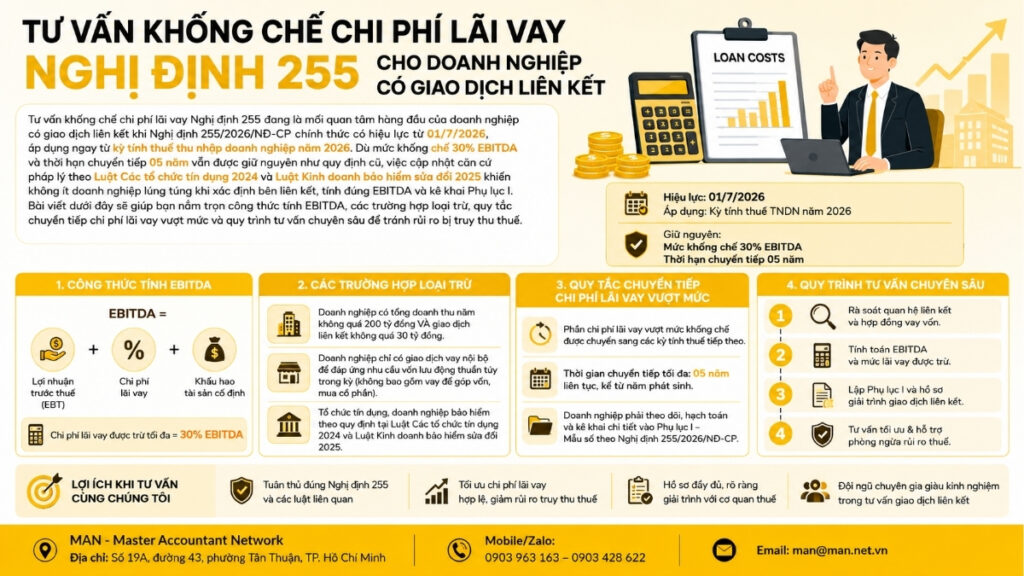
Consulting on controlling interest expense under Decree 255 is a top concern for businesses with related-party transactions. Decree 255/2026/ND-CP Officially effective from July 1, 2026, it will apply immediately from the 2026 corporate income tax period. Although the 30% EBITDA limit and the 5-year transition period remain the same as the old regulations, the legal basis has been updated accordingly. Law on Credit Institutions 2024 and Amended Insurance Business Law 2025 This often leaves many businesses confused when identifying related parties, correctly calculating EBITDA, and declaring Appendix I. This article will help you understand the EBITDA calculation formula, exclusion cases, rules for carrying forward excess interest expense, and in-depth consultation procedures to avoid the risk of tax arrears.
Regulations on limiting interest expense under EBITDA (30%) as per Decree 255/2026/ND-CP
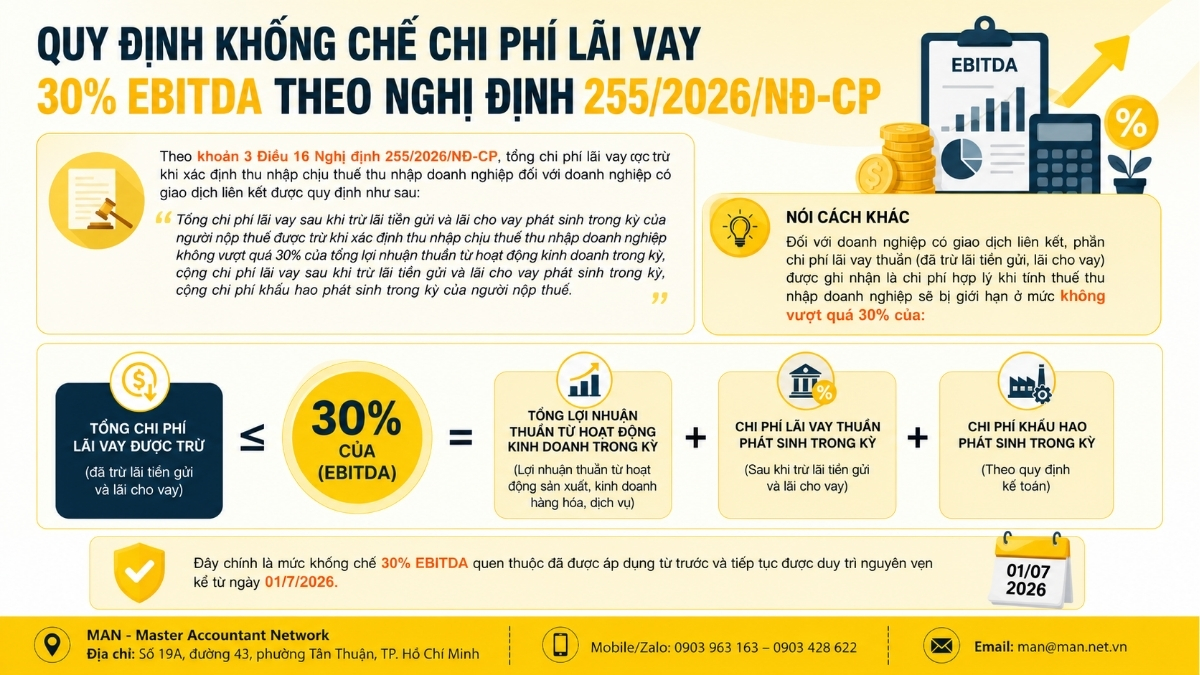
According to Clause 3, Article 16 of Decree 255/2026/ND-CP, the total interest expense deductible when determining taxable income for corporate income tax purposes for enterprises with related-party transactions is stipulated as follows: the total interest expense after deducting interest on deposits and loans incurred during the period of the taxpayer, deductible when determining taxable income for corporate income tax purposes, shall not exceed 30% of the total net profit from business operations during the period, plus interest expense after deducting interest on deposits and loans incurred during the period, plus depreciation expense incurred during the period of the taxpayer.
In other words, for businesses with related-party transactions, the portion of net interest expense (after deducting interest on deposits and loans) recognized as a deductible expense when calculating corporate income tax will be limited to a maximum of 30% of:
- Total net profit from business operations during the period;
- Add the net interest expense incurred during the period;
- Add up the depreciation expense incurred during the period.
This is the familiar 30% EBITDA cap that has been in place and will remain unchanged from July 1, 2026.
EBITDA Calculation Formula According to Decree 255: Detailed Guidance from Experts
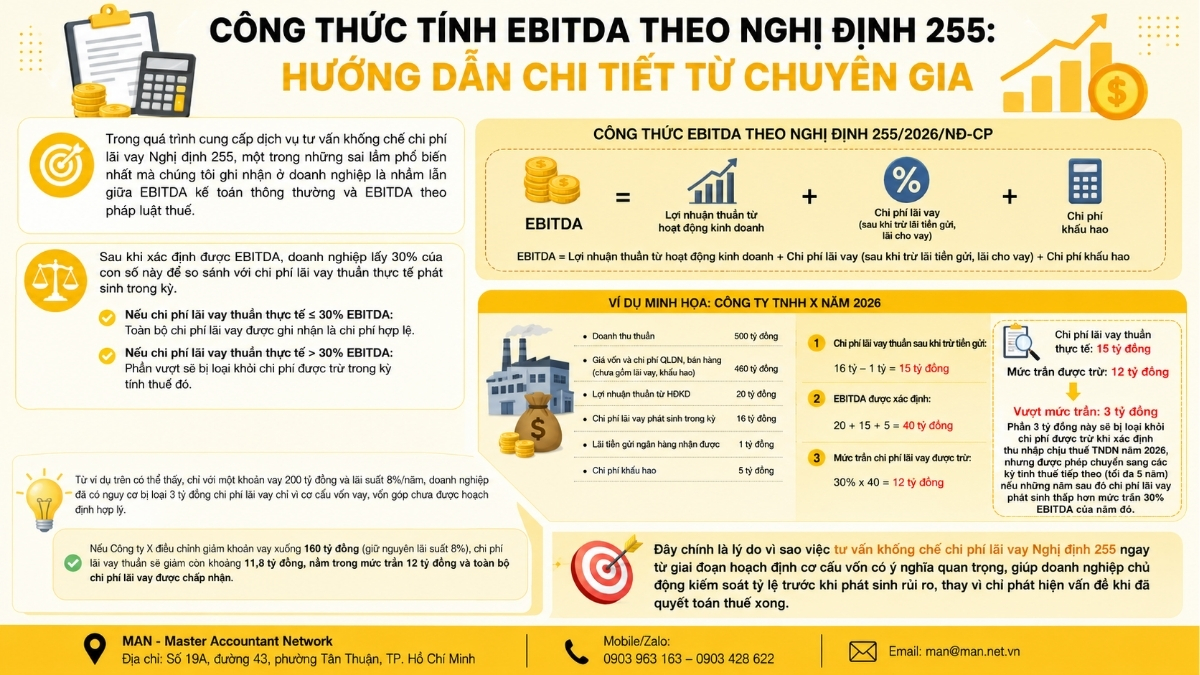
During the process of providing consulting services on controlling interest expense under Decree 255, one of the most common mistakes we have observed among businesses is confusing the conventional accounting EBITDA with the tax-deductible EBITDA. In accordance with the spirit of Decree 255/2026/ND-CP, the formula for determining EBITDA as the basis for calculating the ceiling on deductible interest expense is as follows:
EBITDA = Net profit from business operations + Interest expense (after deducting interest on deposits and loans) + Depreciation expense |
After determining EBITDA, the business uses the 30% of this figure to compare with the actual net interest expense incurred during the period. If the actual net interest expense is less than or equal to the 30% EBITDA, the entire interest expense is recognized as a deductible expense. Conversely, if it exceeds the 30%, the excess will be excluded from deductible expenses in that tax period.
Example: Company X, a limited liability company, is a subsidiary of a foreign corporation in Vietnam. In 2026, it borrowed VND 200 billion from its parent company (affiliated party) at an interest rate of 8%/year to invest in expanding its factory. The company's financial data for the 2026 tax period is as follows:
- Net revenue: 500 billion VND;
- Cost of goods sold and administrative and selling expenses (excluding interest and depreciation): VND 460 billion;
- Net profit from business operations (including interest expense and depreciation in the cost of goods sold as reported in the accounting records, then added back using the EBITDA formula): 20 billion VND
- Interest expense incurred during the period: VND 16 billion
- Interest earned on bank deposits during the period: 1 billion VND
- Depreciation cost: 5 billion VND
Net interest expense after deducting deposits is determined as follows:
Net interest expense = Interest expense incurred during the period – Interest on bank deposits = 15 billion VND |
EBITDA is defined as follows:
EBITDA = 20 + 15 + 5 = 40 billion VND |
Maximum amount of deductible interest expense:
The ceiling amount = 30% x EBITDA = 30% x 40 = 12 billion VND |
Compared to the actual net interest expense of VND 15 billion, Company X exceeded the ceiling by VND 3 billion. This VND 3 billion will be excluded from deductible expenses when determining corporate income tax for 2026, but can be carried forward to subsequent tax periods (up to 5 years) if the interest expense incurred in those years is lower than the 30% EBITDA ceiling for that year.
From the above example, it can be seen that with a loan of only 200 billion VND and an interest rate of 8%/year, the company risks having 3 billion VND in interest expense disallowed simply because the loan and equity structure was not properly planned. If Company X adjusts the loan down to 160 billion VND (keeping the interest rate at 8%), the net interest expense will decrease to approximately 11.8 billion VND, within the ceiling of 12 billion VND, and the entire interest expense will be accepted.
This is why consulting on controlling interest expense under Decree 255 right from the capital structure planning stage is crucial, helping businesses proactively control the ratio before risks arise, instead of only discovering problems after tax settlements are completed.
See also: How to calculate interest expense according to Decree 255.
Comparing Decree 255/2026/ND-CP with Decree 132/2020/ND-CP
By comparing Clause 3, Article 16 of Decree 132/2020/ND-CP with Decree 255/2026/ND-CP, it can be seen that:
| Content | Decree 132/2020 | Decree 255/2026 |
| Interest expense limit | 30% EBITDA | 30% EBITDA |
| The period for carrying forward interest expense that is not deductible. | Maximum of 05 consecutive years | Constant |
| Excluded loan categories | According to the old regulations | Keep the exclusion groups unchanged. |
| Legal basis for credit institutions | Law on Credit Institutions 2010 | Law on Credit Institutions 2024 |
| Legal basis for insurance business | Insurance Business Law 2022 | The Insurance Business Law 2022, amended and supplemented by the amended Insurance Business Law 2025. |
Thus, Decree 255/2026/ND-CP mainly inherits the entire content of Decree 132/2020/ND-CP, without changing the fundamental nature of the policy on controlling interest expense deductions for enterprises with related-party transactions, but focuses on updating the legal basis to conform with the current legal system.
To gain a more complete and systematic understanding of all these changes, businesses can refer to the following analysis. New points in Decree 255/2026/ND-CP before proceeding with a review of their related-party transaction records.
The excess interest expense under 30% EBITDA can be carried forward to subsequent tax periods.
One point businesses often overlook when calculating their own tax liability is the right to carry forward excess interest expense. According to Decree 255/2026/ND-CP, the portion of interest expense that is not deductible due to exceeding the 30% EBITDA limit will be carried forward to the next tax period when determining the total deductible interest expense, applicable if the total deductible interest expense incurred in the next tax period is lower than the prescribed limit.
The carry-over period is calculated continuously for no more than 5 years, starting from the year following the year in which the non-deductible interest expense was incurred. However, to fully utilize this benefit, businesses need to closely monitor the data each year, avoiding missing the 5-year period or miscalculating the carry-over interest expense balance. This is also one of the key aspects that the consulting service on controlling interest expenses under Decree 255 helps businesses track across multiple tax periods.
Cases excluded from the interest expense limitation regulations.
Not all loans to businesses with related-party transactions are subject to the 30% EBITDA ceiling. According to Decree 255/2026/ND-CP, the regulation limiting interest expense does not apply to the following loans:
- Loans granted to taxpayers that are credit institutions under the Law on Credit Institutions 2024;
- Loans taken out by taxpayers who are insurance businesses are governed by the Insurance Business Law 2022, as amended by the amended Insurance Business Law 2025;
- Official development assistance (ODA) loans and preferential government loans are implemented through a method where the government borrows from foreign sources and then lends to businesses.;
- Loans for implementing national target programs (new rural development program and sustainable poverty reduction program);
- Loans are used to invest in programs and projects implementing the State's social welfare policies, including resettlement housing, housing for workers and students, social housing, and other public welfare projects.
Accurately determining whether a business's loan falls under the exclusion category is the first and most crucial step in the process of advising on interest expense deductions under Decree 255. In practice, many businesses with loans from credit institutions mistakenly apply the 30% deduction due to a lack of understanding of the exclusion boundaries, leading to the unnecessary exclusion of legitimate interest expenses and causing direct financial losses.
Why do businesses need advice on controlling interest expense under Decree 255?

Risks associated with miscalculating EBITDA or incorrectly identifying associated parties.
In practice, many businesses encounter the following risks when handling related-party transaction documents themselves without professional support:
- Incorrect calculation of EBITDA formulas leads to incorrect determination of the 30% ceiling and the unauthorized exclusion or acceptance of interest expense.;
- Inaccurate identification of related parties under Article 5 leads to businesses failing to declare or over-declaring related-party transactions;
- Omitting the carry-forward right to deduct interest expenses for a period of 5 years results in the loss of significant legitimate benefits;
- Incorrectly applying the excluded loan categories, especially for loans related to credit institutions under the Law on Credit Institutions 2024;
- Incorrect or incomplete declarations in Appendix I issued with Decree 255/2026/ND-CP may result in the tax authorities requesting explanations or even imposing tax assessments.
These errors, however minor, can lead to consequences such as retroactive collection of corporate income tax, late payment interest, and in some cases, even administrative penalties for tax violations.
Benefits of having a consultant by your side.
This is why consulting services on controlling interest expense under Decree 255 are increasingly being chosen by businesses with related-party transactions instead of handling it internally. As part of related party transaction advisory services Comprehensively, MAN's team of experts will work alongside businesses to completely solve the problem of controlling interest expenses, specifically helping businesses to:
- Conduct a comprehensive review of the loan structure, accurately identifying related parties in accordance with the 12 criteria groups in Article 5 of Decree 255/2026/ND-CP;
- Calculate EBITDA and the 30% control ratio accurately, in accordance with the spirit of Clause 3, Article 16 of Decree 255;
- Optimize deductible interest expenses within legal limits by restructuring the loan-equity ratio appropriately;
- Monitor and manage the portion of interest expense carried forward across tax periods, ensuring that the required 5-year deadline is not missed;
- Assist in preparing and filing Appendix I and related documents, and be ready to provide explanations when requested by tax inspectors or auditors.;
- Timely updates on changes in the legal basis, such as Decree 255/2026/ND-CP referring to the Law on Credit Institutions 2024 instead of the Law on Credit Institutions 2010, or the application of the amended Law on Insurance Business 2025.
For businesses with complex ownership structures, multiple layers of subsidiaries and affiliated companies, or frequent intercompany lending transactions, having a consulting firm to control interest expense under Decree 255 is essential. MAN – Master Accountant Network Providing comprehensive support throughout the entire process, from planning to tax settlement, will significantly minimize legal risks and optimize financial performance in a sustainable manner.
Procedures for advising on controlling interest expense under Decree 255
To ensure accuracy and compliance with legal regulations, the process of advising on controlling interest expense under Decree 255 is typically implemented in the following steps:
- Step 1 – Review related party transaction records: Collect and analyze all information regarding ownership structure, loans, guarantees, and executive personnel relationships to accurately identify the related party in accordance with Article 5 of Decree 255/2026/ND-CP.
- Step 2 – Calculate EBITDA and determine the ceiling for deductible interest expense: Apply the correct formula as per Clause 3, Article 16, and compare it with the actual financial data of the enterprise during the tax period.
- Step 3 – Check for carried-forward interest expense: Review the history of previous years to identify any excess interest expense that is still within the 5-year carry-forward period, ensuring the business does not miss out on its legal rights.
- Step 4 – Consulting on optimal debt and equity structure: Proposing appropriate adjustments to the debt and equity ratios to proactively control the interest expense ratio within the 30% EBITDA range.
- Step 5 – Support in completing Appendix I and related-party transaction pricing documentation: Prepare all necessary documents according to the mẫu form issued with Decree 255/2026/NĐ-CP, ready for tax settlement and explanations when needed.
Conclude
Although Decree 255/2026/ND-CP does not fundamentally change the 30% EBITDA limit, the updated legal basis and stricter requirements for identifying related parties necessitate that businesses review all related-party transaction records starting from the 2026 tax year. Understanding the regulations correctly, accurately calculating EBITDA, and maximizing the carry-forward of interest expense will not only help businesses avoid the risk of tax arrears but also optimize capital utilization legally.
If your business has related-party transactions, especially intra-corporate loans, loans from parent companies, or loans from affiliated companies abroad, don't wait until tax settlement to review them. contact Contact our team of expert trading professionals today for advice on controlling interest expense under Decree 255, tailored to your company's specific circumstances.
Contact information MAN – Master Accountant Network
- Address: No. 19A, Street 43, Tan Thuan Ward, Ho Chi Minh City
- Mobile/Zalo: 0903 963 163 – 0903 428 622
- E-mail: man@man.net.vn
- Google Business Profile: View MAN – Master Accountant Network's Google Business Profile
- LinkedIn Founder: View expert Le Hoang Tuyen's LinkedIn profile.
Responsible for production and professional content review by: Mr. Le Hoang Tuyen – Founder & CEO of MAN – Master Accountant Network. He is a CPA Vietnam auditor with over 30 years of in-depth experience in accounting, auditing, taxation, and corporate legal consulting.
Frequently Asked Questions about Consulting on Controlling Interest Expenses under Decree 255
Will interest expense continue to be subject to the 30% EBITDA cap from July 1, 2026?
Yes. According to Clause 3, Article 16 of Decree 255/2026/ND-CP, the limit on interest expense (EBITDA) for enterprises with related-party transactions continues to be maintained, unchanged from the previous regulations.
How is EBITDA calculated according to Decree 255?
EBITDA is determined by the total net profit from business operations, plus interest expense after deducting interest on deposits and loans, plus depreciation expense incurred during the period.
Can excess interest expenses be carried forward to the following year, and for a maximum period?
Yes. The portion of interest expense that is not deductible due to exceeding the 30% EBITDA limit can be carried forward to the next tax period, with a continuous carry-forward period of no more than 5 years from the year following the year in which it was incurred.
Which types of loans are not subject to interest expense limits?
This includes loans from credit institutions, insurance companies, ODA loans and preferential government loans, loans for national target programs, and loans for state-funded social welfare projects.
What information does a business with related-party transactions need to declare according to Decree 255?
Businesses are required to declare the ratio of interest expense in the tax period according to Appendix I issued with Decree 255/2026/ND-CP.