





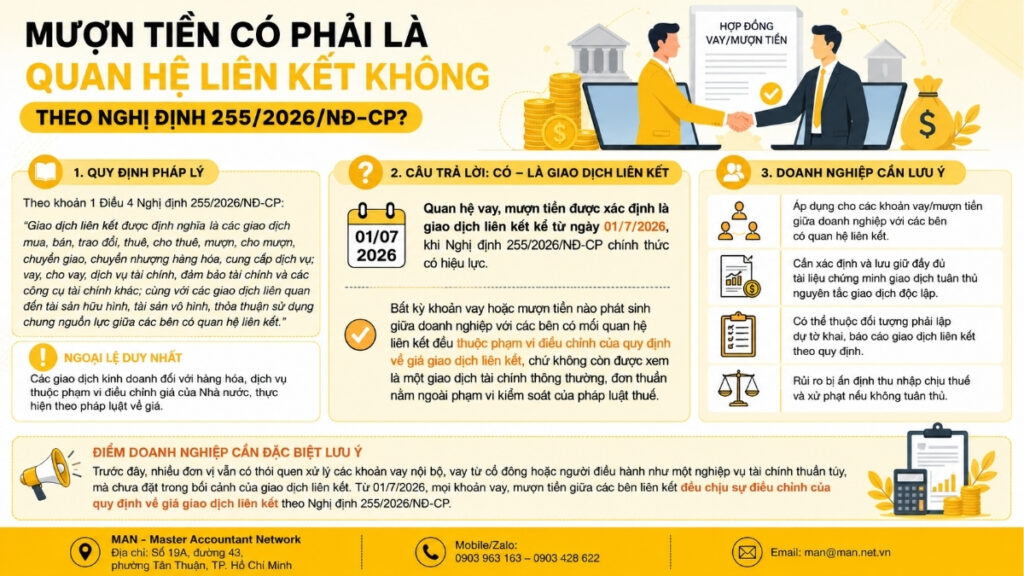
Is borrowing money considered a related-party transaction? This is a question many businesses are asking now that Decree 255/2026/NĐ-CP officially took effect on July 1, 2026, expanding the scope of related-party transactions to include borrowing, lending, and other money-lending activities. Under the new regulations, a loan or borrowing transaction is considered a related-party transaction only if it meets both of the following conditions:
- The transaction value must be at least 10% of shareholders' equity at the time the transaction occurs.
- And the other party is an individual who manages or controls the business or has a related-party relationship as defined by regulations.
The following article provides a detailed analysis of the legal basis set forth in Articles 4, 5, 12, and 13 Decree 255/2026/ND-CP, helping businesses accurately identify transactions, determine appropriate transfer pricing, and proactively mitigate tax risks.
Is borrowing money considered a related-party transaction under Decree No. 255/2026/NĐ-CP?

Pursuant to Paragraph 1 of Article 4 of Decree No. 255/2026/ND-CP:
Related-party transactions are defined as transactions involving the purchase, sale, exchange, lease, rental, borrowing, lending, transfer, or assignment of goods; the provision of services; borrowing, lending, financial services, financial guarantees, and other financial instruments; as well as transactions involving tangible and intangible assets and agreements for the shared use of resources among parties in an affiliated relationship.
The only exception is business transactions involving goods and services subject to state price regulation, which are conducted in accordance with the law on pricing.
Thus, the answer to the question of whether borrowing money constitutes a related-party relationship has been clearly defined: Loan and borrowing relationships will be classified as related-party transactions effective July 1, 2026, when Decree No. 255/2026/NĐ-CP officially takes effect. This means that any loan or borrowing arrangement between a business and related parties falls within the scope of the regulations on transfer pricing, rather than being considered a routine financial transaction that falls outside the scope of tax law.
This is a point that businesses need to pay special attention to, because in the past, many companies were in the habit of treating internal loans and loans from shareholders or executives as purely financial transactions, without considering them in the context of related-party transactions.
Businesses may refer to the following for more information New points of Decree 255/2026/ND-CP to get an overview of the changes before delving into the specific regulations related to borrowing and lending money.
Conditions under which loan and borrowing transactions are considered affiliated relationships

Not every transaction involving borrowing or lending money automatically constitutes a related-party transaction. According to Point l, Clause 1, Article 5 of Decree No. 255/2026/NĐ-CP, a loan or borrowing relationship is considered an affiliated relationship only when it simultaneously meets the conditions regarding the threshold ratio and the parties involved in the transaction, specifically:
- A business that has conducted transactions involving the transfer or acquisition of at least 25% of the business owner’s equity interest during the tax period; or
- A business that engages in borrowing, lending, or lending out at least 10% of owners’ contributed capital at the time the transaction occurs during the tax period, with the counterparties being individuals who manage, control the enterprise, or with individuals who fall under one of the relationships specified in Point g, Clause 1, Article 5 of this Decree.
This can be easily illustrated with an example: If a business’s equity capital is 10 billion VND, then any loan or credit facility of 1 billion VND or more (equivalent to 10% of the equity capital) that occurs with individuals who manage or control the enterprise during the tax period will be deemed a related-party transaction under the new regulations.
In other words, to accurately determine whether a borrowing or lending relationship constitutes a related-party relationship in each specific case, a business must simultaneously consider two factors: the ratio of the transaction value to equity, and the relationship between the business and the lender or borrower.
Why are borrowing and lending money classified as related-party transactions?

The expansion of the scope of related-party transactions to include lending and borrowing activities stems from the fact that these types of financial transactions are highly susceptible to being exploited for transfer pricing and the shifting of profits among related parties through interest rate agreements that do not accurately reflect market value.
A loan with an interest rate that is too high or too low compared to the market rate can be used as a tool to shift taxable income among related parties, thereby affecting the amount of corporate income tax owed.
Therefore, under Article 13 of Decree 255/2026/NĐ-CP, interest payments in borrowing and lending activities are identified as one of the cases where the method of comparing related-party transaction prices with independent transaction prices applies. This serves as an important legal basis for tax authorities to assess the reasonableness of interest rates on loans between related parties, and it also serves as the basis for businesses to self-review and prepare documentation demonstrating that their transactions comply with the arm’s-length principle.
What should a business do when it enters into a loan or borrowing transaction with an affiliated party?
Once a business has clearly determined whether a loan constitutes a related-party transaction in its specific case, the next step is to determine the arm’s-length price for that loan in accordance with the methods and principles prescribed by law.
How are transfer pricing rates determined for loans and borrowings?
According to Article 13 of Decree No. 255/2026/ND-CP, the method of comparing related-party transaction prices with arm’s-length transaction prices is applied based on the following principles:
There are no differences in product characteristics or contract terms between an arm’s-length transaction and a related-party transaction that have a material effect on price. If there are differences that have a material effect, the enterprise must eliminate these differences before making the comparison.
With regard to loans and lending, factors that have a significant impact on price (in this case, the interest rate) should be considered, including:
- The characteristics and size of the loan;
- Loan contract terms, such as the loan term and the payment schedule for interest and principal;
- The economic factors and operational functions of the business at the time the transaction occurred.
After eliminating significant differences, the price (interest rate) of the related-party loan will be adjusted based on the arm’s-length transaction value or the corresponding standard arm’s-length transaction range.
One point businesses need to pay particular attention to: The results of transfer pricing assessments serve as the basis for filing returns and determining the amount of corporate income tax due, but shall not reduce the tax liability payable to the state budget of the taxpayer. This is a fundamental principle that ensures the determination of transfer pricing does not become a means of evading tax obligations.
Principles for Selecting a Method to Determine the Transfer Pricing for a Loan
Pursuant to Article 12 of Decree No. 255/2026/ND-CP, the method for determining the price of related-party transactions must be selected in accordance with the arm’s-length principle, the nature of the transaction, and the taxpayer’s functions, and must be applied consistently throughout the entire production and business cycle or phase.
The selection of the method must also be based on the financial data of independent comparables, selected in accordance with the principles of analysis and comparison set forth in Articles 6, 7, 8, 9, and 10 of this Decree, as well as on the specific characteristics of the related-party transaction and the information and data available at the time of price determination.
For loans and borrowings, given their nature as transactions that can be directly compared based on market interest rates, the arm’s-length transaction price comparison method under Article 13 is typically the preferred method if the enterprise is able to collect sufficient and appropriate comparative data.
Risks if a business fails to properly identify related-party relationships when borrowing money
If a business fails to properly identify whether a borrowing or lending relationship constitutes a related-party relationship in a specific transaction, the consequences may include:
- Failure to comply with the obligation to prepare documentation to determine the price of related-party transactions;
- Failure to fully disclose information on related-party transactions during the tax period.
These are deficiencies that are easily detected when tax authorities conduct audits and inspections, and may result in the tax base for that loan or borrowing being reassessed.
Therefore, from the very moment a loan or borrowing transaction with related parties arises, businesses should proactively review the ratio of such transactions to shareholders’ equity and clearly define the relationship with the borrower or lender, so they can develop an appropriate reporting strategy and prepare the necessary documentation from the outset, rather than reacting passively once a request has been issued by the tax authorities.
If in-depth support is needed, businesses can seek advice related party transaction documentation service to ensure that the records are prepared completely and in accordance with regulations right from the start of the tax period.
Conclude
Based on the above analysis, it can be clearly stated that, effective July 1, 2026, borrowing and lending money are officially considered related-party transactions under the provisions of Decree 255/2026/NĐ-CP. However, determining whether a specific borrowing or lending transaction qualifies as a related-party transaction depends on whether the transaction meets the equity contribution threshold (a minimum of 10% of equity capital) and involves an individual who manages, control the enterprise, or an individual with a related-party relationship as defined by the regulations.
Once a transaction has been identified as a related-party transaction, the enterprise must determine the transaction price in accordance with the methods and principles specified in Article 12, Article 13 of Decree No. 255/2026/ND-CP, and simultaneously prepare a complete set of documentation and comparative data to demonstrate that the interest rates on loans and borrowings comply with the arm’s-length principle. This is a crucial step that helps businesses not only comply with legal regulations but also minimize the risk of having their taxable value adjusted during tax audits or inspections.
For assistance with reviewing and identifying transactions, as well as advice on compliance strategies tailored to the specific needs of your business, please refer to related party transaction advisory services from MAN’s team of experienced affiliate trading experts.
Contact MAN – Master Accountant Network For free support and advice!
Contact information MAN – Master Accountant Network
- Address: No. 19A, Street 43, Tan Thuan Ward, Ho Chi Minh City
- Mobile/Zalo: 0903 963 163 – 0903 428 622
- E-mail: man@man.net.vn
- Google Business Profile: View MAN – Master Accountant Network's Google Business Profile
- LinkedIn Founder: View expert Le Hoang Tuyen's LinkedIn profile.
Responsible for production and professional content review by: Mr. Le Hoang Tuyen – Founder & CEO of MAN – Master Accountant Network. He is a CPA Vietnam auditor with over 30 years of in-depth experience in accounting, auditing, taxation, and corporate legal consulting.