





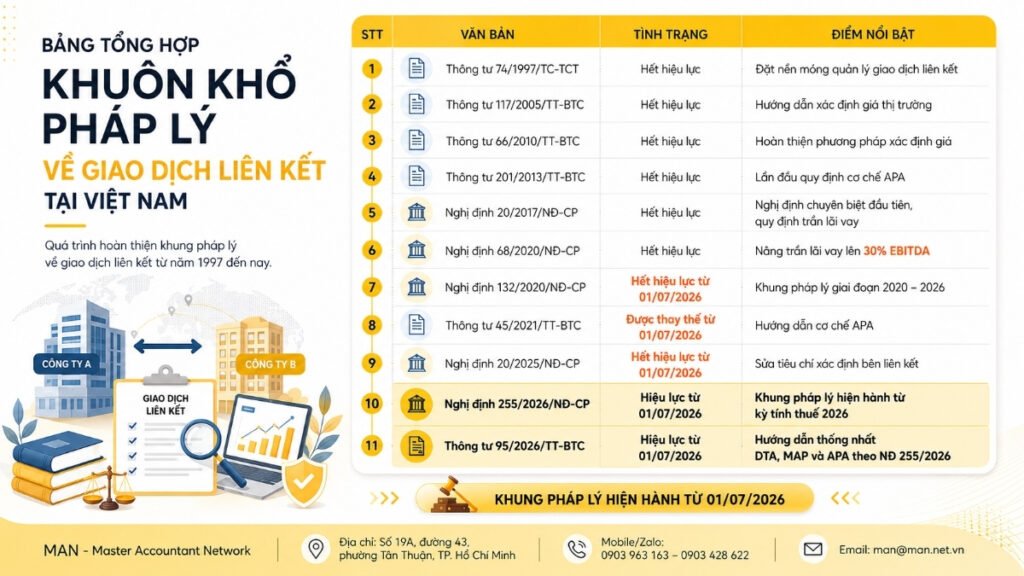
The legal framework for related-party transactions in Vietnam has just entered a new chapter when Decree 255/2026/ND-CP and Circular 95/2026/TT-BTC Officially effective from July 1, 2026, replacing the familiar Decree 132/2020/ND-CP of the past six years, this article comprehensively systematizes the nearly 30-year journey of this legal framework, from Circular 74-TC/TCT of 1997 to the latest documents. It also clearly points out the core changes regarding pricing methods, declaration procedures, and exemption thresholds that businesses need to update immediately to avoid the risk of tax assessment and retroactive collection.
Why do businesses need to understand the legal framework regarding related-party transactions?

The nature of related-party transactions under current regulations
According to Article 4 of Decree 255/2026/ND-CP, which came into effect on July 1, 2026, related-party transactions are understood as transactions involving the purchase, sale, exchange, lease, rental, transfer, and assignment of goods and services; loan and lending transactions; financial services; transactions related to tangible and intangible assets; as well as agreements on the shared use of resources and cost sharing between related parties. This definition remains largely unchanged from previous decrees, but the scope of the list has been increasingly clarified to limit circumvention through non-traditional transaction forms such as resource sharing, corporate synergies, or digital economy transactions.
Without a sufficiently robust legal framework for related-party transactions, related-party enterprises, especially multinational corporations, can easily manipulate internal pricing to shift profits from high-tax jurisdictions to low-tax jurisdictions. This is why the arm's-length principle is consistently emphasized in all Vietnamese laws on related-party transactions: the price, profit margin, or profit allocation ratio in related-party transactions must be equivalent to transactions between independent parties under similar conditions.
Affected parties
The legal framework for related-party transactions applies to all organizations producing or trading goods and services that are subject to corporate income tax and have transactions with related parties, not just FDI enterprises. Domestic enterprises with ownership relationships, loan relationships, management personnel relationships, or personal relationships with their trading partners are also subject to regulation if they meet the criteria for identifying related parties.
An overview of the legal framework for related-party transactions in Vietnam through different stages.

To properly understand the nature of current regulations, it is necessary to look back at the nearly 30-year journey of the formation and development of the legal framework through three main stages:
Foundation laying phase (1997 – 2013)
The earliest document laying the foundation for the legal framework on related-party transactions in Vietnam is Circular 74-TC/TCT dated October 20, 1997, issued by the Ministry of Finance, guiding regulations on taxation for investment forms under the Law on Foreign Investment in Vietnam. This document was a starting point, closely linked to the context of attracting foreign investment during the early stages of economic opening, and did not directly address the concept of "related-party transactions" as it does today.
The real turning point came with Circular 117/2005/TT-BTC, the first document providing specific guidance on determining market prices in business transactions between related parties. This marked the first time Vietnam officially legalized the arm's-length principle in accordance with international practice (OECD standards). In 2010, Circular 66/2010/TT-BTC was issued, replacing Circular 117/2005, further refining the methods for determining market prices and expanding the scope of application.
In 2013, the Advance Pricing Agreement (APA) mechanism was first stipulated in Circular 201/2013/TT-BTC, marking a significant step forward: related-party enterprises could proactively negotiate with the tax authorities on pricing methods in advance, instead of only being subject to inspection and assessment after transactions occurred.
The phase of forming a specific legal framework (2017 – 2021)
This period witnessed the development of the legal framework for related-party transactions, demonstrating the government's determination to tighten management of transfer pricing.
Decree 20/2017/ND-CP is the first decree-level document specifically regulating tax management for enterprises with related-party transactions. The most notable point of this Decree is that it, for the first time, introduces a ceiling on deductible interest expenses when determining taxable income, an effective tool to prevent "thin capitalization," a common form of transfer pricing through inter-corporate borrowing transactions.
By 2020, Decree 68/2020/ND-CP amended and supplemented Decree 20/2017, notably raising the ceiling for deductible interest expenses from 20% to 30% (total net profit plus interest expenses and depreciation expenses (EBITDA)), and allowing the carry-forward of non-deductible interest expenses to subsequent tax periods.
Just a few months later, Decree 132/2020/ND-CP, issued on November 5, 2020, completely replaced both Decree 20/2017 and Decree 68/2020, becoming the cornerstone of the legal framework for related-party transactions throughout the 2020-2026 period. Decree 132/2020 fully systematizes: the principle of comparative analysis, three methods for determining transfer pricing, the obligation to prepare three levels of documentation (National Documentation, Global Documentation, Country-by-Country Report), and cases exempt from the obligation to declare and prepare documentation. Accompanying this, Circular 45/2021/TT-BTC provides detailed guidance on the application of the APA mechanism under the new legal framework.
Update and restructuring phase (2025 – 2026)
After nearly five years of implementation, the legal framework for related-party transactions is entering a phase of significant updating to keep pace with new international standards, particularly the global Base Erosion Prevention and Control Initiative (BEPS) and the global minimum tax initiative.
Decree 20/2025/ND-CP, issued on February 10, 2025 and effective from March 27, 2025, amends several important provisions of Decree 132/2020/ND-CP, focusing on clarifying the cases for determining related parties through guarantees and loans (especially excluding certain cases where credit institutions do not participate in the management and control of the borrowing enterprise), adding the responsibility of the State Bank of Vietnam to coordinate in providing information, and replacing Appendix I on related party information and related party transactions.
The biggest turning point is Decree 255/2026/ND-CP, issued on June 30, 2026, and officially effective from July 1, 2026, applicable immediately from the corporate income tax period of 2026. This Decree completely replaces both Decree 132/2020/ND-CP and Decree 20/2025/ND-CP, and is built on the new legal basis including Law No. 108/2025/QH15 on Tax Administration and Law No. 67/2025/QH15 on Corporate Income Tax. Compared to previous versions, Decree 255/2026/ND-CP systematizes all the principles of analysis, comparison, and selection of independent comparable entities, clarifies the concept of "standard independent transaction value range" (from the 35th to the 75th percentile), and specifies the minimum number of independent comparable entities to be selected depending on the degree of material differences to be excluded.
Simultaneously, Circular 95/2026/TT-BTC, issued and effective on July 1, 2026, consolidated three previously scattered areas of regulation: guidance on implementing Double Taxation Avoidance Agreements (DTAs), procedures for bilateral agreements (MAPs), and guidance on applying the APA mechanism in tax management for enterprises with related-party transactions. This Circular simultaneously replaces Circular 201/2013/TT-BTC and Circular 45/2021/TT-BTC, marking the first time Vietnam has had a comprehensive and synchronized guidance document on the application of tax agreements linked to the APA mechanism for related-party transactions.
Summary of the legal framework on related-party transactions in Vietnam
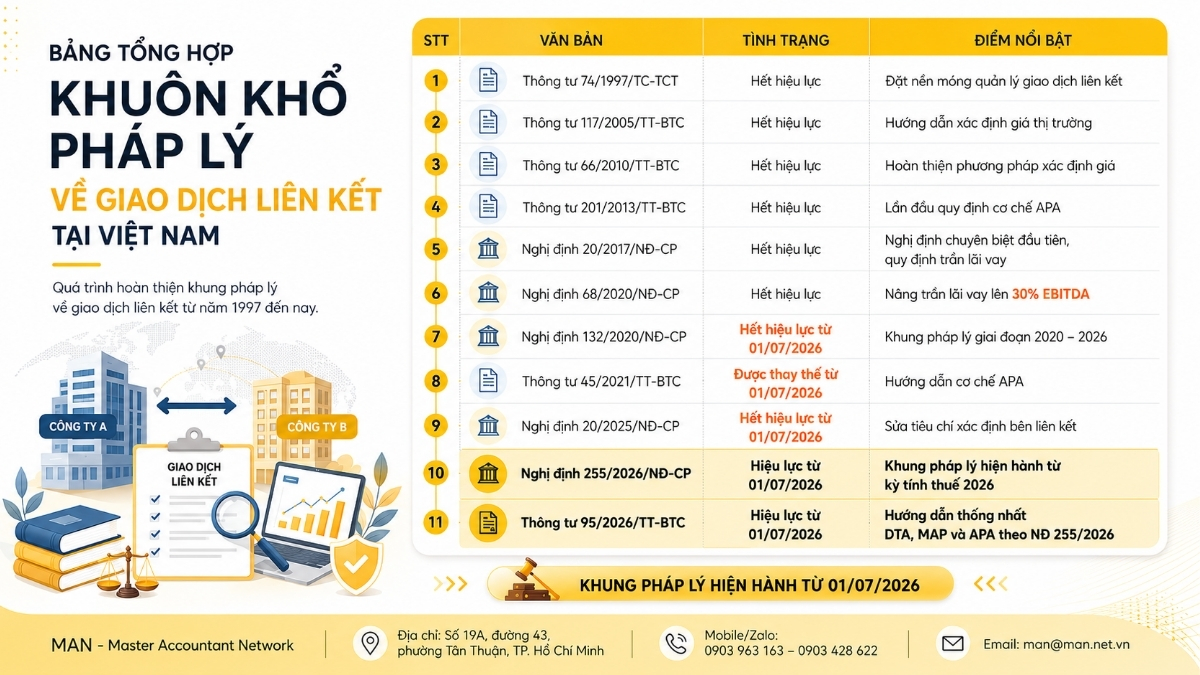
Over nearly 30 years of formation and development, the legal framework for related-party transactions in Vietnam has undergone numerous revisions and replacements to increasingly approach international standards on anti-transfer pricing. The summary table below systematizes all the legal documents that constitute this legal framework in chronological order, helping businesses easily compare which documents are currently in effect, which have been replaced, and the specific role of each document.
| No. | Document | Date of issuance | Validity | Role |
| 1 | Circular 74/1997/TC-TCT | 20/10/1997 | Expired | This document lays the first foundation, linked to foreign investment tax. |
| 2 | Circular 117/2005/TT-BTC | 19/12/2005 | Expired | First-time guidance on determining inter-party market prices. |
| 3 | Circular 66/2010/TT-BTC | 22/04/2010 | Expired | Replacing Circular 117/2005, improving the method for determining prices. |
| 4 | Circular 201/2013/TT-BTC | 20/12/2013 | Expired | This is the first time a mechanism for Advance Pricing Agreements (APAs) has been stipulated. |
| 5 | Decree 20/2017/ND-CP | 24/02/2017 | Expired | The first specialized decree-level document sets a ceiling on interest expense. |
| 6 | Decree 68/2020/ND-CP | 24/6/2020 | Expired | Amend the ceiling on interest expense from 20% to 30% EBITDA. |
| 7 | Decree 132/2020/ND-CP | 05/11/2020 | Expires July 1, 2026 | Key documents for the period 2020-2026 |
| 8 | Circular 45/2021/TT-BTC | 18/6/2021 | Expired, replaced by Circular 95/2026/TT-BTC | Detailed instructions on applying the APA mechanism. |
| 9 | Decree 20/2025/ND-CP | 10/02/2025 | Effective March 27, 2025, expires July 1, 2026 | Amend and supplement the criteria for identifying affiliated parties, replacing Appendix I. |
| 10 | Decree 255/2026/ND-CP | 30/06/2026 | Officially effective from July 1, 2026 | Current pillar text, applicable from the 2026 tax year. |
| 11 | Circular 95/2026/TT-BTC | 01/7/2026 | Officially effective from July 1, 2026 | Consolidating DTA, MAP, and APA guidelines for affiliate transactions. |
It is evident that the legal framework for related-party transactions in Vietnam is not a single document but a system built up over many stages, reflecting the increasingly clear trend of tightening transfer pricing management. Currently, the two key documents that businesses need to understand are Decree 255/2026/ND-CP and Circular 95/2026/TT-BTC, both effective from July 1, 2026, and applicable from the corporate income tax period of 2026.
Summary of new points in Decree 255/2026/ND-CP on related-party transactions
On July 9, 2026, the Tax Department issued... Official Document 4697/CT-CS Detailed introduction of New points of Decree 255/2026/ND-CP Compared to the old legal framework (Decree 132/2020/ND-CP and Decree 20/2025/ND-CP), this is an important document that helps businesses accurately understand the technical changes and compliance obligations. The table below summarizes all the notable new points by content group, along with the basis clauses and purpose of the amendments.
| No. | Revised content | Clause | Update new points | Purpose |
| 1 | Principles of application | Article 3 | Referencing the principles of tax administration under Clause 4, Article 6 and the principles of tax inspection under Clause 1, Article 22 of the 2025 Law on Tax Administration. | In line with the Law on Tax Administration No. 108/2025/QH15 |
| 2 | Word explanation | Article 4 | Complete the definitions of "Supreme Parent Company" and "Tax Agreement" (referencing Resolution 107/2023/QH15 and Decree 236/2025/ND-CP); complete the definitions of "Related-Party Transactions," "National File," "Global File," and "Status of Non-Systematic Information Exchange."“ | Establish a clear and consistent legal basis for application. |
| 3 | Relationship | Article 5 | Enhance the relationship through the following forms: borrow, lend (Similar to borrowing and lending) between businesses and individuals who manage or control; additional exclusions apply to creditors and guarantors that are state-owned organizations tasked with buying, selling, and handling debt. | Accurately reflecting the nature of transactions and resolving practical issues. |
| 4 | Database used | Article 17 | Referencing commercial databases and tax administration data under the 2025 Tax Administration Law; Supplementing the National Database; additional order of priority: Publicly available data Commercial data Tax authority data | Expand reliable data sources and increase transparency in the selection of data for comparison. |
| 5 | Taxpayer rights and obligations | Article 18 | Referring to Clauses 1 and 2 of Article 37 of the 2025 Tax Administration Law; change "business company handling tax procedures" to “"Business organizations that handle tax procedures"” | Synchronize legal terminology |
| 6 | Country-by-Country Reporting (CbCR) | Article 19 | Revenue threshold is determined by fiscal year immediately preceding the reporting year (previously based on tax period); maintain threshold 750 million Euros; supplement the exchange rate according to the central or cross exchange rate for December announced by the State; clarify cases of exemption or requirement to pay CbCR; specify the payment format XML encoding Through the Tax Management Information System; Notification of taxpayers using Form 01/TB-BCLN, payable only once, updated within 90 days if there are any changes. | In line with OECD guidelines (BEPS Action 13), increasing transparency. |
| 7 | Exemption from preparing valuation documentation. | Point c aligns with OECD guidance (BEPS Action 13), increasing transparency. | Raise the revenue threshold to below 500 billion VND., Remove the criterion of "business with simple functions".“ | Expanding the scope of low-risk entities exempt from filing requirements reduces compliance costs. |
| 8 | Responsibilities and powers of tax authorities | Article 21 | Please clarify: Do not use the CbCR report to adjust related-party transaction prices.; supplement the mechanism “"Compliance management and voluntary compliance support"” (Disclosure of industry profit margins, assistance with declarations, information security) | Shifting from a "post-risk management" model to a model of partnership and support for taxpayers. |
| 9 | Responsibilities of ministries, departments, and People's Committees | Article 22 | Update the names and functions of Ministries, Departments, and Provincial/City People's Committees after organizational mergers. | In line with the new organizational structure |
| 10 | Transitional provisions | Clause 3, Article 23 | Businesses subject to the transitional provisions regarding interest expense under Article 3 of Decree 20/2025/ND-CP will continue to be subject to these provisions for the remaining period. | Ensuring policy continuity and protecting taxpayer rights. |
As can be seen, Decree 255/2026/ND-CP not only simply updates the legal basis according to the Law on Tax Administration and the Law on Corporate Income Tax 2025, but also brings three most substantive changes that businesses need to pay attention to immediately:
- Add the link/connection;
- Raise the revenue threshold for exemption from price determination documentation;
- Strengthen and standardize all obligations related to Country-by-Country Profit Reporting according to BEPS 13 standards.
Businesses should immediately review these criteria to redefine the scope of their declaration and documentation obligations, applicable from the corporate income tax period of 2026.
With the increasing complexity of technical regulations, careful consideration is needed. related party transaction documentation service We rely on specialized, experienced units like MAN – Master Accountant Network to ensure that your tax return is properly prepared, includes all necessary documents, and minimizes the risk of tax assessment.
Summary of the implementation timeline from 2017 to 2026:
| Year of application | Applicable Decree | Applicable Circular |
| 2017 – 2019 | Decree 20/2017/ND-CP | Circular 41/2017/TT-BTC |
| 2020 – 2024 | Decree 132/2020/ND-CP | Circular 45/2021/TT-BTC |
| 2025 | Decree 20/2025/ND-CP amends and supplements Decree 132. | Circular 45/2021/TT-BTC |
| 2026 | Decree 255/2026/ND-CP | Circular 95/2026/TT-BTC |
Conclude
From Circular 74-TC/TCT of 1997 to Decree 255/2026/ND-CP and Circular 95/2026/TT-BTC of 2026, the legal framework for related-party transactions in Vietnam has undergone a continuous development, increasingly approaching international standards on anti-transfer pricing and tax transparency. Mastering this entire system of regulations not only helps businesses fulfill their declaration obligations but also enables them to proactively plan sustainable internal transaction pricing strategies.
If you need to specifically assess the impact of Decree 255/2026/ND-CP on your business operations, you can refer to the following information. related party transaction advisory services To receive support in reviewing and planning compliance strategies tailored to the specific characteristics of your industry and business size.
If your business needs a more in-depth analysis of each transfer pricing method and how to build a Transfer Pricing Profile using the latest template, please contact us. Contact MAN – Master Accountant Network For in-depth support and advice.
Contact information MAN – Master Accountant Network
- Address: No. 19A, Street 43, Tan Thuan Ward, Ho Chi Minh City
- Mobile/Zalo: 0903 963 163 – 0903 428 622
- E-mail: man@man.net.vn
- Google Business Profile: View MAN – Master Accountant Network's Google Business Profile
- LinkedIn Founder: View expert Le Hoang Tuyen's LinkedIn profile.
Responsible for production and professional content review by: Mr. Le Hoang Tuyen – Founder & CEO of MAN – Master Accountant Network. He is a CPA Vietnam auditor with over 30 years of in-depth experience in accounting, auditing, taxation, and corporate legal consulting.