





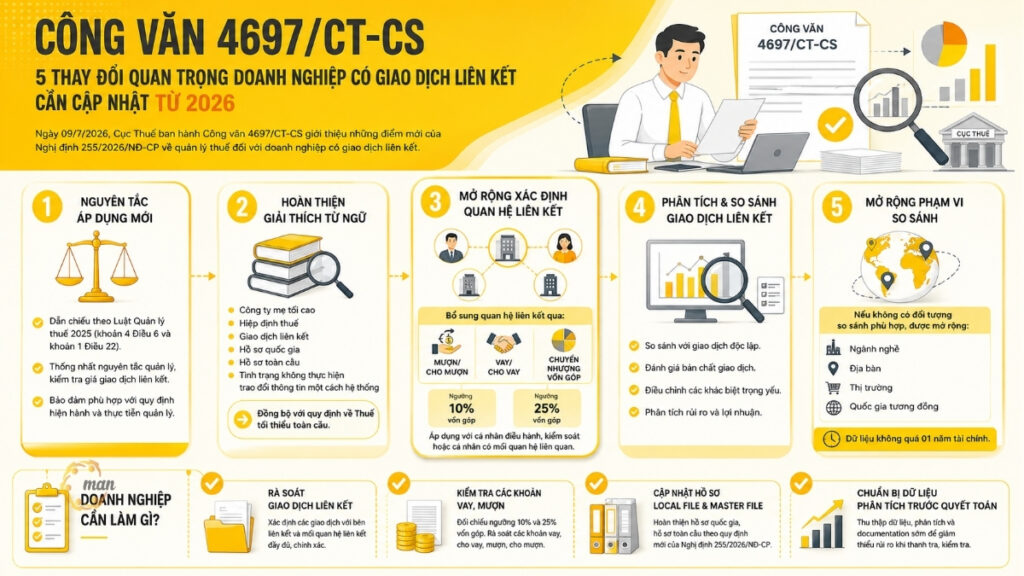
Official Document 4697/CT-CS Officially issued by the Tax Department on July 9, 2026, to introduce these New points of Decree 255/2026/ND-CP, This document regulates tax management for businesses with related-party transactions. Any business engaging in transactions with related parties, from borrowing and lending capital to transferring capital contributions, needs to be aware of these changes, as they directly impact the determination of related-party relationships, comparative price analysis, and tax declaration obligations applicable from the 2026 tax year.
What is Official Document 4697/CT-CS?
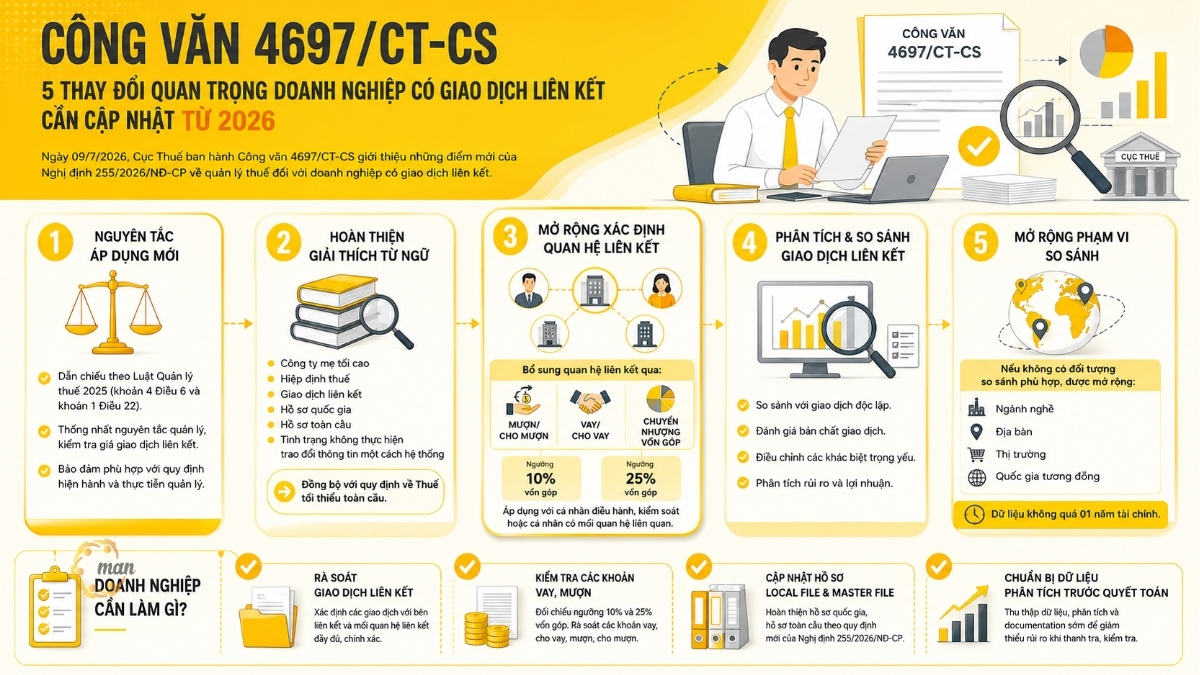
Official Letter 4697/CT-CS is a document issued by the Tax Department on July 9, 2026, with the purpose of introducing and disseminating the amendments and additions to the following: Decree 255/2026/ND-CP.
In other words, this document helps tax authorities at all levels and the business community to understand and correctly apply the spirit of the new Decree right from the moment of its issuance.
Issuing authority and date of issuance of Official Letter 4697/CT-CS
The document was signed and issued by the Tax Department on July 9, 2026. This is an important date for businesses to compare with their tax periods, thereby determining when the new regulations on declaration and determination of transfer pricing will apply.
Purpose of issuing the Official Letter
The core content of Official Letter 4697/CT-CS is to introduce the new points of Decree 255/2026/ND-CP on five main groups of issues:
- Principles of application
- Word explanation
- Affiliate relationship
- Principles of analysis
- Compare related transactions with independent transactions
- Expand the scope of the analysis.
The contents mentioned in Official Letter 4697/CT-CS directly relate to determining the declaration obligation, preparing documentation for determining transfer pricing (national documentation, global documentation), and the pricing method applied during the tax period. Businesses that update this information early will have time to review transactions with related parties, avoiding the risk of tax adjustments or assessments when tax authorities conduct audits and inspections.
Official document 4697/CT-CS provides guidance on new points regarding the principles of application.

According to Official Letter 4697/CT-CS, Article 3 of Decree 255/2026/ND-CP is amended and supplemented to the effect that the principle for tax authorities to manage and inspect transfer pricing will refer to the principles applied in tax management stipulated in Clause 4, Article 6, and the principles of tax inspection stipulated in... Clause 1, Article 22 of the 2025 Law on Tax Administration.
This amendment is not simply a change in wording, but aims to ensure consistency, completeness, and compliance with the current provisions of the 2025 Tax Administration Law. This will provide a common framework of principles for tax authorities and businesses when managing and auditing related-party transactions in the future.
Official document 4697/CT-CS supplements and refines the definition of terms (Article 4).
One of the notable new points mentioned in the Official Document is the addition and refinement of the definitions of terms in Article 4 of Decree 255/2026/ND-CP.
The concept of the ultimate parent company and the tax agreement.
These two concepts were refined in accordance with the guidelines stipulated in Resolution No. 107/2023/QH15 regulating the application of supplementary corporate income tax to taxpayers under the global anti-base erosion regulations and Decree No. 236/2025/ND-CP This document provides guidance on the implementation of this Resolution. This reference helps to unify the understanding of the ultimate parent company and tax agreements between the regulations on related-party transactions and the global minimum tax regulations.
Complete the terminology related to records and information exchange.
In addition, Official Letter 4697/CT-CS also clarifies the need to refine the explanations of the terms:
- Affiliate transactions
- National profile
- Global Profile
- The situation involves a lack of systematic information exchange.
These are all fundamental concepts that directly influence the determination of the scope of transactions to be declared and the type of business documents that need to be prepared.
According to the document, the addition and refinement of these terms aim to ensure consistency and uniformity with the regulations in relevant legal documents, while also creating a clear and consistent legal basis for application and implementation.
The official document clarifies the new points regarding the linkage relationship (Article 5).

This is the most practically impactful aspect introduced in Circular 4697/CT-CS, as it directly relates to determining whether a business is required to declare related-party transactions.
Strengthening relationships through borrowing and lending.
According to point 1, clause 2, Article 5 of Decree 255/2026/ND-CP, the new regulation adds the following linkage relationship:
Businesses that have transactions involving the transfer or acquisition of at least 25% of owner's capital contributions during the tax period; or borrowing, lending, or lending at least 10% of owner's capital contributions at the time of the transaction during the tax period with individuals managing or controlling the business, or with individuals in one of the relationships specified in point g, clause 2, Article 5.
Previously, regulations did not address the relationship between businesses and individuals managing or controlling (or related individuals) formed through borrowing or lending, but only focused on loaning and lending relationships.
Official document 4697/CT-CS clarifies that the addition of this regulation aims to overcome practical difficulties, ensure the full determination of related-party relationships, accurately reflect the nature of transactions, and improve tax management efficiency.
Cases where the relationship is not applicable.
In parallel with expanding the scope of defining related-party relationships, Decree 255/2026/ND-CP also adds an exclusion case at point d.3, clause 2, Article 5:
A creditor or guarantor that is a state-owned organization with charter capital and functions in buying, selling, and handling debt will not be considered to have an affiliated relationship if that organization does not directly or indirectly participate in the management, control, capital contribution, or investment in the debtor enterprise or the guaranteed enterprise as stipulated in points a and c of Clause 2, Article 5.
According to Official Letter 4697/CT-CS, previous regulations did not address this issue. The addition aims to ensure compliance with the actual situation and the correct principles and nature of related parties, preventing organizations handling state debt from being wrongly identified as related parties simply because of their role as creditors or guarantors.
Guidelines on principles for analyzing and comparing related-party transactions with independent transactions (Article 6)
Besides defining related-party transactions, Official Letter 4697/CT-CS also presents content related to the principles for analyzing and comparing related-party transactions with independent transactions according to Clause 2, Article 6 of Decree 255/2026/ND-CP.
Reconciliation of related-party transactions
The analysis and comparison must be based on a comparison of contracts, documents, agreements, and economic, commercial, and financial relationships in related-party transactions of the taxpayer. This data and the actual execution of transactions between related parties should be compared with business decisions that could be approved by independent parties under similar conditions. The principle of comparison applied in the analysis and comparison prioritizes the nature and practice of business and the risks borne by related parties over written agreements.
Requirement for similarity when analyzing and comparing
Analysis and comparison must ensure similarity between the independent transaction and the related-party transaction, or between the independent transaction and the related-party transaction, with no material differences affecting the price, profit margin, or profit allocation ratio between the parties. If material differences exist, the enterprise must analyze, identify, and adjust to eliminate those material differences by comparing the factors stipulated in Articles 7 and 10, and in accordance with each method for determining transfer pricing as stipulated in Articles 13, 14, and 15 of Decree 255/2026/ND-CP.
Regulations on expanding the scope of analysis and comparison of related-party transactions (Article 9)

Another important point introduced in Official Letter 4697/CT-CS is the regulation on expanding the scope of analysis and comparison of related-party transactions in Article 9 of Decree 255/2026/ND-CP, applicable to cases of transactions with specific characteristics where it is difficult to find independent comparable entities.
Cases where the scope of comparison is extended
For specific related-party transactions where no independent comparable entity can be found, businesses will broaden the scope of analysis and comparison across industries, geographical markets, and time periods to find a suitable independent comparable entity.
Methods for expanding the scope
Expanding the scope of analysis and comparison is done in two steps:
- Step 1: Select independent comparable entities based on statistical economic sectors that have the highest degree of similarity to the taxpayer's business sector within the same market, geographical area, and country;
- Step 2: If necessary, expand the scope of comparison to countries in the region with similar industry conditions and levels of economic development.
Requirements when expanding the scope of comparison
In cases where the scope of analysis is expanded and independent comparable entities are selected in the aforementioned locations, the enterprise must analyze the qualitative and quantitative similarities and material differences as stipulated in Clause 6, Article 10 and Article 14 of Decree 255/2026/ND-CP, or use data from independent comparable entities in the previous fiscal year and adjust for material differences due to time (if any).
It is worth noting: The data collection period for independent comparable entities must not exceed one fiscal year beyond the taxpayer's fiscal year if the enterprise uses the transfer pricing method stipulated in Article 14 of Decree 255/2026/ND-CP. This is an important limitation that enterprises need to be aware of when building a comparative data set for their transfer pricing documentation.
What should businesses do after Circular 4697/CT-CS was issued?
Following the issuance of Official Letter 4697/CT-CS, businesses that conduct transactions with related parties should proactively take the following steps:
- Review all transactions with related parties, especially loan and borrowing transactions with individuals managing or controlling the business, to compare them with the new 10% owner's equity threshold as stipulated in Article 5.
- Update your understanding of new terminology, especially country profiles, global profiles, and ultimate parent company, to properly prepare the required transfer pricing documentation.
- Prepare analytical and comparative data in accordance with the principles in Articles 6 and 9, especially for specific transactions requiring a broader scope of comparison, before entering the tax settlement period.
Conclude
Official Letter 4697/CT-CS is an important document that helps businesses understand and uniformly apply the new regulations of Decree 255/2026/ND-CP on tax management for related-party transactions. Changes related to determining related-party relationships, comparative analysis principles, and expanding the scope of comparable entity selection will directly impact the declaration, documentation for determining related-party transaction prices, and tax settlement from the 2026 tax year. Therefore, businesses need to proactively review existing transactions, update new regulations, and prepare complete documentation as required to minimize the risk of tax adjustments or penalties during tax audits. If regulations remain unclear or the business has complex related-party transactions, consultation is recommended. related party transaction advisory services With the expertise and experience of organizations like MAN – Master Accountant Network, we help ensure legal compliance and optimize tax management efficiency.
Contact MAN – Master Accountant Network For free support and advice!
Contact information MAN – Master Accountant Network
- Address: No. 19A, Street 43, Tan Thuan Ward, Ho Chi Minh City
- Mobile/Zalo: 0903 963 163 – 0903 428 622
- E-mail: man@man.net.vn
- Google Business Profile: View MAN – Master Accountant Network's Google Business Profile
- LinkedIn Founder: View expert Le Hoang Tuyen's LinkedIn profile.
Responsible for production and professional content review by: Mr. Le Hoang Tuyen – Founder & CEO of MAN – Master Accountant Network. He is a CPA Vietnam auditor with over 30 years of in-depth experience in accounting, auditing, taxation, and corporate legal consulting.