





Accounting for transfer pricing adjustments is a mandatory step that businesses with related-party transactions must perform at the right time and according to the correct principles, if they do not want to face the risk of tax arrears during tax settlement. This article systematizes three common forms of transfer pricing adjustments (reductions in purchase prices, increases in selling prices, and compensation), the principles of corresponding recording in the books of both parties, the ripple effects on VAT and customs, and important warnings about legal risks when performing true-down transactions after tax settlement, updated accordingly. Decree 255/2026/ND-CP Regarding related-party transactions.
Why is accounting for transfer pricing adjustments always a headache at the end of each year?
Every tax season, the accounting and tax departments of many foreign-invested enterprises (FDI) or multinational corporations face a familiar but never easy question: are the internal transaction prices between related parties during the year still consistent with the independent market price principle?
Otherwise, how should that difference be handled and how should the transfer pricing be properly adjusted according to regulations?
This is not simply a matter of accounting. Inaccurate, untimely, or inconsistent accounting of transfer pricing adjustments between the two parties involved can expose businesses to a range of risks:
- Expenses were disallowed;
- Collecting back taxes on corporate income.;
- Suspected of engaging in transfer pricing.
In the context of Vietnam's increasingly stringent transfer pricing regulations, a thorough understanding of the principles and methods of adjusting transfer pricing has become a mandatory requirement for any business with related-party transactions.
What is accounting for price adjustments in related-party transactions?
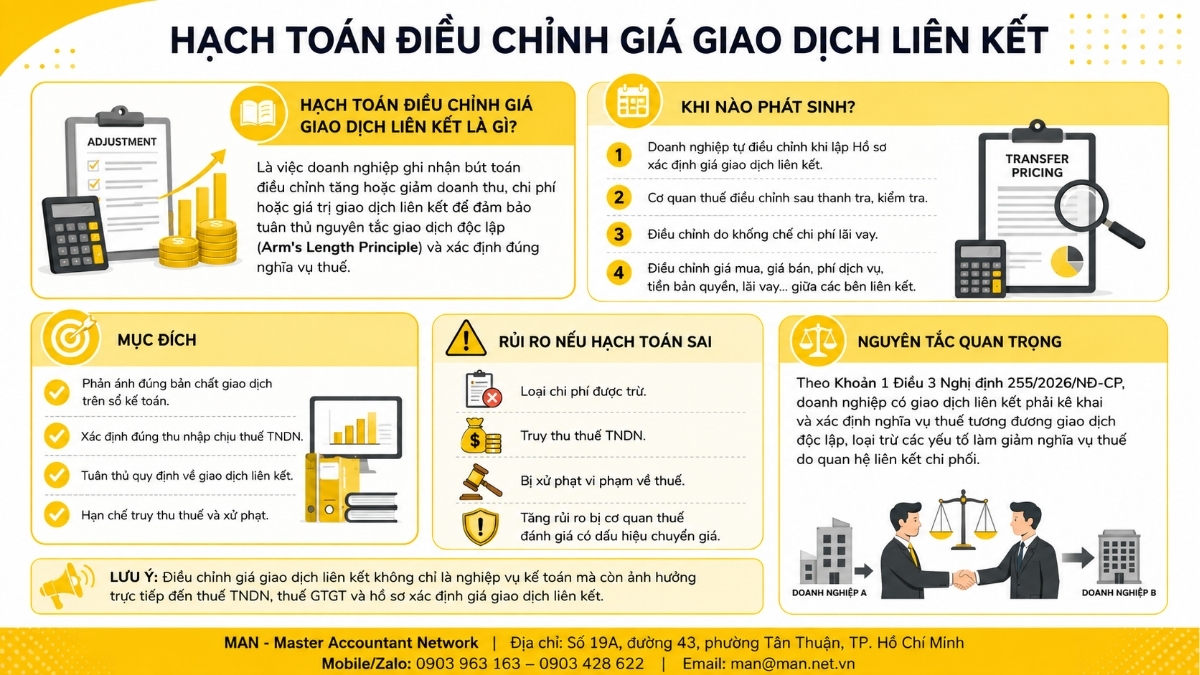
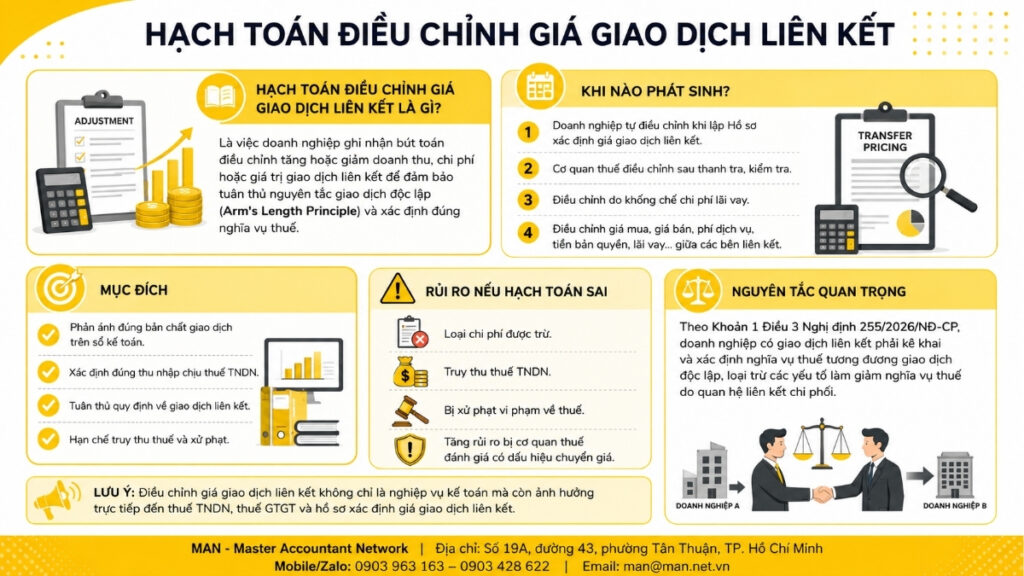
Transfer pricing adjustments are accounting entries made by businesses to reflect adjustments that increase or decrease taxable income, expenses, or the value of related-party transactions in accordance with tax management laws, in order to ensure that the transaction complies with the arm's length principle.
Simply put, this involves adjusting accounting or tax figures when the transaction price between related parties does not match the price that independent parties would agree on under similar conditions.
When does accounting for adjustments to transfer pricing occur?
Some common cases include:
- Business self-adjustment When preparing transfer pricing documentation, the goal is to bring profit margins to a level consistent with the arm's-length principle.
- Tax authorities set or adjust Following an inspection and audit, it was determined that the transfer pricing was inappropriate.
- Adjustments due to controlling interest expense according to regulations on related-party transactions.
- Adjusting purchase prices, selling prices, service fees, royalties, interest rates, etc., between affiliated parties.
The purpose of accounting adjustments is to:
- Ensure that financial statements and accounting records accurately reflect the nature of the transactions.
- Accurately determine taxable corporate income.
- Comply with tax management regulations for related-party transactions.
- Minimize the risk of tax arrears and penalties.
The key point: Taxpayers with related-party transactions must declare and determine their tax obligations for related-party transactions equivalent to independent transactions under the same conditions, excluding factors that reduce tax obligations due to the influence of the related-party relationship. Specifically, Clause 1, Article 3 of Decree 255/2026/ND-CP stipulates:
Taxpayers with related-party transactions must exclude factors that reduce tax liability due to the influence or impact of the related-party relationship in order to declare and determine tax liability for related-party transactions equivalent to independent transactions under the same conditions.
This is the foundation for understanding why all subsequent adjustments to the GDLK price must revolve around the principle of independent market pricing.
For example: Company A sells goods to its parent company overseas for 900 million VND, while a comparative analysis shows the independent transaction price to be 1 billion VND. In that case:
- Revenue according to accounting records: 900 million VND.
- Revenue based on the standalone transaction principle: 1 billion VND.
- Businesses must adjust their taxable income upwards by 100 million VND (if applicable according to regulations).
This adjustment may only affect corporate income tax or simultaneously generate accounting entries, depending on the specific case and legal basis.
Note: Not all related-party transaction price adjustments are recorded the same way. The accounting method depends on: the nature of the adjustment (revenue, expenses, interest expense, cost of goods sold); when the discrepancy is discovered (during the year or after closing); and whether the adjustment is made by the company itself or based on a conclusion from the tax authorities.
Distinguishing between “trued-up” and “trued-down” in related-party transaction price adjustments.
In international transfer pricing practice, two terms commonly used to describe the nature of adjustments are “trued-up” and “trued-down”:
- Trued-up (adjusted upwards): When the actual business results of the affiliated company fall below the profit margin or price based on independent market pricing principles, an upward adjustment is needed to bring it back to the appropriate range.
- Trued-down: When actual business results exceed the profit margin or price based on the principle of independent market pricing, a downward adjustment is theoretically necessary.
Distinguishing between these two types of adjustments is crucial because not all trued-down cases are accepted by the tax authorities, especially when the adjustment occurs after the tax settlement date and reduces the tax liability.
Legal principles to follow when accounting for price adjustments in related-party transactions.

The principle of reciprocal recognition at both sides of the transaction.
One of the most important principles when accounting for transfer pricing adjustments is that any price adjustments for related-party transactions arising at the end of the year (whether trued up or trued down) must be recognized and accounted for in the accounting books of both parties involved in the transaction; it cannot be unilaterally adjusted by only one party.
This matching principle ensures consistency in data, avoiding discrepancies between the financial statements of the buyer and seller in the same related-party transaction, and serves as an important basis for explaining matters to the tax authorities when necessary.
The principle of independent market prices serves as the basis for adjustment.
All price adjustments for related-party transactions must be based on the Arm's Length Principle. Decree 255/2026/ND-CP further affirms this principle when determining pricing methods. The determination of price levels, profit margins, or profit allocation ratios is based on the analysis of independent comparable entities to serve as a basis for comparison and application in determining the corporate income tax liability of taxpayers, without reducing the tax liability payable to the state budget.
At the same time, the calculation method must be applied consistently throughout the entire production and business cycle, in accordance with the function and business model of the enterprise, avoiding arbitrary changes in methods from period to period solely for the purpose of optimizing the amount of tax payable.
In other words, the accounting for adjustments to transfer pricing cannot be arbitrary, based on the subjective will of the enterprise or the goal of tax optimization. Instead, it must accurately reflect the economic nature and be based on appropriate comparisons with comparable independent transactions.
Requirements for accompanying transfer pricing documentation.
In parallel with accounting, businesses need to note that all related-party transaction price adjustments must be supported by complete related-party transaction pricing documentation, clearly showing the pricing methodology, comparative data, and the basis for calculating the adjustment. This is a crucial point that helps businesses demonstrate the reasonableness of the adjustment when requested by the tax authorities for explanation.
For businesses that do not have the internal resources to prepare themselves, related party transaction documentation service Professionals like MAN will help ensure that records are consistent with accounting data and meet the requirements of the tax authorities.
Three common forms of related-party transaction price adjustments and their corresponding accounting methods.
In practice, there are three most commonly applied forms of transfer pricing adjustments. Understanding the nature of each form is the first step to accurately accounting for transfer pricing adjustments.
Option 1: Adjusting the purchase price of goods downwards.
This is a case where a business discovers that the purchase price of goods and services from related parties during the year is higher than the price based on independent market principles, and needs to adjust it downwards. Essentially, this adjustment reduces the cost of goods sold or the value of inventory (depending on the recording time, whether the goods have been sold during the period or are still in inventory at the time of adjustment).
When accounting for transfer pricing adjustments using this method, businesses need to clearly identify:
- Time of adjustment (during the fiscal year or after the closing and settlement of accounts);
- Affected parties: Cost of goods sold, inventory, or fixed assets (if the imported goods are machinery or equipment);
- Supporting documents: Adjustment invoices, price adjustment agreements between related parties, and debt reconciliation statements.
Form 2: Adjusting the selling price of goods upwards.
Conversely, when the selling price of goods and services to related parties during the year is lower than the price based on the principle of independent market pricing, the enterprise needs to adjust its revenue accordingly. This adjustment increases the enterprise's tax liability (increased revenue, increased taxable income).
When accounting, businesses need to pay special attention to issuing adjustment invoices correctly according to regulations, ensuring consistency between accounting data, VAT tax declaration data, and related-party transaction pricing records.
Form 3: Compensation
Unlike the two forms above, which are directly tied to a specific purchase or sale transaction, compensation is typically used when adjustments cannot be linked to a specific shipment or invoice, but rather represent an overall offset for an entire period or line of products or services. This is a common practice in contract manufacturing companies or limited-risk distribution companies, where the parent company commits to guaranteeing a minimum profit margin for its subsidiary under an internal transfer pricing policy.
When accounting for price adjustments in the form of compensation, businesses need to be aware that the nature of this revenue or expenditure is not tied to specific goods or services. Therefore, the identification of supporting documents and invoices (if any) and the method of recording them in the income statement must be carefully considered to avoid confusion with normal business revenue or expenses.
Important considerations when accounting for adjustments to related-party transaction prices.

Prioritize accounting for the adjustment in the main business operations.
A key principle of practice is that price adjustments for related-party transactions should be prioritized for accounting under the company's core business operations, rather than under other income or expense categories. This accurately reflects the economic nature of the transaction, which is essentially an adjustment to the purchase or sale price of goods or services within the core business, while also avoiding the risk of tax authorities questioning the legitimacy of intentionally classifying large price adjustments as extraordinary income or expenses.
Identify the spillover effects on other tax categories.
Accounting for transfer pricing adjustments goes beyond corporate income tax. Businesses need to proactively identify the potential impact of these adjustments on other taxes such as value-added tax (VAT) and customs duties (on goods imported and exported between related parties).
For example: A downward adjustment in the price of imported goods may necessitate a readjustment of the declared customs value, while an upward adjustment in the selling price may result in additional declaration and payment of output VAT. Therefore, before deciding on the adjustment and accounting mechanism, businesses should comprehensively review all relevant taxes to select the most suitable option and avoid overlapping risks.
The adjustments must be recorded in the accounting books of both parties.
This is the overarching principle: Year-end price adjustments for related-party transactions (trued-up, trued-down) must be recorded in the accounting books of both parties involved. If only one party records the adjustment while the other does not, this inconsistency can become a primary point of suspicion when tax authorities conduct audits of international transfer pricing.
Legal risks associated with conducting "true-down" transactions after settlement.
This is a point that any business performing transfer pricing adjustments needs to pay particular attention to:
- Current regulations do not accept true-down transactions. after settlement, if such adjustment reduces the declared tax liability. The principle of "not reducing the tax liability payable to the state budget" is consistently stipulated in Decree 255/2026/ND-CP, and the tax authority has the right to make adjustments to determine the correct tax liability if it discovers that the transaction does not comply with the principle of independent market price.
This means that if a business waits until after the tax settlement period to make adjustments to reduce related-party transaction prices in order to lower corporate income tax payable, there is a very high probability that the tax authorities will not accept this adjustment during an audit or inspection.
Consequences if businesses fail to properly assess the nature of transactions.
If a business adjusts the price of related-party transactions without properly assessing the timing, nature, and legal basis of the adjustment, the consequences may include: the adjustment being excluded from taxable income, being subject to retroactive collection of corporate income tax, being charged late payment penalties, and even being subject to administrative penalties for tax violations if the tax authorities determine that there was intentional misdeclaration aimed at reducing tax obligations.
Conclude
Given the complexity and high risk of related-party transactions, businesses should establish a close coordination mechanism between their accounting, tax, and legal departments, and consider consulting with a specialized and experienced transfer pricing consultancy firm such as MAN – Master Accountant Network before making significant adjustments to related-party transaction prices. Thorough preparation at the beginning of the fiscal year, rather than rushing to the tax settlement date, is key to ensuring compliance with legal regulations, optimizing resources, and avoiding unnecessary tax risks.
If a business is unsure about the appropriate course of action, please refer to the following. related party transaction advisory services Specialized and experienced units like MAN – Master Accountant Network will help review internal pricing policies, accurately assess the nature of each adjustment, and develop safe accounting and declaration plans before the tax season. Thorough preparation at the beginning of the fiscal year, instead of rushing to address issues at the tax settlement time, is key for businesses to comply with legal regulations, optimize resources, and avoid unnecessary tax risks.
Contact MAN – Master Accountant Network For expert support and advice!
Contact information MAN – Master Accountant Network
- Address: No. 19A, Street 43, Tan Thuan Ward, Ho Chi Minh City
- Mobile/Zalo: 0903 963 163 – 0903 428 622
- E-mail: man@man.net.vn
- Google Business Profile: View MAN – Master Accountant Network's Google Business Profile
- LinkedIn Founder: View expert Le Hoang Tuyen's LinkedIn profile.
Responsible for production and professional content review by: Mr. Le Hoang Tuyen – Founder & CEO of MAN – Master Accountant Network. He is a CPA Vietnam auditor with over 30 years of in-depth experience in accounting, auditing, taxation, and corporate legal consulting.
Frequently Asked Questions about Accounting Adjustments for Related-Party Transaction Prices
Does accounting for adjustments to transfer pricing apply to all businesses?
No. This regulation only applies to businesses that have transactions with related parties according to the criteria of tax management law. Businesses without related-party transactions are not required to comply with the regulations on determining transfer pricing.
What risks might a business face if it does not adjust for related-party transaction prices?
Businesses may face numerous risks, such as having transaction prices reassessed by tax authorities; being subject to back taxes on corporate income; being penalized for administrative violations related to tax collection; or incurring increased compliance costs when having to explain or undergo audits of related-party transactions.
When should the adjustment of transfer pricing be recorded?
As a general principle, businesses should make adjustments and accounting entries within the fiscal year, prior to the corporate income tax settlement period.
Does accounting for adjustments to transfer pricing affect the financial statements?
Not every adjustment results in changes to the financial statements. If the adjustment only serves the purpose of determining taxable income, the business may only need to make the adjustment on the tax return. Conversely, if the adjustment changes the value of revenue, expenses, or assets according to accounting standards, it must be recorded in the accounting books and financial statements.
Does adjusting transfer pricing affect corporate income tax?
Yes. This is the primary objective of adjusting transfer pricing. The adjustment can increase or decrease taxable income, thereby directly impacting the amount of corporate income tax payable for the period.