





Service fees between related parties are the most questioned item in any transfer pricing audit, and Decree 255/2026/ND-CP Effective from July 1, 2026, the regulations further tighten deduction requirements with a very specific set of conditions and five categories of expenses that are outright disallowed. A vaguely worded management service contract, an annual fee invoice without proof of services rendered, or a fee charged twice by two companies within the same group can all be completely disallowed as deductible expenses. This article reviews the legal basis in Clause 2, Article 16, the six-step review process, the supporting documentation, and the most common mistakes.
Why are service fees between related parties such a closely scrutinized item?
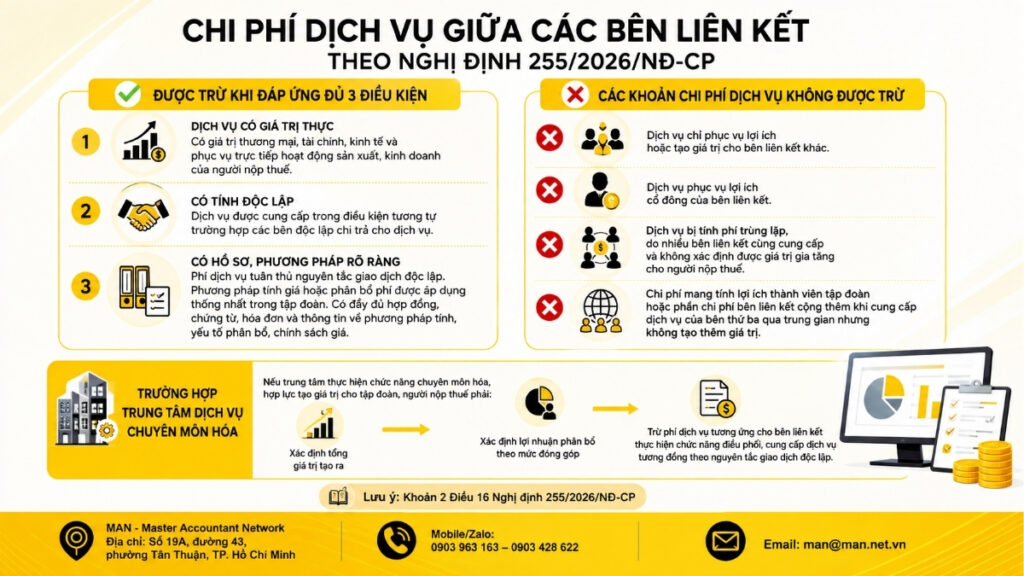
Inter-party service fees are fees paid by a business to its parent company, subsidiary, or other related parties for management, technical, financial, human resources, information technology, marketing, and other support services. Clause 2 of Article 16 of Decree 255/2026/ND-CP only allows deduction of these expenses when they meet the conditions regarding actual economic value, independence of the fee amount, and supporting documentation.
In other words, this is the only expense within the related-party transaction group that a business must substantiate with two layers of documentation simultaneously:
- The service must be genuine;
- And it delivers real value, while the fees are in line with the principles of independent trading.
Important Note: If either of the two criteria is missing, the expenditure will be disqualified.
Decree 255/2026/ND-CP replaces the old legal framework from July 1, 2026.
On June 30, 2026, the Government issued Decree 255/2026/ND-CP regulating tax management for related-party transactions of enterprises with related-party relationships, effective from July 1, 2026, and applicable to the corporate income tax period of 2026. This Decree inherits and replaces the previous regulatory framework in Decree 132/2020/ND-CP and Decree 20/2025/ND-CP.
The conditions for deductions still revolve around three familiar pillars: actual commercial value, independent benchmarks, and consistency of allocation methods across the group, along with the obligation to submit documentation from the time of filing.
How to identify relationships Article 5 is further clarified, meaning that the group of businesses required to account for related-party service costs in 2026 is likely to be broader than in previous years, including entities that previously believed they were outside the scope of regulation.
Three financial consequences when an internal service fee claim is rejected:
- Back taxes on corporate income tax: The disallowed service fees increase the taxable income for that period. At the standard tax rate, for every 10 billion VND of disallowed fees, approximately 2 billion VND in additional tax is generated.
- Late payment interest accrues over time: Errors from the 2026 period, if only discovered in 2029, will result in late payment interest calculated from the time the payment should have been due.
- Risk of spillover to other taxes and periods: Non-existent or value-added services often lead to a review of deducted contractor taxes, and set a precedent for tax authorities to expand the scope of audits to adjacent periods, as internal service contracts rarely last only one year.
See also: New points in Decree 255/2026/ND-CP regarding related-party transactions.
Legal basis: Clause 2, Article 16 of Decree 255/2026/ND-CP

Clause 2 of Article 16 concerns the determination of expenses for tax calculation purposes for enterprises with related-party transactions. This clause comprises two points:
- Regulations specifying the conditions under which deductions are allowed;
- And list the items that are not deductible.
Point a, Clause 2, Article 16
Conditions for deductible service fees between related parties:
Except for expenses specified in point b of this clause, taxpayers may deduct service fees from their taxable expenses for the period if the following conditions are met: The service provided has commercial, financial, and economic value and directly serves the taxpayer's production and business activities; the service from related parties is determined to have been provided under similar circumstances as independent parties would pay for these services; the service fee is paid on the basis of the arm's length principle and the method of calculating transfer pricing or allocating service fees among related parties must be applied uniformly throughout the group for similar types of services; and the taxpayer must provide contracts, documents, invoices, and information on the calculation method, allocation factors, and pricing policy of the group for the service provided.
Specific regulations for centers of specialization and synergy to create added value.
Point (a) also includes a section dedicated to the group's integrated service center model:
In cases involving centers performing specialized functions and synergistically creating added value for the group, taxpayers must determine the total value generated from these functions, and determine the appropriate profit allocation based on the value contributed by the affiliated parties after deducting (-) the corresponding service fees for the affiliated party performing the coordination and service provision functions of independent transactions of a similar nature.
This section applies to familiar models:
- Centralized shopping centers;
- Shared service center;
- Regional Research and Development Center;
- Cash flow management center.
Businesses must not only demonstrate the fees, but also... quantify total added value This collaborative function generates profits, which are then distributed according to the value of each party's contribution, after deducting the service fee paid to the coordinating party.
This is the most labor-intensive category of cases and also the one where service fees between related parties are most susceptible to manipulation, as the added value is always a quantifiable indicator.
Point b, Clause 2, Article 16
Specifically, there are five groups of service fees between related parties that are not deductible:
| No. | Excluded expense group | Recognizing reality |
| 1 | The service is intended solely to serve the interests or create value for other affiliated parties. | Costs for preparing consolidated financial statements for the group; internal audits to meet the requirements of the parent company. |
| 2 | Services that serve the interests of the related party's shareholders. | Costs include parent company shareholder meetings, investor relations, listing, and compliance with legal regulations in the parent company's location. |
| 3 | Double billing occurs when multiple parties provide the same type of service, without defining the added value. | The same IT service is charged by both the global headquarters and the regional headquarters. |
| 4 | The service is, by its very nature, a benefit of being a member of the corporation. | Passive brand advantage, group credit reputation, the right to be recognized as a member company. |
| 5 | The additional charges for services provided by third parties through intermediaries or affiliates that do not add value. | The parent company purchases insurance, software, and consulting services from independent providers and then recalculates the costs for the subsidiary with purely mark-up. |
Evaluating service costs among affiliated parties.
Carefully reading points a and b reveals that both revolve around the same question. The entire logic of paragraph 2 of Article 16 can be reduced to a single test.
So who are the real beneficiaries?
Before each service fee entry, the tax authorities will review and raise the following questions:
- Was this service actually performed? Were there any email exchanges, meeting minutes, handover reports, timesheets, or lists of participating personnel?.
- Who is the beneficiary? If the primary beneficiary is the parent company or another affiliated party, the expenditure falls under group 1 or group 2 of point b.
- Would an independent party in similar circumstances be willing to pay this fee? If the answer is no, either because they can do it themselves or because the service is not necessary, then the second condition of point a is not met.
Next, we move on to the pricing step: whether the fees are consistent with the arm's-length principle and whether the allocation is consistent across the entire group.
Distinguish between substantive service and activities that serve shareholders and the interests of corporate members.
This is the dividing line that causes many service fee claims between affiliated parties to be rejected, even if the service was genuine.
- Activities related to public relations: These are activities undertaken by the parent company in its capacity as owner: preparing consolidated financial statements, complying with disclosure obligations in the listed market, organizing board meetings, and covering the costs of raising capital for the parent company itself. The subsidiary does not place orders for these activities and does not have a direct interest, so any allocated fees will be excluded.
- The benefits of being a member of a conglomerate are passive: greater trust from suppliers due to the conglomerate's name, and better credit ratings from banks because of a strong parent company. No one does anything specific for the subsidiary, so there is no basis for charging fees.
- Substantive service: Involves specific requirements, personnel to perform the service, a delivered product, and a measurable impact on the subsidiary's business operations.
Practical example: Breaking down service costs between related parties.

Company B (manufacturer of consumer goods in Vietnam, foreign-owned, 100%) recorded a total service fee paid to related parties in the 2026 tax period of VND 30 billion. The review results are as follows:
| Item | Amount (billion VND) | Conclude |
| Production engineering services, process transfer. | 12 | Deductible, documented handover, measurable impact. |
| IT services for ERP system operation. | 6 | Deductible, factor allocated based on number of users, consistent across the entire corporation. |
| Allocation of costs for consolidated financial reporting and corporate audit. | 4 | Disqualified, serving the interests of the related party's shareholders. |
| Regional marketing service fees are the same as global marketing service fees. | 5 | Disqualified, double charging, failure to demonstrate unique added value. |
| The mark-up 10% on insurance premiums purchased from independent providers through the parent company (original insurance premiums accounted for separately, not included in the 30 billion VND) | 3 | With all the extra value removed, the intermediary adds no further value. |
Result: The non-deductible portion of service fees between related parties is VND 12 billion. Company B adjusted its taxable income upwards by VND 12 billion for the period 2026, corresponding to approximately VND 2.4 billion in additional corporate income tax, and this entire amount cannot be carried forward to the next period.
This is the core difference compared to the mechanism. controlling interest expense, The interest expense exceeding the 30% EBITDA threshold can be deferred for a maximum of 5 years, while the disallowed service fee is forfeited entirely.
In the case of duplicate service charges from two affiliated parties.
Company B's 5 billion VND marketing budget deserves careful analysis, as this is the most common type of error in corporations with a three-tiered structure (global – regional – national).
The global headquarters charges for “brand and marketing services” as a percentage of revenue. The Asia regional headquarters adds “regional marketing support,” also based on revenue. Both contracts are genuine, both have invoices, and both have been paid. However, when the inspection team requested that the regional headquarters demonstrate the differences between the work performed by the global headquarters and that performed by the global headquarters, the company failed to produce separate deliverables.
Point b, Clause 2, Article 16 precisely classifies this case as duplicate fee-based services provided by multiple affiliated parties for the same type of service, where the added value for the taxpayer cannot be determined.
If a business can demonstrate that its regional office conducts local market research, produces Vietnamese-language content, and works with local agencies, while its global headquarters only develops the brand identity, then the two fees can exist side-by-side legitimately.
In the case of additional charges for services provided by a third party.
The 3 billion VND mark-up also needs to be read correctly. Point b does not exclude all expenses for purchasing services through affiliated intermediaries. What is excluded is the portion of the cost added by the affiliated party when that intermediary does not contribute additional value to the service.
This means that the original insurance premium collected by the independent provider is still a valid expense if it directly serves the operations of Company B. Only the additional 10% is excluded, because the parent company only acts as a forwarder of the invoice.
Conversely, if the parent company actually performs centralized negotiation, supplier management, and bears payment risks, thereby reducing unit prices for the entire group, then the additional cost reflects true value and is deductible, provided that the corresponding function, assets, and risks can be demonstrated. The line lies in whether the intermediary contributes value, not in whether or not there is markup.
Documentation proving service fees between related parties submitted to the tax authorities.
Point a, Clause 2, Article 16 explicitly states the obligation to provide documentation. The minimum set of documents should include:
- Service contract: Clearly describe the scope of work for each type of service, the term, and the pricing mechanism, avoiding vague framework contracts like "management support services".
- Invoices and payment documents: Must match the contract and service period.
- Proof of service provided: Handover report, acceptance report, timesheet, email correspondence, training materials, meeting minutes, list of participating personnel with job titles.
- Explanation of pricing methodology: This serves as the basis for confirming that the fee level is consistent with the arm's-length principle.
- Allocation Factor Spreadsheet: Shows the allocation criteria, input data, and evidence that these criteria are applied consistently to other member companies within the group.
- The corporation's pricing policy: For services provided, which are typically documented by the regional tax authority, advance requests are required.
- Transfer pricing documentation (Country documentation, Global documentation, Country-by-Country Profit and Loss Report): If not included Exempt cases, in which the functional analysis must clearly explain why the company in Vietnam needs those services.
Errors that cause service fees between related parties to be disallowed during audits.

Through consulting and serving over 500 businesses with related-party transactions, MAN – Master Accountant Network has compiled and summarized common mistakes that lead to the disallowance of service fees between related parties during audits. Specifically:
- The framework service contract does not describe the scope of work;
- Do not separate shareholder services from service fees;
- The allocation factor is inconsistent or does not reflect the level of benefit received;
- Only the invoice, no proof of service;
- Internal service fees are charges that can be carried forward.
To proactively avoid risks and prevent expense exclusions, businesses should consider consulting the following: related party transaction advisory services This allows MAN's affiliate trading team to support and collaborate with businesses.
Conclude
In summary, service fees between related parties must be real and directly serve the taxpayer's operations, and the fee level must be consistent with the arm's length principle and allocated consistently across the entire group.
Here are three things businesses need to keep in mind:
- Contracts and invoices cannot replace proof of services performed;
- The five expense categories at point b, including services for other affiliated parties, services for shareholders, duplicate services, corporate member benefits, and intermediary premiums, need to be proactively separated before the tax authorities conduct their work.;
- The disallowed fee is lost permanently; there is no carry-forward mechanism like with excess interest expense.
In other words, the quality of service cost allocations between related parties is determined from the time the contract is signed and the service is operational, not at the time of filing the final settlement statement. Businesses that begin standardization early will have sufficient time to restructure contracts, agree on allocation factors with the group, and accumulate evidence quarterly.
If your company's internal service fee report for 2026 still has uncertainties ranging from defining the scope of services between different tiers within the corporation, evaluating attribution factors, to preparing proof of service.
Contact MAN – Master Accountant Network For free consultation and review assistance.
Contact information MAN – Master Accountant Network
- Address: No. 19A, Street 43, Tan Thuan Ward, Ho Chi Minh City
- Mobile/Zalo: 0903 963 163 – 0903 428 622
- E-mail: man@man.net.vn
- Google Business Profile: View MAN – Master Accountant Network's Google Business Profile
- LinkedIn Founder: View expert Le Hoang Tuyen's LinkedIn profile.
Responsible for production and professional content review by: Mr. Le Hoang Tuyen – Founder & CEO of MAN – Master Accountant Network. He is a CPA Vietnam auditor with over 30 years of in-depth experience in accounting, auditing, taxation, and corporate legal consulting.
Frequently Asked Questions about Service Fees Between Affiliates
What conditions must be met for service fees between related parties to be deductible?
The service must have commercial, financial, and economic value and directly serve the business operations of the taxpayer; it must be determined that the service was provided under similar conditions and circumstances, with independent parties paying for it; the service fee must be paid on the basis of the arm's length principle and the related-party pricing method, or a uniform fee allocation applied across the entire group for similar services; and the taxpayer must provide contracts, documents, invoices, and information on the calculation method, allocation factors, and pricing policy of the group.
Which service fees are excluded when determining taxable income?
Costs incurred from services solely for the benefit or value creation of other related parties; services that benefit the shareholders of the related party; duplicate fees charged by multiple related parties for the same type of service without a defined added value; services that are essentially benefits received from membership in the group; and costs that an related party adds to services provided by a third party through the related party that do not contribute additional value.
Are management fees paid to the parent company automatically deductible?
No. A management fee typically contains many different components, which may include activities serving the interests of shareholders or corporate members. Businesses need to break it down by service type and provide separate documentation for each component.
Can service fees between affiliated parties that are disallowed be carried forward to the next period?
No. Clause 2 of Article 16 does not establish a transitional mechanism. This is different from the portion of interest expense exceeding the 30% EBITDA threshold.
How should we handle purchasing services from third parties through the parent company?
The portion of the original service fee provided by a third party may still be deductible if the conditions in point a are met. However, the additional portion from the affiliated party will be disallowed if that intermediary does not contribute additional value to the service.