





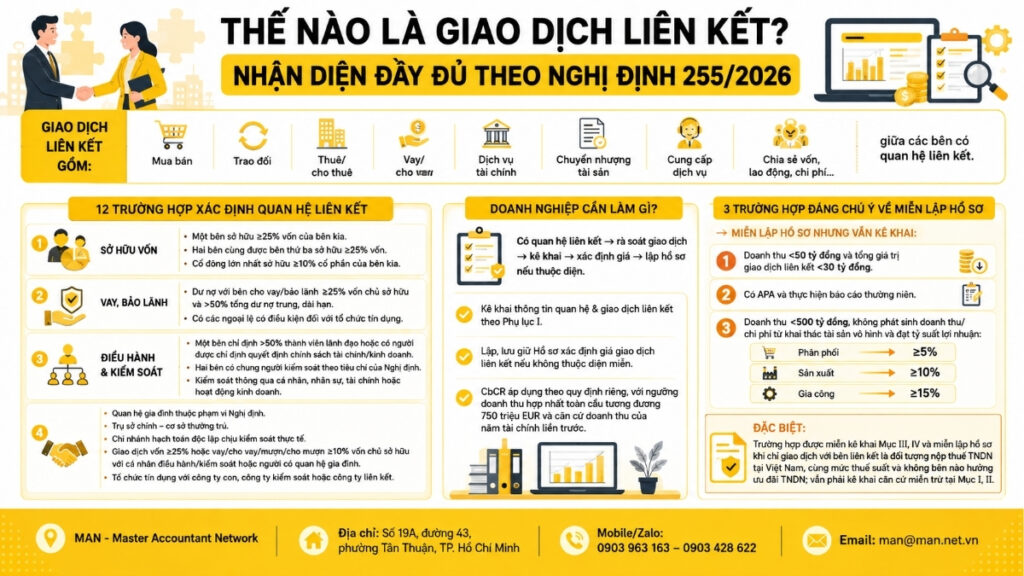
What constitutes a related-party transaction is the first question any chief accountant or CFO must answer before undertaking any tax management obligations related to related businesses. From July 1, 2026, when Decree 255/2026/ND-CP Officially replacing the old legal framework and effective from the 2026 corporate income tax period, the scope of identifying related-party relationships is now clearly and more detailed. Incorrect identification can lead to consequences regarding declaration obligations, documentation, and the risk of tax assessment. This article systematically reviews the entire legal basis, 12 forms of related-party relationships, and the self-assessment process to help businesses proactively prepare for the tax settlement period.
What are related-party transactions?
Affiliate transactions These include transactions involving the buying, selling, exchanging, leasing, lending, and transferring of goods, assets, and services; loan and lending transactions; financial services; and agreements for the shared use of resources such as capital, labor, and expenses, carried out between related parties, excluding transactions subject to state price regulation under the law on pricing.
In other words, answering this question correctly is not simply a matter of answering it; it's the first step that determines the entire chain of obligations that follow, from declaring related-party relationships and preparing documentation for determining transfer pricing, to applying the 30% EBITDA interest expense limit. An incorrect answer at this stage will lead to discrepancies in all subsequent steps.
How does Decree 255/2026/ND-CP change the way related-party transactions are identified?

Decree 255/2026/ND-CP on tax management for related-party transactions of enterprises with related-party relationships was issued by the Government on June 30, 2026, effective from July 1, 2026, and applicable from the corporate income tax period of 2026, replacing Decree 132/2020/ND-CP and Decree 20/2025/ND-CP.
Key points to note: The framework of 12 forms of affiliated relationships in Article 5 has been rephrased in more detail, adding specific criteria regarding loan ratios, shareholding ratios, and conditional exceptions for independent credit institutions.
Reference: New points in Decree 255/2026/ND-CP regarding related-party transactions.
What constitutes an affiliated party? Twelve forms of affiliated relationships according to Article 5.

Answering the question of what constitutes a related-party transaction is inseparable from answering the second question: what constitutes a related party? Article 5 of Decree 255/2026/ND-CP lists 12 forms, from point a to point m, each reflecting a way in which one party can influence, control, or share economic benefits with another party.
Criteria group regarding equity ownership
The criteria for equity ownership are as follows:
- An enterprise directly or indirectly holds at least 25% of the equity of the owner of the other enterprise.
- Both businesses have at least 25% of owner's equity held directly or indirectly by a third party.
- One business is the largest shareholder in terms of owner's equity and directly or indirectly holds at least 10% of the total shares of the other business.
These three criteria cover most cases involving parent-subsidiary companies, companies within the same group, or businesses with controlling shareholders. The 25% and 10% thresholds are quantitative benchmarks that should be immediately referenced whenever a business undergoes any changes in its shareholder structure.
Criteria group regarding guarantees, loans, and exceptions for independent credit institutions.
An entity that guarantees or lends capital to another entity in any form (including third-party loans secured by the financial resources of an affiliated entity) is considered an affiliated entity if the total outstanding debt of the borrowing entity to the lending or guaranteeing entity is at least equal to 25% of the owner's equity of the borrowing entity and exceeds 50% of the total outstanding debt of all medium and long-term liabilities of the borrowing entity.
This is the most often confusing criterion, as businesses easily assume that "bank loans are independent transactions." In reality, the Decree stipulates three conditional exceptions:
- The guarantor or lender is a credit institution as defined by the Law on Credit Institutions, which does not directly or indirectly participate in the management, control, capital contribution, or investment in the borrowing enterprise or the guaranteed enterprise according to other criteria of Article 5.
- The guarantor or lender is a credit institution, and the borrowing or guaranteed enterprise is not under the same management, control, capital contribution, or investment of another party.
- The creditor/guarantor is a state-owned organization with charter capital of 100% whose function is to buy, sell, and process debt, but does not participate in the management, control, or capital contribution of the debtor's enterprise.
In other words, the exception for credit institutions is a conditional exception, not a default one. Businesses need documentation proving that the lending bank is not involved in management, control, or capital contribution; they cannot simply assume otherwise.
Criteria group regarding personnel management, control, and family relationships.
Specifically:
- An enterprise may appoint a member of the executive board or control of another enterprise, provided that the number of appointed members exceeds 50% of the total number of executive board members of the second enterprise, or that a appointed member has the authority to decide on the financial policy and business operations of the second enterprise.
- Two companies may have more than one 50% board member, or both may have a board member with the authority to make decisions on financial or operational policies, appointed by a third party.
- Two businesses are managed or controlled in terms of personnel, finance, and business operations by individuals with family relationships (spouses; parents and children; grandparents and grandchildren; siblings; aunts, uncles, and nieces/nephews, as specified in the Decree).
- The two businesses have a head office and permanent establishment relationship, or both are permanent establishments of a foreign organization or individual.
- Businesses are controlled by an individual through that individual's capital contribution to the business or direct involvement in its management.
- Other cases involve situations where one business (including independently accounting branches) is subject to the de facto management, control, and decision-making power over the business operations of another business.
This set of criteria shows that the relationship extends beyond just the percentage of equity ownership to encompass actual managerial power, even in the absence of any direct equity ownership relationship.
Specific criteria regarding capital contributions and borrowing by individual managers.
Specifically:
- Businesses that have transactions involving the transfer or acquisition of at least 25% of owner's capital contributions during the tax period; or borrowing, lending, or lending at least 10% of owner's capital contributions at the time of the transaction with individuals managing or controlling the business or with individuals related to the family as specified in point g.
- Credit institutions with their subsidiaries, controlling companies, or affiliated companies as defined by the Law on Credit Institutions.
Points to noteBecause this is the only criterion associated with transactions occurring during the period, rather than a stable ownership structure. A loan or borrowing that is not large in absolute value, but reaches a ratio of 10% of the owner's equity at the time of occurrence, between the business and the individual operator, is sufficient to create an affiliated relationship for that tax period, even if the two parties had no prior ownership relationship.
A practical example of identifying related-party transactions in a foreign-invested enterprise.
Company B (100%, foreign-owned, engaged in processing activities) has the following relationships in the 2026 tax period:
| Customers | The nature of the relationship | Rate/Condition |
| Overseas parent company | Direct equity ownership | 100% capital contribution |
| Domestic commercial banks | Working capital loans | Not involved in the management or control of Company B. |
| Mr. Nguyen Van X - General Director of Company B | Borrowing money from individuals to supplement short-term working capital. | The loan amount is equal to 12% of the owner's equity at the time of borrowing. |
Analysis:
- With the parent company: The related party relationship is established immediately under point a, clause 2, Article 5, because the ownership ratio of 100% far exceeds the threshold of 25%. All buying and selling transactions, fee payments, and loans between the two parties are considered related party transactions.
- For commercial bank A: If the bank does not participate in the management, control, capital contribution, or investment in Company B, this loan... Are not This creates a related-party relationship, regardless of the loan amount, provided that Company B has supporting documentation (bank confirmation, credit agreement without management control clauses).
- Regarding Mr. Nguyen Van X: The loan amounted to 12% of owner's equity., Exceeding the threshold of 10% As stipulated in point l, clause 2, Article 5, since Mr. X is the General Director and the individual managing the business, this loan transaction creates a related-party relationship specifically for that tax period, even though the two parties had no prior financial transactions.
Declaration and documentation obligations when a business has related-party transactions.

Once an affiliated party has been identified under Article 5, the enterprise has the obligations under Article 18 of Decree 255/2026/ND-CP:
- Declare information on related party relationships and related party transactions according to Appendix I, submitted together with the Corporate Income Tax Return, in which Section I requires clearly stating the name of the related party, country, tax code and the form of related party relationship corresponding to each point a to m of Article 5.
- Prepare, maintain, and provide Transfer Pricing Documentation, including Country Documentation, Global Documentation (if applicable), and Country-by-Country Reports (if the ultimate parent company or part of a multinational corporation with revenue exceeding €750 million).
- Demonstrate that the analysis, comparison, and selection of the transfer pricing method applied do not reduce the corporate income tax liability payable in Vietnam.
Cases where declaration and documentation for determining transfer pricing are waived.
According to Article 20 of Decree 255/2026/ND-CP, not all businesses with related-party transactions are required to prepare complete documentation:
- Completely exempt from declaration and documentation requirements: When a business only has transactions with related parties that are subject to corporate income tax in Vietnam, the same tax rate applies, and neither party is entitled to tax incentives during the period.
- No need to file a report (but you still have to declare): When total revenue for the tax period is below VND 50 billion and total value of related-party transactions is below VND 30 billion; or the enterprise has signed an Advance Pricing Agreement (APA); or the enterprise does not generate revenue or expenses from the exploitation of intangible assets, has revenue below VND 500 billion and achieves a minimum net profit margin according to the sector (distribution from VND 5%, manufacturing from VND 10%, processing from VND 15%).
See also: Exemptions under Decree 255.
Important Note: Even though exempt from filing, businesses must still correctly determine whether or not there are related-party transactions in order to apply the regulations on the threshold for deductible interest expenses as stipulated in Clause 3, Article 16 of Decree 255/2026/ND-CP. Exemption from the filing requirement does not mean exemption from the obligation to declare Appendix I.
5 common mistakes when defining what constitutes a related party transaction.
Firstly, only direct ownership is reviewed, excluding indirect ownership. Points a and b of Article 5 clearly stipulate that the 25% ratio is calculated including both direct and indirect ownership, through multiple layers of intermediary companies.
Secondly, by default, all bank loans are considered independent transactions. The exception for credit institutions is a conditional exception, requiring documentation proving that the bank does not participate in management, control, or capital contribution.
Third, loans and borrowings from individuals managing the company and their relatives are often overlooked. These are irregular transactions that are easily forgotten during year-end reviews, while the 10% capital contribution threshold is quite low compared to actual business operations.
Fourth, confusion between "having a related party relationship" and "having related party transactions". A business whose parent company owns 100% capital but does not have any purchase, sale, or borrowing transactions with the parent company during the period still has a structural related party relationship, but does not incur the obligation to apply the related party pricing regulations for that period if there are no actual transactions.
Fifth, it is argued that exemption from filing means exemption from all obligations related to related-party transactions. Businesses exempt from filing under Article 20 are still required to declare Appendix I and are still subject to the provisions of Clause 3, Article 16 regarding the threshold for interest expense deductions.
To avoid unfortunate risks that could lead to penalties, back taxes, and even tax assessments for businesses, proactively seeking advice is essential. related party transaction advisory services We rely on specialized, experienced units like MAN – Master Accountant Network to ensure compliance with legal regulations.
Checklist for identifying related-party transactions before the 2026 tax filing period.
Before closing the books for the 2026 tax year, quickly check the following six items:
- Draw a diagram of direct and indirect capital ownership, comparing the thresholds of 25% and 10% at points a, b, and c of Article 5.
- Review all loans and guarantees and determine the ratio to equity and to total medium- and long-term debt in accordance with point d of Article 5.
- There must be documentation proving (if applicable) that the lender is an independent credit institution not involved in the management or control of the business.
- Review leadership personnel and family relationships according to points d, e, and g of Article 5.
- Review all loan, borrowing, and capital contribution transfer transactions arising during the period with the managing individual as per point l of Article 5.
- Clearly identify the cases where businesses are exempt from declaration and documentation requirements under Article 20, and record the grounds for exemption in writing.
Conclude
What constitutes a related-party transaction is no longer a question that can be answered subjectively or based on experience, as Decree 255/2026/ND-CP systematizes the definition in Article 4 and expands and clarifies 12 forms of related-party relationships in Article 5, ranging from capital ownership, loan guarantees, personnel management, to borrowing and lending transactions with individuals managing businesses.
Three most memorable things from the entire article:
- Related-party transactions only arise when there is a related-party relationship that meets one of the 12 criteria of Article 5;
- The exception for independent credit institutions is a conditional exception;
- Documentation is required; it cannot be assumed that the transaction is genuine. Even if exempted from preparing documentation for price determination, businesses must still accurately determine whether or not related-party transactions exist in order to apply the relevant regulations correctly.
If your business is still unsure about identifying related parties, classifying transactions, or preparing Appendix I for the 2026 tax year, MAN – Master Accountant Network's team of related party transaction experts is ready to review it with your business before the books are closed. Identifying them correctly from the start is always easier than having to explain them after an audit.
Contact MAN – Master Accountant Network For free support and advice!
Contact information MAN – Master Accountant Network
- Address: No. 19A, Street 43, Tan Thuan Ward, Ho Chi Minh City
- Mobile/Zalo: 0903 963 163 – 0903 428 622
- E-mail: man@man.net.vn
- Google Business Profile: View MAN – Master Accountant Network's Google Business Profile
- LinkedIn Founder: View expert Le Hoang Tuyen's LinkedIn profile.
Responsible for production and professional content review by: Mr. Le Hoang Tuyen – Founder & CEO of MAN – Master Accountant Network. He is a CPA Vietnam auditor with over 30 years of in-depth experience in accounting, auditing, taxation, and corporate legal consulting.
Answering the question: What is a linked transaction?
What constitutes a related-party transaction according to the latest regulations?
Related-party transactions include the purchase, sale, exchange, lease, rental, borrowing, lending, transfer, and assignment of goods and services; borrowing, lending, financial services, and financial guarantees; transactions involving tangible and intangible assets; and agreements for the shared use of resources between related parties, excluding transactions subject to state price regulation.
Is a business borrowing from a commercial bank considered a related-party transaction?
No, if the lending institution does not directly or indirectly participate in the management, control, capital contribution, or investment in the borrowing or guaranteed enterprise. Conversely, if the loan simultaneously reaches the threshold of 25% of owner's equity and over 50% of total medium- and long-term debt in the context of other control factors, the enterprise falls within the scope of application.
Are loan transactions between businesses and individual executives considered related-party transactions?
Yes, if the loan, borrowing, or lending amounts to at least 10% of the owner's equity at the time the transaction occurs during the tax period, with the individual managing or controlling the business or a relative of that individual within the scope of the family relationship as stipulated.
Can a business with related-party transactions but low revenue be exempt from filing related-party transaction records?
Yes. Businesses with related-party transactions but with total revenue in the period under VND 50 billion and total value of related-party transactions under VND 30 billion are exempt from preparing a Transfer Pricing Documentation File, but must still declare all transactions fully according to Appendix I.
From which tax period does Decree 255/2026/ND-CP apply?
The Decree takes effect from July 1, 2026 and applies from the corporate income tax period of 2026, replacing Decree 132/2020/ND-CP and Decree 20/2025/ND-CP.