





Regulations regarding related-party transactions are the first foundation that any chief accountant or CFO must master before moving on to more detailed tasks such as controlling interest expense, preparing cost identification documents, or filing country-by-country reports. From July 1, 2026, Decree 255/2026/ND-CP officially replace Decree 132/2020/ND-CP And Decree 20/2025/ND-CP introduces several important adjustments regarding the identification of related parties, the threshold for exemption from reporting requirements, and cross-border reporting obligations. This article systematizes all regulations on related-party transactions under the new legal framework, helping businesses gain an overall understanding before delving into specific business operations.
What are the regulations regarding related-party transactions?
Related-party transaction regulations are a system of legal rules issued by the Government and the Ministry of Finance to manage and control transactions between related parties, i.e., businesses with ownership, management, or financial, capital, or personnel dependencies.
According to Decree 255/2026/ND-CP, these regulations help ensure that transaction prices between related parties accurately reflect market prices (the principle of independence), preventing transfer pricing practices aimed at tax evasion or reducing taxable income in Vietnam.
Simply put, regulations on related party transactions are a legal framework that requires businesses with related party relationships to:
- Fully declare information on related transactions
- Prepare transfer pricing documents (Master file, Local file, CbCR)
- Comply with market price principles
Regulations on related-party transactions are a tool that helps tax authorities detect and prevent transfer pricing, and helps businesses fulfill their tax obligations correctly, avoiding legal risks in the context of international integration.
Core legal basis for the regulation of related party transactions

Compliance with regulations on related party transactions in Vietnam is mainly regulated by the following legal documents:
Decree 255/2026/ND-CP, regulating related-party transactions, replaces Decree 132/2020/ND-CP.
On June 30, 2026, the Government issued Decree 255/2026/ND-CP regulating tax management for related-party transactions of enterprises with related-party relationships, effective from July 1, 2026, and applicable from the corporate income tax period of 2026. This Decree simultaneously replaces Decree 132/2020/ND-CP and Decree 20/2025/ND-CP, comprising 4 Chapters and 24 Articles, covering all principles of application, methods of determining related parties, methods of determining prices, determining costs for tax calculation, rights and obligations of taxpayers, responsibilities related to the Country-by-Country Profit Reporting, and responsibilities of state management agencies.
Points to emphasize: The regulations on related-party transactions in Decree 255/2026/ND-CP essentially inherit the foundation of the old legal framework, but clarify and expand on some key contents – from how to identify related-party relationships, the threshold for exemption from filing, to the priority order of comparative data sources and the threshold for submitting Country-by-Country Reports according to international standards.
Scope of application and affected subjects
Regulations on related-party transactions under Decree 255/2026/ND-CP apply to organizations producing and trading goods and services that have transactions with related parties, tax authorities, and other relevant state agencies, organizations, and individuals. The overarching principle is that taxpayers with related-party transactions must exclude factors that reduce tax liability due to the influence of the related-party relationship, in order to declare and determine tax liability equivalent to transactions between independent parties.
Regarding the principles of application, Article 3 of Decree 255/2026/ND-CP directly refers to the tax management principles stipulated in Clause 4, Article 6 and the tax inspection principles stipulated in Clause 1, Article 22 of Law No. 108/2025/QH15 on Tax Administration. This update of the legal basis aims to ensure consistency between the regulations on related-party transactions and the current tax administration legal system.
What are related-party transactions? Updated according to new regulations.
Related-party transactions include the purchase, sale, exchange, lease, rental, borrowing, lending, transfer, assignment of goods, provision of services; borrowing, lending, financial services and other financial instruments; purchase and exchange of tangible and intangible assets; and agreements for the shared use of resources and sharing of costs between related parties, excluding transactions subject to state price regulation under the law on pricing.
This is the first time the concept of related-party transactions has been defined in detail and comprehensively at the Decree level (Clause 1, Article 4 of Decree 255/2026/ND-CP), whereas previously, Clause 18, Article 4 of the 2025 Tax Administration Law only defined related-party transactions as transactions arising between related parties.
In other words, to determine whether a transaction falls within the scope of regulations on related-party transactions, a business needs to answer two questions simultaneously:
- Does the nature of the transaction fall within the categories mentioned above?;
- And are the two parties involved in the transaction related parties according to Article 5?.
Regulations on related-party transactions in identifying related parties.
This is the most crucial part of the entire regulation on related-party transactions, because all obligations regarding declaration, documentation, or control of interest expense only arise when the enterprise is considered to be related. Clause 1 of Article 5 of Decree 255/2026/ND-CP refers to the provisions of Clause 17 of Article 4 of the 2025 Tax Administration Law, while Clause 2 of Article 5 specifically lists the cases that are determined to be related parties.
Group of criteria related to capital and share ownership:
- A business directly or indirectly holds at least 25% of owner's equity in another business.
- Two businesses both have 25% or more of their capital contributed by a third party, either directly or indirectly.
- A business is the largest shareholder, owning directly or indirectly 10% of the total shares of another business.
Group of criteria for borrowing, lending, guaranteeing, taking out loans, and lending:
- Businesses that guarantee or lend capital to other businesses in any form are permitted to do so only when the loan meets two thresholds simultaneously: it must be at least 25% of the owner's equity of the borrowing business and account for over 50% of the total value of the borrowing business's medium and long-term debts.
- Businesses with loan, borrowing, or lending transactions involving at least 10% of owner's equity at the time the transaction occurs during the tax period with individuals managing or controlling the business, or with individuals related to those managing or controlling, are subject to the regulations. This is also the most notable addition of Decree 255/2026/ND-CP compared to the old legal framework: previously, the regulations on related-party transactions only recognized related-party relationships arising from borrowing and lending, not covering borrowing and lending transactions with this group of entities.
Group of criteria related to general management, control, and personal relationships:
- Businesses are all under the direct or indirect management or control of a single organization or individual.
- Individuals with defined family relationships (spouses; biological parents, adoptive parents, stepfathers, stepmothers, parents-in-law; biological children, adopted children, stepchildren, daughters-in-law, sons-in-law; siblings with the same parents or half-siblings; grandparents and grandchildren; aunts, uncles, and nieces/nephews) participating in the management or contributing capital to a business also create an affiliated relationship between the related businesses.
Exclusions for independent credit institutions
One very practical point that regulations on related-party transactions must always clarify is that borrowing from a bank does not automatically create a related-party relationship. Decree 255/2026/ND-CP inherits the principle established from Decree 20/2025/ND-CP. Specifically:
- If a credit institution only provides loans or guarantees but does not participate in the management, control, capital contribution, or investment in the borrowing or guaranteed enterprise, then the loan or guarantee alone does not make the enterprise an affiliated party.
The basis for this principle has also been updated in accordance with the Law on Credit Institutions 2024 (amended and supplemented in 2025).
The decree also adds another similar exclusion case:
- A creditor or guarantor that is a state-owned organization with charter capital and functions in buying, selling, and handling debt, if it does not directly or indirectly participate in the management, control, capital contribution, or investment in the debtor or guaranteed enterprise, is not considered an affiliated party.
Important Note: This is an exception specific to the lender, not a default exception for all bank loans. Businesses need to maintain records proving that the lender is not involved in management, control, capital contribution, or investment, instead of assuming that all loans from credit institutions fall outside the scope of regulations on related-party transactions.
Regulations on related-party transactions in price determination.
The principle of substance over form dictates that price adjustments do not reduce tax obligations.
Throughout the regulations on related-party transactions, the principle of substance over form prevails, meaning that tax authorities analyze related-party transactions based on their actual economic nature, not solely on the legal form expressed in the contract. When the price of a related-party transaction does not conform to the arm's length principle, the taxpayer must adjust the price to market value, and an important principle to remember is that this adjustment must only be made in a way that does not reduce the tax liability of the enterprise.
Database priority order
To analyze, compare, and determine the transfer pricing of related-party transactions, Article 17 of Decree 255/2026/ND-CP stipulates three database sources:
- Commercial database (updated in accordance with Clause 15, Article 4 of the 2025 Tax Administration Law);
- National database (completely new content compared to Decree 132/2020/ND-CP);
- and the tax authority's database.
Important new points: The regulations on related-party transactions under Decree 255 clearly define the order of priority for use. Previously, there were no regulations on the order of priority, leading to differences in how businesses and tax authorities selected data for comparison during audits. Clarifying the order of priority helps minimize disputes and increase consistency in application.
Transfer pricing documentation: Components, exemption thresholds, and deadlines for submission.
Demonstrating compliance with regulations on related-party transactions doesn't stop at the declaration stage; it also involves documentation for determining transfer pricing, which businesses must submit when requested by the tax authorities, typically within 30 working days of receiving the request.
The dossier consists of three components: the Country Profile, the Global Profile, and the Country-by-Country Report.
According to the general structure inherited through the Decree periods, the Transfer Pricing Documentation consists of three components:
- Local File: Information about the business in Vietnam, related-party transactions, and the pricing methods applied;
- Global Profile (Master File): Information about the multinational corporation to which the business is a member;
- Country-by-Country Profit Report (CbCR): This applies only to businesses that meet the global consolidated revenue threshold as stipulated.
Cases exempt from preparing Transfer Pricing Documentation.
Article 20 of Decree 255/2026/ND-CP distinguishes two groups of exemptions in the regulations on related-party transactions:
Exemption from declaration and document preparation.
This applies when a taxpayer only has transactions with related parties who are all subject to corporate income tax in Vietnam, apply the same tax rate, and neither party enjoys any corporate income tax incentives during the period.
Declaration is still required, but documentation is waived.
Applicable to the following cases:
- Total revenue generated during the tax period is less than VND 50 billion, and the total value of all related-party transactions arising during the period is less than VND 30 billion.
- Businesses that have signed an Advance Pricing Agreement (APA) and submitted annual reports as required by the APA should note that the exemption from filing only applies to the portion of transactions within the scope of the signed APA; related-party transactions outside the scope of the APA must still be declared as stipulated in Article 18.
- Businesses with revenue below 500 billion VND (The threshold has been raised compared to the level of under 200 billion VND according to Decree 132, removing the condition "performing with simple functions" compared to the old regulation and applying a minimum net profit margin before deducting interest expenses and corporate income tax on net revenue for each sector: from 5% for distribution, from 10% for manufacturing, from 15% for processing.).
- The business does not generate revenue or incur expenses from the exploitation or use of intangible assets.
Important Note: Being exempt from filing related-party transactions does not mean exemption from tax obligations. Businesses must still fully declare information on related-party transactions and are responsible for the accuracy of the declared data; the tax authorities still have the right to reassess the price of related-party transactions if they detect signs of non-compliance with the arm's length principle, regardless of whether the business is exempt from filing related-party transactions or not.
See also: Exemptions are granted under Decree 255/2026/ND-CP.
The threshold and procedures for submitting the Country-by-Country Report of Income.
This is the most significant change in the regulations on related-party transactions concerning cross-border reporting obligations. While Decree 132/2020/ND-CP stipulated that the ultimate parent company in Vietnam with consolidated global revenue of VND 18,000 billion or more must prepare a Country-by-Country Report, Article 19 of Decree 255/2026/ND-CP shifts the threshold to equivalent consolidated global revenue of €750 million or more in the fiscal year immediately preceding the reporting year.
This threshold also applies similarly to taxpayers in Vietnam whose ultimate parent company is located abroad and is required to submit a Country-by-Country Report.
Regarding the submission method, the Country-by-Country Profit Report is submitted in encrypted XML format via the Tax Management Information System. The foreign exchange rate used to determine the consolidated revenue threshold is calculated using the central exchange rate or the average cross-exchange rate of December of the year preceding the reporting year, as published by the State Bank of Vietnam. The Decree also adds a case where taxpayers are exempt from submitting the Country-by-Country Profit Report to the Vietnamese tax authorities when the group's global consolidated revenue, as reported in the consolidated financial statements, is lower than the threshold required by the country or territory where the ultimate parent company is headquartered.
Regulations on related-party transactions regarding the limitation of interest expense 30% EBITDA
One of the most concerning aspects for businesses in the regulations on related-party transactions is the threshold for deductible interest expenses as stipulated in Clause 3, Article 16 of Decree 255/2026/ND-CP. Accordingly:
The total interest expense, after deducting interest on deposits and loans incurred during the period, is deductible when determining taxable income, provided it does not exceed the total net profit from business operations plus net interest expense plus depreciation expense incurred during the period.
The amount exceeding the threshold is excluded from deductible expenses, but may be carried forward to subsequent tax periods for a continuous period not exceeding 5 years, provided that the carry-forward period has related-party transactions and the deductible interest expense is lower than the prescribed threshold.
This threshold does not apply to:
- Loans from credit institutions;
- Insurance business organization;
- ODA loan;
- Preferential government loans;
- Loans for implementing national target programs or state social welfare policies.
Overall, the regulations on interest expense in Decree 255/2026/ND-CP are inherited and unchanged from the previous regulations in Decree 132/2020/ND-CP and Decree 20/2025/ND-CP.
Because this is a highly technical operation, businesses may want to refer to an in-depth analysis of the following: How to calculate EBITDA according to Decree 132 To understand the calculation formula, as well as the transition regulations.
Common mistakes businesses make when failing to comply with regulations on related-party transactions.
In practice, many businesses still encounter common errors when declaring and preparing related-party transaction records, leading to the risk of being subject to tax arrears or administrative penalties:
- Missing or failing to declare information on related party transactions: Many businesses omit transactions between related parties in their corporate income tax returns, making their records incomplete and causing suspicion from tax authorities.
- Failure to file or incomplete documentation: Lack of Local file, Master file or CbCR is one of the serious errors. Even if the file is filed, if the information is not detailed and there is no transparent comparison database, the enterprise can still be subject to transfer pricing adjustments.
- Using the wrong method to determine transfer pricing: Enterprises apply methods that are not suitable to the nature of the transaction or comparable data, leading to declared prices that are far from the market price principle (Arm's Length Principle), increasing the possibility of being subject to tax arrears.
Seemingly small errors in related party transaction records can expose businesses to significant tax risks. Therefore, understanding the penalty levels and collection mechanisms is an important step to help businesses proactively prevent and comply with the law.
How are businesses punished when they violate regulations on related transactions?

According to the provisions of Decree 125/2020/ND-CP, The penalties for violations regarding the timeframes for preparing and submitting related-party transaction documents are as follows.
A fine of between VND 8,000,000 and VND 15,000,000 will be imposed for any of the following acts:
- Submitting tax declaration documents 61 to 90 days past the prescribed deadline;
- Submitting tax declaration documents 91 days or more after the prescribed deadline but no tax payable arises;
- Not submitting tax return but no tax payable;
- Failure to submit appendices as prescribed in tax management regulations for enterprises with related transactions attached to corporate income tax settlement dossiers.
A fine of VND 15,000,000 to VND 25,000,000 shall be imposed for submitting tax declaration documents more than 90 days after the deadline, provided that there is tax payable and the taxpayer has paid the full amount of tax and late payment penalties to the state budget before the tax authority announces a tax audit or inspection decision, or before the tax authority draws up a report on the late submission of tax declaration documents as prescribed.
In addition, if an enterprise fails to submit a dossier of related-party transactions or intentionally fails to fulfill its obligation to declare within the time limit for preparing and submitting a dossier of related-party transactions, the penalty will be very severe. According to the law on tax administration, an enterprise may be fined based on the percentage of the under-declared tax, usually 20% of the under-declared tax due to the act of not declaring or making incorrect declarations leading to a lack of tax obligations. In addition, if the tax authority determines that there are signs of tax evasion, the penalty may be increased to 1-3 times the amount of tax evaded, along with additional collection and late payment fees.
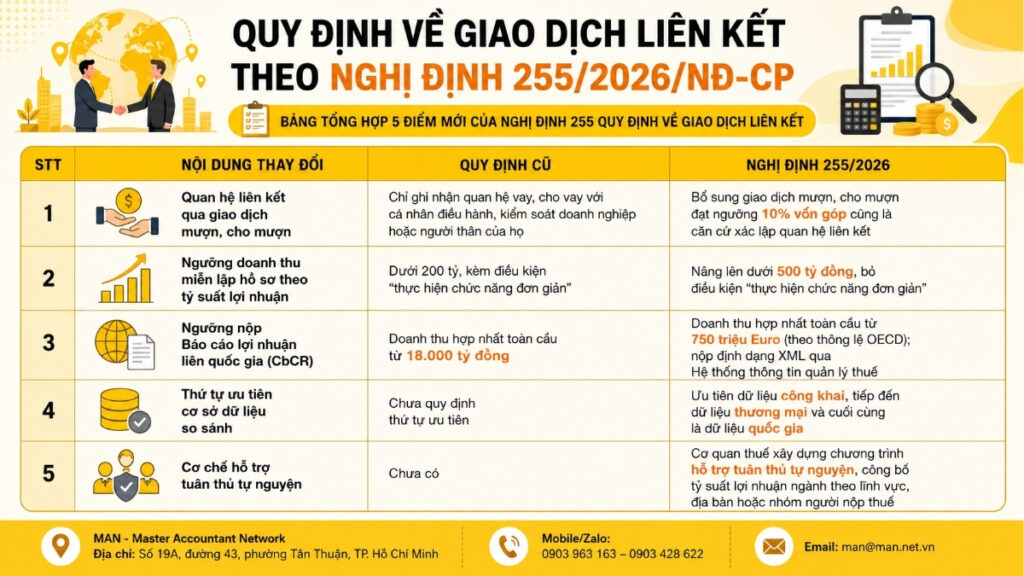
Here are 5 notable new points in Decree 255/2026/ND-CP compared to the old regulations.
The table below summarizes the five core changes to the regulations on related-party transactions in Decree 255/2026/ND-CP:
| No. | Content changed | Old regulations | Decree 255/2026 |
| 1 | Relationships formed through borrowing and lending transactions. | Only record lending and borrowing relationships with individuals who manage or control the business, or their relatives. | Adding loan and lending transactions that reach the threshold of 10% capital contribution also serves as a basis for establishing a liên kết (linked) relationship. |
| 2 | Revenue threshold for exemption from filing based on profit margin. | Under 200 billion, with the condition of "performing simple functions"“ | Raising the threshold to under 500 billion VND, removing the condition of "performing simple functions".“ |
| 3 | Deadline for submitting Country-by-Country Reports (CbCR) | Global consolidated revenue of VND 18 trillion. | Consolidated global revenue of €750 million (according to OECD practice); submitted in XML format via the Tax Management Information System. |
| 4 | Database comparison priority order | No order of priority has been specified. | Prioritize publicly available data, followed by commercial data, and finally national data. |
| 5 | Voluntary compliance support mechanism | Not yet | The tax authorities develop voluntary compliance support programs and publish industry profit margins by sector, location, or taxpayer group. |
Conclusion and recommendations
The regulations on related-party transactions under Decree 255/2026/ND-CP maintain the foundation established in Decree 132/2020/ND-CP but significantly supplement and clarify three areas: how to identify related-party relationships (especially lending and borrowing transactions), the threshold for exemption from price determination documentation, and cross-border reporting obligations according to international standards.
If your business is still unsure whether it falls under the regulations on related-party transactions, needs to review pricing documents, or needs to accurately calculate the threshold for interest expense deductions, the related-party transaction experts at MAN – Master Accountant Network are ready to support you before the 2026 tax year. An independent review is always easier than a tax assessment conclusion.
Contact information MAN – Master Accountant Network
- Address: No. 19A, Street 43, Tan Thuan Ward, Ho Chi Minh City
- Mobile/Zalo: 0903 963 163 – 0903 428 622
- E-mail: man@man.net.vn
- Google Business Profile: View MAN – Master Accountant Network's Google Business Profile
- LinkedIn Founder: View expert Le Hoang Tuyen's LinkedIn profile.
Responsible for production and professional content review by: Mr. Le Hoang Tuyen – Founder & CEO of MAN – Master Accountant Network. He is a CPA Vietnam auditor with over 30 years of in-depth experience in accounting, auditing, taxation, and corporate legal consulting.
Frequently Asked Questions about Related Party Transaction Regulations
Which entities are subject to regulations on related-party transactions?
This applies to organizations producing and trading goods and services that have transactions with related parties as defined in Article 5 of Decree 255/2026/ND-CP, tax authorities, and relevant agencies, organizations, and individuals, not limited to foreign-invested enterprises.
Does taking out a loan from a commercial bank automatically create a related-party relationship?
Not automatically. If a credit institution only provides loans or guarantees without participating in the management, control, capital contribution, or investment in the borrowing or guaranteed enterprise, then that loan alone does not create an affiliated relationship. The enterprise needs to provide supporting documentation; it cannot be assumed automatically.
What revenue threshold exempts individuals from preparing a Transfer Pricing Documentation File?
Revenue below VND 50 billion and total value of related-party transactions below VND 30 billion; or revenue below VND 500 billion with a net profit margin meeting the minimum level for the sector (distribution 5%, manufacturing 10%, processing 15%).
Does being exempt from filing a tax return mean being exempt from tax obligations?
No. Businesses are still required to fully declare related-party transactions and may have their prices and taxable income reassessed by the tax authorities if found to be inconsistent with the arm's length principle, regardless of whether they are exempt from filing related-party transactions.
What is the current threshold for submitting a Country-by-Country Report?
According to Article 19 of Decree 255/2026/ND-CP, the threshold for consolidated global revenue is 750 million Euros or more in the fiscal year immediately preceding the reporting year, replacing the previous threshold of 18,000 billion VND as stipulated in Decree 132/2020/ND-CP.