






Limitations and regulations Decree 255/2026/ND-CP is imposing a series of new restrictions on businesses engaged in related-party transactions, starting with a cap related party interest expense, the price adjustment principle shall not reduce tax liabilities until the 30-working-day deadline for submitting the pricing documentation upon request by the tax authority. Effective July 1, 2026, this Decree not only tightens the rules on deductible expenses but also introduces a new obligation for multinational corporations to file a Country-by-Country Report. The article below provides a comprehensive and accurate breakdown by each provision, helping businesses proactively review their compliance and avoid the risk of tax reassessments or disallowed expenses starting with the first tax filing period under the new regulations.
Why do businesses need to understand the limitations and regulations of Decree 255?

Decree 255/2026/ND-CP is not a document exclusively for large multinational corporations. In fact, its scope covers all businesses with related-party transactions, from the purchase and sale of goods, provision of services, lending, leasing of assets, to the transfer of intangible assets between related parties. The fundamental principle of the decree is that taxpayers must determine and declare their tax obligations based on the actual economic nature of the transaction, not just on the form expressed in the contract. Related-party transactions must be analyzed and compared equivalently with independent transactions occurring under similar conditions, in order to eliminate factors arising from the related-party relationship that reduce tax obligations to the state budget.
It is precisely because of this principle that understanding and grasping the limitations and regulations of Decree 255 becomes particularly important. If businesses do not proactively review their transfer pricing policies and do not prepare complete documentation as required, the risk of tax authorities adjusting taxable income upwards, excluding invalid expenses, or collecting back taxes is entirely possible. To help businesses visualize this more easily, the following content will be divided into two main groups:
- The first group consists of mandatory legal limitations that businesses are not allowed to exceed.
- And the second group consists of regulations and obligations that businesses need to comply with to ensure transparency in reporting.
Key limitations in Decree 255 that businesses must not exceed.
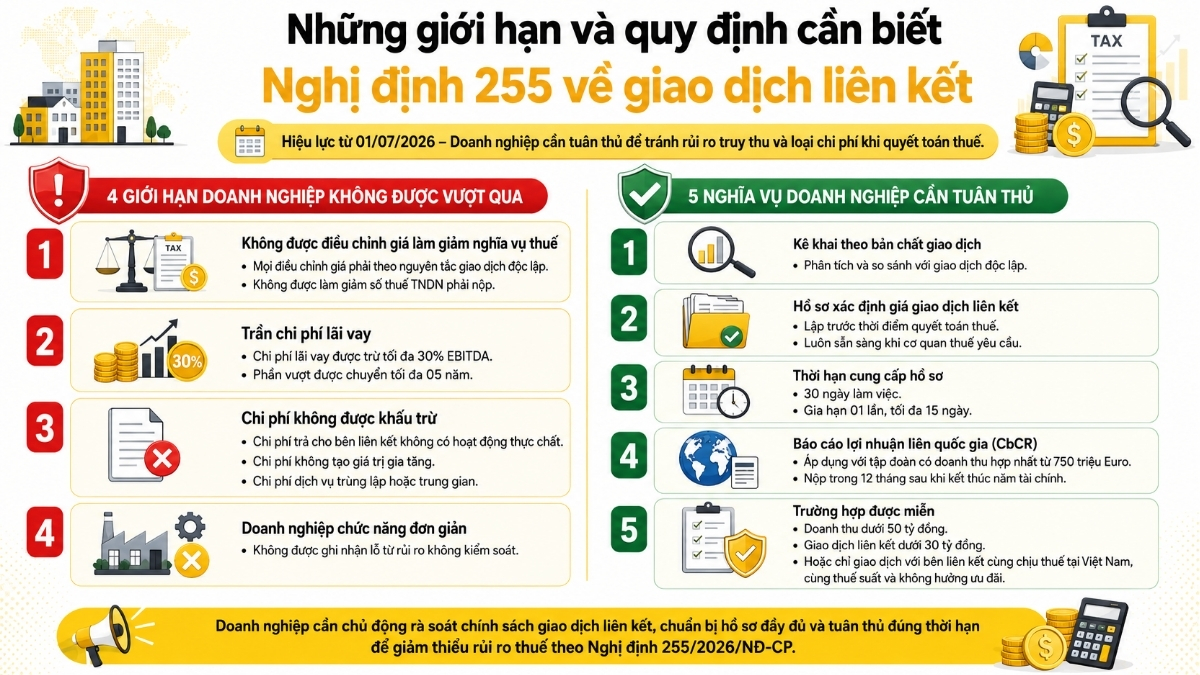
The first set of regulations in Decree 255, outlining the limits and requirements that businesses must adhere to in order to avoid violations and adverse adjustments from tax authorities.
The principle of price adjustments should not reduce tax obligations.
This is considered a guiding principle and the highest limit in the entire process of determining transfer pricing under Decree 255. Specifically, any adjustments related to the price, profit margin, or profit allocation ratio in related-party transactions must ensure that they do not reduce the amount of corporate income tax payable to the state budget. In other words, regardless of the pricing method applied, the final result must not lead to a reduction in tax liability compared to the amount that would have been payable if the transaction had been conducted according to the principle of independence and objectivity. This principle is stipulated throughout Article 8 (Clauses 1, 2, 3), Article 13 (Clause 4), Article 14 (Clause 4), Article 15 (Clause 4), and Article 18 (Clause 2a) of the decree, showing that this is not a single regulation but a guiding principle applied to the entire system of determining transfer pricing.
Limits on deductible interest expenses under Decree 255
One of the limitations and regulations under Decree 255 that businesses with related-party lending transactions need to pay particular attention to is the threshold for deductible interest expense when calculating corporate income tax. According to Article 16, Clause 3, the total interest expense after deducting interest on deposits and loans incurred during the period must not exceed 30% of the total net profit from business operations plus interest expense and depreciation expense during that tax period.
The portion of interest expense exceeding the 30% threshold will not be recognized as a deductible expense in the current tax period. However, the decree also provides more flexibility for businesses:
- Excess interest expense can be carried forward to subsequent tax periods, with a maximum carry-forward period of no more than 5 years. This is a point that businesses need to closely monitor in their financial planning, especially for businesses with a high proportion of borrowing from parent companies or affiliated parties.
See also: How to calculate interest expense according to Decree 255.
Expenses that are not deductible when calculating taxes.
Besides the limits on interest expenses, Decree 255 also clearly stipulates that certain payments to related parties will not be recognized as deductible expenses when calculating corporate income tax. According to Article 16, Clause 1, these expenses include:
Expenses paid to related parties that do not engage in substantive business activities; expenses disproportionate to the scale of the related party's operations; or expenses paid to related parties residing in a country or territory not subject to corporate income tax, while those parties do not create any added value for the transaction.
Furthermore, according to Article 16, Clause 2, service expenses that only benefit one related party, duplicate expenses, or additional expenses added by the related party when acting as an intermediary in providing services to a third party will not be accepted as deductible expenses. These are limitations and regulations under Decree 255 that the accounting and finance departments of enterprises need to carefully review when accounting for expenses incurred with related parties, to avoid having expenses disallowed during tax settlement.
Businesses with simple functions should not incur losses.
Another specific limitation is stipulated in Article 14, Clause 2d, which applies specifically to businesses with simple business models, such as purely manufacturing or distribution businesses, which do not hold significant intangible assets and do not bear decisive risks such as market risk or inventory risk. According to this regulation, businesses in this simple functional group are not allowed to bear losses arising from risks that they themselves cannot control. This regulation aims to prevent businesses with simple functions in the value chain from being "shifted" to losses from strategic business decisions of their parent company or other affiliated parties, thereby protecting state budget revenue.
Regulations you need to know to comply with Decree 255/2026/ND-CP on time.

In addition to the aforementioned limitations, Decree 255 also includes a set of procedural and declaration obligations that businesses are required to fulfill fully and on time to ensure transparency in related-party transactions.
Principle of tax declaration based on the nature of the transaction.
As mentioned earlier, Article 3 (Clause 1) and Article 6 (Clause 1) of Decree 255 establish the fundamental principles:
- Tax obligations must be determined and declared based on the actual economic nature of related-party transactions. Businesses need to conduct a comparative analysis between related-party transactions and independent transactions occurring under similar conditions, thereby eliminating factors influenced by the related-party relationship that could reduce tax obligations. This is the theoretical basis for the entire system of price determination and tax declaration according to Decree 255.
Obligation to declare and prepare Transfer Pricing Documentation
According to Article 18 (Clauses 2 and 3), taxpayers with related-party transactions are required to declare information in accordance with the prescribed Appendices (Appendices I, II, and III) and submit them along with their annual corporate income tax return. Beyond simply declaring the information, businesses are also obligated to create and maintain a Transfer Pricing Documentation file, comprising two main components: the National File and the Global File.
One point that businesses need to pay particular attention to in the limitations and regulations of Decree 255 is the deadline for completing the application:
- The documentation for determining transfer pricing must be completed before the annual tax return filing deadline and must always be readily available for submission upon request from the tax authorities.
This requires businesses to proactively prepare documentation in parallel with the financial reporting and tax settlement process, instead of waiting until they receive a request from the tax authorities to begin.
Given the large volume of information and appendices that need to be cross-referenced, many businesses should consult this resource. related party transaction documentation service Professionalism is essential to ensure that the National and Global Profiles are completed in the correct structure, on time, and in accordance with the regulations of Decree 255.
Deadline for submitting documents when requested by the tax authorities.
In cases where the tax authorities issue a written request, according to Article 18 (Clause 4), the enterprise is obligated to provide complete and accurate Transfer Pricing Documentation within no more than 30 working days from the date of receiving the request. The Decree also provides for an extension of this deadline once, for a period not exceeding 15 working days, if the enterprise has a legitimate reason. This is a crucial deadline that the legal and tax departments of the enterprise need to remember to avoid penalties for violations due to delayed document provision.
Requirements for Country-by-Country Profit Reporting
For businesses that are members of multinational corporations, Article 19 stipulates an additional important obligation:
The ultimate parent company in Vietnam with global consolidated revenue of 750 million Euros or more must prepare and submit a Country-by-Country Report (CbCR).
Remarkable: Even if the parent company is located abroad, taxpayers in Vietnam still have obligations related to this report. In certain specific cases, such as when the country where the parent company is headquartered does not have an automatic information exchange agreement with Vietnam, the Vietnamese enterprise will have to directly submit the Country-by-Country Report there. The deadline for submission is set at 12 months from the end of the parent company's fiscal year.
Cases exempt from the obligation to declare and file documents.
Not all businesses with related-party transactions are required to fully comply with the declaration and documentation obligations as described above. Article 20 of Decree 255 clearly stipulates the cases where partial declaration or documentation for determining related-party transaction prices is waived.
Specifically, businesses may be exempt when they only have transactions with related parties that are subject to the same corporate income tax rate in Vietnam, and none of these parties enjoy tax incentives.
In addition, small-scale businesses, specifically those with revenue under 50 billion VND and total value of related-party transactions arising during the period under 30 billion VND, are also exempt.
Understanding these exemptions within the limits and regulations of Decree 255 will help businesses, especially small and medium-sized enterprises, significantly reduce the burden of administrative compliance while still ensuring legal compliance.
See also: New points in Decree 255/2026/ND-CP regarding related-party transactions.
What should businesses do after understanding the limitations and regulations of Decree 255?

After thoroughly systematizing the limitations and regulations of Decree 255, the next step for businesses is to translate this knowledge into concrete actions in internal tax management. Below are some things businesses should proactively review:
- Review the current transfer pricing policy., In accordance with the principle that price adjustments should not reduce tax obligations as stipulated in Articles 8, 13, 14, 15, and 18.
- Check the interest expense ratio. The accounting is being conducted against the 30% control threshold as per Article 16, Clause 3, and a plan is being developed to carry forward any excess amount within a 5-year period, if applicable.
- Prepare the Transfer Pricing Documentation. (National and Global records) must be complete before the tax settlement deadline to avoid being caught off guard when the tax authorities request them within 30 working days.
- Determine whether the business is required to prepare a Country-by-Country Report., based on the consolidated global revenue of the ultimate parent company as per Article 19.
- Check the exemption conditions under Article 20. to determine whether businesses can reduce their reporting and documentation obligations, especially those with low revenue and related-party transaction values.
Due to the complex and constantly changing nature of regulations regarding related-party transactions, businesses should consider seeking legal advice. related party transaction advisory services With the help of experienced experts such as MAN – Master Accountant Network, we provide comprehensive review of pricing policies, tax risk assessment, and the development of compliance plans tailored to the specific operations of each business.
Proactively understanding and correctly applying the limits and regulations of Decree 255 now will not only help businesses avoid tax risks but also create a solid foundation for transparent and sustainable financial management in the long term.
Conclude
It can be seen that the limitations and regulations of Decree 255/2026/ND-CP not only tighten the method of determining transfer pricing, but also restructure the entire declaration, documentation, and reporting obligations of related-party enterprises. This includes the principle that price adjustments must not reduce tax obligations, the ceiling on interest expense under Decree 30%, excluded expenses, and the obligation to prepare a Country-by-Country Report for multinational corporations. These changes directly impact how businesses account for expenses, plan their finances, and prepare annual tax documents.
Proactively understanding and fully complying with the necessary limits and regulations of Decree 255 from the first tax period of application, effective July 1, 2026, will significantly reduce the risk of price adjustments, expense deductions, or tax arrears later on. In particular, for businesses with large related-party transactions or those that are members of multinational corporations, reviewing pricing policies, preparing pricing documentation, and assessing country-by-country reporting obligations should be done concurrently with the financial reporting process, rather than waiting for a request from the tax authorities.
Contact MAN – Master Accountant Network For free support and advice!
Contact information MAN – Master Accountant Network
- Address: No. 19A, Street 43, Tan Thuan Ward, Ho Chi Minh City
- Mobile/Zalo: 0903 963 163 – 0903 428 622
- E-mail: man@man.net.vn
- Google Business Profile: View MAN – Master Accountant Network's Google Business Profile
- LinkedIn Founder: View expert Le Hoang Tuyen's LinkedIn profile.
Responsible for production and professional content review by: Mr. Le Hoang Tuyen – Founder & CEO of MAN – Master Accountant Network. He is a CPA Vietnam auditor with over 30 years of in-depth experience in accounting, auditing, taxation, and corporate legal consulting.
Frequently Asked Questions about Limitations and Regulations 255
The highest and overarching principle of the entire decree is that any adjustments to prices, profit margins, or profit allocation ratios in related-party transactions must not reduce the amount of corporate income tax payable. This is a boundary that businesses must not cross when implementing any pricing method.
According to Article 16, Clause 3, total interest expense (after deducting interest on deposits and loans) shall not exceed 30% of total net profit from business operations plus interest expense and depreciation expense for the period. Any amount exceeding this limit is not immediately deductible but may be carried forward to subsequent tax periods, for a maximum of 5 years.
According to Article 16 (Paragraphs 1 and 2), non-deductible expenses include: expenses paid to related parties that do not engage in substantive business activities, are disproportionate in scale, or are residents of countries not subject to corporate income tax, and do not create added value; service expenses that only serve other related parties, are redundant, or the additional fees charged by related parties for acting as intermediaries in providing services to third parties.
Yes. According to Article 18, enterprises with related-party transactions (except in cases of exemption) are required to declare them according to Appendices I, II, and III accompanying the Corporate Income Tax Return, and to prepare and maintain national and global records. These records must be completed before the annual tax return filing deadline and readily available for presentation upon request.
According to Article 18, Clause 4, businesses must provide complete documentation within no more than 30 working days from the date of receiving the request. This deadline may be extended once, for a maximum of 15 working days, if there is a valid reason.What is the most important limitation in Decree 255 that businesses need to be aware of?
What is the maximum percentage deductible for interest expenses paid to related parties?
Which expenses paid to related parties will not be recognized for tax purposes?
Is it mandatory for businesses to prepare a Transfer Pricing Documentation file, and when is it required to be completed?
When requested by the tax authorities, how much time does a business have to provide the Pricing Documentation?