





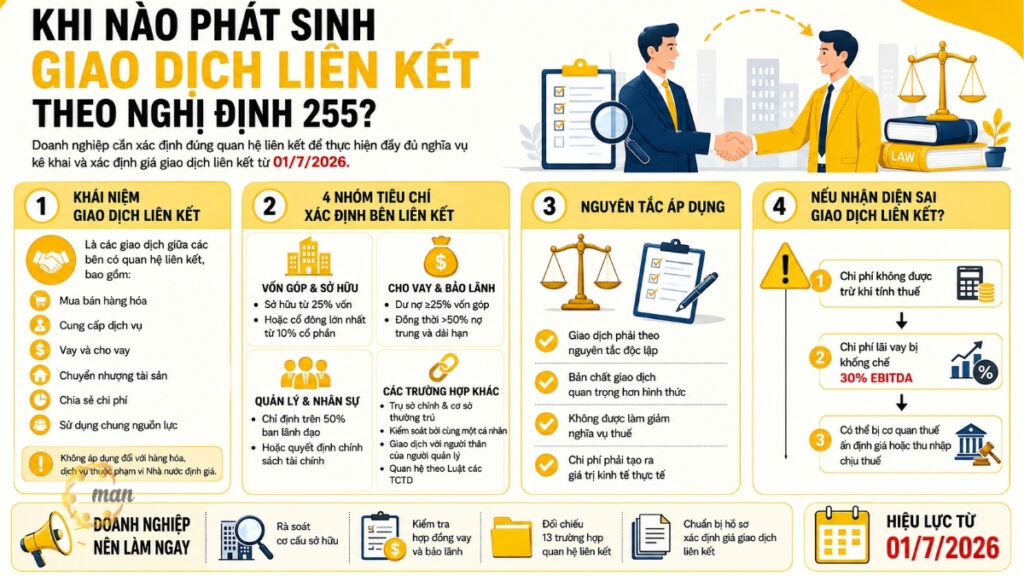
The term "related party transactions" under Decree 255 is crucial for all businesses to understand before July 1, 2026, the date when the new decree officially replaces Decree 132/2020/ND-CP and Decree 20/2025/ND-CP. From criteria for identifying related parties and valuation methods to the threshold for exemption from documentation, this article systematically compiles the legal basis for each Article and Clause, enabling accountants and business owners to immediately compare it to their own specific situations.
Why is identifying related-party transactions important according to Decree 255?

Scope of regulation of Decree 255/2026/ND-CP The scope of regulations is quite broad, ranging from the principles of applying tax management to related-party transactions, methods for identifying related parties, comparative analysis methods for determining transfer pricing, to the determination of deductible expenses for tax purposes, the rights and obligations of taxpayers in declaring income, and responsibilities related to the Country-by-Country Report.
In other words, once a business is identified as having related-party transactions, almost the entire chain of related tax obligations, from declaration and documentation to the possibility of being audited, is affected.
It is worth notingDecree 255 continues to uphold the overarching principle throughout the entire system of regulations on related-party transactions in Vietnam:
Taxpayers with related-party transactions must exclude factors that reduce tax liability due to the influence or impact of the related-party relationship, in order to declare and determine tax liability equivalent to independent transactions under the same conditions.
This is the crucial point that governs all subsequent chapters and clauses, from the selection of comparable entities and valuation methods to the determination of deductible expenses. Therefore, if a business incorrectly identifies or overlooks related-party transactions, all subsequent steps in the tax declaration process are at risk of being inaccurate.
What are related-party transactions as defined in Decree 255/2026/ND-CP?

According to Decree 255/2026/ND-CP:
Related-party transactions are understood to include transactions involving the purchase, sale, exchange, lease, rental, borrowing, lending, transfer, assignment of goods, provision of services; borrowing, lending, financial services, financial guarantees and other financial instruments; transactions related to tangible and intangible assets; and agreements for the purchase, shared use of resources such as assets, capital, labor, or cost sharing, provided that these transactions occur between related parties.
One point worth noting: This scope excludes business transactions involving goods and services subject to state price regulation, which are governed by separate pricing laws. Furthermore, the scope of related-party transactions is not limited to ordinary goods trading, but extends to informal agreements such as cost sharing and shared resource utilization—types of transactions that many businesses often fail to declare.
13 cases for identifying related parties: Basis for the occurrence of related-party transactions under Decree 255
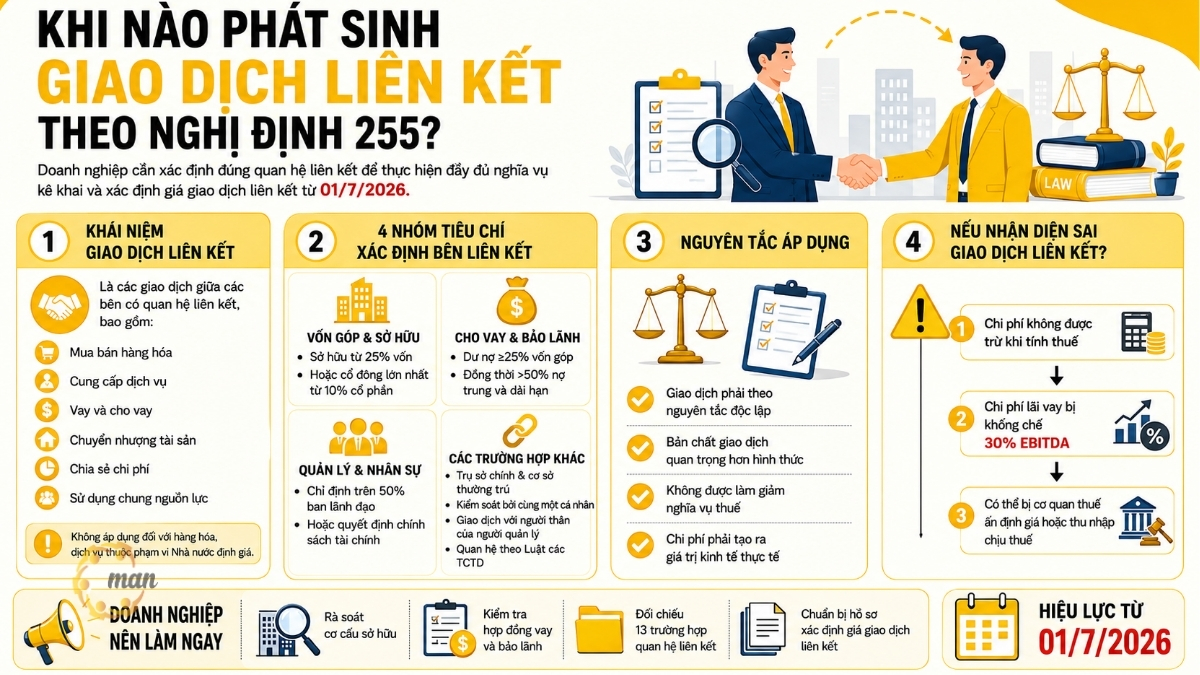
To determine whether a transaction is a related-party transaction, a business must first determine whether the two parties involved in the transaction are related parties.
This is the most important part, because Decree 255 lists in considerable detail the cases considered to be related. These criteria can be grouped into four main categories for easier reference.
Criteria group regarding capital contribution and ownership
These are the most common and easily identifiable criteria, specifically as follows:
- A business is considered to be affiliated with another business if it directly or indirectly holds at least 25% of the owner's equity of that business;
- If both businesses have at least 25% capital contributions held directly or indirectly by a third party, these two businesses are also considered affiliated parties.;
- Additionally, a business that is the largest shareholder in terms of capital contribution and directly or indirectly holds at least 10% of the total shares of the other business is also considered to have an affiliated relationship.
Criteria group regarding guarantees and loans.
This is the group of criteria that many businesses most easily overlook, as it relates not to capital ownership but to financial relationships. Specifically:
- An entity that guarantees or lends capital to another entity in any form, including third-party loans secured by the financial resources of an affiliated entity, constitutes an affiliated relationship if the total outstanding debt of the borrowed capital is at least 25% of the owner's equity of the borrowing entity, and exceeds 50% of the total outstanding debt of all medium and long-term liabilities of the borrowing entity.
However, Decree 255 also clearly stipulates the exclusion cases, mainly applicable to credit institutions operating under the Law on Credit Institutions No. 32/2024/QH15:
When the guarantor or lender does not directly/indirectly participate in the management, control, or capital contribution of the borrowing or guaranteed enterprise.
This is a point that businesses borrowing from banks need to be aware of to avoid confusing a regular credit relationship with a related-party relationship.
Criteria group related to management, administration, and human resources.
An affiliated relationship also arises when one business appoints a member of the executive or supervisory board of another business, provided that the number of appointed members exceeds 50% of the total number of board members, or that a appointed member has the authority to decide on the financial policies or business operations of the other business.
Similarly, two companies that both have more than 50% members on their board of directors, or both have a member with policy-making authority appointed by a third party, are also considered affiliated companies.
Besides management personnel, Decree 255 also includes blood relations and marriage in the group:
- Two businesses that are managed or controlled in terms of personnel, finance, or business operations by individuals who are related as spouses, parents and children, siblings, grandparents and grandchildren, or aunts, uncles, cousins, or nephews and nieces are also considered to have an affiliated relationship.
This is a point that family businesses need to pay particular attention to.
Another set of criteria leads to the occurrence of related-party transactions.
In addition to the three groups above, Decree 255 also stipulates several other cases that constitute a related-party relationship, including:
- The two businesses have a head office and permanent establishment relationship, or both are permanent establishments of a foreign organization or individual;
- Businesses are controlled by an individual through capital contribution or direct management;
- Businesses that engage in transactions involving the transfer of at least 25% of owner's capital contributions, or borrow or lend at least 10% of capital contributions from individuals managing or controlling the business, or from relatives of those individuals;
- The relationship between a credit institution and its subsidiaries, controlling companies, or affiliated companies is governed by the Law on Credit Institutions.
Principles applicable when businesses engage in related-party transactions (Decree 255)
After identifying related-party transactions, businesses need to understand the principles governing tax declaration and determination of tax obligations. The central principle is that the nature of the activity or transaction determines the tax obligation; that is, the nature of the transaction is determined by comparing the legal contract or written agreement between the related parties with the actual implementation. If a taxpayer engages in related-party transactions but lacks a written agreement, or if the agreement/actual implementation does not conform to the arm's length principle, the transaction must still be determined according to the nature of the business conducted between independent parties.
This principle has an important consequence, specifically as follows:
- The related party receiving revenue and profit from the transaction must actually have ownership and control over the business risks associated with the related assets, goods, and services;
- On the other hand, the party incurring the cost must receive direct economic benefits or value, or contribute to generating revenue or added value for their business operations.
In other words, the tax authorities don't just look at the contract, but also examine whether the actual flow of money and benefits is consistent with what is shown on paper.
Important Note: Regardless of the pricing method applied, the final adjustment must not reduce taxable income or the tax liability payable to the State budget. This principle is consistently reiterated in many provisions of Decree 255, demonstrating the anti-transfer pricing stance throughout the entire document.
See also: New points in Decree 255/2026/ND-CP regarding related-party transactions.
Consequences of not correctly identifying related-party transactions arising under Decree 255.

Omitting or misidentifying related-party transactions is not just a procedural issue; it can lead to direct financial consequences:
- Firstly, expenses of related-party transactions that are inconsistent with the nature of independent transactions, or that do not contribute to generating revenue or income for the business's operations, will not be deductible expenses when determining taxable income. This includes payments to related parties that do not engage in substantive business activities, or whose assets and personnel are disproportionate to the value of the transaction received.
- Secondly, regarding interest expense, the total interest expense after deducting interest on deposits and loans deductible for tax purposes must not exceed 30% of the total net profit from business operations plus interest expense and depreciation expense incurred during the period. This is a limit applied specifically to businesses with related-party transactions, and any expense exceeding this limit can only be carried forward to subsequent tax periods, for a maximum of 5 consecutive years.
- Thirdly, and perhaps most significantly, is the possibility of the tax authorities arbitrating the price, profit margin, profit allocation ratio, or taxable income. The tax authorities have the right to make such arbitrages when a business fails to declare, declares incomplete or incorrect information, fails to provide complete transfer pricing documentation as required, or uses dishonest, inaccurate, or illegitimate information about independent transactions, or relies on illegal or unverified documentation.
What should businesses be aware of when the new regulations officially come into effect?
With the effective date of July 1, 2026, and application starting from the 2026 tax year, businesses should not wait until the last minute to begin reviewing. The first step is to review the entire ownership structure, loan agreements, and guarantees, then compare them with the 13 criteria for identifying related parties presented above to accurately determine whether or not they have any related-party transactions.
The second step is to prepare data and independent comparative dossiers in accordance with the priorities stipulated in Decree 255, prioritizing domestic comparison subjects, then comparison subjects residing in the same country, and finally expanding to countries in the region with similar industry conditions and levels of economic development.
The third step, for businesses that are subject to these regulations. Decree No. 20/2025/ND-CP Previously, it was necessary to compare the transitional conditions, because Decree 255 still allowed businesses subject to the transitional period to continue applying for the remaining time under the old regulations.
Conclude
In summary, related-party transactions under Decree 255 are not only based on shareholder structure, but also include loan-guarantee relationships, management personnel, and the blood relationship of executives. Businesses need to understand three things:
- Compare the criteria for identifying affiliates;
- Choose the right pricing method that suits the nature of the transaction;
- Declare and maintain price determination records, even if you are exempt from filing, you must still declare the basis for the exemption.
Preparing a price determination report requires complex technical and professional skills, such as identifying comparative data (benchmarking), selecting an appropriate pricing method, and explaining the chosen data. To avoid errors leading to risks, businesses should consider these factors. related party transaction documentation service from specialized units to receive in-depth support.
Decree 255/2026/ND-CP applies to the corporate income tax settlement period of 2026. Businesses need to proactively review all transactions, and if there are any uncertainties regarding how to identify related parties, now is the appropriate time to seek advice. related party transaction advisory services From units with in-depth expertise and experience such as MAN – Master Accountant Network, you can receive support and advice from a team of experts.
Contact MAN – Master Accountant Network For expert advice and support!
Contact information MAN – Master Accountant Network
- Address: No. 19A, Street 43, Tan Thuan Ward, Ho Chi Minh City
- Mobile/Zalo: 0903 963 163 – 0903 428 622
- E-mail: man@man.net.vn
- Google Business Profile: View MAN – Master Accountant Network's Google Business Profile
- LinkedIn Founder: View expert Le Hoang Tuyen's LinkedIn profile.
Responsible for production and professional content review by: Mr. Le Hoang Tuyen – Founder & CEO of MAN – Master Accountant Network. He is a CPA Vietnam auditor with over 30 years of in-depth experience in accounting, auditing, taxation, and corporate legal consulting.
Frequently Asked Questions about Related-Party Transactions under Decree 255
Decree 255/2026/ND-CP takes effect from July 1, 2026, and applies immediately from the corporate income tax period of 2026, replacing Decree No. 132/2020/ND-CP and Decree No. 20/2025/ND-CP. Businesses subject to the transitional provisions under Decree 20/2025/ND-CP will continue to be subject to the remaining transitional period.
No, if the lender is a credit institution operating under the Law on Credit Institutions and does not directly/indirectly participate in the management, control, or capital contribution of the borrowing enterprise. This is an exception clearly stipulated in Article 5.2 of Decree 255.
Yes, in two cases: Two businesses are jointly managed and controlled by individuals who are related as spouses, parents and children, siblings, etc.; or the business engages in capital transfer transactions of 25% or more, or borrows or lends 10% or more of capital contributions from the managing individual or their relatives.
The total interest expense, after deducting interest on deposits and loans, is deductible for tax purposes and must not exceed the 30% of (net profit from business operations plus net interest expense plus depreciation expense) for the period. Any amount exceeding this threshold can be carried forward to subsequent tax periods, for a maximum of 5 consecutive years.
Yes. The related-party relationships under Decree 255 are not limited to multinational corporations but also encompass domestic transactions between domestic companies that share shareholders, managers, or loan-guarantee relationships meeting the prescribed thresholds. Therefore, even purely Vietnamese businesses need to review their declarations to avoid missing any reporting obligations.When does Decree 255/2026/ND-CP take effect and which tax periods does it apply to?
Does a business borrowing from a bank constitute a related-party transaction?
Are transactions with relatives of the director or business owner considered related-party transactions?
How are interest expenses for businesses with related-party transactions controlled?
Do businesses without foreign ownership need to be concerned about related-party transactions?