





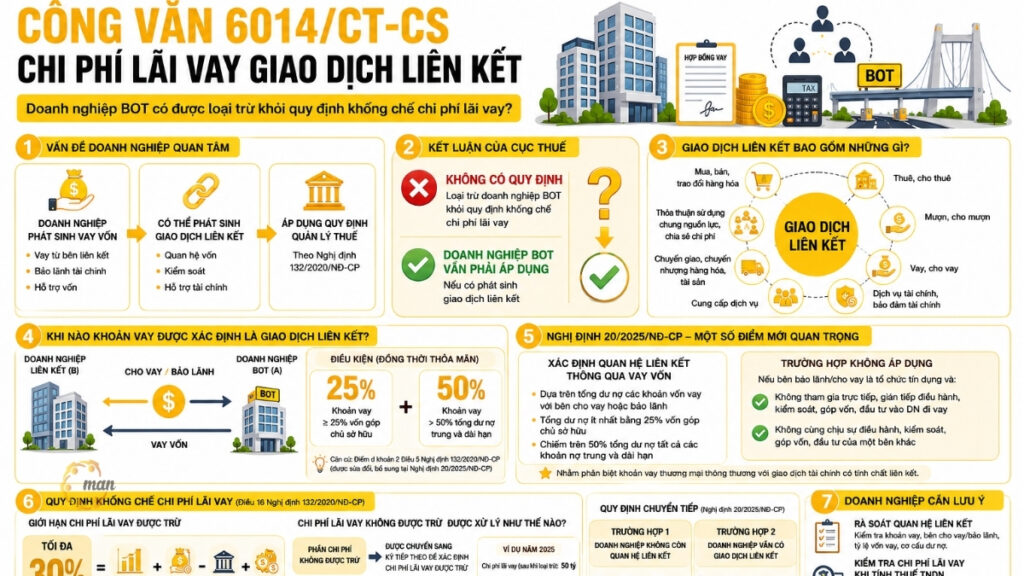
During their operations, many businesses often need to raise significant capital for investment, project implementation, and operation. Loans, financial guarantees, or capital support between related parties may result in related-party transactions and are subject to tax regulations applicable to businesses with related-party transactions.
Official Document 6014/CT-CS, Official document related party interest expense Regarding the case of Trung Phuong Co., Ltd., a matter of concern for many businesses has been clarified: whether BOT businesses are exempt from the regulations determining deductible interest expenses when calculating corporate income tax.
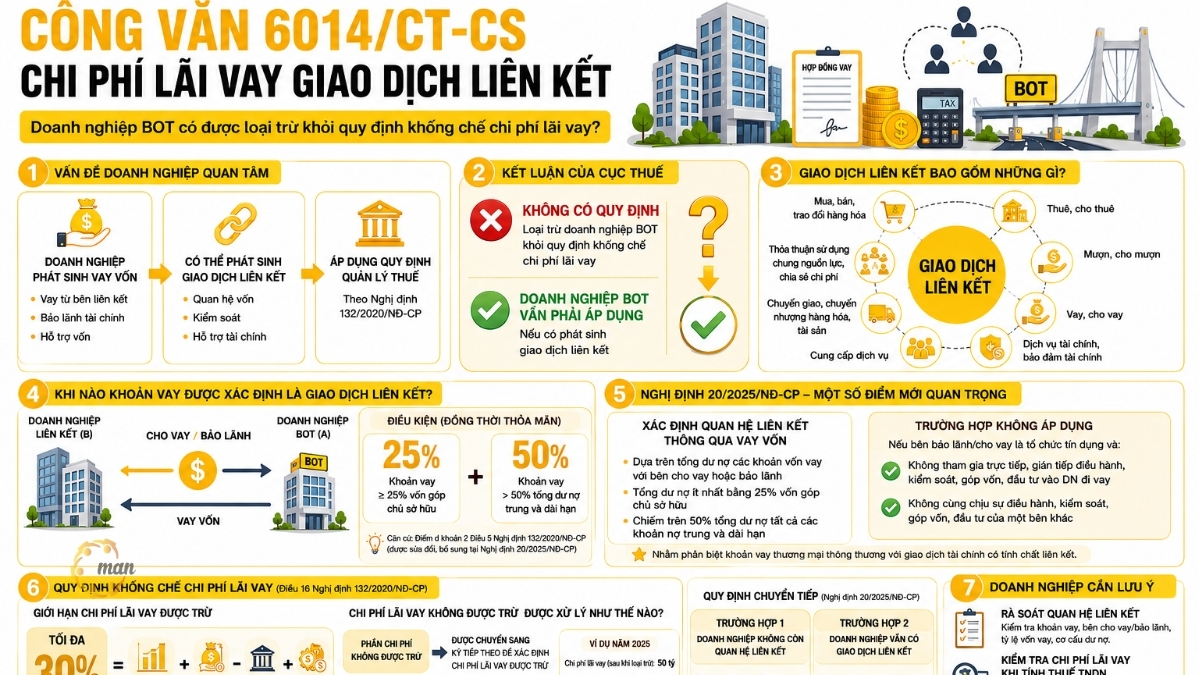
According to the Tax Department's response, current law does not exclude BOT enterprises from the scope of application of regulations on limiting interest expense deductions for enterprises with related-party transactions. Therefore, in cases where BOT enterprises have related-party transactions, they must still comply with the regulations. Decree No. 132/2020/ND-CP and the amendments and additions at Decree No. 20/2025/ND-CP.
This article provides a detailed analysis of the content of the Official Letter regarding interest expense on related-party transactions, the legal basis, and points that businesses need to note when declaring and determining deductible expenses for corporate income tax purposes.
What does the official document on interest expense for related-party transactions clarify?
The Tax Department received Document No. 2345/DAN-QLDN2 dated November 7, 2025, from the Da Nang City Tax Department and Official Letter No. 51/TT-TPC dated November 28, 2025, from Trung Phuong Co., Ltd. regarding tax management for BOT enterprises with related-party transactions.
The content of the proposal for consideration focuses on determining the obligation to apply regulations on interest expense for BOT enterprises.
Specifically, the business raised the question of whether enterprises operating under the BOT (Build-Operate-Transfer) model fall under the category of entities subject to the regulations on limiting interest expense deductions as stipulated in Clause 3, Article 16 of Decree No. 132/2020/ND-CP.
After reviewing the current legal regulations, the Tax Department has reached the following conclusion:
- There are no regulations excluding BOT enterprises from the scope of application of regulations on determining deductible interest expenses.
- BOT enterprises that have related-party transactions falling within the scope of Decree 132/2020/ND-CP must still comply with the regulations on limits on interest expense deductions.
- The proposal by Trung Phuong Co., Ltd. to exclude BOT enterprises from the scope of application is inconsistent with legal regulations.
This is an important point in the Official Letter regarding interest expense on related-party transactions, helping businesses understand that the BOT (Build-Operate-Transfer) model is not a basis for exemption from the regulations on related-party transactions..
Regulations on related-party transactions according to Decree 132/2020/ND-CP
According to Government Decree No. 132/2020/ND-CP dated November 5, 2020, related-party transactions falling under the scope of regulation include various types of transactions between related parties.
Clause 2, Article 1 of Decree 132/2020/ND-CP stipulates that related-party transactions include:
- Transactions involving the buying, selling, and exchange of goods.
- Lease and rental transactions.
- Borrowing and lending transactions.
- Transfer and assignment of goods and assets.
- Providing services.
- Borrowing and lending.
- Financial services, financial guarantees.
- Other financial instruments.
- Transfer of tangible and intangible assets.
- A shared resource and cost-sharing agreement.
Thus, borrowing, guaranteeing, or providing financial support between related parties is one of the groups of transactions considered within the scope of tax management regarding related-party transactions.
For BOT (Build-Operate-Transfer) enterprises, raising capital to implement a project may involve loan transactions or financial guarantees. If the conditions for determining a related-party relationship are met, the enterprise must fully fulfill its obligations to declare and determine costs as prescribed by regulations.
The official document clarifies whether interest expense related to related-party transactions is applicable to BOT enterprises.

One of the key aspects of the Circular on Interest Expense for Related-Party Transactions is determining the scope of application for BOT (Build-Operate-Transfer) enterprises.
According to Decree 132/2020/ND-CP, the applicable entities are enterprises with related-party transactions, regardless of the industry in which the enterprise operates.
This means:
- Manufacturing businesses.
- Commercial enterprise.
- Construction investment company.
If any related-party transactions fall within the scope of regulation, they must comply with the regulations.
Therefore, BOT businesses cannot be automatically excluded from the regulations determining deductible interest expenses when calculating corporate income tax.
In cases where a BOT enterprise incurs a loan from an affiliated party and this loan meets the conditions for determining an affiliated relationship, the resulting interest expense must be considered within the limits stipulated in the regulations. Decree 132 on related-party transactions.
Conditions for determining the relationship related to a loan.
An important aspect when applying the Circular on Interest Expense for Related-Party Transactions is determining whether the enterprise falls under the category of having an affiliated relationship.
According to point d, clause 2, Article 5 of Decree 132/2020/ND-CP, an enterprise is determined to have an affiliated relationship in the following cases:
A business that guarantees or lends capital to another business in any form, including:
- Direct loan.
- A loan from a third party but secured by the financing of an affiliated party.
- Financial transactions are similar in nature.
Conditions apply:
- The loan amount must be at least equal to 25% of the owner's equity of the borrowing enterprise.
- The loan accounts for over 50% of the total value of the borrowing company's medium and long-term debt.
This regulation aims to identify cases where a business has a significant financial dependence on an affiliated party.
Example: BOT enterprise A has owner's equity of 200 billion VND. This enterprise borrows 60 billion VND from affiliated enterprise B. The total medium and long-term debt of enterprise A is 100 billion VND.
Then:
- The loan of 60 billion VND is larger than the owner's equity contribution of 25% (50 billion VND).
- This loan accounts for 60% of the total outstanding medium and long-term debt.
The business may fall under the category of determining affiliated relationships according to regulations.
How does Decree 20/2025/ND-CP amend the regulations on linkage relationships?
On February 10, 2025, the Government issued Decree No. 20/2025/ND-CP amending and supplementing a number of articles of Decree 132/2020/ND-CP.
One point worth noting in Decree 20 on related-party transactions This is the amendment to point d, clause 2, Article 5 regarding related-party relationships through loan transactions.
According to the new regulations:
The conditions for determining a relationship are based on:
- The total outstanding debt of borrowed capital from the lending or guaranteeing enterprise.
- This outstanding debt is at least equal to 25% of the owner's equity.
- This accounts for over 50% of the total outstanding balance of all medium and long-term loans.
In addition, Decree 20/2025/ND-CP adds cases where this regulation does not apply.
Specifically, this does not apply if the guarantor or lender is an economic organization operating under the Law on Credit Institutions and:
- Do not directly or indirectly participate in the management, control, capital contribution, or investment in the borrowing enterprise.
- Not subject to joint management, control, capital contribution, or investment from another party.
This regulation aims to distinguish between ordinary commercial loans from credit institutions and related-party financial transactions.
Regulations on limiting interest expense are stipulated in Article 16 of Decree 132/2020/ND-CP.
According to Clause 3, Article 16 of Decree 132/2020/ND-CP, the total deductible interest expense when determining corporate income tax for enterprises with related-party transactions is limited to:
The total net profit from business operations for the period plus interest expense, after deducting interest on deposits, loans, and depreciation expenses incurred during the period, shall not exceed 30%.
Simply put:
- Businesses are not allowed to include the entirety of interest expenses as deductible expenses if these expenses exceed the legally prescribed limits.
- Any interest expense exceeding the permitted limit will not be deductible in the current tax period.
- However, businesses can carry forward this expense to the next tax period if they meet the necessary conditions.
How are non-deductible interest expenses handled?
According to point b, clause 3, Article 16 of Decree 132/2020/ND-CP:
“"The portion of interest expense that is not deductible in the tax period is carried forward to the next period to determine deductible interest expense."”
Transfer time:
- Not continuously for more than 5 years.
- Starting from the year following the year in which the non-deductible interest expense was incurred.
For example, in 2025, the business will have the following:
- Interest expense incurred after deducting interest on deposits: VND 50 billion.
- The deductible interest expense under the 30% limit is VND 35 billion.
Undeducted portion:
Undeducted amount = 50 – 35 = 15 billion VND |
This amount of 15 billion VND can be carried over to subsequent years for a maximum period of 5 years if the conditions are met.
Transitional provisions in Decree 20/2025/ND-CP
Decree 20/2025/ND-CP provides for the transitional provisions regarding non-deductible interest expenses incurred in previous tax periods. According to Article 3 of Decree 20/2025/ND-CP, this applies from the 2024 tax year onwards. There are two scenarios:
In cases where businesses no longer have an affiliated relationship...
If the business:
- There is no link between them.
- No related-party transactions occurred.
The portion of interest expense that is not deductible and has not been carried forward to the next period as of the end of 2023 will be allocated to subsequent periods over the remaining time.
In cases where the business still has related-party transactions
If the enterprise continues to have related-party transactions, the portion of interest expense that is not deductible will continue to be handled according to the provisions of point b, clause 3, Article 16 of Decree 132/2020/ND-CP.
What should businesses be aware of regarding interest expenses on related-party transactions?

Based on the content of Official Letter 6014/CT-CS, businesses with related-party transactions need to pay attention to the following:
Review of affiliations
Businesses need to check:
- Loans.
- The lender.
- The guarantor.
- Loan-to-value ratio.
- Loan structure.
Checking interest expense when calculating corporate income tax.
Businesses need to determine:
- Total interest expense.
- Interest on deposits, interest on loans.
- Net profit.
- Depreciation expense.
From there, determine the portion of the expenses that can be deducted and the portion that must be carried forward to the next period.
Prepare related party transaction documents.
Businesses with related-party transactions need to ensure:
- Declare accurate information regarding related-party transactions.
- Prepare documentation to determine transfer pricing in accordance with regulations.
- Keep supporting documents.
Frequently Asked Questions about the Official Letter on Interest Expense for Related-Party Transactions
No. This expense can be carried forward to the next tax period, but for a maximum of 5 years.
According to Clause 3, Article 16 of Decree 132/2020/ND-CP, the limit is determined based on: Net profit from business operations during the period, Interest expense after deducting interest on deposits and loans incurred during the period, and Depreciation expense incurred during the period.
No. Decree 20/2025/ND-CP mainly amends and supplements some provisions of Decree 132/2020/ND-CP, including regulations on determining related-party relationships through loan transactions and transitional provisions. The regulation limiting interest expense in Clause 3, Article 16 of Decree 132/2020/ND-CP still applies to enterprises with related-party transactions.
Businesses should retain relevant documents such as: loan agreements, guarantee documents or financial agreements, related party transaction records, documents calculating interest expense limits, and supporting documents related to incurred interest expenses. This is crucial for businesses to explain their financial situation during tax audits and inspections.
Businesses need to: Separately track undeductible interest expense, determine when it is incurred, control the carry-forward period (maximum 5 years), and assess its deductibility in each subsequent tax period. Accurate tracking helps businesses avoid missing out on the right to carry forward interest expense as stipulated by regulations.Will interest expenses exceeding the 30% limit be completely lost?
How is the deductible interest expense (30%) determined? What is the basis for calculating it?
Does Decree 20/2025/ND-CP completely change the way interest expense is determined?
What documents are needed to prove that the determination of interest expense complies with regulations?
What should be considered when carrying forward non-deductible interest expenses to the following year?
Conclude
The content of the Official Letter regarding interest expense on related-party transactions has helped clarify the application of tax management regulations to BOT enterprises that have related-party transactions.
Accordingly, BOT enterprises are not exempt from the regulations determining deductible interest expenses when calculating corporate income tax. If related-party transactions fall within the scope of these regulations, the enterprise must still comply with Decree 132/2020/ND-CP and Decree 20/2025/ND-CP.
Proactively reviewing loans, related-party relationships, and limiting interest expense will help businesses ensure compliance with tax regulations and minimize risks during the tax settlement process.
For any further questions, assistance, or advice, please contact your business. Contact MAN – Master Accountant Network via:
Contact information MAN – Master Accountant Network
- Address: No. 19A, Street 43, Tan Thuan Ward, Ho Chi Minh City
- Mobile/Zalo: 0903 963 163 – 0903 428 622
- E-mail: man@man.net.vn
- Google Business Profile: View MAN – Master Accountant Network's Google Business Profile
- LinkedIn Founder: View expert Le Hoang Tuyen's LinkedIn profile.
Responsible for production and professional content review by: Mr. Le Hoang Tuyen – Founder & CEO of MAN – Master Accountant Network. He is a CPA Vietnam auditor with over 30 years of in-depth experience in accounting, auditing, taxation, and corporate legal consulting.