





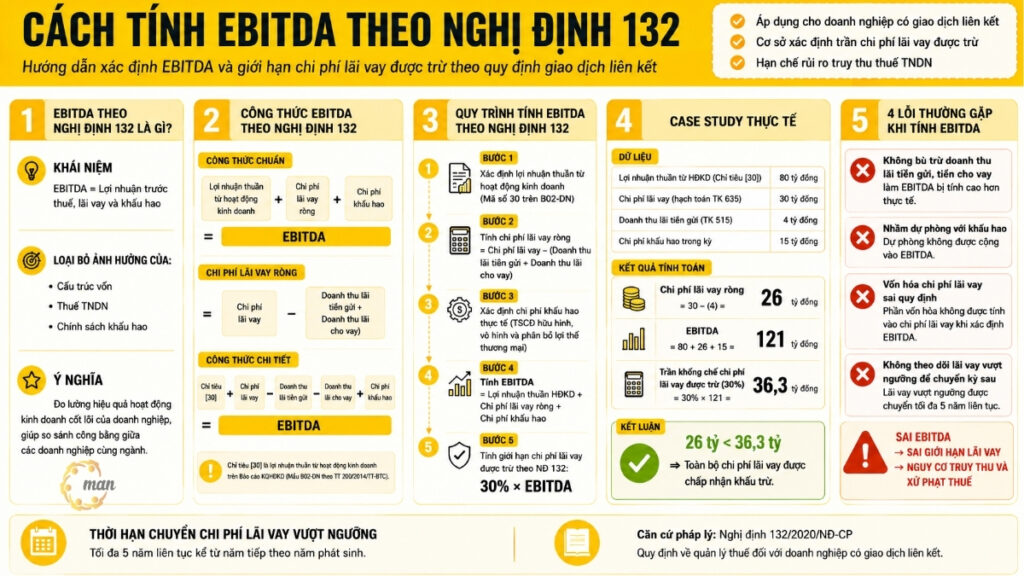
For businesses with related-party transactions, accurate identification is crucial. interest expense Tax deductions are a crucial factor in mitigating the risk of back taxes and penalties during corporate income tax settlement. In particular, understanding how to calculate EBITDA according to Decree 132 is a core concept that chief accountants, CFOs, and business owners need to grasp in order to accurately determine the threshold. Controlling interest expense according to Decree 132. This article will provide detailed instructions on how to calculate EBITDA according to Decree 132, analyze the legal nature of each indicator, clarify the differences between accounting EBITDA and EBITDA for tax purposes, and provide practical examples and in-depth notes to help businesses apply the regulations correctly, optimize costs, and minimize tax audit risks.
What is EBITDA according to Decree 132?

EBITDA stands for Earnings Before Interest, Taxes, Depreciation, and Amortization. According to Decree 132, EBITDA represents the actual cash flow from a business's operations before being affected by:
- Capital structure: Interest expense depends on whether the business chooses to finance its operations with debt or equity.
- Legal obligations: Corporate income tax depends on the country or jurisdiction where the business is registered.
- Accounting policy: Depreciation expense of tangible fixed assets and allocation of intangible assets depend on the depreciation method chosen by the business (straight-line, declining balance, etc.).
By eliminating the subjective or specific factors mentioned above, EBITDA helps investors and CFOs compare core profitability among businesses in the same industry in the fairest way possible.
Basic EBITDA calculation formula in accounting.
There are three common approaches to determining EBITDA from a company's financial statements:
Method 1: Approach from Net Profit
This method works backwards, starting from the final business result (Net Profit) and adding back all deductible expenses.
EBITDA = Net Profit + Corporate Income Tax + Interest Expense + Depreciation Expense |
Method 2: Approaching from Pre-Tax Profit
This is the quickest and most common calculation method when reading an Income Statement. Specifically, the formula is as follows:
EBITDA = Earnings before tax + Interest expense + Depreciation expense |
Method 3: Approach through EBIT
EBIT stands for Earnings Before Interest and Taxes. Therefore, the specific formula for determining it is as follows:
EBITDA = EBIT + Depreciation Expense |
In there:
EBIT = Earnings before tax + Interest expense |
Note: The general EBITDA calculation formulas in Decree 132 above are not sufficient for direct application to corporate income tax (CIT) settlement documents of enterprises with related-party transactions. To comply correctly, enterprises must follow the detailed instructions on how to calculate EBITDA according to Decree 132 below.
Detailed instructions on how to calculate EBITDA according to Decree 132.
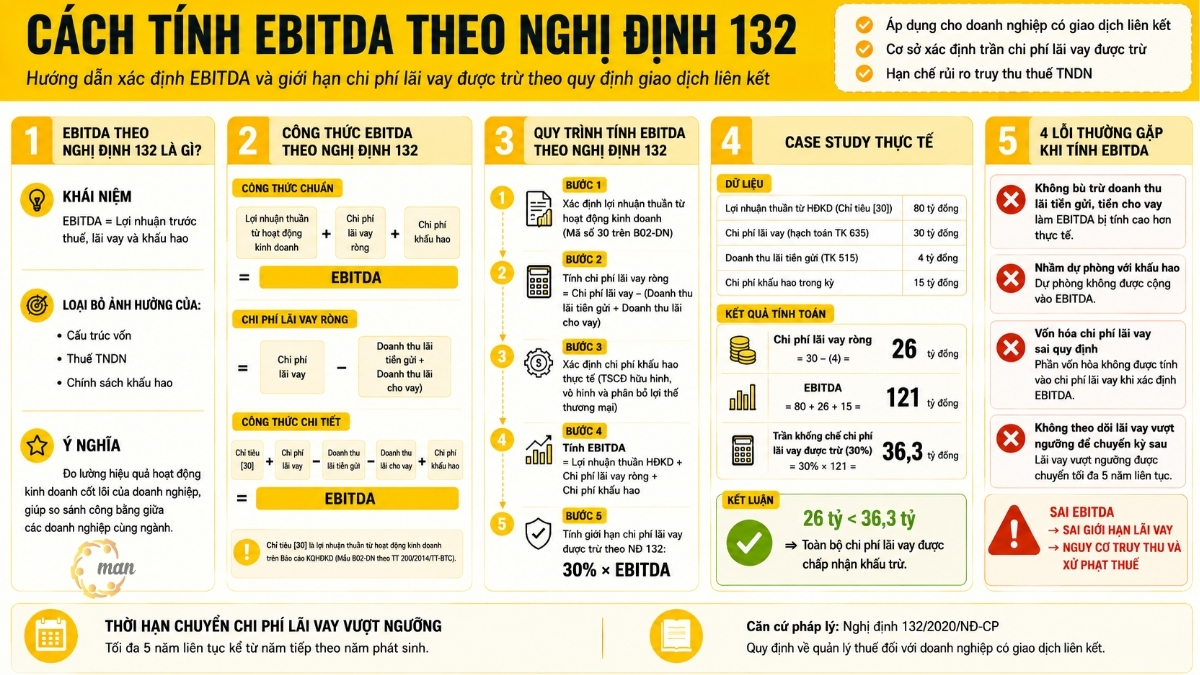
The scope of the Tax Administration Law for related-party transactions and the statutory EBITDA ratio show a clear differentiation compared to regular accounting figures. Calculating the EBITDA ratio according to Decree 132 (also known as adjusted EBITDA) is a mandatory step to determine a reasonable limit on interest expense.
How to calculate EBITDA from related-party transactions
Based on the specific regulations at Point a, Clause 3, Article 16 of Decree 132/2020/ND-CP, Join MAN – Master Accountant Network to learn how to calculate EBITDA according to Decree 132.
How to calculate EBITDA according to Decree 132:
EBITDA = Net profit from business operations + Net interest expense + Depreciation expense |
To understand and apply this formula correctly, let's look at each indicator in detail as follows:
Net operating profit
This is an extremely clear indicator, taken directly from indicator [30] on the Business Performance Report (Form No. B02-DN issued with Circular 200/2014/TT-BTC). This indicator includes both financial revenue and financial expenses (including interest expenses) incurred during the period of the enterprise.
Net Interest Expense (NIE)
Decree 132 allows businesses to offset interest expenses incurred against revenue from deposits and loans. Therefore, net interest expense in the formula is determined by:
Net interest expense = Interest expense incurred during the period – (Interest revenue from deposits + Interest revenue from loans) |
Note: Interest expense here refers to the total interest expense incurred and recognized as financial expense during the period, regardless of whether it is interest from related parties or independent credit institutions. Therefore, when starting to calculate EBITDA for related-party transactions, corporate accountants need to aggregate all interest expenses incurred during the period.
Depreciation expense
This is the total cost of depreciation of fixed assets (tangible and intangible) and the allocation of goodwill that has been directly accounted for in the business's operating expenses during the tax period.
Based on the above components, the detailed method for calculating EBITDA according to Decree 132 is specified by the following formula:
EBITDA = Indicator [30] + Interest expense – (Deposit interest revenue + Loan interest revenue) + Depreciation expense |
Update: The formula for calculating EBITDA under the latest regulations.
A real-world case study applying the EBITDA calculation method according to Decree 132.
To help you easily visualize the calculation process on the tax return, let's analyze a practical example applying the EBITDA calculation method according to Decree 132 as follows:
If company B has transactions involving the purchase and sale of raw materials with its parent company abroad during the fiscal year, the company's accounting data is recorded as follows:
- Net profit from business operations: 80 billion VND.
- Interest expense incurred during the period (recorded in account 635): VND 30 billion.
- Revenue from interest on demand and time deposits (Account 515): VND 4 billion.
- The actual depreciation expense of fixed assets allocated to expenses during the period was VND 15 billion.
Determine the deductible interest expense by following these steps:
Step 1: Calculate the actual net interest expense incurred.
Net interest expense = 30 billion - 4 billion = 26 billion VND |
Step 2: Apply the EBITDA calculation method according to Decree 132.
EBITDA = 80 billion + 26 billion + 15 billion = 121 billion VND |
Step 3: Determine the ceiling for deductible net interest expense (30%).
Maximum limit = 30% x EBITDA = 30% x 121 billion = 36.3 billion VND |
Step 4: Compare and draw conclusions for final settlement.
Compare the actual net interest expense with the maximum limit. Since the net interest expense is lower than the maximum limit (26 billion < 36.3 billion VND), the entire actual net interest expense incurred during the period by Company B is below the limit.
Properly calculating EBITDA according to Decree 132 has proven that the entire VND 30 billion in initial interest expense is considered a reasonable expense deductible when determining corporate income tax.
For multinational corporations or businesses with numerous internal transactions involving purchases, loans, and services between related parties, calculating EBITDA is only one part of the compliance process. Businesses should integrate this with... Transfer pricing advisory services To conduct a comprehensive review of pricing policies and documentation demonstrating the independence of related-party transactions.
Depreciation in EBITDA according to Decree 132
When learning how to calculate EBITDA according to Decree 132, the most complex point that confuses many accountants lies in the Depreciation Expense item. Therefore, businesses need to master the two core principles below to protect their figures before tax audits.
Depreciation in EBITDA is an accounting indicator, not a tax-deductible expense.
A harmful and extremely common misconception among inexperienced accountants when calculating EBITDA for related-party transactions is: Only reasonable and legitimate depreciation expenses accepted by the tax authorities for corporate income tax purposes should be added back when calculating EBITDA.
In fact, this view is completely contrary to the financial nature of the EBITDA indicator. Specifically:
- The EBITDA index under Decree 132 is constructed based on data from the enterprise's financial reporting system prepared according to Vietnamese accounting standards (VAS/VFRS).
- Therefore, in the EBITDA calculation method according to Decree 132, if the depreciation expense has actually been incurred and accounted for as an operating expense in the period (reducing Net Profit from Business Operations – Code 30), then that amount must be added back to determine EBITDA.
- Even if this depreciation is subsequently excluded from deductible expenses when calculating corporate income tax (for example: depreciation exceeding the standard rate for passenger cars with 9 seats or fewer and an original cost exceeding VND 1.6 billion; depreciation of fixed assets without complete legal invoices and documents…), this amount must still be added back when calculating EBITDA.
Removing these depreciation expenses from the reverse summation formula would unreasonably reduce the EBITDA figure, thereby indirectly lowering the ceiling for deductible interest expenses, causing a double tax loss for the company.
Inventory trap: Only the actual depreciation expense recorded in the period's income statement is included.
Another key point in the EBITDA calculation under Decree 132 relates to depreciation expense, specifically the inventory trap. This is a common error that tax authorities frequently exploit to disallow interest expenses for manufacturing businesses.
In manufacturing or construction businesses, the depreciation costs of machinery, equipment, and factory buildings are initially accumulated in general production costs (Account 627) and then transferred to work-in-progress (Account 154) to calculate the cost of goods sold (Account 155).
- If the products manufactured have not yet been sold (they are still in the form of ending inventory in account 154 or account 155), the accumulated depreciation expense for these products has not yet been included in the Income Statement but remains pending on the Balance Sheet.
- Since it has not yet been included in the business results, this depreciation expense has not yet reduced the Net Profit from Business Operations for this period.
- Therefore, when calculating EBITDA according to Decree 132, businesses are not allowed to add back the depreciation expense currently held in inventory. Businesses are only allowed to add back the depreciation expense that has actually been transferred to the Cost of Goods Sold during the period (Account 632), i.e., the depreciation expense associated with products that have been successfully sold.
Advice from experts at MAN – Master Accountant Network: The accounting department needs to establish a detailed cost allocation table, clearly separating the depreciation included in the ending inventory value and the depreciation transferred to the cost of goods sold during the period to ensure accuracy when calculating EBITDA according to Decree 132.
Instructions for carrying over-limited interest expense to the next period.
Besides mastering the calculation of EBITDA according to Decree 132, corporate accountants must also clearly understand how to handle interest expense exceeding the limit set in Form 30%. This excess interest expense will be excluded from deductible expenses when determining corporate income tax payable in the current period.
However, to provide maximum support to businesses in restoring their operating cash flow, Decree 132/2020/ND-CP has opened up a mechanism for transferring expenses, with the principles for transferring interest expense specifically stipulated as follows:
- Expense carryforward period: Businesses are allowed to continuously carry forward the non-deductible portion of interest expense from the current tax period to subsequent tax periods when determining the total deductible interest expense.
- Maximum period: The period for carrying forward interest expense continuously shall not exceed 5 years from the year following the year in which the non-deductible interest expense was incurred. After this 5-year period, any uncashed portion of the interest expense will be permanently written off.
- Method of implementation: In subsequent years, when there is room for maneuver (i.e., the total net interest expense for that year is less than the 30% EBITDA ceiling for that year), the enterprise is allowed to add the interest expense carried over from previous years for tax deduction purposes. However, the total deductible interest expense (including both the interest expense incurred in that year and the interest expense carried over from the past) must still strictly adhere to the 30% EBITDA limit as stipulated in Decree 132 for that transitional year.
By thoroughly understanding how to calculate EBITDA according to Decree 132, businesses can easily plan the optimal allocation and carryforward of net interest expense over the years, minimizing the tax burden for businesses in their initial investment phase.
Common mistakes when applying the EBITDA calculation method according to Decree 132.

In reality, when applying the EBITDA calculation method according to Decree 132, businesses often make several common mistakes leading to unnecessary tax arrears and late payment penalties. Below is a summary of common errors:
- Omitting offsetting financial revenue when determining net interest expense: Many businesses fail to subtract interest income from deposits and loans from interest expense before comparing it to the 30% EBITDA threshold. This error unnecessarily increases net interest expense, directly impacting the calculation and application of related-party transaction EBITDA.
- Confusing provisions with depreciation expenses: Mistaking the cost of provisions (such as provisions for inventory devaluation, provisions for doubtful receivables, etc.) for non-monetary expenses like depreciation and arbitrarily adding them back to EBITDA is a completely incorrect practice when calculating EBITDA according to Decree 132.
- Incorrect capitalization of interest expense: Instead of recognizing interest expense as financial expense in the period (Account 635) to apply the EBITDA calculation method according to Decree 132, the enterprise arbitrarily capitalized interest expense into the value of work-in-progress assets (Account 241) when it did not meet the conditions according to VAS 16 (Borrowing Costs). This distorts the entire structure of the entity's financial statements.
- Failure to establish a detailed accounting system to track disallowed interest expenses over the years: The lack of a detailed record of disallowed interest expenses for each fiscal year causes businesses to overlook their right to carry forward expenses when they reach a stable business phase with high EBITDA figures as per Decree 132.
Standardizing the calculation of related-party transaction EBITDA and addressing the aforementioned errors will help businesses minimize the risk of having their expenses scrutinized by the tax authorities.
Conclude
Mastering the calculation of EBITDA according to Decree 132 is a mandatory requirement for businesses with related-party transactions to ensure compliance with regulations on limiting interest expense when determining taxable corporate income. Beyond simply applying the formula correctly, businesses also need to understand the nature of each component of EBITDA, especially how to determine net interest expense, depreciation expense, and the principles for handling interest expense exceeding the 30% ceiling.
In practice, many errors arise not from the calculation formula but from an incomplete understanding of regulations related to depreciation, inventory, interest income from deposits, or tracking interest expense carried forward over the years. Therefore, correctly calculating EBITDA according to Decree 132 not only helps businesses mitigate the risk of tax arrears, late payment penalties, and administrative sanctions, but also supports optimizing capital structure, improving financial management efficiency, and building a sustainable long-term tax strategy.
Businesses should proactively review their EBITDA figures periodically in accordance with Decree 132, standardize documentation, and promptly update new legal guidelines to ensure full compliance with current regulations and maximize the protection of their legitimate tax rights.
For any further questions, assistance, or advice, please contact us. Contact MAN – Master Accountant Network:
Contact information MAN – Master Accountant Network
- Address: No. 19A, Street 43, Tan Thuan Ward, Ho Chi Minh City
- Mobile/Zalo: 0903 963 163 – 0903 428 622
- Email: man@man.net.vn
Content production by: Mr. Le Hoang Tuyen – Founder & CEO of MAN – Master Accountant Network, CPA Vietnam auditors with over 30 years of experience in accounting, auditing, and financial consulting.