





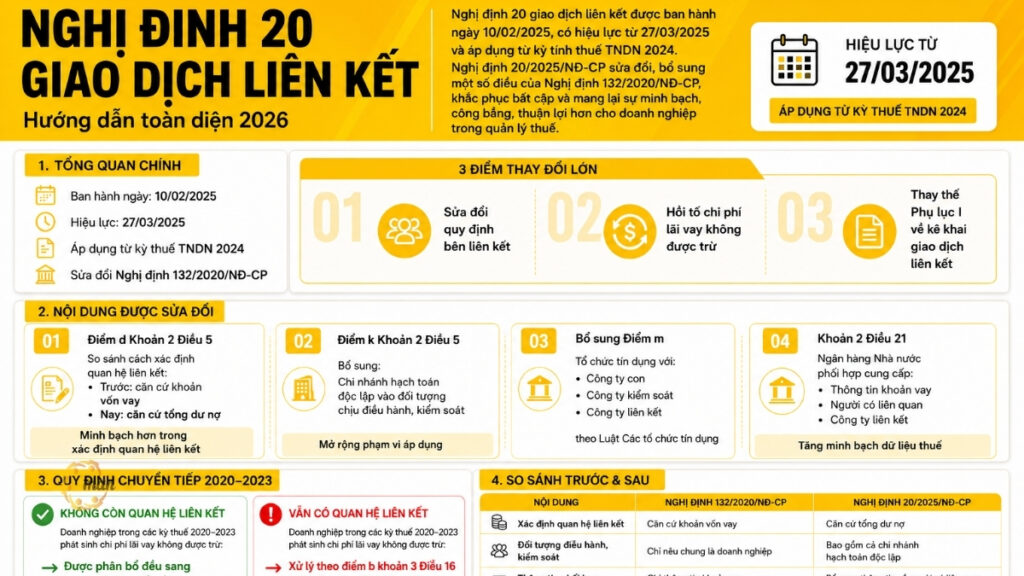
Decree 20 on related-party transactions was issued by the Government on February 10, 2025, and officially came into effect on March 27, 2025. Decree 20/2025/ND-CP is considered an important adjustment, addressing many shortcomings from previous regulations. Decree 132/2020/ND-CP. Particularly noteworthy are three key points: amending the regulations defining related parties, adding a retroactive mechanism for non-deductible interest expenses, and replacing Appendix I regarding... declaration of related party transactions. These changes bring greater transparency, fairness, and convenience to businesses in the tax management process.
Overview of Decree 20 on related-party transactions
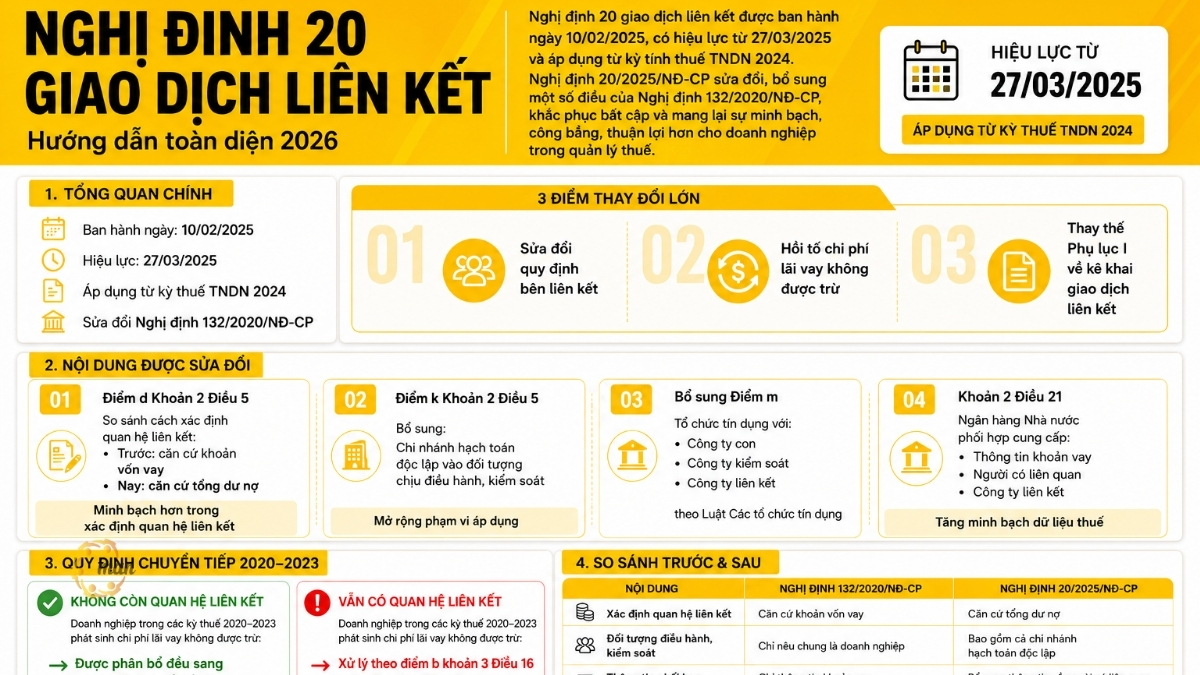
On February 10, 2025, the Government issued Decree 20 on related-party transactions, amending and supplementing a number of articles of Decree 132/2020/ND-CP (issued on November 5, 2020) on tax management for enterprises with related-party transactions. Decree 20/2025/ND-CP Effective from March 27, 2025, and applicable to the corporate income tax (CIT) period of 2024.
Decree 20 on related-party transactions amends and supplements several articles of Decree 132/2020/ND-CP regulating tax management for enterprises with related-party transactions as follows:
- Amend and supplement points d and k and add point m, clause 2, Article 5 Decree 132/2020/ND-CP on related parties.
- Amending and supplementing Clause 2, Article 21 of Decree 132/2020/ND-CP on the responsibilities of the State Bank.
- Replace Appendix I (Information on related parties and related-party transactions issued with Decree 132/2020/ND-CP) with Appendix I issued with Decree 20/2025/ND-CP.
At the same time, Decree 20 on related-party transactions includes the following transitional provisions.
In cases where businesses, during the tax periods of 2020-2023, borrowed capital, provided guarantees, or transacted with credit institutions classified as related parties under Decree 132/2020/ND-CP (amended and supplemented by Decree 20 on related-party transactions), resulting in non-deductible interest expenses, the following procedures will apply starting from the 2024 tax period:
- For businesses that have no related-party transactions or related-party transactions as stipulated in Decree 132/2020/ND-CP and Decree 20/2025/ND-CP, the portion of interest expense that is not deductible up to the end of the 2023 tax period will be evenly allocated to subsequent tax periods, as prescribed in point b, clause 3, Article 16 of Decree 132/2020/ND-CP.
- For businesses with related-party relationships and transactions as stipulated in Decree 132/2020/ND-CP and Decree 20/2025/ND-CP, interest expenses that are not deductible and cannot be carried forward to the next tax period will be handled according to point b, clause 3, Article 16 of Decree 132/2020/ND-CP.
From the above overview, it can be seen that Decree 20 on related-party transactions not only inherits existing regulations but also includes many important adjustments. To better understand the practical impact, let's delve into the highlights of Decree 20 on related-party transactions.
Key new points in Decree 20 regarding related-party transactions.

Decree 20 on related-party transactions amends and supplements several articles of Decree 132/2020/ND-CP on tax management for enterprises with related-party transactions, officially taking effect from March 27, 2025 and applicable from the corporate income tax period of 2024.
Accordingly, here are some notable new points of Decree 20/2025/ND-CP.
Amending and supplementing Point d, Clause 2, Article 5 of Decree 132/2020/ND-CP
One of the notable amendments is the regulation in point d, clause 2, Article 5, regarding the criteria for determining affiliated relationships through loans and guarantees. Compared to Decree 132/2020/ND-CP, this regulation has been revised to clarify how to calculate the total outstanding debt instead of just considering the loan amount, thus ensuring more consistent and transparent application. Details are shown in the following table:
| Criteria | Decree 132/2020/ND-CP | Decree 20/2025/ND-CP |
| Applicable objects. | The Company guarantees or lends capital in any form (including loans from third parties guaranteed by affiliates, and similar financial transactions). | Maintain the regulation: Enterprises guarantee or lend capital in any form (including loans from third parties guaranteed by affiliates, and similar financial transactions). |
| Conditions that determine the association relationship. | The loan amount is at least equal to 25% of the capital contribution of the borrowing enterprise owner and accounts for more than 50% of the total value of medium and long-term debts of the borrowing enterprise. | The total outstanding debt of the borrowing enterprise with the lending or guaranteeing enterprise is at least equal to 25% of the capital contribution of the borrowing enterprise's owner and accounts for more than 50% of the total outstanding debt of all medium- and long-term debts of the borrowing enterprise. |
| Main changes | Based on loan amount | Based on total outstanding debt |
In comparison, Decree 20 on related-party transactions has changed the approach from loan capital to total outstanding debt, making the regulations stricter and more transparent in determining related-party relationships.
Amending and supplementing point k, clause 2, Article 5 of Decree 132/2020/ND-CP
One of the key amendments to Decree 20 on related-party transactions is the addition of independently accounting branches to the scope of entities subject to management and control. A comparison before and after the amendment is as follows:
| Criteria | Decree 132/2020/ND-CP | Decree 20 on related-party transactions |
| Regulations | Other cases in which an enterprise is actually under the management, control and decision-making power over the production and business activities of another enterprise. | Other cases in which an enterprise (including an independent accounting branch that declares and pays corporate income tax) is subject to the actual management, control, and decision-making on the production and business activities of the other enterprise. |
| Main changes | Just general business. | It is also clear that independent accounting branches are also in this case. |
Decree 20/2025/ND-CP has expanded the scope of application by adding independently accounting branches to the list of entities subject to management and control. This regulation clarifies the relationship between related parties in practice, while also supporting tax authorities and businesses with a more transparent basis for tax declaration, payment, and management of related-party transactions.
Supplement point m, clause 2, Article 5 of Decree 132/2020/ND-CP
Point m, Clause 2, Article 5 of Decree No. 132/2020/ND-CP is amended as follows:
“Credit institutions with Subsidiaries or with Controlling Companies or with Affiliated Companies of credit institutions as prescribed in the Law on Credit Institutions and amendments, supplements or replacements (if any)”
Amending and supplementing Clause 2, Article 21 of Decree 132/2020/ND-CP regulating the responsibilities of the State Bank.

To better understand the changes, particularly in the role of the State Bank of Vietnam in coordinating with tax authorities, let's compare the provisions in Clause 2, Article 21 of Decree 132/2020/ND-CP and the amended and supplemented content in Decree 20 on related-party transactions in the table below.
| Criteria | Decree 132/2020/ND-CP | Decree 20 on related-party transactions |
| Responsibility for coordinating the provision of information on foreign loans and debt repayment. | The State Bank provides information and data on foreign loans and debt repayments of each enterprise with related-party transactions according to the list requested by the tax authority. Information includes: loan turnover, interest rate, interest payment period, principal payment, actual capital withdrawal, debt repayment (principal, interest) and other relevant information (if any). | Keep the previous regulations intact. |
| Scope of information provided jointly | No regulations yet. | Additional information: The State Bank of Vietnam will cooperate in providing information about relevant parties as required by law, including: Members of the Board of Directors, Board of Management, Board of Supervisors, General Director or Director, Deputy Director and equivalent positions; Related persons of shareholders owning 01% or more of the charter capital of a credit institution; Affiliated companies of credit institutions. Information is extracted from the State Bank's management data system when requested by the tax authority. |
In comparison, Decree 20 on related-party transactions has expanded the scope of information that the State Bank of Vietnam must provide to the tax authorities, including data on related parties and affiliated companies. This addition increases transparency, supports tax authorities in controlling related-party transactions, and provides a clearer legal basis for businesses to comply with regulations.
Frequently Asked Questions about Decree 20 on Related-Party Transactions
To assist businesses in resolving issues related to related-party transactions under Decree 20, MAN – Master Accountant Network has compiled the following information:
No. This is a crucial breakthrough in Decree 20/2025/ND-CP that helps alleviate financial pressure on businesses. According to the new regulations, if a bank (credit institution) provides a loan or guarantee and the borrowing enterprise is not directly or indirectly under the management, control, capital contribution, or investment of another party (as per points b, e, and i of Clause 2, Article 5), then this loan is not considered a related-party transaction.
The determination of total outstanding debt for assessing related-party relationships is at the end of the tax period, based on data from audited or legally prepared annual financial statements. If, during the year, the enterprise proactively reduces the principal debt, causing the actual outstanding debt at the end of the year to fall below the threshold of 25% of equity or below 50% of total medium- and long-term debt, the enterprise will not be determined to have a related-party relationship in that tax period.
Yes. Although Decree 20/2025/ND-CP takes effect from March 27, 2025, the transitional provisions clearly state that this document applies immediately to the 2024 corporate income tax period. Therefore, if a business has already filed a tax return according to the old regulations, resulting in the limitation on bank interest expense, the business needs to proactively submit a supplementary corporate income tax return and replace it with the new Appendix I form issued with Decree 20/2025/ND-CP to receive a tax refund or reduce the amount of corporate income tax payable.Are loans from regular commercial banks considered related-party transactions and subject to the interest rate cap under Article 30% EBITDA?
At what point in the year is the total outstanding loan balance determined?
If a business submitted its corporate income tax return before the effective date of Decree 20/2025/ND-CP, are the new regulations applicable?
Conclude
Decree 20 on related-party transactions marks a significant adjustment compared to Decree 132, with several notable points such as:
- Revise the criteria for determining affiliation.,
- Additional non-deductible interest expenses.,
- Replace Appendix I on the declaration of related-party transactions.
- Expand the coordinating role of the State Bank of Vietnam in providing information.
These changes not only increase transparency and fairness in tax administration but also make it easier for businesses to comply and reduce legal risks.
To proactively adapt and minimize the risks of tax audits, businesses need to:
- Immediately review the list of affiliated parties: Re-evaluate loans and guarantees based on the new total outstanding balance instead of the initial balance.
- Update the form system: Use the correct Appendix I newly issued with Decree 20/2025/ND-CP.
- Prepare documentation for determining transfer pricing: Gather complete supporting documents and conduct appropriate comparative data analysis to be ready for explanation when required. If the company faces difficulties in terms of specialized personnel, seek assistance from service providers. related party transaction documentation service Reputation is the best solution to avoid the risk of having the transaction price assessed by the tax authorities.
If your business is having difficulty identifying new related-party relationships, calculating deductible interest expenses, or properly filing Appendix I, let the MAN – Master Accountant Network team assist you. related party transaction advisory services In-depth analysis helps optimize costs in the most legal and secure way possible.
For any further questions, assistance, or advice, please contact us. Contact MAN – Master Accountant Network:
Contact information MAN – Master Accountant Network
- Address: No. 19A, Street 43, Tan Thuan Ward, Ho Chi Minh City
- Mobile/Zalo: 0903 963 163 – 0903 428 622
- Email: man@man.net.vn
Content production by: Mr. Le Hoang Tuyen – Founder & CEO of MAN – Master Accountant Network, CPA Vietnam auditors with over 30 years of experience in accounting, auditing, and financial consulting.