





Understanding the difference between EBIT and EBITDA is a seemingly basic question, yet it's the starting point for many serious errors in the tax records of companies with related-party transactions. This is especially relevant starting from the corporate income tax period of 2026, when... Decree 255/2026/ND-CP Officially replacing the old legal framework, misunderstanding the nature of these two indicators can lead businesses to miscalculate the interest expense limit, resulting in the disallowance of expenses, tax arrears, and loss of carryforward rights. This article clearly and logically reviews these two concepts to prevent confusion between chief accountants and CFOs.
Why is it important for businesses with related-party transactions to understand the difference between EBIT and EBITDA?

In financial statements, EBIT and EBITDA are often presented side-by-side, both derived from operating profit and excluding taxes and interest expenses. This similarity leads many accountants, even experienced CFOs, to consider these two metrics almost equivalent and use them interchangeably when preparing management reports or calculating tax obligations. This is where the risk begins.
Confusing EBIT with EBITDA can lead businesses to miscalculate the threshold for interest expense.
Failing to clearly distinguish between EBIT and EBITDA is not just a terminology error, but also directly impacts a legally significant figure: the 30% EBITDA threshold used to limit deductible interest expenses when calculating corporate income tax.
If a business inadvertently uses EBIT instead of EBITDA, or forgets to add up depreciation expenses, the resulting calculation will be inaccurate, either lower or higher than the actual figure, leading to an incorrect calculation of disallowed interest expenses and directly affecting the amount of tax payable.
The context of Decree 255/2026/ND-CP places EBITDA at the center of tax obligations.
Decree 255/2026/ND-CP on tax management for enterprises with related-party transactions, effective from July 1, 2026 and applicable from the 2026 corporate income tax period, continues to maintain the previously stipulated mechanism for limiting interest expense at 30% EBITDA. This means that correctly understanding the difference between EBIT and EBITDA is no longer just "essential" financial knowledge, but a mandatory condition for accurate tax declaration and avoiding rejection by tax authorities during audits.
How do EBIT and EBITDA differ in nature and calculation formulas?
To fully answer the question of how EBIT and EBITDA differ, it's necessary to break down each metric from its root before making a comparison.
What is EBIT? Earnings before interest and taxes.
EBIT (Earnings Before Interest and Taxes) is a company's profit before deducting interest expenses and corporate income tax. In other words, EBIT reflects the profitability of its core business operations after deducting all normal operating expenses, including depreciation of fixed assets, but without considering how the company raises capital (borrowing or equity) and its tax obligations.
The formula is determined:
EBIT = Earnings before tax + Interest expense |
Or calculated from revenue:
EBIT = Net Revenue – Cost of Goods Sold – Selling Expenses – Administrative Expenses |
What is EBITDA? Earnings before interest, taxes, and depreciation.
EBITDA (Earnings Before Interest, Taxes, Depreciation, and Amortization) goes a step further than EBIT: it includes depreciation costs for tangible fixed assets and amortization costs for intangible assets. This is the core difference that answers the question of how EBIT and EBITDA differ. EBITDA eliminates the impact of depreciation policies, which depend on how a business chooses its depreciation method and timing, and does not reflect actual cash outflows during the period.
Recipe:
EBITDA = EBIT + Depreciation and amortization expenses |
Formula for converting between EBIT and EBITDA
From the two formulas above, it can be seen that the relationship between the two indicators is very simple mathematically but creates a significant difference in meaning: EBITDA is always greater than or equal to EBIT, and the difference is equal to the depreciation expense incurred during the period.
For businesses with a large proportion of fixed assets such as factories, production lines, and investment properties, the gap between EBIT and EBITDA can be very large, and this is why understanding the difference between EBIT and EBITDA is far more important than a simple term-based question.
Comparison Table: How EBIT and EBITDA differ based on various criteria
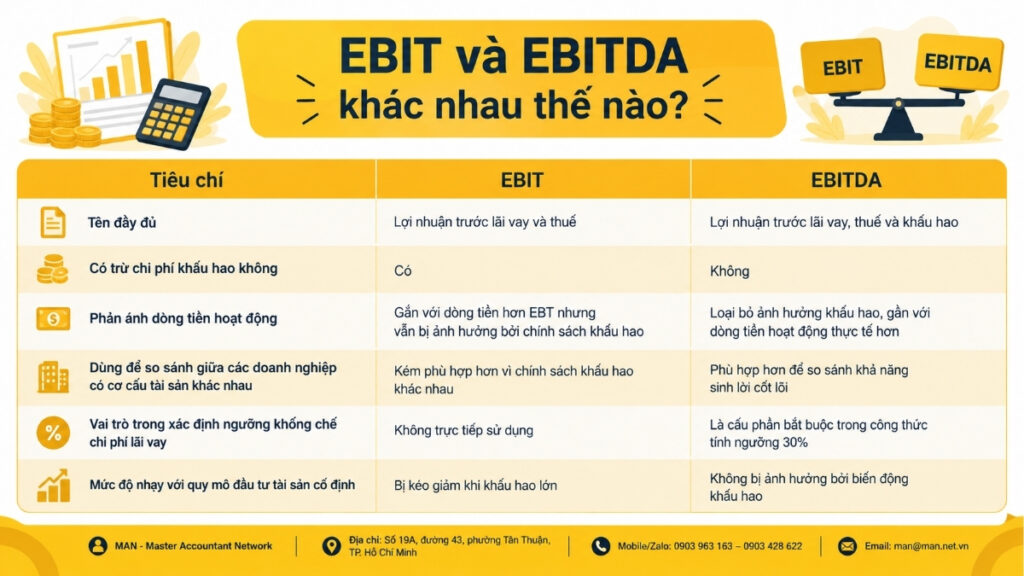
To easily understand the difference between EBIT and EBITDA without having to reread the entire formula, the table below compares the two indicators according to six criteria commonly encountered in management and tax practice, from calculation methods and the extent to which they reflect cash flow, to the role of each indicator in determining the threshold for interest expense limits:
| Criteria | EBIT | EBITDA |
| Full name | Profit before interest and taxes | Profit before interest, taxes, and depreciation |
| Is depreciation expense deductible? | Have | Are not |
| Reflects operating cash flow. | More closely tied to cash flow than EBT, but still affected by depreciation policies. | Eliminate the effect of depreciation, bringing it closer to actual operating cash flow. |
| Used to compare businesses with different asset structures. | Less suitable due to different depreciation policies. | It is more appropriate to compare core profitability. |
| The role in determining the threshold for controlling interest expenses. | Do not use directly. | It is a mandatory component in the 30% threshold calculation formula. |
| Sensitivity to the scale of fixed asset investment | Reduced due to high depreciation. | Not affected by depreciation fluctuations. |
Looking at the table above, the answer to the difference between EBIT and EBITDA can be summarized in one sentence: EBIT measures operating profit after depreciation, while EBITDA measures operating profit before depreciation, and it is this "before depreciation" portion that is chosen by tax law as the basis for limiting interest expense, rather than EBIT.
How does tax-based EBITDA differ from financial-based EBITDA?
Answering the question of how EBIT and EBITDA differ from a corporate finance perspective is only the first step. When applying this to tax obligations, businesses also face a second distinction: EBITDA in the conventional management sense differs from taxable EBITDA as defined in Clause 3, Article 16 of Decree 255/2026/ND-CP.
Why is the question "What is the difference between EBIT and EBITDA?" not enough, and why is it necessary to differentiate between taxable EBITDA?
According to regulations, taxable EBITDA is determined as follows:
“"Total net profit from business operations during the period, plus interest expense after deducting interest on deposits and loans incurred during the period, plus depreciation expense incurred during the period."”
The two biggest differences compared to conventional management EBITDA are:
- The starting point is net profit from business operations., not profit before tax in general, meaning other income and other expenses (such as gains from the sale of fixed assets) are not included.
- The total interest component is net interest., After offsetting interest on deposits and loans, there is no gross interest expense on the books.
Businesses want to have a firm grasp of the situation. EBITDA calculation formula According to current tax regulations, carefully compare these two differences before including the data in the tax return to avoid mistakenly using financial EBITDA to calculate the tax threshold.
Here's an example illustrating the difference between EBIT and EBITDA using real-world data.
To clearly see how EBIT and EBITDA differ based on a specific set of data, consider Company B, a manufacturing business that borrows capital from its parent company abroad, for the tax year 2026:
| Indicators | Amount (billion VND) |
| Net operating profit | 40 |
| Interest expense incurred during the period | 35 |
| Interest earned on deposits + Interest earned on loans during the period | 5 |
| Depreciation expense for the period | 15 |
Determine EBIT:
EBIT = Net profit from business operations + Interest expense = 75 billion VND |
Calculate EBITDA:
EBITDA = EBIT + Depreciation Expense = 90 billion VND |
Calculate taxable EBITDA (according to Clause 3, Article 16 of Decree 255/2026/ND-CP):
- Net interest expense = 35 − 5 = 30 billion VND
- Taxable EBITDA = 40 + 30 + 15 = 85 billion VND
With just one set of data, three different results clearly demonstrate the difference between EBIT and EBITDA, and explain why businesses cannot use financial EBITDA instead of tax EBITDA when calculating the 30% threshold. If Company B mistakenly uses 90 billion VND instead of 85 billion VND, the deductible threshold will be calculated higher than the actual amount by 1.5 billion VND (a 5 billion VND difference in 30%), leading to an under-declaration of interest expense that should be disallowed.
Why do businesses with related-party transactions need to track both EBIT and EBITDA?

Beyond simply explaining the difference between EBIT and EBITDA for tax purposes, businesses with related-party transactions need to monitor both indicators simultaneously for the following reasons:
- EBIT helps assess actual operating performance., This excludes the impact of capital structure but still reflects the burden of fixed asset investment, useful for comparing business performance between years or between member units within the same group.
- EBITDA is a mandatory foundation for determining the control threshold. interest expense in related party transactions, This is especially true for businesses that have loans from their parent company, affiliated companies, or individuals with close family ties to the executives.
- Monitor both indicators over multiple periods. This helps businesses predict when interest expenses are likely to exceed a certain threshold, allowing them to proactively adjust their borrowing plans or asset structure before the expense arises. Interest expenses are not deductible..
In other words, understanding the difference between EBIT and EBITDA is not only useful for settling accounts for a single period, but also serves as a multi-year financial planning tool for related businesses.
3 common mistakes when distinguishing and using EBIT and EBITDA in related party transaction records.
First, using EBIT instead of EBITDA when calculating the 30% threshold is a fundamental error stemming from a misunderstanding of the difference between EBIT and EBITDA. Omitting depreciation costs leads to a lower denominator, resulting in a smaller deduction threshold and an unnecessary increase in disallowed interest expense.
Secondly, using financial EBITDA instead of tax EBITDA. Failing to exclude other income and not properly offsetting interest on deposits and loans results in an inaccurate calculation compared to the regulations in Clause 3, Article 16 of Decree 255/2026/ND-CP, leading to the risk of being reassessed during an audit.
Third, failing to maintain reconciliation statements between financial EBIT, EBITDA, and tax EBITDA. When explaining to the tax authorities, if the business cannot clearly demonstrate the step-by-step conversion between these indicators, proving the correct calculation of the threshold will be much more difficult, even if the data itself is accurate. Handling interest expenses exceeding the 30% EBITDA threshold The correct process always begins with a transparent spreadsheet, with clear and verifiable data.
Conclude
The question of how EBIT and EBITDA differ may seem simple, but it forms the foundation of the entire process of determining the interest expense limit under Decree 255/2026/ND-CP. Three things to remember: EBIT is profit before interest and taxes, while EBITDA includes depreciation; tax law only uses EBITDA – specifically, tax EBITDA with its own formula, not EBIT as the basis for calculating the 30% limit; and the difference between financial EBITDA and tax EBITDA is large enough to alter the calculation results if the business does not clearly separate them.
If your business still has questions about how to calculate taxable EBITDA, how to determine net interest expense, or how to handle excess expenses, MAN – Master Accountant Network's team of related-party transaction experts is ready to review them with you before the closing date. Understanding the root cause of a financial indicator is always cheaper than facing a tax audit.
Contact MAN – Master Accountant Network For free support and advice!
Contact information MAN – Master Accountant Network
- Address: No. 19A, Street 43, Tan Thuan Ward, Ho Chi Minh City
- Mobile/Zalo: 0903 963 163 – 0903 428 622
- E-mail: man@man.net.vn
- Google Business Profile: View MAN – Master Accountant Network's Google Business Profile
- LinkedIn Founder: View expert Le Hoang Tuyen's LinkedIn profile.
Responsible for production and professional content review by: Mr. Le Hoang Tuyen – Founder & CEO of MAN – Master Accountant Network. He is a CPA Vietnam auditor with over 30 years of in-depth experience in accounting, auditing, taxation, and corporate legal consulting.
Answering the question: What is the difference between EBIT and EBITDA?
What is the fundamental difference between EBIT and EBITDA?
The core difference lies in depreciation costs: EBIT is profit after depreciation, while EBITDA is profit before depreciation (depreciation is added back to EBIT).
Why does tax law use EBITDA instead of EBIT to limit interest expense?
Because EBITDA reflects the profitability of core business operations without being affected by depreciation policies, and capital varies between businesses, it is more appropriate to use it as a general benchmark when determining the threshold for deductible interest expense.
Are financing EBITDA and tax EBITDA the same thing?
No. Taxable EBITDA, as defined in Clause 3, Article 16 of Decree 255/2026/ND-CP, derives from net profit from business operations plus net interest expense (after deducting interest on deposits and loans), while financial EBITDA is typically calculated from overall pre-tax profit and gross interest expense.
How do EBIT and EBITDA differ for businesses with large fixed assets?
Businesses with a high proportion of fixed assets and high depreciation rates often have a significantly larger gap between EBIT and EBITDA compared to trading or service businesses with less investment in fixed assets.
Can EBIT be used to calculate the 30% threshold for deductible interest expense?
No. Clause 3, Article 16 of Decree 255/2026/ND-CP clearly defines the threshold based on tax-deductible EBITDA, not EBIT, so substituting these two indicators would lead to incorrect calculations.