





The EBITDA margin is a metric that measures the ratio of profit before interest, taxes, tangible depreciation, and intangible depreciation to net revenue. It's a familiar tool for every CFO when evaluating the core profitability of a business. However, for businesses with related-party transactions, correctly understanding this metric is not only important for management purposes but also a crucial first step before tackling the challenge of controlling interest expenses according to the 30% EBITDA threshold. Decree 255/2026/ND-CP. This article systematically reviews the formulas, how to read the indicators, and their relationship to tax obligations, addressing common misconceptions among chief accountants.
Why is EBITDA margin an important indicator that cannot be ignored in 2026?
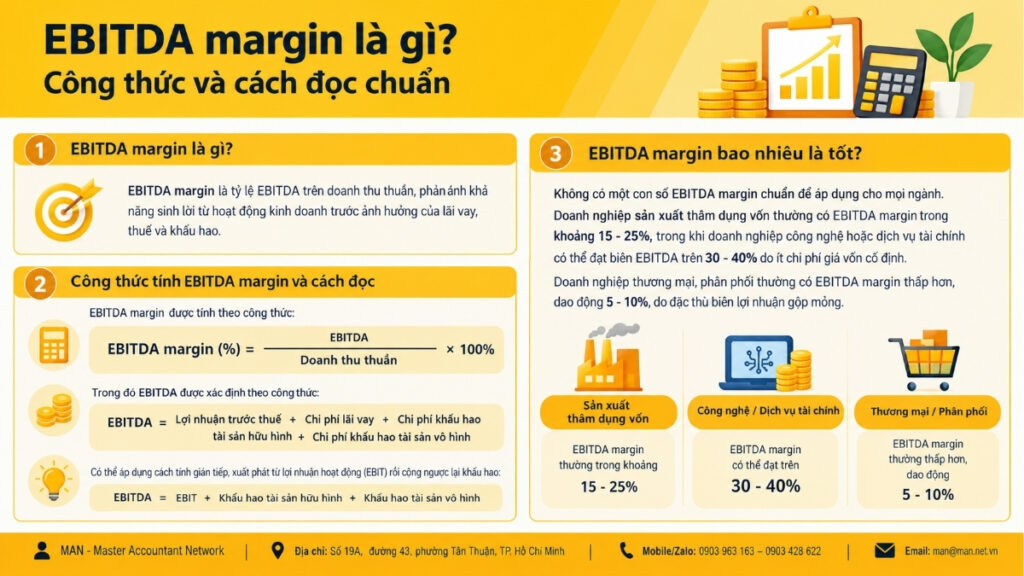
The EBITDA margin is the percentage ratio between EBITDA and net revenue in the same period, reflecting the profitability of core business operations before being influenced by capital structure, tax policies, or depreciation methods of each company.
To put it simply, if revenue is the "scale," then the EBITDA margin is the "quality" of that scale. Two businesses with the same revenue of 100 billion VND but one with an EBITDA margin of 251 TP3T and the other only 81 TP3T indicate completely different cash generation capabilities from their operations, even though their reported after-tax profits may be similar due to different depreciation or interest expense accounting.
The index helps eliminate noise from capital structure and depreciation policies.
Net profit after tax is affected by many variables that do not reflect the nature of business operations, such as high or low financial leverage, fast or slow depreciation methods, and corporate income tax incentives depending on the location or sector.
The index eliminates all variables, allowing investors, banks, and regulators to more fairly compare operational efficiency between businesses in the same industry.
Three groups of stakeholders are of particular interest in the 2026 fiscal year.
Banks and credit institutions use this indicator as a criterion for approving loan limits and pricing interest rates; the more stable the EBITDA margin, the lower the credit risk.
Investors and transferees use the EBITDA margin to value businesses using the multiple method (EV/EBITDA), where the profit margin is the direct basis for comparison with businesses in the same industry.
The chief accountant and tax department of a business with related-party transactions need the EBITDA margin as a stepping stone to understand the components of EBITDA before calculating taxable EBITDA, a fundamental indicator of the 30% threshold for interest expense under Decree 255/2026/ND-CP, which takes effect from July 1, 2026 and applies immediately from the corporate income tax period of 2026.
EBITDA margin calculation formula and how to correctly interpret each component.
The EBITDA margin is calculated using the following formula:
EBITDA margin (%) = (EBITDA / Net Revenue) x 100% |
In which EBITDA is determined by the formula:
EBITDA = Profit before tax + Interest expense + Depreciation expense of tangible assets + Depreciation expense of intangible assets |
An indirect calculation method can be applied, starting from operating profit (EBIT) and then adding depreciation back:
EBITDA = EBIT + Depreciation of Tangible Assets + Depreciation of Intangible Assets |
To ensure consistency and comparability of EBITDA margin calculations across periods, businesses should refer to detailed guidelines on... EBITDA calculation formula To standardize the method of obtaining data from the Income Statement, avoiding a situation where each reporting period uses a different calculation method.
How does EBITDA margin differ from taxable EBITDA from a management perspective?
This is the most common mistake when businesses with related-party transactions shift from reading management ratios to calculating tax obligations. From a management perspective, this ratio is usually derived from profit before tax and does not distinguish between gross or net interest expense.
Meanwhile, EBITDA, used to calculate the threshold for interest expense deductions under Clause 3, Article 16 of Decree 255/2026/ND-CP, is derived from net profit from business operations. This figure includes revenue and financial expenses but excludes other income and expenses, plus interest expense after deducting interest on deposits and loans incurred during the period, along with depreciation expenses incurred during the period.
This difference is not just a matter of calculation technique. Businesses with significant other income (e.g., gains from the liquidation of fixed assets) will see a substantial discrepancy between their management-managed EBITDA margin and tax-tax EBITDA, leading to misestimation of the interest expense deduction margin if the wrong metric is applied.
What is a good EBITDA margin? Read the indicator by industry and by period.

There is no single standard figure applicable to all industries. Capital-intensive manufacturing businesses typically range from 15–251 TP3T, while technology or financial services businesses can achieve EBITDA margins above 30–401 TP3T due to lower fixed cost of goods sold. Trading and distribution businesses have lower figures, ranging from 5–101 TP3T, due to their thin gross profit margins.
More important than the absolute number is the trend of EBITDA margin fluctuations over multiple periods. If the index continuously declines despite increasing revenue, it is often a sign that operating costs are increasing faster than revenue, or the business is in an expansion phase causing profit margins to temporarily shrink.
Low EBITDA margin increases the risk of exceeding the 30% EBITDA threshold for interest expense.
This is a connection that not many chief accountants immediately realize: businesses with low figures, meaning profit before interest, taxes, and depreciation accounts for only a small proportion of revenue, will have a correspondingly smaller EBITDA tax denominator, resulting in a smaller threshold for deductible interest expense (equal to 30% EBITDA tax).
With the same amount of borrowing from related parties, a business with a low ratio will be more likely to fall into a situation of misappropriation. related party interest expense This exceeds the borrowing limit compared to businesses of similar size but with better profit margins.
In other words, improving the EBITDA margin is not just a conventional profit management goal, but also directly expands the room for deducting interest expenses when calculating corporate income tax—a double benefit that the finance department needs to incorporate into its capital planning from the beginning of the year.
Illustrative example and relation to the 30% EBITDA threshold (interest expense).
Let's assume: Company B is a manufacturing business that has a loan transaction with its parent company abroad, with the following figures for the 2026 tax period:
| Indicators | Amount (billion VND) |
| Net revenue | 400 |
| Net operating profit | 40 |
| Net interest expense (after deducting interest on deposits and loans) | 32 |
| Depreciation expense for the period | 8 |
Step 1: Calculate EBITDA and EBITDA margin
Determine EBITDA:
EBITDA = 40 + 32 + 8 = 80 billion VND |
Determine the EBITDA margin:
EBITDA margin (%) = (80 / 400) x 100% = 20% |
With an EBITDA margin of 20%, Company B is in the mid-range of the manufacturing industry, a positive sign when dealing with banks or presenting to investors.
Step 2: Compare with the 30% EBITDA threshold.
- Taxable EBITDA = 40 + 32 + 8 = 80 billion VND (matches the management EBITDA in this case because there is no other significant income)
- Deduction threshold = 30% × 80 = 24 billion VND
- Excess amount to be disqualified = 32 − 24 = 8 billion VND
The results show that: Although the 20% ratio is within safe management limits, the company still incurred a loss of 8 billion VND. Interest expenses are not deductible. This is due to the debt structure being too large compared to the size of EBITDA. This is why a good EBITDA margin does not mean that the business is immune to the risk of controlling interest expenses; these two issues need to be considered simultaneously and cannot be addressed by relying on a single indicator.
If Company B wants to know how to handle this disallowed 8 billion VND, including the right to carry it forward to subsequent periods and the accompanying conditions, the company needs to refer to the full procedure in the in-depth article on... Handling interest expenses exceeding the 30% EBITDA threshold, which clearly states that the continuous transition period shall not exceed 05 years according to point b, clause 3, Article 16 of Decree 255/2026/ND-CP.
Three ways to improve and expand the deductible space for interest expenses.
First, optimize the operating cost structure before considering capital restructuring. Reviewing the cost of goods sold and selling and administrative expenses to eliminate inefficient expenditures is the most direct way to increase the EBITDA margin without changing the debt structure.
Secondly, rebalance the debt-to-equity ratio. When the ratio is at a reasonable level but interest expenses still exceed the threshold due to excessive borrowing, the company should consider converting a portion of internal loans into equity to reduce pressure on the denominator of the 30% EBITDA threshold calculation.
Third, monitor the index quarterly instead of just at the end of the year. Profit margins fluctuate seasonally, making it easy to miss periods of shrinking EBITDA when the company incurs large loans from related parties, increasing the risk of local overruns that go undetected.
Conclude
The EBITDA margin is a fundamental indicator that helps businesses see their core profitability, separate from the influence of capital structure and depreciation policies. However, for businesses with related-party transactions, the indicator goes beyond simply being a management indicator; it's also a starting point for understanding taxable EBITDA, thereby correctly determining the margin for deducting interest expenses according to the 30% EBITDA threshold of Decree 255/2026/ND-CP.
A company with a good EBITDA margin can still exceed the threshold if the amount of borrowing from related parties is too large relative to its EBITDA. Conversely, understanding and making the right improvements is a legitimate tool to expand the scope for deductible interest expenses when calculating taxes.
If your business needs to review its calculations, compare them with taxable EBITDA, and assess the risk of exceeding the 30% EBITDA threshold for the 2026 period, MAN – Master Accountant Network's team of related-party transaction experts is ready to assist you before the figures are finalized.
Contact MAN – Master Accountant Network For free support and advice!
Contact information MAN – Master Accountant Network
- Address: No. 19A, Street 43, Tan Thuan Ward, Ho Chi Minh City
- Mobile/Zalo: 0903 963 163 – 0903 428 622
- E-mail: man@man.net.vn
- Google Business Profile: View MAN – Master Accountant Network's Google Business Profile
- LinkedIn Founder: View expert Le Hoang Tuyen's LinkedIn profile.
Responsible for production and professional content review by: Mr. Le Hoang Tuyen – Founder & CEO of MAN – Master Accountant Network. He is a CPA Vietnam auditor with over 30 years of in-depth experience in accounting, auditing, taxation, and corporate legal consulting.
Frequently Asked Questions about EBITDA Margin
The EBITDA margin is the ratio of EBITDA to net revenue, reflecting profitability after deducting all operating expenses but before interest, taxes, and depreciation. The gross profit margin only reflects the difference between revenue and the cost of goods sold, without excluding selling and administrative expenses, so the two indicators serve different analytical purposes.
Not entirely. A high EBITDA margin helps expand the room for deducting interest expenses, but if the scale of borrowing from related parties is too large compared to EBITDA, the business may still incur interest expenses exceeding the 30% EBITDA threshold according to Clause 3, Article 16 of Decree 255/2026/ND-CP.
From a management perspective, businesses can use pre-tax profit to quickly calculate the EBITDA margin. However, when calculating the 30% EBITDA threshold as required by tax regulations, businesses are required to base the calculation on net operating profit and net interest expense to ensure legal compliance.
Yes. EBITDA margin remains an important indicator for evaluating business performance, serving valuation purposes, bank lending, and comparison with competitors in the same industry, regardless of whether the company has related-party transactions.
Businesses with related-party transactions or those planning large borrowings should monitor their quarterly EBITDA margin to detect early signs of shrinking profit margins, thereby proactively adjusting their borrowing plans before the risk of exceeding the 30% EBITDA threshold at the end of the accounting period arises.What is EBITDA margin and how is it different from gross profit margin?
Does a high EBITDA margin mean you don't have to worry about the 30% EBITDA threshold?
When calculating EBITDA margin, is it necessary to use the same net profit from business operations as when calculating taxable EBITDA?
Do businesses with no related-party transactions need to be concerned about EBITDA margin?
How often should I monitor my EBITDA margin?