





Is a high EBITDA truly a good thing, or just a nice number on a management report? This is a question that many chief accountants and CFOs have been forced to reconsider since then. Decree 255/2026/ND-CP Officially applicable from the corporate income tax period of 2026, when EBITDA is no longer simply a management indicator but becomes the denominator determining the portion of interest expense deductible under the 30% EBITDA threshold, a "good" EBITDA figure can be both a tax advantage and a trap if businesses don't understand its true nature. This article analyzes whether a high EBITDA is truly beneficial in certain situations, when it's merely a financial illusion, and how to properly assess it before tax settlement.
Why does the question "Is high EBITDA really a good thing?" make many CFOs reconsider their approach?
For many years, EBITDA has been considered a benchmark for comparing profitability among businesses, as it eliminates the influence of capital structure, depreciation policies, and tax rates. However, the question of whether a high EBITDA is truly beneficial is not limited to management comparisons; it directly relates to the tax obligations of businesses with related-party transactions, particularly the challenge of controlling interest expense.
What is EBITDA and why has it become an important metric?
EBITDA (Earnings Before Interest, Tax, Depreciation, and Amortization) is profit before interest, taxes, and depreciation. Essentially, it's an approximate measure of operating cash flow, helping investors and regulators identify a company's core profitability, separate from financial decisions such as high or low debt levels and rapid or slow depreciation. Because of this neutrality, EBITDA is often used for business valuation, credit rating, and, since Decree 132/2020/ND-CP and now Decree 255/2026/ND-CP, has been used as a benchmark for limiting interest expense deductions for companies with related-party transactions.
The 30% EBITDA threshold is based on Decree 255/2026/ND-CP.
According to point a, clause 3, Article 16 of Decree 255/2026/ND-CP, the total interest expense after deducting interest on deposits and loans incurred during the period, which is deductible when calculating corporate income tax, must not exceed 30% of the taxable EBITDA.
In other words, the higher the EBITDA, the wider the margin for deductible interest expenses. This is why the question of whether a high EBITDA is truly beneficial is no longer simply a matter of management, but has become a variable directly affecting the amount of corporate income tax payable in 2026.
Is a high EBITDA really a good thing, or just a financial illusion?

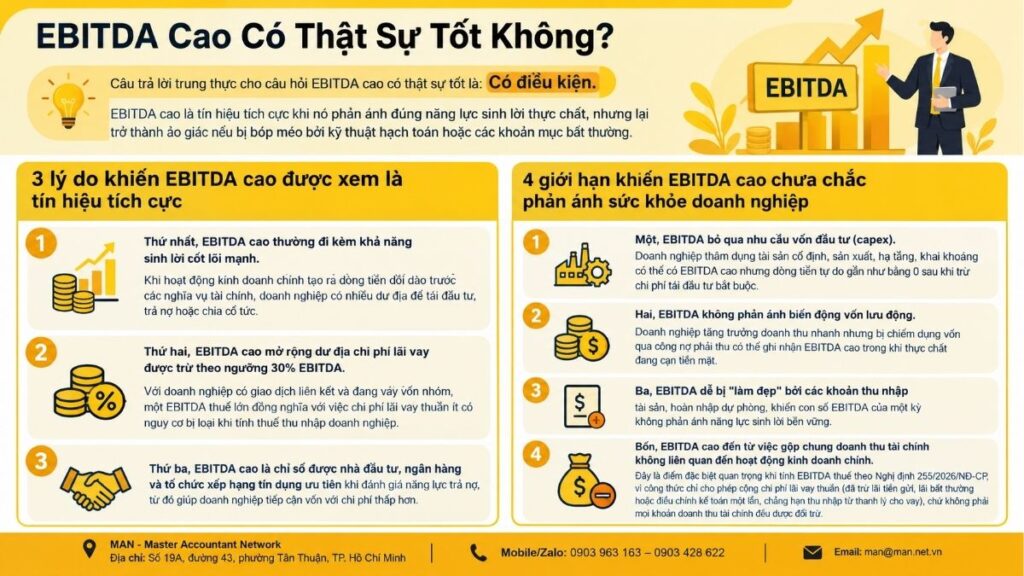
The honest answer to the question "Is high EBITDA really a good thing?" is: Conditional. High EBITDA is a positive sign when it accurately reflects true profitability, but it becomes an illusion if distorted by accounting techniques or unusual items.
3 reasons why high EBITDA is considered a positive sign.
First, high EBITDA is usually accompanied by strong core profitability. When the core business generates ample cash flow before financial obligations, the company has more room to reinvest, pay off debt, or distribute dividends.
Secondly, high EBITDA expands the room for deductible interest expenses under the 30% EBITDA threshold. For businesses with related-party transactions and group borrowing, a large taxable EBITDA means that net interest expense is less likely to be disallowed when calculating corporate income tax.
Third, a high EBITDA is a preferred indicator for investors, banks, and credit rating agencies when assessing debt repayment capacity., This helps businesses access capital at a lower cost.
4 limitations that mean high EBITDA doesn't necessarily reflect a company's health.
First, EBITDA ignores the need for capital expenditure (capex). Asset-intensive businesses, such as manufacturing, infrastructure, and mining, may have high EBITDA, but their free cash flow is almost zero after deducting mandatory reinvestment costs.
Second, EBITDA does not reflect changes in working capital. Businesses experiencing rapid revenue growth but with capital tied up through accounts receivable may report high EBITDA while actually running low on cash.
Third, EBITDA is easily manipulated by earnings reports. Assets and provisions reversals mean that the EBITDA figure for a period does not reflect sustainable profitability.
Fourth, high EBITDA comes from the inclusion of financial revenue unrelated to core business operations. This is a particularly important point when calculating taxable EBITDA according to Decree 255/2026/ND-CP, because the formula only allows adding net interest expense (after deducting interest on deposits and other interest). one-time unusual or adjusted accounting, (for example, income from the liquidation of loans), but not all financial revenue is offset.
Therefore, to fully answer the question of whether high EBITDA is truly good, businesses need to differentiate between EBITDA that accurately reflects the nature of their business and EBITDA that is "inflated" by accounting techniques or unusual items.
Taxable EBITDA and the 30% problem: When high EBITDA becomes an advantage.ế
To properly assess whether high EBITDA is truly beneficial in the context of related-party transaction taxes, businesses need to understand this thoroughly. EBITDA calculation formula In accordance with the provisions of Article 16 of Decree 255/2026/ND-CP, instead of applying the conventional management-based EBITDA concept.
How is the formula for calculating taxable EBITDA determined?
According to point a, clause 3, Article 16, taxable EBITDA is determined as follows:
Taxable EBITDA = Net operating profit for the period + Net interest expense + Depreciation expense incurred during the period |
In this context, net interest expense is the interest expense after deducting interest on deposits and loans incurred during the period. The corresponding deductible interest expense threshold is equal to 30% of the recently determined taxable EBITDA.
| Indicators | How to determine |
| Net operating profit | According to the expenditures shown in the Statement of Income, excluding other income and other expenses. |
| Net interest expense | Interest expense incurred during the period – (Interest on deposits + Interest on loans incurred during the period) |
| Depreciation expense | Depreciation expense of fixed assets incurred during the period |
| Deduction threshold | 30% x EBITDA tax |
How does a high EBITDA expand the scope for deductible interest expenses?
Since the taxable threshold is directly proportional to taxable EBITDA, a business with high EBITDA due to strong net profit from operations or large depreciation expenses will have room for maneuver. related party interest expense This allows for a correspondingly broader deduction. This perspective leads many businesses borrowing from the group to question whether high EBITDA is truly beneficial, not only from a management standpoint but also in terms of optimizing tax obligations.
A simple example: A company with a taxable EBITDA of VND 100 billion will have a net interest expense deduction threshold of VND 30 billion; while a company with a taxable EBITDA of only VND 50 billion will be limited to VND 15 billion, even though both have the same level of borrowing and the same interest expense. Clearly, from a tax perspective, is a high EBITDA truly beneficial for a company bearing interest expenses from related parties?.
The risk arises when businesses intentionally inflate EBITDA to avoid interest expense thresholds.
Because they recognize the high tax benefits of EBITDA, many businesses try to artificially inflate their EBITDA to expand their deductible interest expense. This is where experience in reviewing related-party transaction records shows that it is most likely to be rejected by tax authorities.
Common tricks and why they are rejected by the tax authorities.
Incorrectly including gross interest expense instead of net interest expense in EBITDA. Some businesses fail to deduct interest on deposits and loans from the addition side of EBITDA, leading to inflated EBITDA and miscalculation of the deduction threshold in a way that creates a false sense of advantage.
Include other income in the net profit from business operations. Since the formula only takes net profit from business operations, adding gains from asset liquidation and reversal of provisions to this indicator to artificially inflate EBITDA is fundamentally incorrect and is likely to be disqualified when compared with audited financial statements.
Depreciation is recorded in an incorrect period or in a manner inconsistent with the registered policy. Accelerating or delaying depreciation solely to impact the EBITDA of a specific period is a sign that tax auditors should pay particular attention to.
The consequences of interest expense not being deductible being reassessed.
When tax authorities discover that EBITDA has been miscalculated or inflated, the consequences are not only a correction of the EBITDA but also a complete reassessment of the entire tax base. Interest expenses are not deductible., This involves collecting back taxes on corporate income and calculating late payment penalties from the time the tax should have been paid. In other words, intentionally inflating EBITDA might seem beneficial in the short term on the tax return, but it creates a much greater risk of back taxes being collected in the long term if discovered.
When is a high EBITDA really a good thing?
To definitively answer the question of whether high EBITDA is truly a good thing, chief accountants and CFOs should compare EBITDA with at least two other sets of data instead of looking at the number in isolation.
Compare high EBITDA with actual operating cash flow.
A high EBITDA is only truly positive when it translates into corresponding cash flow from operating activities. If EBITDA increases but operating cash flow is negative or declining due to inflated accounts receivable or stagnant inventory, then the high EBITDA is merely an accounting figure, not a true reflection of financial health.
Compare high EBITDA with earnings quality and related-party transactions.
For businesses with related-party transactions, whether a high EBITDA is truly beneficial depends on whether the internal borrowing interest rates, selling prices, and purchase prices with related parties comply with the arm's length principle. A high EBITDA generated from transfer pricing that benefits a domestic party but lacks supporting documentation carries the risk of being reassessed, leading to a recalculation of both EBITDA and the deductible interest expense threshold.
Practical example: Two businesses with high EBITDA but different tax risks.
Company B and Company C are in the same manufacturing industry, both have a taxable EBITDA of VND 100 billion in 2026, and both borrow capital from their parent companies abroad with net interest expense of VND 35 billion.
| Indicators | Company B | Company C |
| Taxable EBITDA | 100 billion VND | 100 billion VND |
| EBITDA component | Net operating profit, depreciation in accordance with policy. | There was 20 billion VND in other income from asset liquidation that was mistakenly included in net profit. |
| Net interest expense | 35 billion VND | 35 billion VND |
| Deduction threshold | 30 billion VND | 30 billion VND |
| Taxable EBITDA after the tax authorities recalculate it. | 100 billion VND | 80 billion VND (excluding 20 billion VND in other income) |
| Deduction threshold | 30 billion VND | 24 billion VND |
| Exceeding the limit | 5 billion VND | 11 billion VND |
The above example shows that, even with the same high EBITDA figure of 100 billion VND, only company B can definitively say whether a high EBITDA is truly beneficial to them, because the EBITDA component accurately reflects the company's true nature and has been proactively managed. Handling interest expense exceeding the 30% EBITDA threshold The process was correct. Company C, on the other hand, had a high EBITDA figure that was only temporary, with the risk of being completely recalculated when tax inspectors compare it with the audited financial statements.
Conclude
Whether a high EBITDA is truly good doesn't lie in the size of the number, but in the quality of the components that generate it. In the context of Decree 255/2026/ND-CP continuing to maintain the 30% EBITDA limit for interest expense deductions of enterprises with related-party transactions, a genuinely high EBITDA will expand the scope for legally and sustainably deductible interest expense deductions.
Conversely, a high EBITDA resulting from incorrect inclusion of other income, miscalculation of net interest expense, or related-party transactions not reflecting market prices will only be a temporary figure, subject to recalculation during an audit.
In other words, the question of whether high EBITDA is truly a good thing needs to be answered through a process of reviewing the EBITDA components, comparing cash flow and related-party transaction records, rather than relying on subjective feelings based on a single number in a management report.
If your business needs to review its EBITDA tax calculation, reconcile the 30% interest expense threshold, or standardize related-party transaction records before the 2026 tax year, MAN – Master Accountant Network's team of related-party transaction experts is ready to work with you to ensure that the EBITDA figures on your report are truly an advantage, not a potential risk.
Contact MAN – Master Accountant Network For free support and advice!
Contact information MAN – Master Accountant Network
- Address: No. 19A, Street 43, Tan Thuan Ward, Ho Chi Minh City
- Mobile/Zalo: 0903 963 163 – 0903 428 622
- E-mail: man@man.net.vn
- Google Business Profile: View MAN – Master Accountant Network's Google Business Profile
- LinkedIn Founder: View expert Le Hoang Tuyen's LinkedIn profile.
Responsible for production and professional content review by: Mr. Le Hoang Tuyen – Founder & CEO of MAN – Master Accountant Network. He is a CPA Vietnam auditor with over 30 years of in-depth experience in accounting, auditing, taxation, and corporate legal consulting.
Frequently Asked Questions: Is High EBITDA Really a Good Thing?
Is a high EBITDA really good for all types of businesses?
Not entirely. High EBITDA is a positive sign when it accurately reflects core profitability and is accompanied by corresponding operating cash flow. For capital-intensive businesses or those with related-party transactions, high EBITDA needs to be further compared with reinvestment costs and the reasonableness of related-party transactions.
Why is a high EBITDA related to deductible interest expenses when calculating taxes?
According to point a, clause 3, Article 16 of Decree 255/2026/ND-CP, the threshold for deductible net interest expense when calculating corporate income tax is equal to the taxable EBITDA. The higher the EBITDA, the greater the margin for deductible interest expense.
Should businesses seek to increase their EBITDA to be able to deduct more interest expenses?
It should not be done by incorrectly merging components or making calculations that don't reflect the true nature of the business. A high EBITDA is only truly good if it accurately reflects the business's reality; if the tax authorities determine that the calculation is incorrect, the business will be subject to back taxes and late payment penalties.
How does tax-based EBITDA differ from the management-based EBITDA that businesses commonly use?
Taxable EBITDA is calculated from net operating profit, excluding other income and expenses, plus net interest expense (after deducting interest on deposits and loans) and depreciation expense. Management EBITDA typically uses pre-tax profit plus gross interest and depreciation, which can easily result in a higher figure than the actual figure.
Is it a cause for concern if EBITDA is high but operating cash flow is negative?
Yes. This is an indication that high EBITDA has not yet translated into actual cash, possibly due to working capital being tied up or profits coming from non-cash-generating items. The company needs to conduct further review before concluding whether high EBITDA is truly good for its financial situation.