





In the context of increasingly stringent tax audits and inspections of related-party transactions, many businesses find themselves facing tax arrears, penalties, or even double taxation simply because they chose the wrong pricing method or failed to demonstrate its reasonableness. This is why more and more corporations and businesses with related-party transactions are proactively researching and applying transfer pricing methods through Advance Pricing Agreements (APAs) as a long-term tax risk management tool.
This article systematizes all content related to the method of valuing related-party transactions for tax purposes according to current regulations, based on: Law on Tax Administration No. 108/2025/QH15, Decree No. 255/2026/ND-CP and Circular 95/2026/TT-BTC The APA guidelines (Articles 66 to 76) help finance and tax professionals in businesses gain a complete and accurate understanding before making implementation decisions.
What is the method for valuing related-party transactions for tax purposes?
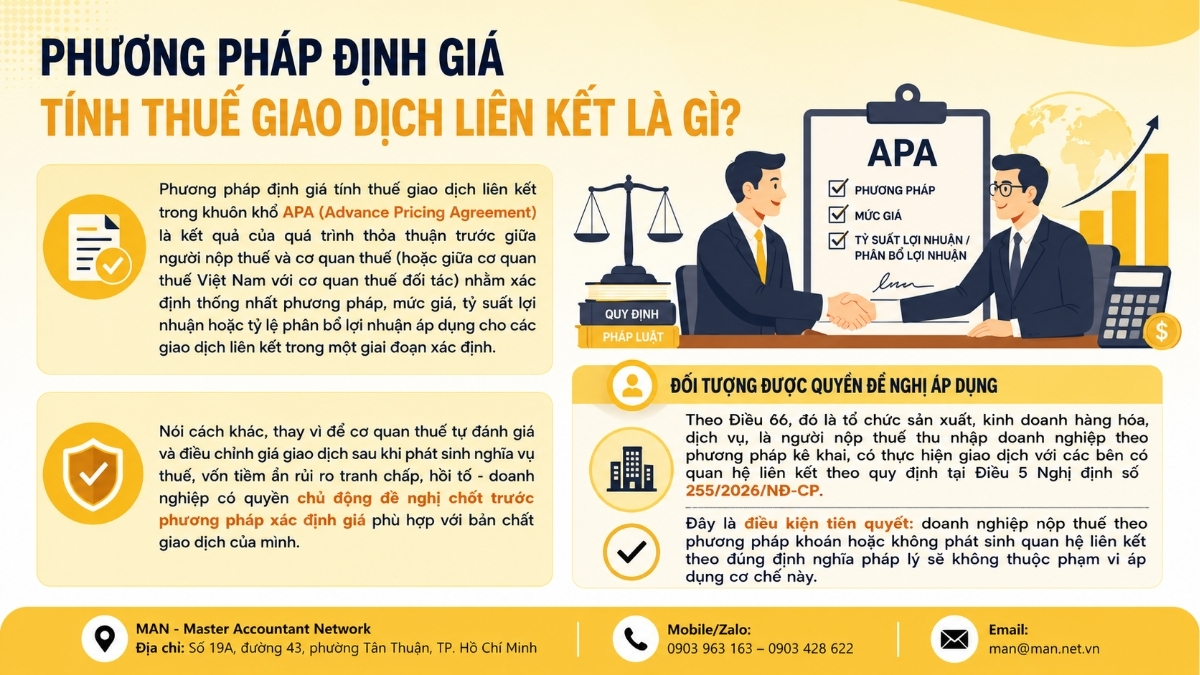
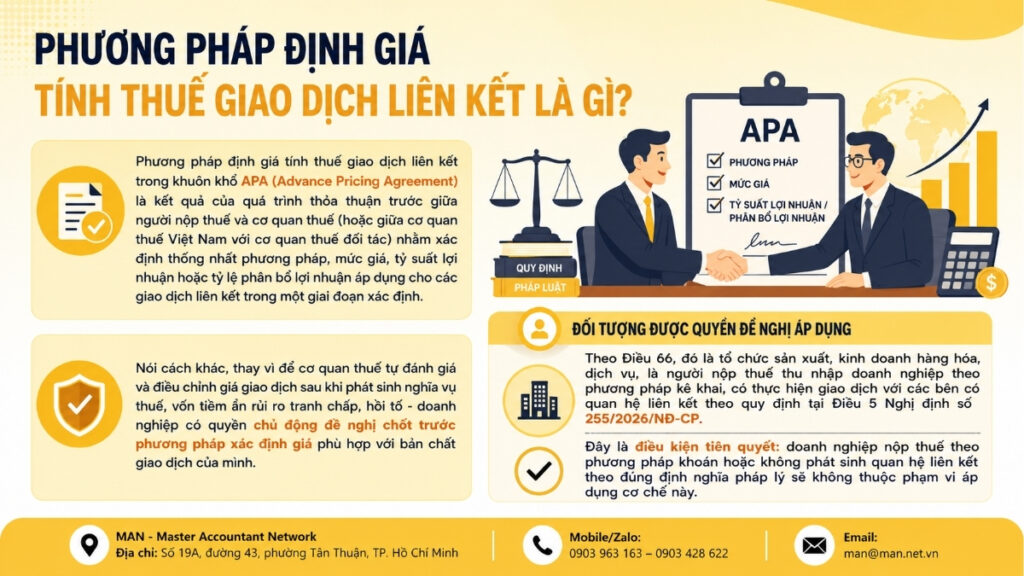
The method for determining the taxable value of related-party transactions within the framework of an APA (Advance Pricing Agreement) is the result of a prior agreement between the taxpayer and the tax authority (or between the Vietnamese tax authority and the partner tax authority) to uniformly determine the method, price, profit margin, or profit allocation ratio applicable to related-party transactions over a defined period.
In other words, instead of letting the tax authorities assess and adjust transaction prices after tax obligations arise, which carries the risk of disputes and retroactive application, businesses have the right to proactively propose a pre-determined pricing method that is appropriate to the nature of their transactions.
Regarding the eligible entities for application, according to Article 66, these are organizations producing and trading goods and services, paying corporate income tax using the declaration method, and conducting transactions with related parties as defined in Article 5 of Decree No. 255/2026/ND-CP. This is a prerequisite: enterprises paying tax using the lump-sum method or those without related parties as defined by law will not be subject to this mechanism.
03 types of APA in the process of applying the transfer pricing method.
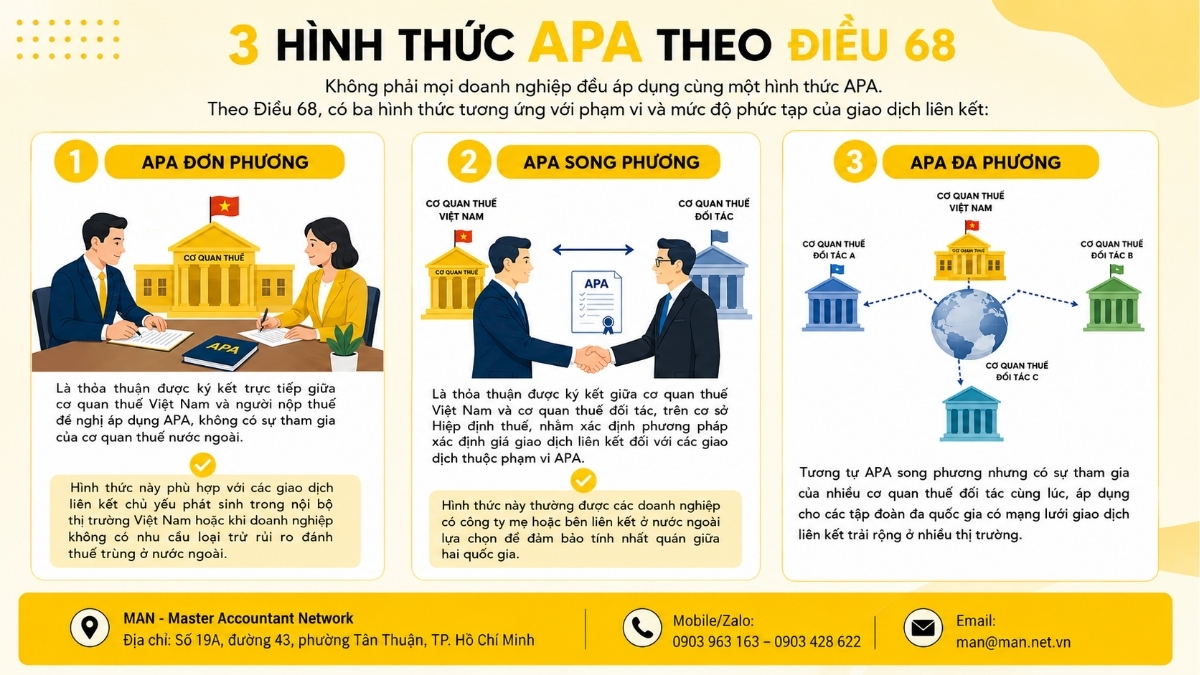
Not all businesses apply the same form of APA. According to Section 68, there are three forms corresponding to the scope and complexity of related-party transactions:
- Unilateral APA: This is an agreement signed directly between the Vietnamese tax authority and the taxpayer requesting the application of an APA, without the involvement of foreign tax authorities. This form is suitable for related-party transactions that mainly occur within the Vietnamese market or when the business does not need to eliminate the risk of double taxation abroad.
- Bilateral APAAn APA is an agreement signed between the Vietnamese tax authority and the tax authority of a partner country, based on a tax agreement, to determine the method for determining transfer pricing for transactions falling within the scope of an APA. This form is often chosen by businesses with parent companies or related parties located abroad to ensure consistency between the two countries.
- Multilateral APASimilar to a bilateral APA but involving multiple partner tax authorities simultaneously, applicable to multinational corporations with extensive related-party transactions across multiple markets.
Choosing the right APA format from the outset directly impacts processing time, drafting language, and the competent authorities involved in negotiations. Therefore, this is a step that businesses need to carefully consider before submitting the official application.
Conditions for applying the transfer pricing method for tax purposes.
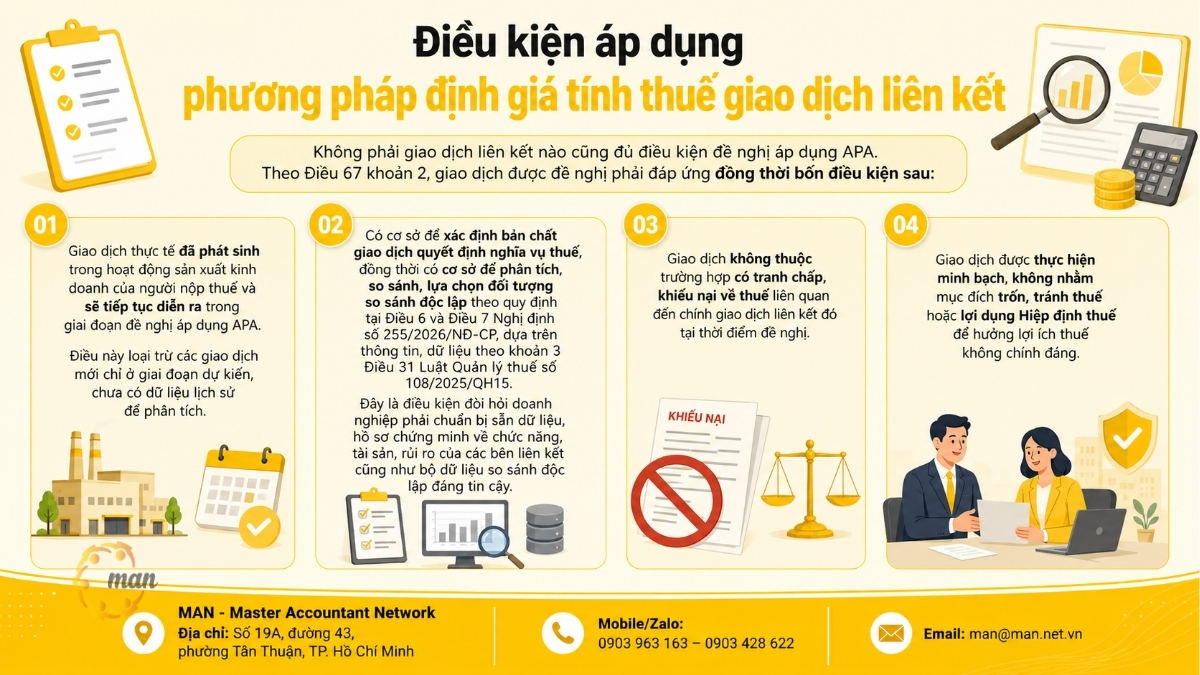
Not all related-party transactions qualify for an APA application. According to Section 67, paragraph 2, a proposed transaction must simultaneously meet the following four conditions:
- The actual transaction has occurred. This applies to transactions within the taxpayer's business operations and will continue throughout the period for which the APA is being proposed. This excludes transactions that are only in the planning stage and lack historical data for analysis.
- There is a basis for determining the nature of the transaction. The determination of tax obligations must be based on information and data as stipulated in Articles 6 and 7 of Decree No. 255/2026/ND-CP, and must be based on information and data as per Clause 3, Article 31 of Law No. 108/2025/QH15 on Tax Administration. This requires businesses to prepare data and documents proving the functions, assets, and risks of related parties, as well as a reliable set of independent comparative data.
- The transaction is not subject to any tax disputes or claims. related to that specific related-party transaction at the time of the proposal.
- The transaction was conducted transparently., not for the purpose of evading or avoiding taxes or exploiting the tax agreement to gain unfair tax benefits.
In fact, the second requirement is often the biggest hurdle for many businesses, because building a suitable, independent comparative dataset requires time, in-depth financial and tax analysis expertise, and needs to be prepared well in advance of the intention to file an APA application. This is also why many businesses seek out alternative solutions. related party transaction advisory services Right from the eligibility assessment stage, to determine early on the likelihood of meeting the requirements before officially submitting the application.
Jurisdiction for processing applications applying the tax valuation method for related-party transactions.
According to Article 69, the jurisdiction for processing APA applications is divided according to their type:
- For bilateral and multilateral APAs, the Tax Department is the lead agency responsible for receiving applications, reviewing, analyzing, and developing negotiation plans, signing, amending, extending, revoking, and canceling APAs. In cases where the APA is complex, involves multiple countries, or relates to matters under the purview of multiple government agencies, the Tax Department must report to the Ministry of Finance to seek guidance on the negotiation plan before officially engaging with the partner tax authority. The tax authority directly managing the taxpayer is responsible for inspecting and monitoring the implementation of the APA after it has been signed.
- For unilateral APAs, the authority to receive, review, analyze, and process the dossier is determined by the Tax Department and assigned to its subordinate units according to internal regulations.
Knowing the competent authority helps businesses proactively contact and submit documents to the correct agency, avoiding wasted time due to sending them to the wrong processing agency.
See also: New points in Decree 255/2026/ND-CP regarding related-party transactions.
The process for handling requests to apply specific valuation methods for tax purposes.
Before proceeding with the formal process, Article 70 allows taxpayers to request the tax authorities to hold a consultation meeting to discuss the scope of the transaction, pricing methods, relevant documents, information, and data. While not a mandatory procedure, this step significantly reduces the risk of businesses having to request multiple revisions or additions to their documents after formal submission.
Following the consultation phase (if any), the process for resolving the APA application is carried out in four steps:
Step 1: Submit the official application.
According to Article 71, taxpayers must submit their request using Form No. 01/APA-DN. The application must be prepared in Vietnamese; for bilateral and multilateral APA applications, an English translation is required, while original documents in other languages must have a Vietnamese translation (and an English translation if it is a bilateral or multilateral application). The taxpayer must sign, stamp, and bear legal responsibility for the content of the translation. If the attached documents are too large to translate completely, the business may summarize the content, explain the reasons, and specify the location and method of storage for the tax authority to access when needed.
Download Form No. 01/APA-DN:
If the attached documents are too large to translate completely, businesses can summarize the content, explain the reasons, and specify the location and method of storage so that the tax authorities can access them when needed. Due to the complexity of the documents, language, and submission deadlines, businesses should consider this carefully. related party transaction documentation service Professionalism is essential to ensure that Form 01/APA-DN and its attached documents are fully and correctly prepared in accordance with regulations from the very first submission.
Step 2: Review and analyze the documents.
According to Article 72, the tax authority shall verify and compare the completeness, accuracy, legality, reasonableness, and validity of the information provided by the enterprise, as a basis for determining the appropriate method and comparison subjects. During this process, the tax authority may request the taxpayer to explain or clarify information, or apply tax management measures to verify the information. Meetings and on-site surveys at the enterprise's headquarters must be recorded in minutes. For bilateral and multilateral cases, if the partner tax authority requests additional information, the enterprise is responsible for cooperating to ensure that all parties involved in the negotiations have consistent information.
Step 3: Discuss and negotiate the APA content.
According to Article 74, negotiations are conducted with the taxpayer (if it is a unilateral APA) or with the partner tax authority (if it is bilateral or multilateral), through in-person meetings, telephone calls, video conferencing, or written exchanges. The results of each exchange must be recorded in writing. In certain necessary cases, and with the approval of the relevant tax authorities, a business representative may be invited to attend to directly explain issues related to their case.
Step 4: Sign and circulate the APA
According to Article 76, after the parties have agreed on all the content, the final draft will be signed. The minimum content of an APA must include: the names and addresses of the participating related parties; a description of the related-party transaction within the scope of the APA; the method for determining the price used as the basis for calculating tax, along with the calculation of the price, gross profit margin, net profit margin, and profit allocation ratio (including the standard independent transaction value range if applicable); material assumptions that may affect the implementation of the APA; the responsibilities and obligations of the taxpayer and the tax authority; the effective date; and any accompanying appendices (if applicable). For unilateral APAs, the official language is Vietnamese; for bilateral and multilateral APAs, the official language is English with a Vietnamese translation.
Bilateral agreements when applying the valuation method for related-party transactions
For businesses that are tax residents in Vietnam and wish to apply for bilateral or multilateral APAs, Article 73 stipulates:
When submitting the formal application, businesses need to include the following additional information: an explanation of the reasons for requesting the application of a bilateral or multilateral APA; a summary of the reasons for requesting the bilateral agreement procedure; and relevant documents issued by the partner tax authority, such as notices or decisions on tax collection or adjustment of tax obligations that may lead to double taxation. After receiving all the necessary documents, the competent authority of the Tax Department will proactively contact and exchange information with the partner tax authority in accordance with the bilateral agreement procedure stipulated in the relevant tax agreement.
Risks that may cause applications for tax valuation methods to be suspended.
Not all applications proceed to the signing stage. According to Article 75, the tax authority will stop processing the application if any of the following situations arise:
- Continuing the resolution process no longer meets the principles for applying APA as stipulated in Article 4 of the Circular.
- The parties involved were unable to agree on the content of the APA before the end of the application period.
- Through tax management measures, the tax authorities may discover that taxpayers provide false, incomplete, or untruthful information that affects the determination of transfer pricing or APA outcomes, and that the business lacks the appropriate basis or documentation to explain or prove this.
- The taxpayer or partner tax authority proactively requests a halt to the processing.
When one of the above cases applies, the tax authority will notify the taxpayer (for unilateral APAs) or simultaneously notify and confirm with the foreign tax authority (for bilateral or multilateral APAs). This shows that the transparency, completeness, and honesty of the documentation from the outset are crucial factors in ensuring the complete processing of the application, avoiding unnecessary costs and time for the business.
Benefits of businesses proactively applying methods for calculating the tax on related-party transactions.
Overall, proactively applying the transfer pricing method through the APA mechanism brings many practical benefits to businesses that have transactions with related parties:
- Reduce the risk of being assessed for tax or having taxes reclaimed.Once the pricing method has been agreed upon with the tax authorities, the business has a clear legal basis to defend the prices and profit margins applied in subsequent audits and inspections.
- Increase certainty in long-term financial and tax planning.Businesses can more accurately predict their tax obligations arising from related-party transactions throughout the validity period of the APA.
- Reduce the risk of double taxation.Particularly with bilateral and multilateral APAs, this mechanism helps to synchronize the pricing methods between Vietnam and partner countries based on the tariff agreement.
- Strengthening the reputation for complianceA company that proactively discloses its related-party transactions is generally viewed more favorably by regulators as well as international partners and investors.
Where should businesses begin applying the transfer pricing valuation method?
If your business is dealing with related parties and identifies potential risks regarding tax pricing, here are three things you should do immediately:
- Review all existing related-party transactions to determine the appropriate scope;
- Carefully compare this with the four conditions for applying the APA in Article 67 to assess its feasibility;
- Consider requesting a preliminary consultation meeting with the tax authorities before preparing the official documents, in order to save time and increase the chances of your application being processed smoothly.
Choosing the right transfer pricing valuation method from the outset not only helps businesses comply with legal regulations but is also a strategic step to protect cash flow and minimize tax disputes in the long term. If you need assistance reviewing documents, building an independent comparative data set, or consulting on choosing the appropriate APA for your business's specific transactions, please leave your information so that the MAN – Master Accountant Network's team of transfer pricing experts can contact you for a more detailed discussion.
Conclude
In summary, the APA (Authorized Purchase Agreement) method for valuing related-party transactions is not merely an administrative procedure, but a legal tool that helps businesses proactively control tax risks instead of passively waiting for the results of audits and inspections. From correctly identifying the subject, fully verifying the four conditions in Article 67, choosing the appropriate form of unilateral, bilateral, or multilateral APA, to strictly adhering to the four-step process as outlined in Articles 70 to 76 of Decree No. 255/2026/ND-CP, each step requires businesses to prepare transparent, accurate data with clear legal basis.
Contact MAN – Master Accountant Network For timely advice and support!
Contact information MAN – Master Accountant Network
- Address: No. 19A, Street 43, Tan Thuan Ward, Ho Chi Minh City
- Mobile/Zalo: 0903 963 163 – 0903 428 622
- E-mail: man@man.net.vn
- Google Business Profile: View MAN – Master Accountant Network's Google Business Profile
- LinkedIn Founder: View expert Le Hoang Tuyen's LinkedIn profile.
Responsible for production and professional content review by: Mr. Le Hoang Tuyen – Founder & CEO of MAN – Master Accountant Network. He is a CPA Vietnam auditor with over 30 years of in-depth experience in accounting, auditing, taxation, and corporate legal consulting.
Frequently Asked Questions about the Taxable Valuation Method for Related-Party Transactions
Which entities are eligible for the APA (Authorized Purchase Agreement) method of valuing related-party transactions for tax purposes?
According to Article 66, the entities eligible for APA are organizations producing and trading goods and services, paying corporate income tax using the declaration method, and having transactions with related parties as defined in Article 5 of Decree No. 255/2026/ND-CP. Enterprises paying tax using the lump-sum method or those without related parties as defined by law are not eligible.
Which related-party transactions are eligible for an APA application?
The transaction must simultaneously meet the four conditions in Article 67, paragraph 2: It must have actually occurred and continue to occur during the proposed period; there must be sufficient basis for analysis and selection of independent comparable entities; it must not be subject to any tax disputes or complaints; and it must be conducted transparently, without the aim of evading or exploiting the tax agreement.
Should an APA be chosen that is unilateral, bilateral, or multilateral?
The choice depends on the scope of the related-party transaction. A unilateral APA is suitable when the transaction mainly occurs domestically and only requires agreement with the Vietnamese tax authorities. A bilateral APA is suitable when the business has related parties in another country and wants to avoid double taxation under the tax agreement. A multilateral APA is for related-party transactions spread across multiple countries, commonly found in multinational corporations.
What language should the application for APA be prepared in?
According to Article 71, the documents must be prepared in Vietnamese. Bilateral and multilateral APA documents must also include an English translation; original documents in other languages must be accompanied by a Vietnamese translation (and an English translation if it is a bilateral or multilateral document), signed and stamped by the taxpayer, who is responsible for the accuracy of the translation.
Can businesses directly participate in bilateral and multilateral APA negotiations?
Yes, but to a limited extent. According to Article 74, paragraph 2, if necessary and with the approval of the Tax Department and the partner tax authority, a business representative may be invited to attend to explain relevant issues, but not to directly participate in the entire negotiation process between the tax authorities.