





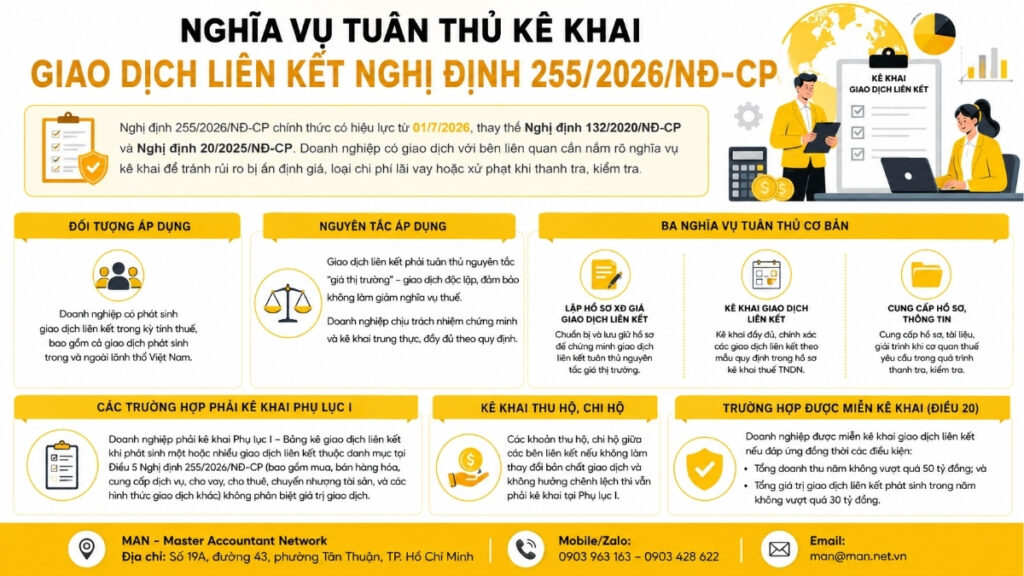
The obligation to declare related-party transactions under Decree 255 is an issue that all businesses with transactions with related parties must understand from the outset. Decree 255/2026/ND-CP Officially effective from July 1, 2026, replacing Decree 132/2020/ND-CP and Decree 20/2025/ND-CP, many businesses still mistakenly believe that exemption from preparing price determination documents means exemption from declaring Appendix I, or they omit declared amounts collected and disbursed on behalf of others. These seemingly minor errors can lead to price assessments, the exclusion of interest expense deductions, or penalties during inspections. This article comprehensively systematizes current legal regulations, from the subjects and principles of application, the three basic compliance obligations, to specific cases requiring declaration of Appendix I, declaration of collected and disbursed amounts, and cases exempted under Article 20 of Decree 255/2026/ND-CP.
Scope and principles of application of the obligation to declare related-party transactions.
The entity obligated to comply
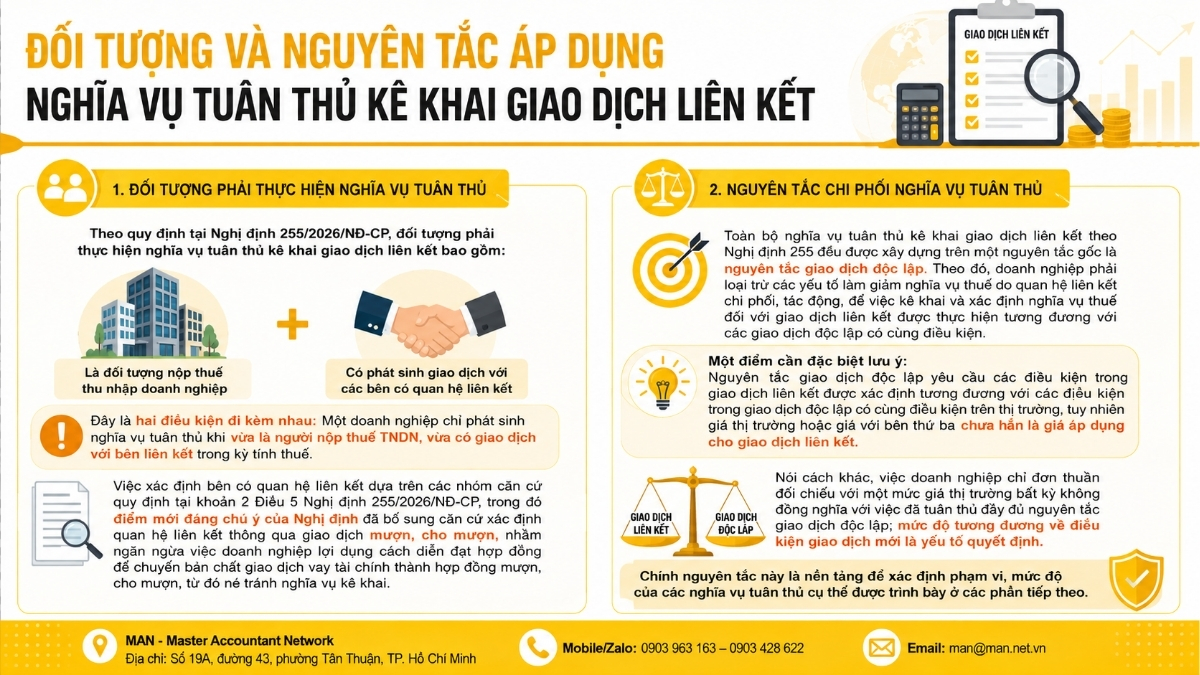
According to Decree 255/2026/ND-CP, the entities required to comply with the obligation to declare related-party transactions include:
- They are subject to corporate income tax;
- Transactions have occurred with related parties.
These are two conditions that go together: A business only incurs compliance obligations when it is both a corporate income tax payer and has transactions with related parties during the tax period.
The determination of related parties is based on the criteria stipulated in Clause 2, Article 5 of Decree 255/2026/ND-CP, in which Key new points of the Decree The basis for determining the relationship through transactions has been added. borrow, lend, This aims to prevent businesses from exploiting contract wording to transform the nature of financial loan transactions into borrowing or lending agreements, thereby avoiding declaration obligations.
Principles governing the obligation to comply
All obligations regarding the declaration of related-party transactions under Decree 255 are based on one fundamental principle: The principle of independent trading. Accordingly, businesses must exclude factors that reduce tax obligations due to the influence and impact of related-party relationships, so that the declaration and determination of tax obligations for related-party transactions are equivalent to independent transactions under the same conditions.
One point that needs special attention: The arm's-length principle requires that the conditions in related-party transactions be determined to be equivalent to the conditions in a standalone transaction with the same conditions in the market; however, the market price or the price with a third party is not necessarily the price applicable to the related-party transaction.
In other words, simply comparing a business's price to any given market price does not necessarily mean it has fully complied with the arm's length principle; the degree of equivalence in trading conditions is the deciding factor.
This principle forms the basis for determining the scope and extent of the specific compliance obligations presented in the following sections.
Three basic obligations when declaring related-party transactions according to Decree 255.
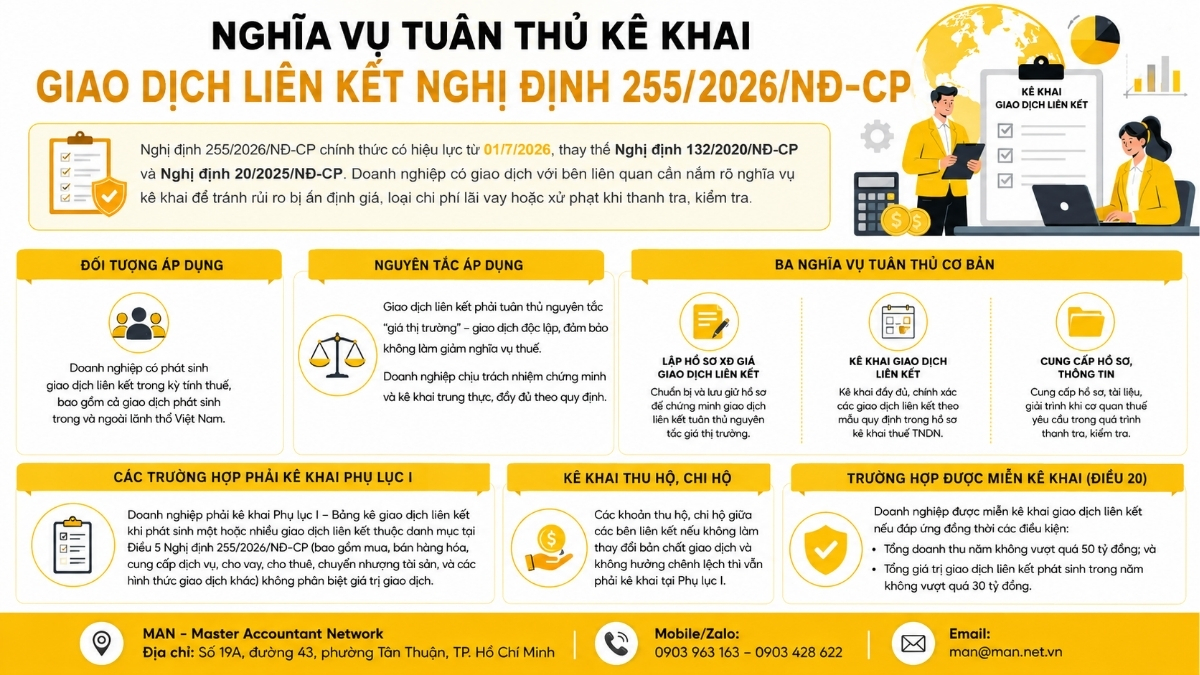
Decree 255/2026/ND-CP stipulates three pillars of compliance obligations that enterprises with related-party transactions need to fulfill:
- Prepare the Related Party Transaction Declaration form according to Appendix I;
- Prepare documentation for determining transfer pricing.;
- Prepare and submit Country-by-Country Reports (CbCR) for eligible corporations.
These three obligations are not interchangeable but exist in parallel, each with its own scope and timeframe.
Obligation to prepare the Related Party Transaction Declaration (Appendix I)
Businesses with related-party transactions must prepare a Related-Party Transaction Declaration form according to Appendix I, Appendix II, and Appendix III issued with Decree 255/2026/ND-CP and submit it together with the Corporate Income Tax Final Settlement Declaration.
Regarding the compliance deadline, businesses must complete this obligation no later than the last day of the third month from the end of the fiscal year to coincide with the annual corporate income tax settlement deadline.
Obligation to prepare Transfer Pricing Documentation
In parallel with the declaration, businesses are required to prepare, maintain, and provide Transfer Pricing Documentation upon request, which includes two components:
- Local File
- Master File
It should be noted that: Both sets of documents must be prepared before the annual corporate income tax return filing deadline and kept at the enterprise. When the tax authorities conduct an inspection and request these documents, the enterprise must provide them within a period not exceeding 30 days, and this period may be extended once for a maximum of 15 days during the pre-inspection process.
Obligation to submit the Country-by-Country Report of Profits (CbCR)
For corporations whose ultimate parent company reaches the prescribed global consolidated revenue threshold, the company is also obligated to submit a Country-by-Country Report within 12 months of the end of the ultimate parent company's fiscal year.
In addition, businesses must notify the entity responsible for submitting the Country-by-Country Report of Profits no later than the end of the fiscal year of the ultimate parent company. This is a separate notification obligation, distinct from the reporting obligation.
One new point that needs special attention: Decree 255/2026/ND-CP shifts the global consolidated revenue threshold from the threshold set in Vietnamese Dong to a new level. 750 million Euros, In accordance with the standards of the Organization for Economic Cooperation and Development (OECD), corporations with their parent companies located abroad need to convert exchange rates according to regulations to accurately determine whether the enterprise is subject to this obligation.
Cases requiring declaration in Appendix I as part of the compliance obligation under Decree 255.
The general principle is that taxpayers who have transactions with related parties are obligated to declare and determine the transfer pricing according to Appendix I, even if the enterprise is exempt from preparing the Transfer Pricing Documentation. This is a point that many businesses often misunderstand, thinking that being exempt from the documentation means they are also exempt from declaring the transaction.
The information to be declared in Appendix I includes:
- Section I – Information about Affiliated Parties: List the full name of each affiliated party; for affiliated parties in Vietnam that are organizations, use the information from their business registration certificate; for affiliated parties that are individuals, use the information from their citizen identification card, passport, or other personal identification document.
- Section II – Information on related-party transactions: This includes revenue, expenses, and business results arising from transactions with related parties.
- Sections III and IV – Exemption criteria for filing/declaration and related APA criteria: This applies to businesses in specific circumstances or those eligible for exemption.
The key compliance requirement that businesses need to remember is that businesses exempt from preparing Transfer Pricing Documentation (according to point a or point c, Clause 2, Article 20 of Decree 255/2026/ND-CP) must still fulfill their declaration obligations in Sections III and IV of Appendix I.
Obligation to declare receipts and disbursements on behalf of others in related-party transactions according to Decree 255
Besides revenue and expenses arising from production and business activities, enterprises with related-party transactions also need to be aware of an often overlooked compliance obligation: declaring amounts received and disbursed on behalf of others.
The nature of collecting and disbursing funds on behalf of others.
Receipts and disbursements are amounts that a business collects or disburses on behalf of related parties. These do not constitute revenue from sales, services provided, or the cost of goods and services purchased by the business itself. Because they are not revenue or expenses of the business, these amounts are separated from the usual revenue and expense declarations.
Principles to follow when declaring receipts and disbursements.ộ
When declaring on Appendix I, the amounts collected and disbursed on behalf of others should be recorded. not to be added Instead of declaring the total sales revenue and total expenses payable to related parties, businesses must declare these amounts separately under the total amount collected on behalf of others and the total amount disbursed on behalf of others in Appendix I.
Obligation to comply
Although not included in taxable revenue or expenses, receipts and payments made on behalf of others are still actual transactions with related parties during the tax period. Transparently declaring these amounts provides tax authorities with a basis to accurately verify the nature of the transactions between the business and its related parties, preventing the business from being accused of concealing related-party transactions during tax audits. Therefore, businesses should not neglect to review and fully declare all receipts and payments made on behalf of others, even if these amounts do not directly affect the corporate income tax payable.
Cases exempt from preparing price determination documents.
Not all businesses with related-party transactions are required to fulfill all three obligations mentioned above. Decree 255/2026/ND-CP, which stipulates cases exempt from declaration and documentation in Article 20, essentially inherits the spirit of Article 19 of Decree 132/2020/ND-CP but includes some important adjustments.
Cases where declaration is waived and file preparation is also waived.
According to points a and b, clause 2, Article 20 of Decree 255/2026/ND-CP:
Taxpayers who only conduct transactions with related parties that are subject to corporate income tax in Vietnam, apply the same corporate income tax rate as the taxpayer, and none of the related parties enjoy corporate income tax incentives during the tax period are exempt from both the obligation to declare and the obligation to prepare tax returns.
This is a comprehensive exemption, applicable to internal related-party transactions that do not create transfer pricing risk because the parties are subject to the same tax rate.
Cases where declaration is required but the obligation to prepare a price determination dossier is waived.
According to point c, clause 2, Article 20 of Decree 255/2026/ND-CP, taxpayers are still responsible for declaring and determining transfer pricing according to Appendix I, but are exempt from preparing a Transfer Pricing Documentation File if they simultaneously meet the following conditions:
- No revenue or expenses are generated from the exploitation or use of intangible assets;
- Generates revenue under 500 billion VND During the tax period, this is A notable new point, raised from 200 billion VND. as previously stipulated in Decree 132/2020/ND-CP;
- Apply the net profit margin (before deducting interest expenses and corporate income tax, excluding the difference between revenue and expenses of financial activities) to net revenue according to the prescribed rate corresponding to each business sector.
Another important new point that businesses need to be aware of: Decree 255/2026/ND-CP has Abolish the criterion of "business with simple functions".“, which was a mandatory condition under the old regulations in Decree 132/2020/ND-CP.
In cases where an APA (Advance Pricing Agreement) has been signed
For businesses that have signed an Advance Pricing Agreement (APA) with the tax authorities, whether unilateral, bilateral, or multilateral, the portion of related-party transactions covered by the signed APA is exempt from the obligation to prepare a Transfer Pricing Documentation. However, it should be noted that this exemption... This only applies to the portion of the transaction that falls within the scope of the APA., This does not automatically apply to all related-party transactions arising during the period. For related-party transactions not covered by the signed APA, the enterprise is still responsible for declaring and determining the transfer pricing in accordance with Article 18 of Decree 255/2026/ND-CP.
Note the following when applying for exemptions: Businesses need to simultaneously compare all conditions regarding revenue, related-party transaction value, and profit margin for each specific case as mentioned above. Meeting only a part of the conditions is not sufficient for exemption. In that case, the obligation to fully comply (including declaration and documentation) still arises as usual.
For businesses that are not exempt, preparing the right documentation from the start is crucial to minimizing risks during inspections and audits, which is why many businesses choose to use this method. related party transaction documentation service We rely on specialized, experienced units like MAN – Master Accountant Network to ensure that your records are complete, compliant with regulations, and ready to be provided when requested by the tax authorities.
Risks of failing to fulfill the obligation to declare related-party transactions.
Incorrect or incomplete declarations, or failure to prepare transfer pricing documentation on time, can expose businesses to numerous tax risks, specifically:
- Defended by the tax authorities setting transfer pricing During inspections and audits, adjustments are made to increase taxable income and the amount of corporate income tax payable.;
- Bag Excluding interest expense exceeding the ceiling. according to the 30% ratio on EBITDA if the reasonableness of the related-party transaction cannot be fully demonstrated;
- Bag administrative penalties for tax violations This applies to the act of failing to declare, declaring incompletely, or failing to provide documents within the deadline when requested by the tax authorities.
If businesses require assistance with detailed review or preparation of documentation for determining transfer pricing, they can refer to our services. related party transaction advisory services MAN's expertise ensures that the Transfer Pricing Documentation and Country-by-County Profit and Loss Report comply with the Independent Transaction Principles.
Conclude
The obligation to comply with the declaration of related-party transactions under Decree 255 does not stop at simply submitting a declaration on time, but is a system of closely linked obligations, from correctly identifying the entities involved and affiliated relationship, adhering to the principle of independent transaction, to clearly distinguishing between the obligation to declare Appendix I, the obligation to prepare price determination documents, the obligation to declare collection and disbursement on behalf of others, and cases of exemption.
In light of Decree 255/2026/ND-CP, which has just come into effect with several adjustments regarding revenue thresholds, exemption criteria, and the basis for determining related-party relationships, businesses should proactively review all transactions arising with related parties starting from the 2026 tax year to accurately determine the scope of their compliance obligations.
If a business needs assistance with a detailed review or preparation of documentation for determining transfer pricing, it can Contact MAN – Master Accountant Network to receive timely advice and support.
Contact information MAN – Master Accountant Network
- Address: No. 19A, Street 43, Tan Thuan Ward, Ho Chi Minh City
- Mobile/Zalo: 0903 963 163 – 0903 428 622
- E-mail: man@man.net.vn
- Google Business Profile: View MAN – Master Accountant Network's Google Business Profile
- LinkedIn Founder: View expert Le Hoang Tuyen's LinkedIn profile.
Responsible for production and professional content review by: Mr. Le Hoang Tuyen – Founder & CEO of MAN – Master Accountant Network. He is a CPA Vietnam auditor with over 30 years of in-depth experience in accounting, auditing, taxation, and corporate legal consulting.
Frequently Asked Questions about the obligation to declare related-party transactions under Decree 255
Is it mandatory for businesses to submit Appendix I even if they are exempt from preparing a Price Determination Document?
Yes. The obligation to declare according to Appendix I and the obligation to prepare the Price Determination Dossier are two independent obligations. Businesses exempted from preparing the dossier under point a or c, Clause 2, Article 20 of Decree 255/2026/ND-CP must still declare all the information in Appendix I.
Do receipts and payments made on behalf of others need to be declared in related-party transactions?
Yes. Although not included in revenue or taxable expenses, receipts and payments made on behalf of others must still be declared separately under the corresponding item in Appendix I to ensure transparency in transactions with related parties.
In which cases is the obligation to declare related-party transactions completely waived?
In cases where the taxpayer only conducts transactions with related parties who are subject to corporate income tax in Vietnam, the same tax rate applies, and neither party is entitled to corporate income tax incentives during the tax period.
What is the deadline for submitting the Related Party Transaction Declaration (Appendix I)?
The related-party transaction declaration form must be submitted together with the Corporate Income Tax return, no later than the last day of the third month from the end of the fiscal year.
What is the revenue threshold for exemption from preparing a Transfer Pricing Documentation File according to Decree 255?
Businesses with revenue under VND 500 billion during the tax period, with no revenue/expenses from the exploitation or use of intangible assets, and applying the correct net profit margin according to the new sector are exempt from filing tax returns. This is a significant increase compared to the VND 200 billion threshold under Decree 132/2020/ND-CP.