





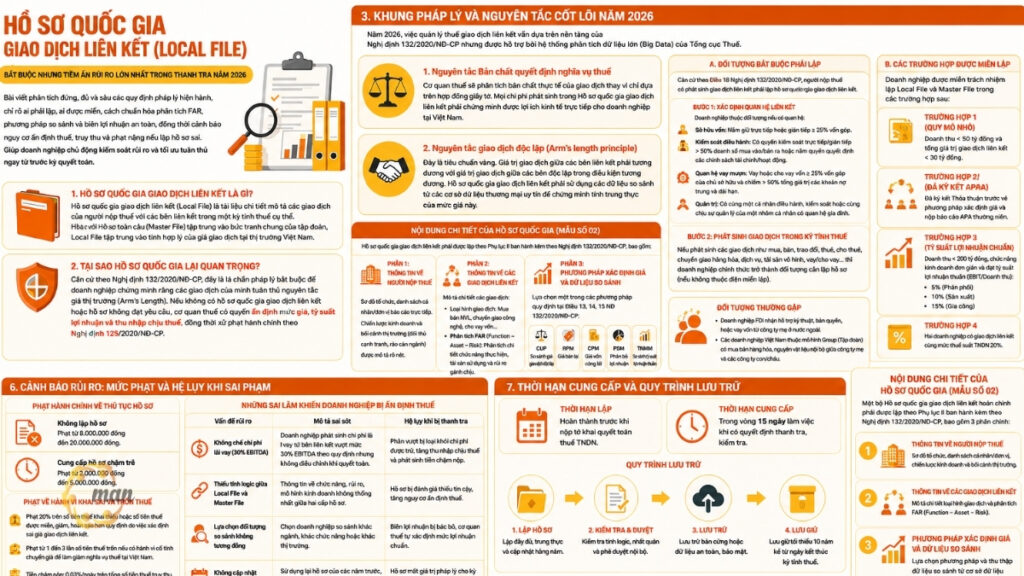
The Local File, a national document for related-party transactions, is mandatory but also poses the greatest risk during transfer pricing audits in 2026. This article provides a thorough and in-depth analysis of current legal regulations, clearly identifying who must prepare it, who is exempt, how to standardize FAR analysis, methods for comparing and determining safe profit margins, and warning of the risk of tax assessment, back taxes, and heavy penalties if the file is incorrectly prepared. The content is developed from an expert perspective on related-party transactions, helping businesses proactively control risks and optimize compliance even before the tax settlement period.
What is a country-specific related-party transaction profile?
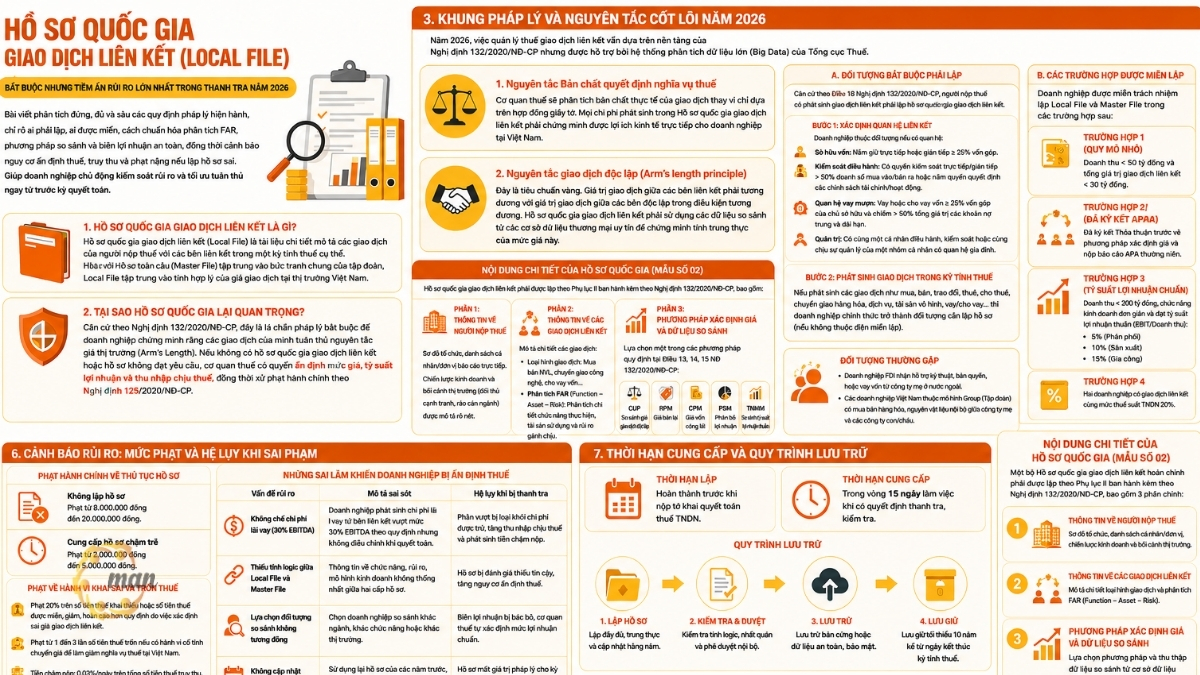
The Local File (or Country File) is a detailed document describing the taxpayer's transactions with related parties during a specific tax period. Unlike the Master File, which focuses on the overall picture of the group, the Local File focuses on the reasonableness of the transaction prices in the Vietnamese market.
Why is national record important?
Based on Decree 132/2020/ND-CP, This is a mandatory legal safeguard for businesses to demonstrate that their transactions comply with the Arm's Length principle. Without a national related-party transaction record, or if the record is incomplete, the tax authorities have the right to determine the price, profit margin, and taxable income, and impose administrative penalties. Decree 125/2020/ND-CP.
Legal Framework and Core Principles 2026
In 2026, the management of related-party transaction tax will still be based on Decree 132/2020/ND-CP but will be supported by the General Department of Taxation's Big Data analytics system.
The principle of substance determines tax liability.
The tax authorities will analyze the actual nature of the transaction rather than relying solely on the paper contract. Any expenses incurred in the Country-Based Transfer Transaction File must demonstrate a direct economic benefit to the business in Vietnam.
Arm's length principle
This is the gold standard. The value of transactions between related parties must be equivalent to the value of transactions between independent parties under comparable conditions. Country records of related-party transactions must use comparative data from reputable trade databases to demonstrate the accuracy of these prices.
Detailed contents of the National Related-Party Transaction Profile (Form No. 02)
To ensure compliance, a complete national dossier on related-party transactions must be prepared according to the list in Appendix II issued with Decree 132/2020/ND-CP, including the following main sections:
Part 1: Taxpayer Information
Businesses need to provide an organizational chart and a list of individuals or units they report directly to. In particular, their business strategy and market context (competitors, industry barriers) need to be clearly described so that the tax authorities understand the company's position.
Part 2: Information about Related Party Transactions
This is the core part of the National Related-Party Transaction Profile. Businesses must describe:
- Types of transactions: Buying and selling raw materials, technology transfer, lending capital, etc.
- FAR (Function – Asset – Risk) analysis: A detailed analysis of the functions performed, assets used, and risks incurred.
Part 3: Pricing Methods and Comparative Data
The national dossier for related-party transactions must select one of the methods stipulated in Articles 13, 14, and 15 of Decree 132/2020/ND-CP:
- The Comparable Prices of Independent Transactions (CUP) method.
- Resale Price method.
- Cost Plus method.
- Profit Sharing Method (PSM)
- The Net Profit Margin (NPRI) Comparison Method
After understanding the structure and detailed content of the National Related-Party Transaction File (Form No. 02), the next question that most businesses are concerned about is: are they required to prepare the file, or are they exempt according to the law? Identifying the correct application from the outset not only helps businesses save on compliance costs but also avoids the risk of being misjudged during tax audits and inspections.
Download the Appendix II template for the National File on Related-Party Transactions:
Details of the subjects that must be included and cases of exemption.
Identifying the right target helps businesses avoid unnecessary legal risks.
Entities required to create a National Related-Party Transaction Profile

According to Article 18 of Decree 132/2020/ND-CP, taxpayers with related-party transactions must prepare and maintain a National Related-Party Transaction File. To determine if they fall under this category, businesses need to go through two steps:
Step 1: Identify the business relationship that requires documentation if it has a relationship with the partner company, based on the following criteria:
- Capital ownership: One party directly or indirectly holds at least 25% of the other party's capital contribution.
- Operational control: One party has direct/indirect control over the total value of purchases/sales or has the power to decide on financial/operational policies.
- Lending relationship: The business borrows or lends at least 25% of the owner's equity and accounts for over 50% of the total value of the business's medium and long-term debts.
- Management: Having a single individual who runs, controls, or is jointly managed by a group of individuals who are related by family ties.
Step 2: Transactions occur during the tax period. After determining the relationship between the two parties, if transactions such as buying, selling, exchanging, leasing, renting, transferring goods, services, intangible assets, borrowing/lending, etc., arise, the business officially becomes subject to the requirement of completing the necessary documentation. related-party transaction pricing documentation (if not eligible) Exemption from filing related-party transaction records.).
Specific target groups commonly encountered:
- FDI enterprises receive technical support, intellectual property rights, or loans from their parent companies abroad.
- Vietnamese businesses operating under the Group model engage in internal buying and selling of goods and raw materials between the parent company and its subsidiaries/subsidiaries.
Cases exempt from national related-party transaction filing.

Businesses are exempt from the responsibility of creating Local Files and Master Files in the following cases:
- Case 1 (Small scale): Revenue below VND 50 billion and total value of related-party transactions below VND 30 billion;
- Case 2 (APA Signed): A Pre-Agreement on Pricing Methodology has been signed and annual APA reports have been submitted.
- Case 3 (Standard Profit Margin): Revenue below VND 200 billion, performing simple business functions and achieving a net profit margin (EBIT/Revenue) of 5% (Distribution), 10% (Manufacturing) or 15% (Processing);
- Case 4: Two businesses have related-party transactions with the same corporate income tax rate under Article 20%.
Although regulations clearly define the entities required to prepare and the cases exempted from the National Related-Party Transaction Record, in practice, many businesses misunderstand the exemption conditions, apply them incompletely, or fail to provide legal grounds when audited. This is the main reason why many records are rejected, leading to tax arrears and heavy penalties. Therefore, businesses need to pay special attention to the risks, penalties, and legal consequences of violating regulations on related-party transactions during tax audits.
Risk Warning: Penalties and Consequences for Violating the National Related-Party Transaction Profile

In 2026, the Tax Authority will not only collect back taxes but also apply strict penalties according to Decree 125/2020/ND-CP. Deficiencies in the National Related-Party Transaction Record can cause businesses to face:
Administrative penalties for procedural issues.
For violations related to the establishment and provision of documentation, businesses will be subject to direct administrative sanctions, specifically as follows:
- Failure to prepare documentation: A fine of VND 8,000,000 to VND 20,000,000 will be imposed for the act of failing to prepare documentation for determining the transfer pricing of related-party transactions as required by regulations.
- Late submission of documents: A fine of VND 2,000,000 to VND 5,000,000 will be imposed if documents are submitted late compared to the deadline required by the inspection agency or if the required list of documents is incomplete.
Penalties for false declarations and tax evasion.
However, the aforementioned administrative penalties are merely the tip of the iceberg. The most severe financial consequences lie in the sanctions directly applied to the amount of tax payable when a business is found to have committed pricing violations:
- Penalties under Article 20% apply to the amount of underdeclared tax or the amount of tax exempted, reduced, or refunded in excess of regulations due to incorrect determination of transfer pricing.
- A penalty of 1 to 3 times the amount of tax evaded will be imposed if the tax authorities determine that the enterprise intentionally engaged in transfer pricing to reduce its tax obligations in Vietnam.
- Late payment penalty: Calculated at 0.031 TP3T/day on the total amount of back taxes. This is an extremely dangerous compound interest rate if the audit extends across multiple tax periods.
The authority to determine taxes
The tax authorities have the right to determine the profit margin if a valid country record of related-party transactions is not provided.
Mistakes that lead to businesses being assessed taxes
To help businesses quickly identify common errors and proactively prevent audit risks, the table below summarizes typical issues arising during the preparation of the National Related-Party Transaction File, along with the practical consequences when tax authorities conduct audits and assess taxes.
| Risk issues | Describe the error. | Consequences of being inspected |
| Control interest expense (30% EBITDA) | The company incurred interest expense from related parties exceeding the 30% EBITDA limit as stipulated but did not adjust it during tax settlement. | The excess amount is disallowed as a deductible expense, increasing taxable income and resulting in late payment penalties. |
| There is a lack of logical connection between Local Files and Master Files. | Information regarding functionality, risks, and business model is inconsistent between the two levels of documentation. | The file was deemed unreliable, increasing the risk of tax assessment. |
| Choose dissimilar objects for comparison. | Businesses select comparable businesses from different industries, different functions, or different markets. | The profit margin was rejected, and the tax authorities determined the standard profit margin themselves. |
| No annual record updates | Reusing records from previous years, without updating financial data and business context. | The records are legally invalid for the tax period under audit. |
| Demonstrate the usefulness of internal services. | Lack of actual service evidence; inability to demonstrate economic benefits received. | The service fee was excluded (100%), increasing the corporate income tax payable. |
Errors in the Local File (National File for Related-Party Transactions) often don't stem from intentional violations but rather from misunderstanding regulations, lack of updates, and superficial preparation of the file. However, in the context of increasingly thorough tax audits, these errors can lead to the exclusion of expenses, tax assessments, and significant penalties, forcing businesses to proactively review and complete their files systematically and consistently from the beginning of the tax period.
To avoid potential risks, businesses should proactively seek advice. related party transaction advisory services Seek advice and support from reputable, specialized, and experienced organizations like MAN – Master Accountant Network, tailored to your specific business field and scale.
Delivery time and storage procedures
Based on Article 18 of Decree 132/2020/ND-CP:
- Deadline for preparation: To be completed before submitting the corporate income tax return.
- Delivery deadline: Within 15 working days of the inspection decision.
Conclude
National related-party transaction records are no longer simply a compliance obligation but have become a tool to protect businesses from the risk of prolonged tax assessments and retroactive tax collection. As the Tax Authority intensifies data analysis and targeted audits in 2026, standardizing records, selecting appropriate pricing methods, and updating information promptly will help businesses proactively control tax costs and maintain financial transparency. In cases where businesses need to review compliance levels or prepare records before an audit, consulting with related-party transaction experts early on will be an effective step to minimize risks.
Standardizing the national transfer pricing documentation from the outset will help businesses avoid the risks of prolonged tax assessments and collection delays. If your business needs independent review of Local File and Master File or preparation of documentation before an audit, the support of MAN – Master Accountant Network, with its team of experienced transfer pricing experts, will help make the compliance process more systematic, efficient, and cost-effective.
Contact MAN – Master Accountant Network for free support and advice!
Contact information MAN – Master Accountant Network
- Address: No. 19A, Street 43, Tan Thuan Ward, Ho Chi Minh City
- Mobile/Zalo: 0903 963 163 – 0903 428 622
- E-mail: man@man.net.vn
Content production by: Mr. Le Hoang Tuyen – Founder and CEO of MAN – Master Accountant Network, CPA Vietnam with over 30 years of experience in accounting, auditing, and financial consulting.
Frequently Asked Questions about the Country Profile for Related-Party Transactions
No. Businesses are not required to submit national documents along with their corporate income tax return. Instead, they must prepare, complete, and store these documents before submitting the tax return. The documents are only required to be presented when requested by the Tax authorities for inspection or audit, and the deadline for submission is typically 15 working days as stipulated by regulations.
Businesses may be exempt from creating a Local File if they fall into one of the following categories: Revenue under VND 50 billion and related-party transactions under VND 30 billion; Having signed an APA; Revenue under VND 200 billion and achieving a standard profit margin; or transactions between parties with the same corporate income tax rate as prescribed.
Yes. A company incurring losses for many years is not a reason to be exempt from creating a Local File. Conversely, companies that consistently report losses but still engage in related-party transactions are often targeted by tax authorities for high-risk audits due to transfer pricing and profit manipulation.
There are significant risks. National records of related-party transactions must be completed before the corporate income tax return filing deadline. Retroactive filing after an inspection decision is often deemed invalid, easily leading to tax assessments, back taxes, and serious administrative penalties.
FAR (Functions - Assets - Risks) analysis is the most important part in determining the nature of related-party transactions. The Tax Authority relies on it to assess what functions a business performs, what assets it uses, and what risks it carries, thereby determining the appropriate profit margin according to the arm's length principle.
The areas typically subject to in-depth scrutiny include: internal service fees, royalties, related-party interest, FAR analysis, comparative business selection, and profit margins. If a business cannot demonstrate the reasonableness and actual economic benefits, the tax authorities may disallow the expenses and collect back taxes.Is it mandatory to submit the national related-party transaction record along with the corporate income tax return?
When are businesses exempt from preparing a national related-party transaction record?
Is it mandatory for a business that has incurred losses for many years to prepare a national related-party transaction record?
If I file my national tax return after the tax settlement deadline, will I be penalized?
What is the role of FAR analysis in the Related-Party Transaction Country Profile?
What content in local files do the tax authorities check most often?