





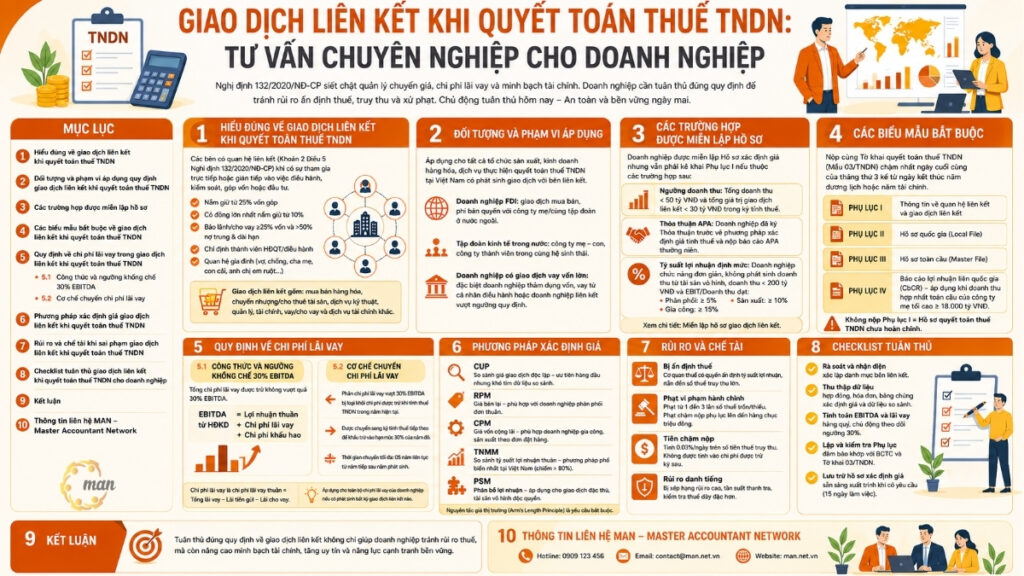
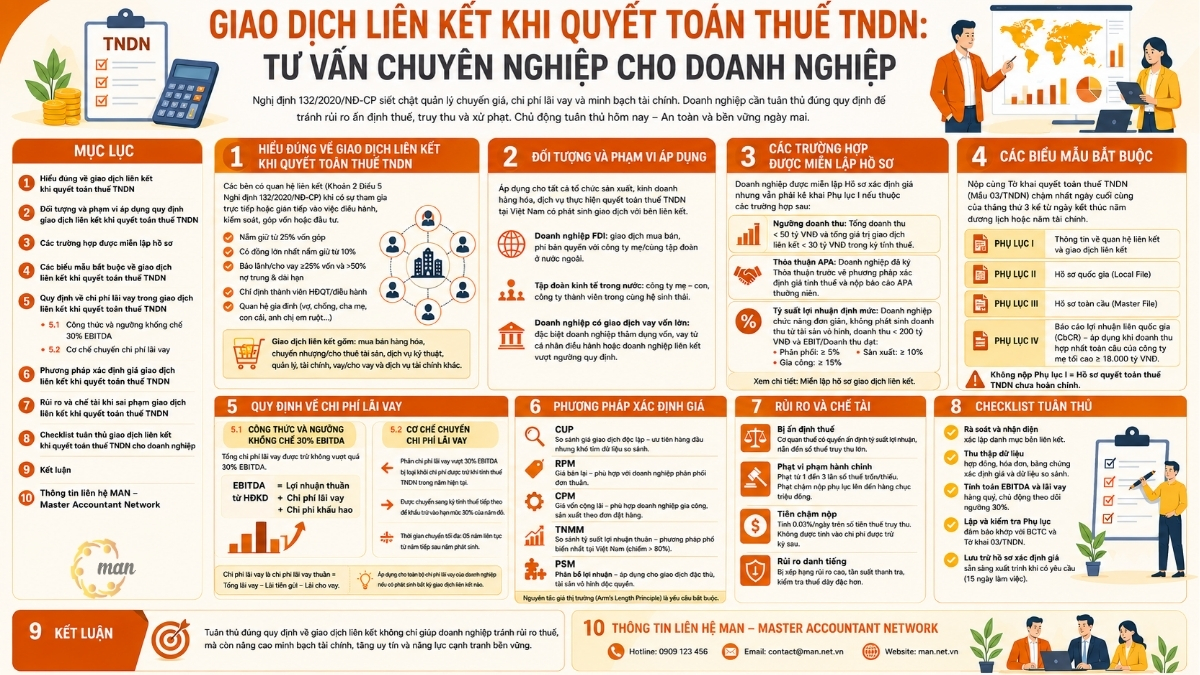
Related-party transactions are a crucial aspect of corporate income tax settlement for businesses in 2026, especially as tax authorities increasingly tighten control over transfer pricing, interest expense, and financial transparency. Even a small error in identifying related-party relationships, declaring appendices, or applying pricing methods can lead to the risk of significant tax assessments, back taxes, and administrative penalties. This article will help businesses understand the legal regulations under Decree 132/2020/ND-CP, correctly identify applicable entities, master the required documentation, understand the limits on interest expense under Article 30% EBITDA, and utilize standard market-based pricing methods for determining related-party transaction prices, thereby proactively developing a safe and sustainable compliance strategy.
Understanding related-party transactions correctly when settling corporate income tax.
To do this correctly, businesses first need to accurately define their position through a system of criteria for identifying related parties. According to Clause 2, Article 5 of Decree 132/2020/ND-CP, related parties are those parties that directly or indirectly participate in the management, control, capital contribution, or investment in any form.
Common criteria for identifying linkage relationships:
- One party directly or indirectly holds at least 25% of the other party's equity; or both parties hold at least 25% of the other party's equity held by a third party.
- One business is the largest shareholder of another business and directly or indirectly holds at least 10% of the total shares of the other business.
- This is the most common scenario. One business guarantees or lends capital to another business in any form (including third-party loans secured by the assets of an affiliated company) provided that the loan amount is at least 25% of the owner's equity and accounts for more than 50% of the total value of the borrowing business's medium and long-term debt.
- One business appoints members of the executive board to manage or control the other business.
- The two businesses are run by individuals who are related (spouse, parents, children, siblings, etc.).
Related-party transactions when settling corporate income tax are not limited to the buying and selling of goods, but also include the transfer and leasing of tangible and intangible assets; the provision of technical, management, and financial services; borrowing, lending, and other financial services.
The subjects and scope of application of regulations on related-party transactions when settling corporate income tax.

This regulation applies to all organizations producing and trading goods and services that settle corporate income tax in Vietnam and have transactions with related parties.
Key target groups:
- FDI enterprises: Companies with foreign investment capital frequently engage in transactions involving the purchase and sale of raw materials or royalties with their parent company/company within the same group abroad.
- Domestic economic conglomerates: Corporations with a parent-subsidiary structure, or member companies within the same ecosystem.
- Businesses with large borrowing transactions: Especially capital-intensive businesses, with loans from individual executives or affiliated companies exceeding the prescribed limits.
Cases exempt from filing
According to Article 19 of Decree 132, enterprises are exempt from preparing Transfer Pricing Documentation but must still declare Appendix I if they fall under the following cases:
- Revenue threshold: Total revenue below VND 50 billion and total value of related-party transactions below VND 30 billion during the tax period.
- APA Agreement: The company has signed a Pre-Agreement on the method of determining taxable prices and submits annual APA reports.
- Standard Profit Margin: Businesses performing simple functions, not generating revenue from intangible assets, with revenue under VND 200 billion, and achieving a net profit margin before interest and taxes (EBIT) on revenue according to industry standards such as Distribution 5%, Manufacturing 10%, and Processing 15%.
See details: No related-party transaction documentation is required.
Required forms for related-party transactions when settling corporate income tax.

By 2026, late or incomplete submission of these appendices will be automatically recorded by the tax management system and penalties will be applied. Businesses need to complete this set of documents at the same time as the Corporate Income Tax Final Settlement Declaration (Form 03/TNDN).
Details of the Appendix system:
- Appendix I (Information on related parties and related-party transactions): This is an important basis for tax authorities to identify risks. Businesses must list related parties, types of transactions, transaction values, and adjustments based on market prices.
- Appendix II (Local File): Focuses on detailed information about businesses in Vietnam, including functional analysis (manufacturing, distribution, research, etc.), economic risk analysis, and specific pricing methods applied.
- Appendix III (Master File): Provides information on the ownership structure, value chain of the entire multinational corporation, intangible assets, and internal financial policies of the corporation.
- Appendix IV (Country of Births Report – CbCR): This applies only if the ultimate parent company in Vietnam has consolidated global revenue of VND 18,000 billion or more. If the parent company is located abroad, the enterprise in Vietnam must notify the tax authorities about the submission of this report by the parent company.
Please note the deadline: The deadline is the last day of the third month from the end of the calendar year or fiscal year. Failure to submit Appendix I means that the corporate income tax return will be considered incomplete.
If the business is not exempt from preparing price determination documents, it must prepare and maintain them. When the tax authority issues a decision to conduct an inspection or audit, or requests an explanation, the business must submit all the necessary documents within 15 working days from the date of receiving the request.
Due to the complexity of these reports, particularly the independent comparative data analysis, businesses should utilize related party transaction documentation service from professional units to ensure consistency and safety before inspections.
Regulations regarding interest expense deductions in related-party transactions when settling corporate income tax.
This is the most contentious issue during tax audits. This regulation aims to prevent thin capitalization, which involves transferring profits overseas or to entities with lower tax rates.
Formula and control threshold for 30% EBITDA
According to Clause 3, Article 16 of Decree 132/2020/ND-CP, the total interest expense deductible when determining corporate income tax shall not exceed 30% EBITDA. In this case, EBITDA is determined as follows:
EBITDA = Net profit from operations + Interest expense + Depreciation expense |
Note: Interest expense here refers to net interest expense, which is calculated by subtracting interest on deposits and loans during the period from the total interest expense incurred.
See details: Formula for calculating interest on related-party transactions.
Mechanism for transferring interest expense
The mechanism for transferring interest expense, specifically:
- If actual interest expense exceeds the 30% EBITDA, the excess will be disallowed as a deductible expense when calculating corporate income tax for the current year.
- Businesses have the right to carry forward this non-deductible portion of interest expense to the next tax period to be deducted from the 30% limit for that year.
- The maximum carry-forward period is 05 consecutive years starting from the year following the year in which the non-deductible interest expense was incurred.
Note: This regulation applies to entire Interest expense of the business (including loans from independent banks) if the business has any related-party transactions during that year.
Methods for determining transfer pricing when settling corporate income tax.
The tax authorities require businesses to comply with the Arm's Length Principle. This means that transaction prices between related parties must be similar to prices under similar transaction conditions between independent parties. Specifically:
- The Comparative Independent Transaction (CUP) method: This method is applied when there are equivalent transactions in terms of commodity characteristics and contract conditions. It is the preferred method but the most difficult to find comparable data for.
- Resale Price Method: Suitable for businesses that perform a purely distribution function and do not add significant value to the product. The profit margin is determined based on the trade discounts offered by independent distributors.
- Cost Plus Method: Suitable for businesses that manufacture goods on order from affiliated companies. Profit is calculated by adding the cost of goods sold to a standard gross profit margin in the market.
- Net Profit Margin Comparison Method (NPRI): This is the most common method in Vietnam (accounting for over 801 cases). Businesses compare their net profit margins (such as ROS, ROA, ROE) with independent businesses in the same industry and function.
- Profit Split Method: This method is only applicable to specific, highly complex transactions or those involving proprietary intangible assets that cannot be separated for individual comparison.
Risks and penalties for violations of related-party transactions when settling corporate income tax.

By 2026, tax authorities will be using centralized data systems and AI to cross-reference data between customs, banks, and international tax sources. The serious consequences include:
- Tax assessment: If a business fails to provide pricing documentation or its selection method is inappropriate, the tax authorities have the right to assess the profit margin. Typically, this assessment is based on the median of the best-performing businesses in the industry, resulting in extremely large amounts of back taxes.
- Administrative penalties: Fines ranging from 1 to 3 times the amount of tax evaded/missing. Additionally, late submission of the appendix may result in fines of up to tens of millions of VND per violation.
- Late payment penalty: Calculated at 0.03%/day on the amount of back taxes. This amount is not deductible as an expense when calculating corporate income tax in the next period.
- Reputation risk: Businesses are rated as high risk, leading to more frequent tax audits and inspections in subsequent years.
Checklist for compliance with related-party transactions when settling corporate income tax for businesses.
To prepare safely for the 2026 tax year, businesses need to follow these steps:
- Review and identification: Examine the list of shareholders, loans, and influential parties to establish a list of associated parties.
- Data collection: Gather contracts, invoices, and other evidence related to price determination. If documentation is required, seek comparative data from professional databases (such as Orbis, Moody's, etc.).
- Calculate quarterly EBITDA and interest expense: Proactively calculate the 30% threshold to adjust your financial plan or prepare for expense exclusions during final accounting.
- Prepare and verify the Appendix: Ensure that the figures in the Appendix on related-party transactions match the Financial Statements and the 03/TNDN Declaration Form. Any discrepancies, however small, will raise questions from the tax authorities.
- Record keeping for transfer pricing: Records of transfer pricing must be prepared and kept at the enterprise for immediate submission upon request from an inspector (the time frame for providing these records is typically only 15 working days).
To develop a long-term financial strategy and optimize tax payments legally, businesses should consider the following: related party transaction advisory services To allow for early structural review and risk control.
Conclude
Managing related-party transactions during corporate income tax settlement is not only a legal compliance requirement but also a foundation for businesses to control tax risks, protect cash flow, and enhance financial transparency. Proactively reviewing, accurately declaring, and fully preparing documentation from the outset will help businesses avoid the risk of tax arrears, penalties, and prolonged audits. If your business has complex related-party transactions or needs assistance reviewing corporate income tax settlement documents, contact MAN – Master Accountant Network for free support and advice!
References:
- Decree 132/2020/ND-CP
- Tax Administration Law No. 38/2019/QH14.
- Circular 80/2021/TT-BTC of the Ministry of Finance.
Contact information MAN – Master Accountant Network
- Address: No. 19A, Street 43, Tan Thuan Ward, Ho Chi Minh City
- Mobile/Zalo: 0903 963 163 – 0903 428 622
- Email: man@man.net.vn
Content is moderated by: Mr. Le Hoang Tuyen – Founder & CEO of Man, CPA Vietnam Auditor with over 30 years of experience in Accounting, Auditing and Financial Consulting.