





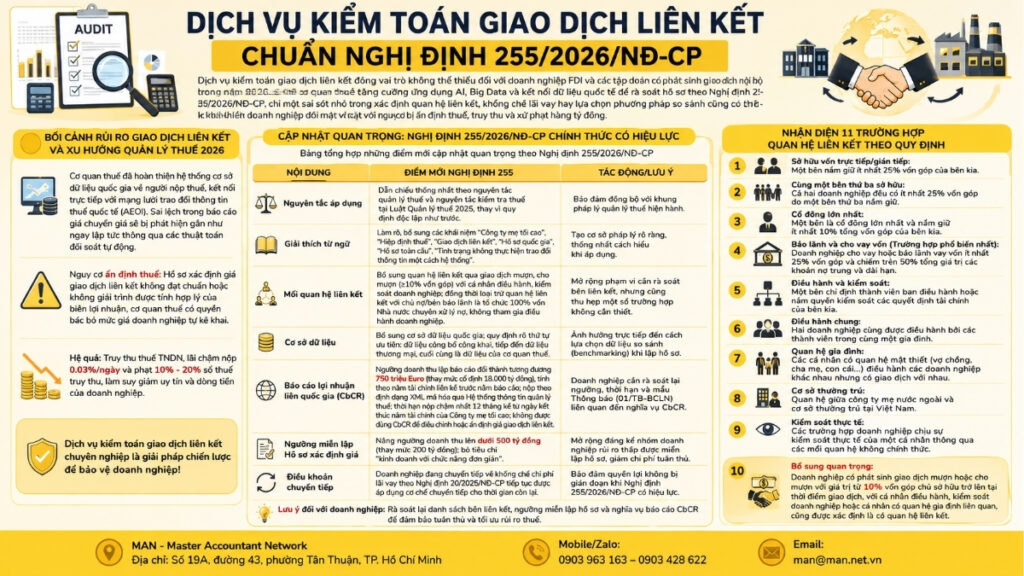
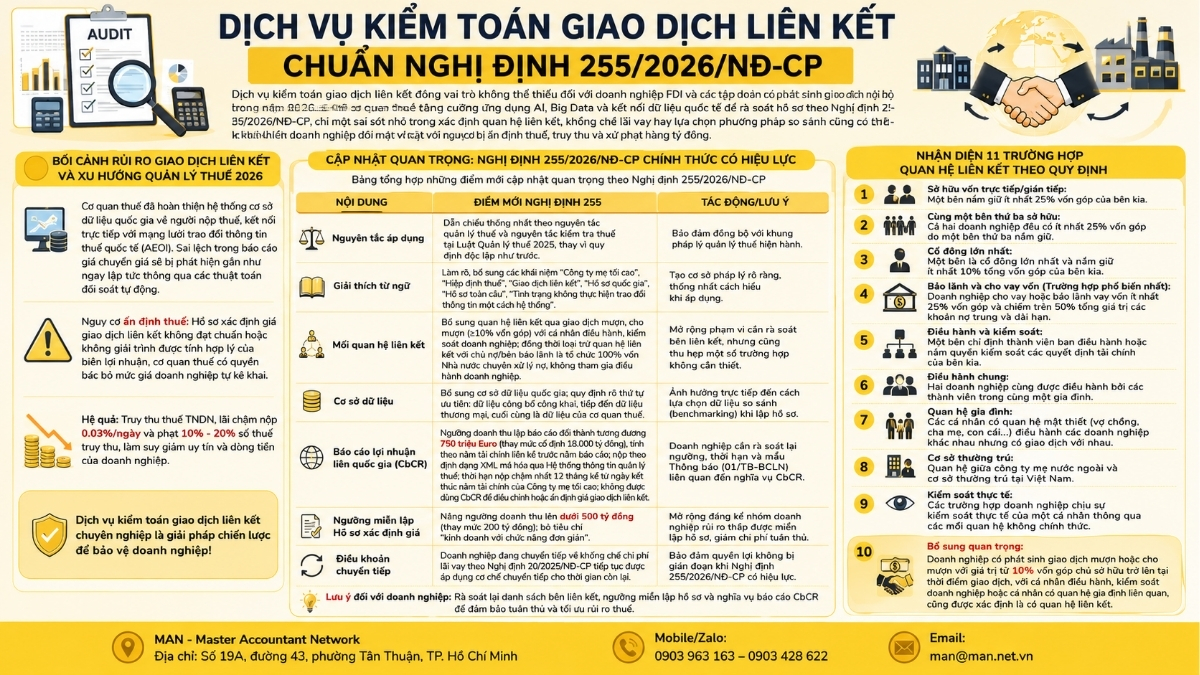
Intercompany transaction audit services will play an indispensable role for FDI enterprises and corporations with internal transactions in 2026. This is especially true as tax authorities increasingly apply AI, Big Data, and international data connectivity to review records. Decree 255/2026/ND-CP, Even a small mistake in determining related-party relationships, controlling interest rates, or choosing a comparison method can put businesses at risk of being assessed taxes, having back taxes collected, and being fined billions of dong.
This article will help businesses understand the tax management landscape in 2026, the key regulations of Decree 255/2026/ND-CP, 11 cases of related-party transactions, 5 methods for determining transfer pricing, the revenue threshold for exemption from preparing transfer pricing documentation, and the reasons why professional related-party transaction audits are necessary to protect documentation, optimize tax risks, and be prepared for explanations before inspectors.
The landscape of related-party transaction risks and tax management trends in 2026
By 2026, the Vietnamese tax authorities will have completed the national database system on taxpayers, directly connecting to the international tax information exchange network (AEOI). This means that discrepancies in transfer pricing reports will be detected almost immediately through automated reconciliation algorithms.
The biggest pain point for businesses today is the tax assessment "trap." When the documentation for determining transfer pricing is substandard or fails to justify the reasonableness of the profit margin, the tax authorities have the right to reject the self-declared price. As a result, businesses not only have to pay additional corporate income tax but also incur late payment interest of 0.031 TP3T/day and administrative penalties ranging from 10 to 201 TP3T of the back taxes, severely damaging their reputation and cash flow. This is why professional transfer pricing audit services are a strategic solution.
Important update: Decree 255/2026/ND-CP officially comes into effect.

To operate safely, businesses need to have a thorough understanding of the legal framework that related-party transaction audits will rely on to conduct their review.
Decree 255/2026/ND-CP on tax management for related-party transactions
Besides Decree 132/2020/ND-CP and Decree 20/2025/ND-CP, businesses need to pay special attention to Decree 255/2026/ND-CP regulating tax management for related-party transactions of enterprises with related-party relationships. This document has already introduced the new points at the Tax Department. Official Document 4697/CT-CS July 9, 2026, with many changes directly impacting the scope of work for related-party transaction audit services. For ease of reference, the key new points are summarized in the following table:
| Content | New points in Decree 255 | Impact/Note |
| Principles of application | The unified reference to tax administration principles and tax audit principles in the 2025 Tax Administration Law will be implemented, instead of separate regulations as before. | Ensure consistency with the current legal framework for tax administration. |
| Word explanation | Clarify and supplement the concepts of "Supreme Parent Company," "Tax Agreement," "Related-Party Transactions," "Country Profile," "Global Profile," and "Non-Systematic Information Exchange.". | Establish a clear legal basis and ensure consistent interpretation when applying the law. |
| Affiliate relationship | The regulations stipulate that the relationship between the business owner and the business owner is supplemented through lending and borrowing transactions (≥10% capital contribution) with individuals managing and controlling the business; while excluding the relationship with creditors/guarantors that are state-owned organizations specializing in debt management and not involved in business management. | Expand the scope of affiliate review requirements, but also narrow down some unnecessary cases. |
| Database | Supplement the national database; clearly define the order of priority: publicly available data, followed by commercial data, and finally data from tax authorities. | This directly impacts how benchmark data is selected when compiling a profile. |
| Country-by-Country Reporting (CbCR) | The reporting revenue threshold has been changed to the equivalent of 750 million Euros (instead of the fixed amount of 18,000 billion VND), calculated based on the fiscal year immediately preceding the reporting year; submission must be in encrypted XML format via the Tax Management Information System; the deadline for submission is no later than 12 months from the end of the fiscal year of the ultimate parent company; the CbCR cannot be used to adjust or fix the price of related-party transactions. | Businesses need to review the thresholds, deadlines, and notification form (01/TB-BCLN) related to their CbCR obligations. |
| Exemption threshold for preparing a valuation report. | Raise the revenue threshold to below 500 billion VND (instead of 200 billion VND); remove the criterion of "business with simple functions". | Significantly expanding the group of low-risk businesses exempt from filing would reduce compliance costs. |
| Transitional provisions | Businesses that are transitioning to the regulations on interest expense deductions under Decree 20/2025/ND-CP will continue to be subject to the transitional mechanism for the remaining period. | Ensuring that rights and benefits are not interrupted when Decree 255/2026/ND-CP comes into effect. |
Note for businesses: These changes make periodic review of the applicable legal framework an integral part of related-party transaction audits. Specifically, businesses need to review: the list of related parties after expanding the scope of related-party relationships, the reporting exemption thresholds, and obligations related to the CbCR reporting.
See also: New points in Decree 255/2026/ND-CP regarding related-party transactions.
Identify 11 cases of related-party relationships as stipulated in the regulations.
Many chief accountants still mistakenly believe that only parent-subsidiary company relationships require the use of related-party transaction audit services. In reality, Decree 132 provides very broad regulations:
- Direct/Indirect Ownership: One party holds at least 25% of the other party's equity stake.
- Jointly owned by a third party: Both businesses have at least 25% capital contributions held by a third party.
- Largest shareholder: One party is the largest shareholder and holds at least 10% of the other party's total contributed capital.
- Loan guarantees and financing (Most common case): Businesses provide loans or loan guarantees for at least 25% of contributed capital and account for over 50% of the total value of medium and long-term debt.
- Management and control: One party appoints members of the executive board or takes control of the other party's financial decisions.
- Joint management: The two businesses are jointly managed by members of the same family.
- Family relationships: Individuals who are closely related (spouses, parents, children, etc.) run different businesses but have dealings with each other.
- Permanent establishment: The relationship between a foreign parent company and its permanent establishment in Vietnam.
- De facto control: Cases where a business is under the de facto control of an individual through informal relationships.
Important addition:
Businesses that engage in borrowing or lending transactions with a value of 10% or more of the owner's equity at the time of the transaction, with individuals managing or controlling the business, or individuals with related family ties, are also considered to have an affiliated relationship.
Incorrectly identifying the linked entity is the first mistake that leads to penalties. A related-party transaction audit service will conduct a thorough review of the supplier and customer list to ensure that no linked parties are overlooked.
Analyzing 5 pricing methods in related-party transaction audit services.
When conducting a related-party transaction audit, MAN – Master Accountant Network experts must choose one of the following five methods to demonstrate the reasonableness of the price:
Comparable Uncontrolled Price (CUP) Method
Directly compare the product prices between affiliated parties with the prices of similar products in the free market.
- Suitable for: Businesses trading in mass-market products with easily comparable publicly listed prices (such as agricultural products, precious metals, raw materials, and standardized goods) or businesses that conduct similar transactions with both related and independent parties.
Resale Price Method (RPM)
Based on the discount rate (gross profit margin) that a business grants to independent parties, which is then applied to its associates.
- Suitable for: Businesses operating in the purely commercial and distribution sectors, purchasing goods from affiliated parties and reselling them to independent parties without significantly altering the physical nature of the product or adding substantial intangible asset value to the product.
Cost plus method (CPM)
Based on production costs plus a reasonable gross profit margin.
- Suitable for: Businesses operating in the field of contract manufacturing for parent companies or affiliated parties; businesses providing internal services within the group (IT, centralized accounting, human resources) that are not core to the value chain.
The Net Profit Margin (NPRI) Comparison Method
Compare the net profit margin (ROS, ROA, ROCE) of the business with that of comparable independent competitors.
- Suitable for: The majority of FDI enterprises in Vietnam have complex production and business operations, making it difficult to find direct price comparison data. This is a popular method in related-party transaction auditing services due to its high feasibility when searching for data in international databases.
Profit Sharing Method (PSM)
Profit sharing is based on each party's actual contribution of assets and risks.
- Suitable for: High-tech companies, pharmaceutical companies, or collaborative research and development (R&D) projects where parties contribute unique intangible assets whose value is difficult to separate, or highly integrated transactions that cannot be analyzed individually.
Why can't businesses create their own related-party transaction records?

Although businesses can familiarize themselves with Decree 255, implementing it without professional related-party transaction auditing services often leads to significant risks due to:
- Lack of benchmarking data: Tax authorities use expensive paid data systems like Orbis and Bloomberg. Businesses that do it themselves often rely on subjective data, which is easily rejected.
- Lack of FAR analysis skills: Functional-Asset-Risk Analysis (FAR Analysis) requires logical thinking and practical experience to defend one's position before inspectors.
- Method of calculating costs according to Decree 255 And transitional provisions: If businesses do not update in time, they can easily miss out on incentives when Decree 132 and Decree 20 are officially replaced by Decree 255/2026/ND-CP.
The outstanding benefits offered by related-party transaction audit services.

When using related-party transaction audit services, businesses receive the following tangible benefits:
- Ensure absolute legal compliance: Complete all 4 tax appendix forms and the 3-level documentation set (Local File, Master File, CbCR) according to standard procedures.
- Protecting data from audits: The related-party transaction audit service provider will work with the business to explain and refute unfavorable arguments from the tax authorities based on scientific data.
- Optimizing cash flow and taxes: Identifying inconsistencies in pricing policies to make timely adjustments, avoiding annual tax arrears and late payment penalties.
- Supporting business strategy: By analyzing industry profit margins, businesses can understand their position relative to competitors, thereby adjusting their business plans more effectively.
- Focus on production with peace of mind: Eliminate worries about transfer pricing tax risks, allowing management to concentrate on growth targets.
To optimize this process, many businesses have opted for related party transaction advisory services For in-depth technical and data support.
Price list for related-party transaction audit services in 2026
The fees for related-party transaction audits are typically flexible and depend on the complexity of the documentation. Below is a sample price range for businesses:
| Business group | Transaction size and characteristics | Service fee (VNĐ) |
| SME/Domestic Business | Revenue is under 100 billion, and the only available loan relationship is a simple one. | 30,000,000 – 55,000,000 |
| FDI enterprises | Revenue of 100-500 billion, with internal transactions involving the purchase and sale of goods and services. | 60,000,000 – 150,000,000 |
| multinational corporation | Revenue exceeding 500 billion, cross-border transactions, royalty fees, and complex financing options. | 160,000,000 – 350,000,000 |
| Review and explanation | Support for businesses that already have documentation but need a review before inspection. | Contact for agreement |
Note: The above price list is for reference only. Please contact MAN – Master Accountant Network for a detailed quote!
MAN's standard procedure for implementing related-party transaction audit services in accordance with Decree 255.
MAN – Master Accountant Network applies a rigorous 5-step process to ensure professionalism and reliability.
- System survey: Identify related parties and classify significant related-party transactions.
- In-depth FAR analysis: Interviewing functional departments to understand who creates value, who holds assets, and who bears the risk in the transaction.
- Benchmarking: Use specialized databases to find at least five independent businesses with similar functions.
- Establishing an independent price range: Calculate financial indicators (such as return on sales – ROS) and determine a benchmark price range using the interquartile method.
- Issuance of documentation and contingency consultation: Finalize documentation for determining transfer pricing and provide recommendations for price adjustments for the following year.
Mistakes to avoid when managing affiliate transactions.
Below are the errors that MAN frequently detects when receiving documents from clients:
- Failure to prepare documents in time. Businesses only have 15 working days to submit documents when requested.
- The figures in the filing contradict the financial statements. The profit margin in the transfer pricing filing does not match the audited financial statements.
- There is no documentation proving internal services were provided. Management fees were paid to the corporation, but there is no evidence of actual work being handed over.
- Use comparative data from the previous year. Decree 255 requires that comparative data be prioritized according to regulations.
To avoid these mistakes, businesses should consider solutions from reputable affiliate trading advisory company To establish a process for storing and reconciling data right from the beginning of the fiscal year.
Conclude
Related-party transactions are a "double-edged sword." If managed well, they can optimize corporate resources, but mistakes can wipe out all business gains through tax penalties. In the digital tax era of 2026, proactively seeking a reputable related-party transaction audit service provider is a strategic move.
Don't let tax risks become a barrier to your business's growth. contact Contact the expert team at MAN – Master Accountant Network today for advice on the safest, most transparent, and most effective tax compliance roadmap.
Contact information MAN – Master Accountant Network
- Address: No. 19A, Street 43, Tan Thuan Ward, Ho Chi Minh City
- Mobile/Zalo: 0903 963 163 – 0903 428 622
- E-mail: man@man.net.vn
- Google Business Profile: View MAN – Master Accountant Network's Google Business Profile
- LinkedIn Founder: View expert Le Hoang Tuyen's LinkedIn profile.
Responsible for production and professional content review by: Mr. Le Hoang Tuyen – Founder & CEO of MAN – Master Accountant Network. He is a CPA Vietnam auditor with over 30 years of in-depth experience in accounting, auditing, taxation, and corporate legal consulting.
Frequently Asked Questions about Related Party Transaction Auditing Services
Can the tax authorities use the Country-by-Country Report of Profits (CbCR) to determine the pricing of related-party transactions?
No. Decree 255/2026/ND-CP clearly stipulates that the taxpayer's CbCR report can only be managed and used by the tax authorities for risk management and information exchange in accordance with Vietnam's international commitments on taxation, and cannot be used to adjust or determine the transfer pricing of related-party transactions of enterprises.
What revenue threshold exempts someone from preparing a Transfer Pricing Documentation file?
Since Decree 255/2026/ND-CP came into effect, the revenue threshold for exemption from preparing transfer pricing documentation has been raised to below VND 500 billion, while the criterion of having a simple business function has been removed. This relaxation aims to expand the group of low-risk tax enterprises exempt from the documentation requirement. However, enterprises exempted from documentation must still declare information on related-party relationships and related-party transactions according to the prescribed appendix, submitting it along with their corporate income tax return.
Can interest expenses exceeding the 30% EBITDA amount be carried forward to the next period?
According to Decree 255/2026/ND-CP, the portion of interest expense exceeding 30% EBITDA It is perfectly permissible to carry it over to the next tax period.. Specifically, this regulation allows for further deductions in subsequent years, with a maximum continuous carry-over period of no more than 5 years.
If a business has already prepared a valuation report based on the old threshold (below 200 billion VND), do they have to redo it according to the new threshold?
No re-application is required for tax periods prior to 2026 because Decree 255/2026/ND-CP does not have retroactive effect. However, from the 2026 tax period onwards, businesses need to re-examine the exemption conditions based on the new revenue threshold (below 500 billion VND, no longer requiring the business criterion of simple function).
Are loan and borrowing transactions with a value below 10% of owner's equity considered related-party transactions?
No. According to the new regulations, related-party relationships only arise through borrowing and lending transactions when the transaction value reaches 10% of the owner's contributed capital or more at the time the transaction occurs within the tax period, and this transaction takes place with the individual managing or controlling the business or an individual belonging to a related family relationship as stipulated. If the transaction value is below this threshold, a related-party relationship based on the borrowing-lending criterion will not arise.