






According to Article 17 of Decree No. 255/2026/ND-CP, the database for managing related-party transaction prices includes publicly available corporate data from the stock market, data from commodity and service exchanges, the National Database, commercial databases, and tax administration databases. These sources do not carry equal weight but are used in a mandatory order of priority. Enterprises that select the wrong source or reverse the order of priority may have their arm’s-length transaction price range rejected by the tax authority, leading to a reassessment of taxable income. The article below analyzes each data group, the order of priority, and practical considerations when preparing filings for the 2026 tax filing season.
What is a transfer pricing database, and why should businesses start paying attention to it as early as the 2026 tax period?
The database for managing transfer pricing is a collection of information sources and data recognized by law. Taxpayers use these sources to report and determine transfer prices. Tax authorities use them to audit, verify, and manage transfer pricing in accordance with the arm’s-length principle. Article 17 of Decree No. 255/2026/ND-CP specifies these sources and the order of priority for their use.
Important Note: The reliability of an analysis depends entirely on the data sources behind it. Even a carefully curated set of comparables can be entirely invalidated if it is drawn from a source not included in the statutory list, or if there is a higher-priority source that the company overlooks.
Decree No. 255/2026/NĐ-CP redefines the legal framework for comparative data
Decree No. 255/2026/ND-CP was issued by the Government on June 30, 2026, takes effect on July 1, 2026, and applies to the 2026 corporate income tax filing period. This Decree replaces Decree No. 132/2020/ND-CP and Decree No. 20/2025/ND-CP. The provisions regarding the database for managing transfer pricing in Article 17 are aligned with the Tax Administration Law No. 108/2025/QH15. Article 17 directly references Clause 15 of Article 4 of this Law regarding the commercial database and Clause 2 of Article 35 regarding the tax management database.
The most notable point is that the priority order among data sources has been defined in three distinct tiers. Businesses are no longer allowed to choose their own sources or rely on commercial databases for which they have purchased licenses.
Three Risks Businesses Face When Selecting Data Sources
Three risks businesses face when selecting data sources, specifically:
- Rejection of the independent transaction price range: When comparable data does not meet the requirements regarding source and order of priority, the tax authority has grounds to reject the company’s analysis results.
- Tax Authority Re-determines Prices: In this case, the tax authority will use its own database for managing transfer pricing to re-determine the prices, including data that the business does not have access to.
- Tax assessments and late payment penalties. These are the direct financial consequences of an adjustment to transfer pricing.
Legal Basis for Establishing a Database for Managing Related-Party Transaction Prices

The entire regulatory framework governing the database for managing transfer pricing is set forth in Article 17 of Decree No. 255/2026/NĐ-CP.
Databases Used in the Declaration, Determination, and Management of Transfer Pricing
The databases used in the reporting and determination of a taxpayer’s related-party transaction prices include:
- The commercial database specified in Clause 15 of Article 4 of the Tax Administration Law No. 108/2025/QH15 and other legal documents on tax administration;
- Information and data of businesses are publicly disclosed on the stock market;
- Information and data published on domestic and international commodity and service exchanges;
- Information from the national database; information from domestic ministries and agencies or other official sources that are publicly available.
The database used by the tax authority to manage transfer pricing includes:
- The database specified in paragraph 1 of this Article;
- The tax administration database as prescribed in paragraph 2 of Article 35 of the Tax Administration Law No. 108/2025/QH15 and other legal documents on tax administration.
The databases are used in the following order of priority:
- Information and data from businesses publicly disclosed on the stock market; information and data disclosed on domestic and international commodity and service exchanges; information from the National Database; information publicly disclosed by domestic ministries, agencies, or other official sources;
- Commercial database;
- Tax Administration Database.
The use of the database priority order as stipulated in this paragraph must ensure compliance with the principles of analysis and comparison set forth in Article 6 of this Decree.
Order of Priority for Using the Related-Party Transaction Price Management Database
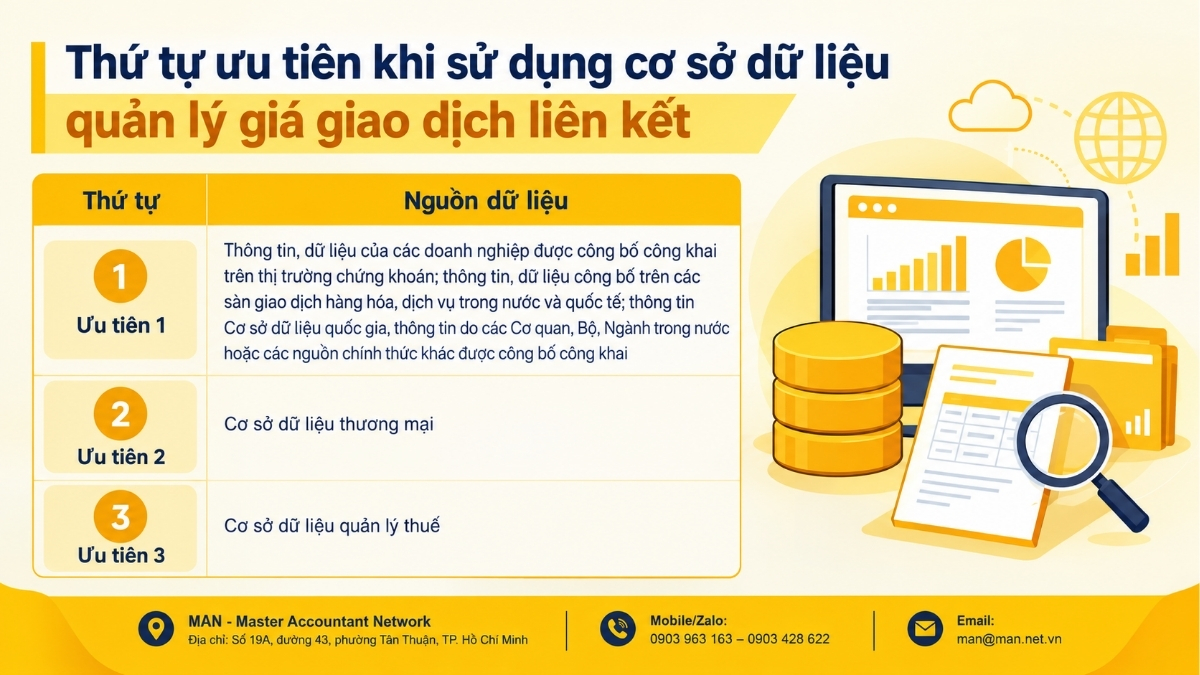
The priority order for using the database for managing transfer pricing is organized into three tiers:
| Order | Data Source |
| Priority 1 | Information and data from businesses publicly disclosed on the stock market; information and data disclosed on domestic and international commodity and service exchanges; information from the National Database, as well as information publicly disclosed by domestic government agencies, ministries, and sectors or other official sources |
| Priority 2 | Trade database |
| Priority 3 | Tax Administration Database |
Why is public data ranked higher than commercial databases?
This classification reflects a clear management philosophy: Sources that are public, official, and verifiable by anyone are given priority. Commercial databases are aggregated sources and are ranked second.
For businesses, this means they should not automatically open a commercial database to search for comparable entities. First, they should check whether Priority Source 1 contains suitable data and document the results of that review in their records.
Priority does not take precedence over the principle of comparison
The order of priority does not mean that Priority 1 sources must be used at all costs. If the data at a higher level does not comply with the principles of analysis and comparison set forth in Article 6, the use of that source does not meet the requirements of the Decree.
Therefore, when using a database to manage related-party transaction prices at a lower level, businesses need to written argument Why the upper-level source is not suitable. This is a point that remains unaddressed in the records of many businesses.
Tax Management Database Ranks Last: What This Means for Businesses
Placing the tax administration database in the third tier indicates that the tax authority’s internal data sources are ranked below public sources and commercial databases. This is a positive sign of transparency. However, businesses should not assume that this source is rarely used. When records do not meet the requirements at the two higher levels, this is the source that businesses find most difficult to challenge.
Priority Order for Selecting Independent Comparables in the Related-Party Transaction Price Management Database
In addition to the priority order regarding source, Paragraph 4 of Article 17 of Decree No. 255/2026/ND-CP also stipulates the order of priority regarding comparison object. Accordingly, the analysis and selection of independent comparables to determine the arm’s-length range must comply with the principles of analysis and comparison, as well as the methods for determining the price of related-party transactions, as stipulated in the Decree. Comparable data shall be selected in the following order of priority:
- The taxpayer’s internal comparables;
- The comparator resides in the same country or territory as the taxpayer;
- The target groups in countries in the region have similar industrial conditions and levels of economic development.
When selecting foreign comparables in other geographic markets, the enterprise must analyze the similarities and material qualitative and quantitative differences in accordance with the provisions of Articles 9 and 10 of Decree 255/2026/NĐ-CP.
The use of a database for managing related-party transaction prices as a two-dimensional array. The first dimension is which data source is used first. The second dimension is which scope of comparison objects is selected first. A well-defined set of comparison objects is one that follows the correct order on both dimensions.
Example: Company B is a foreign-invested contract manufacturer that sells all of its finished goods to its parent company. The procedure for identifying an appropriate comparator is as follows:
- First, Company B checks to see if it has similar processing transactions with independent customers (internal comparables).
- If none are available, Company B will identify a contract manufacturer in the same industry that is publicly listed in Vietnam, using publicly available data from the stock market (priority source 1, same country).
- Only when the above steps do not yield sufficiently reliable results does Company B expand to commercial databases targeting entities in the region with similar conditions.
Note: Each change in floor level must be documented in the file.
Transfer Pricing Documentation: Timing of Preparation and Data Requirements

Choosing the right database to manage new transfer pricing data is only half the job. The other half is accurately reporting that data in the required filings by the deadline. Clause 3 of Article 18 of Decree No. 255/2026/ND-CP stipulates:
The documentation for determining the price of related-party transactions must be prepared prior to the filing of the annual corporate income tax return and must be retained and presented upon request by the tax authorities.
The documentation for determining the price of related-party transactions, as well as the information, documents, and supporting evidence provided by the taxpayer to the tax authority, shall be prepared in accordance with the provisions of tax administration laws. The data, supporting documents, and materials used as the basis for analyzing, comparing, and determining the transfer pricing must clearly state their source. If the data from independent comparables consists of accounting figures, the taxpayer is responsible for storing and providing such data to the tax authority in electronic format, specifically as a spreadsheet.
For businesses that do not yet have a dedicated team, using related party transaction documentation service With support from specialized units and the expertise of organizations such as MAN (Master Accountant Network), we ensure that documentation is completed on time. All comparables spreadsheets are also clearly traced back to individual sources within the transfer pricing database.
Conclude
Article 17 of Decree No. 255/2026/ND-CP has transformed the selection of data sources from a technical choice into a mandatory compliance requirement. There are three key points to keep in mind.
- The tax authority’s database for managing transfer pricing is always more comprehensive than that of businesses, as it includes additional tax administration data.
- The order of priority is as follows: public and official data, commercial databases, and finally tax administration databases. All selections must comply with the principles of analysis and comparison set forth in Article 6.
- Priority for comparison is given first to internal data, then to data from the same country, and finally to regional data. All data must be properly cited and saved as spreadsheets in the files prepared prior to the settlement period.
A business that does things right from the very beginning—starting with supplier selection—will ensure that tax authorities do not have to rely on data over which it has no control. If your business needs to review its comparable entity pool and how to utilize the transfer pricing database in preparation for the 2026 tax filing season, related party transaction advisory services MAN—Master Accountant Network—is ready to support you from the analysis stage through to the completion of your application.
Contact MAN – Master Accountant Network For free support and advice!
Contact information MAN – Master Accountant Network
- Address: No. 19A, Street 43, Tan Thuan Ward, Ho Chi Minh City
- Mobile/Zalo: 0903 963 163 – 0903 428 622
- E-mail: man@man.net.vn
- Google Business Profile: View MAN – Master Accountant Network's Google Business Profile
- LinkedIn Founder: View expert Le Hoang Tuyen's LinkedIn profile.
Responsible for production and professional content review by: Mr. Le Hoang Tuyen – Founder & CEO of MAN – Master Accountant Network. He is a CPA Vietnam auditor with over 30 years of in-depth experience in accounting, auditing, taxation, and corporate legal consulting.
Frequently Asked Questions About the Related-Party Transaction Price Management Database
What does the tax authority’s database for managing transfer pricing consist of?
Pursuant to Paragraph 2 of Article 17 of Decree No. 255/2026/ND-CP, the tax authority shall use the entire database that taxpayers are permitted to use under Paragraph 1. In addition, the tax authority has an additional tax administration database pursuant to Paragraph 2 of Article 35 of the Tax Administration Law No. 108/2025/QH15.
What is the order of priority for using the database that manages transfer pricing?
The priority order consists of three tiers. The first tier comprises publicly available data from domestic and international stock markets, commodity and service exchanges, the National Database, and other official public sources. The second tier consists of commercial databases. The third tier consists of tax administration databases. The application of this order must ensure compliance with the principles of analysis and comparison set forth in Article 6.
Can businesses use commercial databases?
Yes. Commercial databases fall under the category listed in Article 17, paragraph 1, subparagraph a, but are given second priority. Therefore, businesses should be able to demonstrate why the first-priority source is not appropriate.
In what order should independent comparison subjects be selected?
According to paragraph 4 of Article 17, priority is given first to domestic applicants, followed by applicants residing in the same country or territory, and then to applicants from countries in the region with comparable industry conditions and levels of economic development.
In what format should the data for the comparison group be saved?
If the data for the independent comparison entity consists of accounting figures, the taxpayer must retain and provide such data to the tax authority in electronic form, in a spreadsheet format.