





In its business operations, an enterprise may engage in numerous transactions with parties that have relationships involving capital, control, management, or other related factors. These transactions are classified as related-party transactions if they fall under the cases stipulated by law.
Accurately identifying related-party transactions is crucial for businesses to determine their tax declaration obligations and compliance with tax management regulations for related-party transactions, while also mitigating risks during tax audits and inspections.
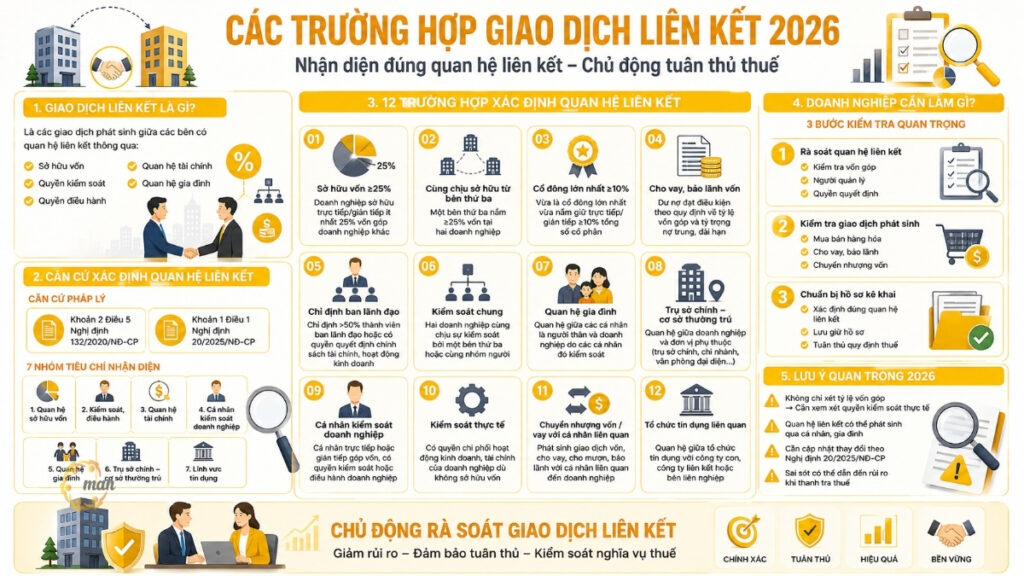
Base Article 5 of Decree 255/2026/ND-CP This regulation replaces Decree 132/2020/ND-CP and Decree 20/2025/ND-CP, officially taking effect from July 1, 2026 and applicable to the corporate income tax period of 2026. Currently, regulations define 12 cases for determining affiliated relationships. These cases are based not only on ownership percentages but also include control relationships, decision-making power, financial relationships, family relationships, and forms of actual influence.
This article will summarize in detail the various types of related-party transactions, helping businesses easily review and determine their compliance status.
Overview of related-party transactions under current regulations
Related-party transactions are transactions that arise between parties that are related to each other in the course of their business operations. These parties may be related through holding equity stakes, control, management rights, or being influenced by another individual or organization.
According to regulations, determining the nature of an affiliated relationship should not only be based on the business registration certificate or the capital contribution ratio in the legal documents, but also on considering the actual control between the parties.
For example, a business that does not directly own capital in another business but has the right to decide on financial policies, business operations, or appoint key management personnel can still be considered to have an affiliated relationship.
Therefore, a thorough understanding of related-party transactions helps businesses proactively review the relationships that arise during their operations.
Legal basis for determining related-party transactions 2026

Currently, the cases for determining affiliated relationships are stipulated in Article 5 of Decree 255/2026/ND-CP. Accordingly, businesses need to identify related relationships based on the following key criteria:
- Ownership relations.
- Appointing managers and supervisors
- Individuals in charge and control.
- Business management and control
- Loans, guarantees
- Family relationships.
- The relationship between the head office and the permanent establishment.
- Specific relationships in the field of credit.
New points in Decree 255/2026 regarding the method of determining related-party transactions.
Specifically, in Decree 255 Point d does not apply.:
- The lender or guarantor is a credit institution that has no equity, investment, management, or control relationship with the borrowing enterprise;
- Neither party is subject to control, capital contribution, or investment from another party;
- Creditor, guarantor is The state-owned organization 100% has the function of buying, selling, and handling debt. and no control over businesses that borrow money.
Transactions with individuals:
- Transfer or receive at least 25% capital contribution; or
- Borrowing, lending, Borrow or lend at least 10% Equity at the time of the transaction.
Summary of the latest related-party transactions in 2026
Properly identifying related-party transactions depends not only on the ownership percentage but also on the nature of control and the controlling relationship between the parties. Specifically, Decree 255 on related-party transactions The regulations specify 12 cases considered as having a related-party relationship, each with its own identification criteria that businesses need to understand during the review and declaration process.
A business directly or indirectly holds at least 25% of the capital contribution of another business.
This is one of the most common scenarios when determining a relationship.
According to regulations, if a business directly or indirectly owns at least 25% of owner's equity in another business, the two businesses are considered to be related.
For example: Company A contributed 30% of charter capital to Company B. In this case, Company A and Company B fall under the category of related parties as defined by regulations.
Capital ownership can be acquired directly or through an intermediary business.
The two businesses each have at least 25% capital contributions held by a third party.
Another example of related-party transactions is when two businesses share the same capital control from a third party.
Specifically:
- A third party directly or indirectly holds at least 25% of the owner's equity in two businesses.
For example: Company X owns 30% of capital contribution in Company A and 35% of capital contribution in Company B. Although Company A and Company B do not directly own capital in each other, because they are both controlled by Company X, they are still considered to have an affiliated relationship.
The company is the largest shareholder and holds at least 10% of the total shares.
This applies when a business simultaneously meets two conditions:
- As the largest shareholder in terms of owner's equity.
- Hold directly or indirectly at least 10% of the total remaining shares of the enterprise.
This regulation aims to identify instances where a business has the potential to significantly influence the operations of another business through its shareholding.
Relationships formed through guarantees or loans.
Businesses can also develop related-party relationships through financial transactions.
Specifically, a business that guarantees or lends capital to another business in any form is considered to have met the following conditions:
- The total outstanding debt from loans or guarantees to the lending or guaranteeing enterprise must be at least equal to 25% of the owner's equity of the borrowing enterprise.
- Simultaneously, it accounts for over 50% of the total outstanding medium and long-term debt of the borrowing enterprise.
This regulation includes:
- A direct loan between two businesses.
- A loan from a third party but secured by the financing of an affiliated party.
- Financial transactions are similar in nature.
A business appoints members of the board of directors or has control over another business.
One of the criteria for identifying related-party transactions is based on management and operational authority.
Specifically:
A business appoints a member of the executive board or takes control of another business if:
- The number of appointed members exceeds 50% of the total number of board members of the other company.
Or:
- A member appointed by the first enterprise has the authority to decide on the financial or operational policies of the second enterprise.
This shows that affiliated relationships can exist even without direct ownership of capital.
Both businesses are controlled by a third party.
Two businesses are considered to be related if:
- There are also more than 50% members on the board of directors appointed by a third party.
Or:
- There may also be a member of the board of directors with the authority to make decisions on financial policy or business operations, designated by a third party.
This is a case of alliance based on shared control.
Control through family relationships
Family relationships are also a basis for determining cases of related-party transactions.
Two businesses can be considered related if they are managed or controlled in terms of personnel, finance, and business operations by individuals who are related:
- Couple.
- Biological parents, adoptive parents, stepfather, stepmother.
- Parents-in-law.
- Biological children, adopted children, and children from a previous marriage of either spouse.
- Daughter-in-law, son-in-law.
- Siblings from the same parents.
- Siblings who share the same father but different mothers, or the same mother but different fathers.
- Brother-in-law, younger brother-in-law, sister-in-law, younger sister-in-law.
- Grandparents on both sides of the family.
- Grandchildren, great-grandchildren.
- Aunts, uncles, and nieces/nephews.
Businesses often overlook this group of cases when only checking capital contribution records.
Relationship between head office and permanent establishment
The next case involves the relationship between:
- Head office and permanent establishment.
- Permanent establishments of the same foreign organization or individual.
This is a common type of relationship in businesses with foreign ownership.
Individuals control businesses through capital contributions or direct management.
An individual can form an association if:
- Having contributed capital to the business.
- Directly involved in managing the business.
This case expands the scope of defining affiliated relationships, not limiting them solely to business-to-business relationships.
Businesses are subject to actual management, control, or decision-making.
One of the key considerations in related-party transactions is determining actual control.
Businesses are considered to be related if:
- Under management.
- Under control.
- Subject to the de facto decision-making power over the business operations of other enterprises.
This regulation also includes branches that independently account for and are responsible for declaring and paying corporate income tax.
Capital transfer or borrowing/lending transactions with related individuals.
Businesses are determined to have an affiliated relationship if the following occurs:
- Transfer or receive the transfer of at least 25% of the owner's capital contribution during the tax period.
Or:
- Borrowing or lending at least 10% of the owner's equity at the time of the transaction during the tax period.
The parties involved in the transaction include:
- Individuals who manage and control businesses.
- Individuals belonging to the family relationship group are defined in case number 7.
Relationship between credit institutions and related businesses
The last case applies to the finance and banking sector.
Accordingly, the credit institution has an affiliated relationship with:
- Subsidiary company.
- The company is in control.
- Affiliated company.
The determination is based on the provisions of the Law on Credit Institutions and its amendments, supplements, or replacements.
What should a business do if it falls under one of the following related-party transactions?
When a business identifies a related-party transaction as falling under one of the categories, it needs to proactively review the relationships involved, assess its declaration obligations, and comply with tax management regulations for related-party transactions. If the business lacks a specialized department or requires in-depth assessment of compliance risks, consulting a professional is recommended. related party transaction advisory services This solution helps businesses determine the correct scope of application, handling methods, and minimize errors during implementation.
Review of ownership and control relationships
Businesses need to check:
- Capital contribution ratio.
- List of shareholders and capital contributors.
- Manager, executive.
- The right to make decisions on financial and business policies.
Check the transactions that have occurred.
The transactions that need to be reviewed include:
- Buying and selling goods and services.
- Lending, borrowing. Borrowing or lending at least 10% of equity capital at the time of the transaction.
- Guarantee.
- Capital transfer.
- Other financial transactions.
Prepare the necessary documents and fulfill your declaration obligations.
Businesses need to ensure:
- Identify the correct relationship.
- Declare all information fully as required.
- Keep supporting documents on file for future reference.
Besides correctly identifying related-party transactions, businesses need to pay attention to the obligation to prepare and maintain records as required by regulations. Records determining transfer pricing are crucial documents that help businesses demonstrate the appropriateness of transactions between related parties. Therefore, businesses can consider the following approach. hire someone to prepare related party transaction documents. To ensure that the dossier is fully prepared, meets all requirements, and complies with current regulations.
Important considerations when identifying related-party transactions in 2026

When reviewing related-party transactions, businesses should note the following:
- It's not just about the percentage of capital contribution; the actual control must also be considered.
- Connections can arise through personal or family relationships.
- Financial transactions such as loans and guarantees require careful scrutiny of their terms and conditions.
- The changes according to Decree 255/2026/ND-CP need to be updated.
In addition to reviewing ownership, control, and related-party transactions, businesses need to properly declare related-party transactions in their tax return. Incomplete declarations or misidentification of related-party transactions can lead to risks during tax audits and inspections. Therefore, businesses should be aware of this. How to declare related-party transactions To ensure that the declarations are made accurately and completely in accordance with regulations.
Conclude
Accurately identifying related-party transactions is a crucial step in helping businesses comply with tax regulations and mitigate risks during operations.
According to Decree 255/2026/ND-CP, which inherits and replaces Decree 132/2020/ND-CP, the law stipulates 12 cases for determining affiliated relationships based on various factors such as capital contribution, control rights, financial relationships, family relationships, and actual management rights.
Businesses should proactively review emerging relationships to accurately determine their reporting and documentation obligations and ensure compliance with regulations on related-party transactions in 2026.
Contact MAN – Master Accountant Network For free support and advice!
Contact information MAN – Master Accountant Network
- Address: No. 19A, Street 43, Tan Thuan Ward, Ho Chi Minh City
- Mobile/Zalo: 0903 963 163 – 0903 428 622
- E-mail: man@man.net.vn
- Google Business Profile: View MAN – Master Accountant Network's Google Business Profile
- LinkedIn Founder: View expert Le Hoang Tuyen's LinkedIn profile.
Responsible for production and professional content review by: Mr. Le Hoang Tuyen – Founder & CEO of MAN – Master Accountant Network. He is a CPA Vietnam auditor with over 30 years of in-depth experience in accounting, auditing, taxation, and corporate legal consulting.
Frequently Asked Questions about Related Party Transactions
How many types of related-party transactions are there under Decree 255?
According to current regulations, there are 12 cases for determining affiliated relationships as stipulated in Article 5 of Decree 255/2026/ND-CP.
What capital ownership level is considered to constitute an affiliated relationship?
Yes. Related parties can still arise if a business has the right to manage, control, or make decisions regarding the business operations of another business.
Can two businesses that do not own capital from each other be considered related?
Yes. An affiliated relationship does not necessarily have to arise from one business owning capital in another. Two businesses can still be considered affiliated if they are both controlled by a third party, share a common manager with the authority to make financial and business decisions, or are both under the actual control and management of the same individual or organization.
Can individuals create connections between businesses?
Yes. According to regulations, individuals can establish an affiliated relationship if they contribute capital to a business or directly participate in the management and control of the business. Additionally, family relationships between individuals who have control or management rights over the business can also be a basis for determining an affiliated relationship.
Can an independently accounting branch be considered a related-party transaction?
Yes. According to regulations, cases where a business is under the de facto management, control, or decision-making authority over the production and business activities of another business can be identified as an affiliated relationship. This regulation includes branches that independently account for and pay corporate income tax.