





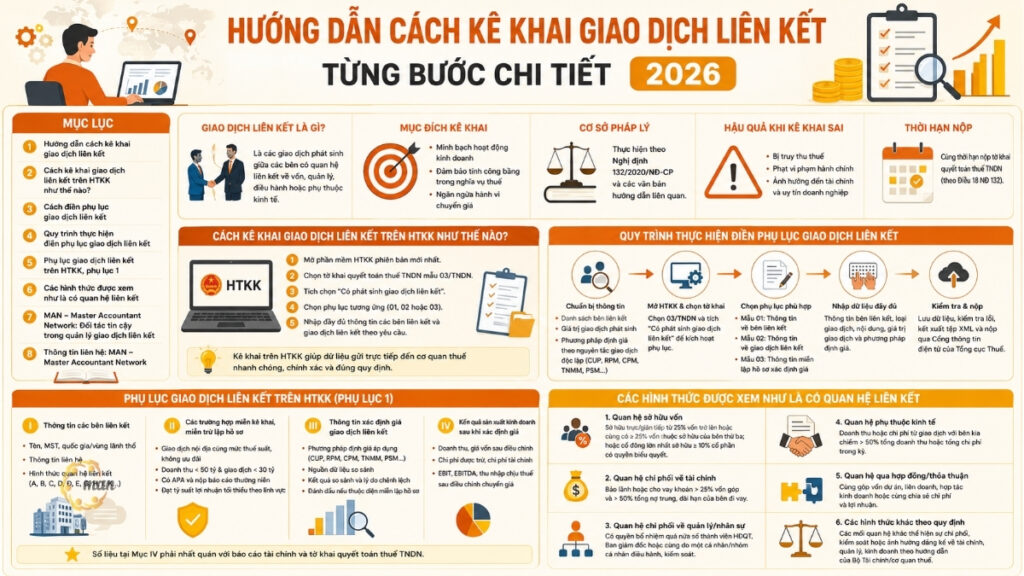
Instructions on how declaration of related party transactions according to Decree 132/2020/ND-CP This is one of the key regulations regarding corporate income tax. Compliance not only helps businesses transparently conduct their operations but also protects them from legal and financial risks. When businesses fail to properly declare related-party transactions, they may face tax arrears and administrative penalties, seriously impacting their financial situation and reputation.
Instructions on how to declare related-party transactions
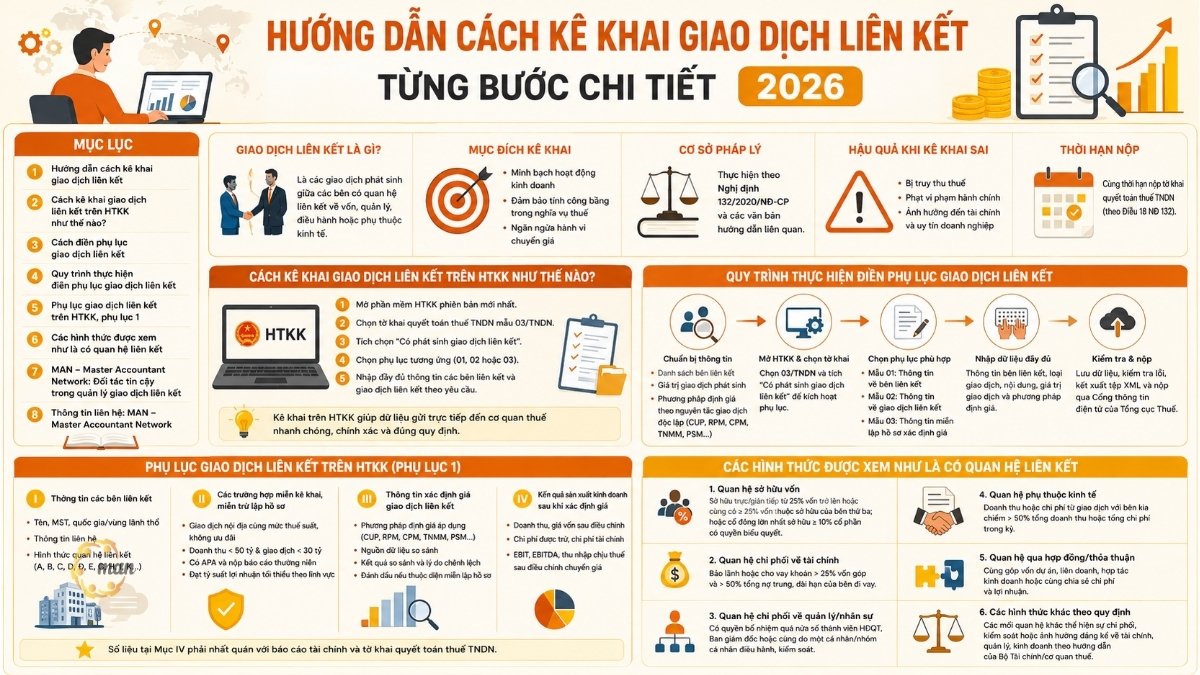
Declaring related-party transactions is the process by which businesses provide the tax authorities with complete information about transactions arising with related parties. The declaration includes:
- Information about affiliate relationships.
- Details of transactions (purchase and sale of goods, provision of services, loans, transfer of assets, etc.).
The purpose of this declaration is to help tax authorities determine and control the taxable price of these transactions, ensuring transparency, fairness, and preventing transfer pricing practices.
According to the regulations, parties are considered to have an affiliated relationship when one party directly or indirectly participates in the management, control, capital contribution or investment in the other party, or when both parties are under the management, control or capital contribution of a third party.
How to declare related-party transactions on HTKK?

Declaring related-party transactions on the HTKK system involves businesses using the Tax Declaration Support Software (HTKK) of the General Department of Taxation to prepare and submit information about transactions with related parties, along with the corporate income tax return. During this process, businesses log into HTKK, select the corporate income tax return form 03/TNDN, check the box "Related-party transactions have occurred," and fill in all the required information in the appendix. This declaration method ensures that data is sent directly to the tax authorities quickly, accurately, and in compliance with legal regulations. Declaring on HTKK helps synchronize data and minimize errors compared to manual entry.
See details: Instructions for declaring related-party transactions on HTKK (Vietnam Tax Declaration System).
How to fill out the affiliate transaction appendix
To declare related-party transactions in the appendix in accordance with the regulations in Decree 132/2020/ND-CP, businesses need to fully prepare the information and complete the data entry steps on the software.
Regarding preparation, first of all, the enterprise must make a list of all related parties according to the criteria specified in Article 5 of Decree 132, clearly stating the business name, tax code, country or territory where the affiliate is registered to operate.
Next, it is necessary to summarize the value of each transaction arising during the tax period, including the purchase and sale of goods, provision of services, borrowing or lending capital, transferring or permitting the use of tangible and intangible assets (such as copyrights, patents, trademarks). At the same time, enterprises must determine the method of transaction valuation according to the principle of independent transactions prescribed in Article 7 of Decree 132, which can be the method of comparing independent transaction prices (CUP), the resale price method (RPM), the cost plus profit method (CPM), the net profit comparison method (TNMM) or the profit allocation method (PSM).
Procedure for completing the related party transaction appendix.
Regarding the procedure on HTKK, businesses open the latest version of the HTKK software, select the corporate income tax final settlement declaration form 03/TNDN, and check the box "There are related party transactions" to activate the appendix.
Next, select the correct appendix form to fill out (Form No. 01 – Information on related parties; Form No. 02 – Information on related-party transactions; or Form No. 03 – Information exempt from documentation for determining transfer pricing) as prescribed in the Appendix issued with Decree 132. In each appendix, enter complete information for each related party, identify the type of transaction, describe the content, clearly state the transaction value and the valuation method applied.
Once data entry is complete, businesses need to save the data and use the software's verification function to check for errors, ensuring the figures match financial statements and related-party transaction pricing records. Finally, export the XML file and submit it through the General Department of Taxation's electronic portal. within the time limit specified in Article 18 of Decree 132.
Appendix on related party transactions on HTKK, Appendix 1
Section I – Information of related parties
Interior related party transaction appendix Used to fully declare identifying data of parties related to the business, according to the criteria stipulated in Article 5 of Decree 132/2020/ND-CP.
In this section, the taxpayer must clearly state the name of each related party, tax identification number, country or territory where that party is registered to operate, along with basic contact information, if any. In addition, the form of related party relationship must be identified and expressed according to the prescribed symbols (A, B, C, D, Đ, E, G, H, I, K), each symbol corresponding to a specific type of relationship such as equity ownership, control rights, loan guarantees or economic dependence.
Accurate and complete declaration in Section I helps tax authorities accurately identify the network of related parties of the enterprise, thereby providing a basis for comparison and verification of the reasonableness of transaction prices, while ensuring the enterprise complies with the principles of transparency and the regulations of Decree 132. In particular, the person implementing this should consider the following points:
- If the affiliate in Vietnam is an organization, fill in information based on the business registration certificate; if it is an individual, fill in information based on the passport or citizen identification card.
- If the affiliated party is an organization or individual not located in Vietnam, the information will be based on the document identifying the affiliated relationship. This can be a transaction agreement, contract, business registration certificate, etc.
- If you are an organization or individual operating in Vietnam, you need to fill in the full Tax Code (MST).
- If the organization or individual is not located in Vietnam: Fill in the full tax code and taxpayer identification code; if not available, state the reason.
Section II: Cases exempted from declaration obligation and exempted from preparing transfer pricing documents
The following cases are exempt from the obligation to declare or to prepare documentation for determining transfer pricing:
Case 1: Case description
Taxpayers will be exempt from declaring in Sections III and IV of the appendix on related-party transactions, and will also be exempt from preparing documentation to determine the transfer pricing of related-party transactions if, during the tax period, transactions only occur with related parties that are subject to corporate income tax in Vietnam, both parties apply the same corporate income tax rate, and neither party enjoys tax incentives.
Case 2: No documentation required
Taxpayers are exempt from preparing transfer pricing documentation in the following cases: (a) There are related-party transactions but the total revenue in the tax period is less than VND 50 billion and the total value of all related-party transactions arising in the period is less than VND 30 billion; (b) An advance pricing agreement (APA) has been signed and all annual reporting obligations have been fulfilled as required by law; (c) The business operates with a basic function, the costs incurred from the exploitation and use of intangible assets are less than VND 200 billion, and the profit margin before interest and corporate income tax is at least the minimum for each sector: distribution from 51% to 3T, manufacturing from 10% to 3T, and processing from 15% to 3T.
See details: No related-party transaction documentation is required.
Section III: Information on determining transfer pricing
This is part of the declaration appendix used by businesses to present how they determine the price for transactions with related parties, ensuring compliance with the arm's-length principle as stipulated in the regulations. Article 6 and Article 7 of Decree 132/2020/ND-CP.
In this section, taxpayers need to clearly state the pricing method applied for each type of transaction, such as the comparable uncontrolled price method (CUP), resale price method (RPM), cost plus method (CPM), net profit comparable method (TNMM) or profit allocation method (PSM).
Along with that, the enterprise must provide information on the data sources used for comparison, including financial statements, commercial databases, industry information or data from similar independent transactions.
Furthermore, Section III is where businesses record the results of price or profit margin comparisons between related-party transactions and independent transactions, and explain the reasons for any discrepancies (if any). Even if exempted from filing related-party transaction pricing documents under Article 19 of Decree 132, taxpayers still need to check the corresponding box for the tax authorities to record.
Providing complete, clear, and accurate information in Section III not only helps tax authorities assess the reasonableness of transfer pricing but also serves as evidence that the business complies with regulations, avoiding the risk of tax assessment or administrative penalties.
Exempt from filing related-party transaction documents.
These are cases where taxpayers are not required to prepare transfer pricing documentation for the tax period, as they have met the exemption conditions stipulated by law. Even with the exemption, businesses must still declare the related-party transaction appendix on the HTKK system (except in cases where some information items are also exempted, as listed below).
As stipulated in Decree 132/2020/ND-CP, applicable to certain special cases where taxpayers meet the legal requirements, businesses will be exempt from filing tax returns if, during the tax period, they only have transactions with related parties that are subject to corporate income tax in Vietnam, both parties apply the same tax rate, and neither party enjoys tax incentives.
Additionally, businesses are exempt from filing tax returns if they are small in scale, specifically when total revenue for the period is below VND 50 billion and the total value of related-party transactions is below VND 30 billion; when transactions are covered by advance pricing agreements (APAs) and the business fulfills its annual reporting obligations; or when the business operates with a basic business function, with expenses from the exploitation and use of intangible assets in the period below VND 200 billion and achieving a minimum profit margin before interest and corporate income tax for each sector, including distribution from 5% or more, manufacturing from 10% or more, and processing from 15% or more. Despite being exempt from filing tax returns, businesses must still declare information on the tax declaration system and retain all supporting documents to present when requested by the tax authorities.
Section IV: Business results after determining transfer pricing.
This is the presentation of the business's profit picture after applying the valuation method according to the principle of independent transactions (declared in Section III) and making the necessary transfer pricing adjustments. This is the "final" figure used to compare with the corporate income tax finalization declaration, so it must be consistent with the financial statements and the entire working documents.
When preparing Section IV, businesses start with the original accounting data for the period (net revenue, cost of goods sold, selling and administrative expenses, financial expenses, other income/expenses) and then separate related-party transactions to determine the scope of adjustments needed. Based on the chosen method (CUP, RPM, CPM, TNMM, PSM) and the independent comparison range, businesses calculate the price adjustment or profit margin for each group of transactions: adjustments may include increasing related-party revenue, decreasing cost of goods sold/internal service expenses, adjusting royalties or internal interest expenses, etc., to bring the results to the desired price and profit margin. After adjustment, businesses re-prepare the profit and loss statement for the tax period, clearly showing the adjusted revenue, adjusted cost of goods sold, gross profit, deductible selling and administrative expenses, financial expenses (note the current regulations on interest expense limits), other income, EBIT, EBITDA, and taxable corporate income after transfer pricing adjustments.
If there is a difference between the initial accounting figures and the adjusted figures, the increase or decrease should be recorded in the appropriate index, with a brief explanation of the comparative data base, the reason for the difference and the tax impact.
In cases where a business is exempt from declarations under Sections III and IV due to only domestic transactions at the same tax rate and without tax incentives, Section IV may not need to be presented. However, if only the preparation of documentation for determining prices (revenue, transactions, APA, or achieving a minimum profit threshold) is exempt, the business must still present the adjusted business results in Section IV for the tax authorities to record as a basis for tax calculation. Presenting complete information with clear explanations and verifiable documentation using working files will help businesses reduce the risk of being assessed for tax arrears, back taxes, and penalties during audits.
See details at: Instructions for preparing the related party transaction declaration form.
The forms are seen as having a relational relationship.

Based on Clause 2, Article 5 of Decree 132/2020/ND-CP, when falling under one of the following cases, are considered to have a linked relationship:
- Equity relationship: One party directly or indirectly holds 25% or more of the other party's equity, or both parties have at least 25% of equity owned by the same third party. In addition, one party is the largest shareholder holding at least 10% of the total voting shares of the other party, which is also considered an affiliate. This applies to both the charter capital of a limited liability company and the share capital of a joint stock company.
- Financial dominance relationship: One party guarantees or lends to the other party with a loan value of more than 25% of the borrower's contributed capital and at the same time accounts for more than 50% of the borrower's total medium and long-term debt. In this case, the borrower's ability to repay the debt and financial performance are significantly influenced by the lender.
- Dominant relationship in management or personnel: One party has the right to appoint more than half of the members of the Board of Directors, Board of Management or key management positions of the other party. Or both parties are directly managed and controlled by an individual or a group of individuals.
- Economic dependence relationship: One party has revenue or expenses from transactions with the other party that account for more than 50% of total revenue or total expenses during the period. For example, if company A sells most of its products to company B and revenue from B accounts for the majority of A's revenue, then the two parties are considered to have an affiliated relationship.
- Contractual or cooperative relationship: Two parties jointly contribute capital to a project, joint venture, business cooperation contract, or jointly share costs and profits.
- Other forms as prescribed by law: Including relationships that do not belong to the above groups but still show significant influence, control or influence on finance, management and business according to the guidance of the Ministry of Finance or tax authorities.
MAN – Master Accountant Network: Trusted partner in affiliate transaction management
MAN – Master Accountant Network proudly offers professional transfer pricing compliance consulting and support services, fully complying with Decree 132/2020/ND-CP and international standards. With a team of experienced experts, MAN not only helps businesses accurately identify related parties and related-party transactions, but also develops solutions for determining prices based on the arm's-length principle, prepares comprehensive transfer pricing documentation, and optimizes tax strategies.
We are committed to providing transparent, legally safe and business effective services, helping businesses feel secure in sustainable development in an integrated environment.
Contact MAN for more detailed advice and answers regarding affiliate transaction management solutions suitable for your business.
Contact information: MAN – Master Accountant Network
- Address: No. 19A, Street 43, Tan Thuan Ward, Ho Chi Minh City
- Mobile/Zalo: 0903 963 163 – 0903 428 622
- Email: man@man.net.vn
Content production by: Mr. Le Hoang Tuyen – Founder & CEO MAN – Master Accountant Network, Vietnamese CPA Auditor with over 30 years of experience in Accounting, Auditing and Financial Consulting.