





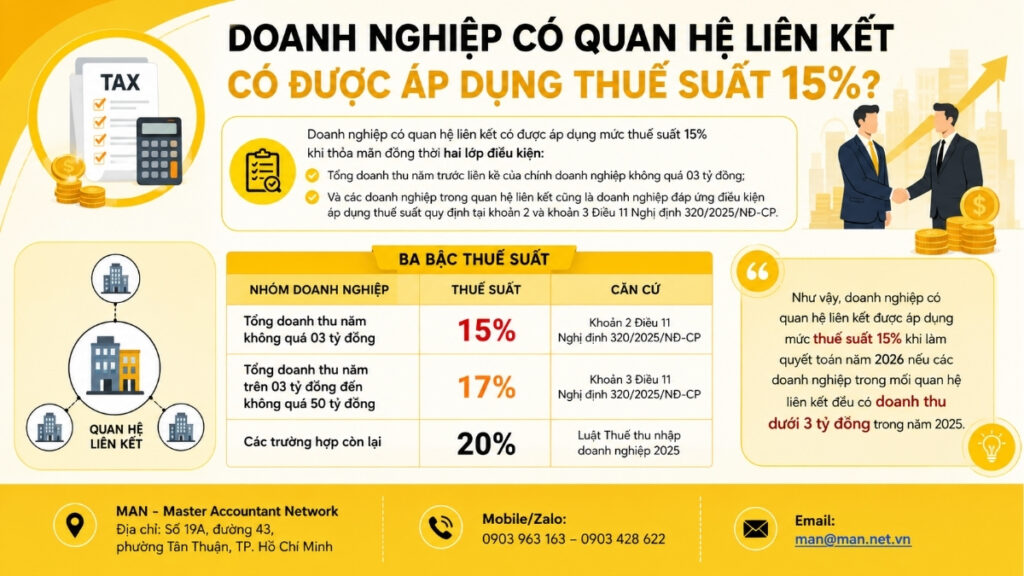
Whether affiliated businesses are eligible for the 15% tax rate is a question that arose immediately after the Corporate Income Tax Law 2025 and Decree 320/2025/ND-CP introduced two preferential tax rate brackets based on revenue size:
- 15% is for businesses with total annual revenue not exceeding 3 billion VND;
- And 17% applies to the group with assets ranging from over 3 billion to no more than 50 billion VND.
Point c, Clause 4, Article 11 of Decree 320/2025/ND-CP stipulates that the exclusion conditions apply to all parties in related-party relationships, not just the legal entity making the declaration. In practice, a review shows that most businesses lose their right to benefit from the 15% rate not because they themselves exceeded the threshold, but because they are grouped with a larger legal entity. This article systematically reviews the legal basis, identifies the exclusion conditions, and outlines the necessary documentation before finalizing the tax rate.
Can related-party enterprises apply tax rate 15% and directly determine the amount of tax payable?
Businesses with related party relationships are eligible for the 15% tax rate if they simultaneously meet two sets of conditions:
- The total revenue of the business in the immediately preceding year did not exceed 3 billion VND;
- And related-party enterprises are also enterprises that meet the conditions for applying the tax rates stipulated in Clauses 2 and 3 of Article 11 of Decree 320/2025/ND-CP.
Three tax brackets:
| Business group | Tax rate | Base |
| Total annual revenue must not exceed 3 billion VND. | 15% | Clause 2, Article 11 of Decree 320/2025/ND-CP |
| Total annual revenue is between 3 billion VND and 50 billion VND. | 17% | Clause 3, Article 11 of Decree 320/2025/ND-CP |
| The remaining cases | 20% | Corporate Income Tax Law 2025 |
For a business with taxable income of 2 billion VND, the difference between tax code 15% and tax code 20% is 100 million VND per tax period. If the wrong tax code is applied for three consecutive periods and discovered during an inspection, the business will have to pay back taxes, late payment penalties calculated from the due date, and administrative fines for tax violations.
Therefore, related-party enterprises will be subject to tax rate 15% when filing their 2026 tax returns if all related enterprises have revenue below 3 billion VND in 2025.
Legal basis to answer the question of whether related-party enterprises are eligible to apply tax rate 15%.

The entire content is found in Article 11 of Decree 320/2025/ND-CP guiding the Corporate Income Tax Law. Chief accountants need to understand:
- Revenue threshold;
- How to determine total revenue as a basis;
- And the exclusion clause.
As stipulated in Clauses 2 and 3 of Article 11
Tax rate 15% applies to businesses with total annual revenue not exceeding 3 billion VND. The next highest rate, 17%, is for businesses with total annual revenue exceeding 3 billion VND but not exceeding 50 billion VND.
This is a revenue threshold, not a profit threshold, not a registered capital threshold, and not a criterion for small and medium-sized enterprises under the law supporting small and medium-sized enterprises.
What are the components used to determine total revenue?
The total revenue used to determine whether an enterprise is subject to tax rates 15% and 17% as stipulated in Clauses 2 and 3 of this Article is the total revenue from sales and service provision (excluding revenue deductions), revenue from financial activities, and other income as shown in the Appendix of business performance results attached to the corporate income tax return for the immediately preceding tax year.
Exclusion conditions for subsidiaries and affiliated companies
The tax rates 15% and 17% stipulated in this Article do not apply to enterprises established under Vietnamese law that are subsidiaries or affiliated companies where the affiliated enterprise does not meet the conditions for applying the tax rates stipulated in Clauses 2 and 3 of this Article.
Under what circumstances can related-party enterprises apply the 15% tax rate?
Can affiliated businesses apply tax rate 15% if the business itself has total revenue in the preceding year not exceeding 3 billion VND? and The parties involved in the related-party relationship. If even one related legal entity falls outside that scope, the exclusion condition is triggered for the business filing the declaration.
Identifying related party relationships under the law on related party transactions.
From July 1st, 2027, Decree 255/2026/ND-CP officially takes effect and applies from the 2026 corporate income tax period. Businesses need to clearly understand the criteria that determine this. affiliated relationship, Specifically, here are some common criteria found in small and medium-sized enterprises (SMEs) in Vietnam:
- Owning capital of 25% or more, directly or indirectly.
- Having a third party holding capital of 25% or more is the most common case in family company groups, where an individual holds capital in multiple legal entities.
- The relationship arises from guarantees or loans when the loan simultaneously reaches the legally stipulated thresholds regarding the ratio of owner's equity to total medium- and long-term debt.
- Management and control relationships; personal relationships between the managers of legal entities as stipulated by regulations.
See also: New points in Decree 255/2026/ND-CP regarding related-party transactions.
The self-assessment process for related-party enterprises determines whether they are eligible for the 15% tax rate.

Here are five steps businesses can take to check if they qualify for the 15% tax rate. Specifically:
- Step 1 – Determine the total revenue of the business in the preceding year: ensure that all three components as specified in Clause 4, Article 11 of the Appendix on business performance results accompanying the submitted tax return are included, and compare them with the threshold of 3 billion VND. Save the spreadsheet with references to each indicator.
- Step 2 – Create a relationship diagram. List all legal entities and individuals that have ownership, management, guarantee, or lending relationships with the business; clearly state the criteria and corresponding percentages. The conclusions must be documented in writing with supporting evidence: business registration certificate, register of members or shareholders, loan agreements, guarantee letters, and articles of incorporation.
- Step 3 – Collect revenue data from affiliated parties: For domestic legal entities, use the total revenue of the immediately preceding year as determined in Clause 4, Article 11 to ensure comparability. For foreign legal entities, use the financial statements or confirmation documents from the parent company.
- Step 4 – Verify the exclusion conditions in point c. If any affiliated party does not meet the revenue requirements under clauses 2 and 3.
- Step 5 – Finalize the tax rate and retain the explanatory document: Record the tax rate on the corporate income tax return, attach the calculation sheet, the linkage diagram, and the internal conclusion minutes to the file.
Businesses can refer to this. related party transaction advisory services For in-depth support, consult specialized and experienced organizations like MAN – Master Accountant Network.
What types of income do businesses have to declare and pay corporate income tax on?

Based on the provisions of Clause 1 and Clause 2, Article 3 of the Corporate Income Tax Law 2025, which stipulate taxable income, the following types of income are subject to corporate income tax:
- Income from the transfer of capital, transfer of equity rights, and transfer of securities.
- Income from the transfer of real estate, excluding income from the transfer of real estate by real estate businesses.
- Income from the transfer of investment projects, the transfer of the right to participate in investment projects, and the transfer of the right to explore, exploit, and process minerals.
- Income from the transfer, lease, or liquidation of assets, including securities, excluding real estate.
- Income from the right to use and own property, including income from intellectual property rights and technology transfer.
- Income from interest on deposits, interest on loans, and the sale of foreign currency, excluding income from credit activities of credit institutions.
- Provisions for expenses that are not used or not fully used and which the business does not account for as a reduction in deductible expenses; bad debts that were written off but are now recovered; liabilities with unidentified creditors; and business income from previous years that was overlooked but is now discovered.
- The difference between revenue from fines, compensation for breach of economic contracts, or bonuses for fulfilling contractual commitments.
- Donations and grants received, whether in cash or in kind.
- Differences arising from the revaluation of assets in accordance with the law for capital contribution, transfer during mergers, consolidations, divisions, separations, changes in ownership, and changes in business type.
- Income from business cooperation contracts; income from production and business activities abroad.
Documentation proving the business's affiliated relationship qualifies for the application of tax rate 15%.
Documentation proving that a business has an affiliated relationship is eligible for the 15% tax rate, specifically:
- The spreadsheet shows the total revenue for the immediately preceding year, referencing each item in the Appendix to the business performance report attached to the submitted tax return.
- The diagram and list of related parties should clearly indicate each legal entity, the criteria for establishing the relationship, the ownership percentage, and be accompanied by supporting documents.
- Revenue figures for related parties and source documents: financial statements, tax returns, and confirmation documents from related parties.
- Internal minutes of the meeting on applicable tax rates, signed by the legal representative and chief accountant, clearly stating the date of preparation.
- Transfer pricing documentation is required in cases where related-party transactions occur and are not exempt from preparation.
Conclude
Therefore, related-party enterprises will be subject to tax rate 15% when filing their 2026 tax returns if all related enterprises have revenue below 3 billion VND in 2025.
Contact MAN – Master Accountant Network For timely advice and support!
Contact information MAN – Master Accountant Network
- Address: No. 19A, Street 43, Tan Thuan Ward, Ho Chi Minh City
- Mobile/Zalo: 0903 963 163 – 0903 428 622
- E-mail: man@man.net.vn
- Google Business Profile: View MAN – Master Accountant Network's Google Business Profile
- LinkedIn Founder: View expert Le Hoang Tuyen's LinkedIn profile.
Responsible for production and professional content review by: Mr. Le Hoang Tuyen – Founder & CEO of MAN – Master Accountant Network. He is a CPA Vietnam auditor with over 30 years of in-depth experience in accounting, auditing, taxation, and corporate legal consulting.
Frequently Asked Questions
What items are included in the total revenue used to determine the 3 billion VND threshold?
This includes total revenue from sales and services (excluding revenue deductions), revenue from financial activities, and other income as shown in the Appendix on business performance results attached to the corporate income tax return for the immediately preceding tax year.
In a related-party relationship, is the subsidiary entitled to the 15% tax rate?
No, if the parent company or its affiliated parties do not meet the revenue requirements under Clauses 2 and 3 of Article 11 of Decree 320/2025/ND-CP.
If the affiliated company has revenue of 30 billion VND, what tax rate will the business be subject to?
That affiliated entity falls under the group subject to tax rate 17% according to clause 3, so literally, the business still meets the conditions for applying the tax rate stipulated in clauses 2 and 3. However, for a file with a large tax value, it is advisable to request written clarification from the directly managing tax authority before filing.
If I don't qualify for the 15% program, can I still apply for the 17% program?
No, if the business is excluded under point c, clause 4, Article 11. This clause excludes both tax rates 15% and 17% simultaneously, the business reverts to applying the standard tax rate.
How do you determine the tax liability for a newly established business that has no prior business year?
It is necessary to directly compare the remaining provisions of Clause 4, Article 11 of Decree 320/2025/ND-CP and the guidance documents of the tax authorities for newly established businesses or tax periods of less than 12 months, instead of arbitrarily converting based on the percentage of operating months.