





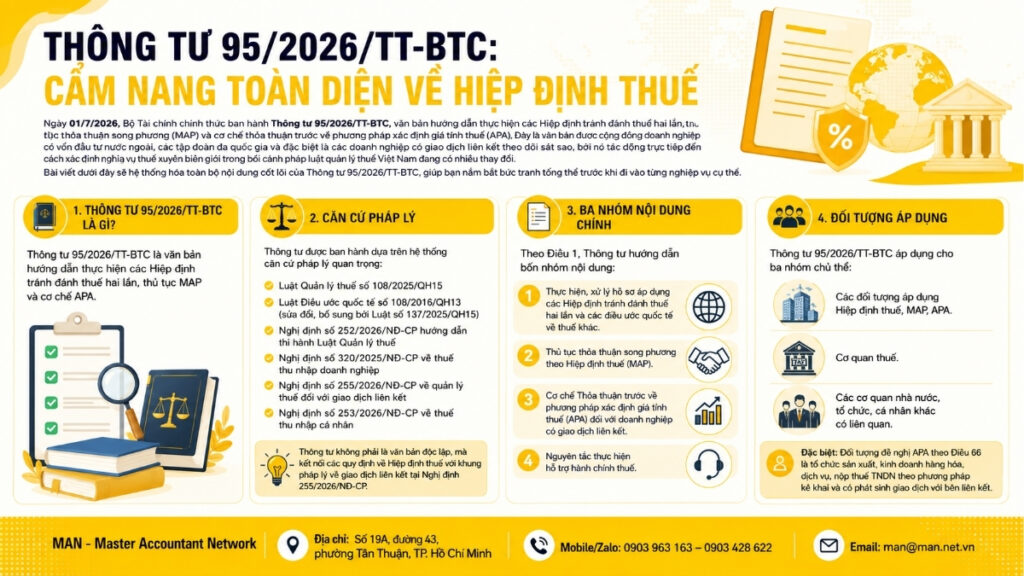
On July 1, 2026, the Ministry of Finance officially issued the following: Circular 95/2026/TT-BTC, This document provides guidance on the implementation of Double Taxation Avoidance Agreements, the Bilateral Agreement Procedure (MAP), and the Advance Pricing Agreement (APA) mechanism. It is closely monitored by foreign-invested enterprises, multinational corporations, and especially businesses with related-party transactions, as it directly impacts the determination of cross-border tax obligations in the context of ongoing changes in Vietnamese tax law.
So what exactly does Circular 95/2026/TT-BTC stipulate? How will businesses with related-party transactions be affected when requesting the application of tax agreements, applying for MAP implementation, or negotiating APA with the tax authorities? This article will systematize the core content of Circular 95/2026/TT-BTC, helping you grasp the overall picture before delving into specific procedures.
What is Circular 95/2026/TT-BTC? Legal basis and scope of application.
On what legal basis was Circular 95/2026/TT-BTC issued?
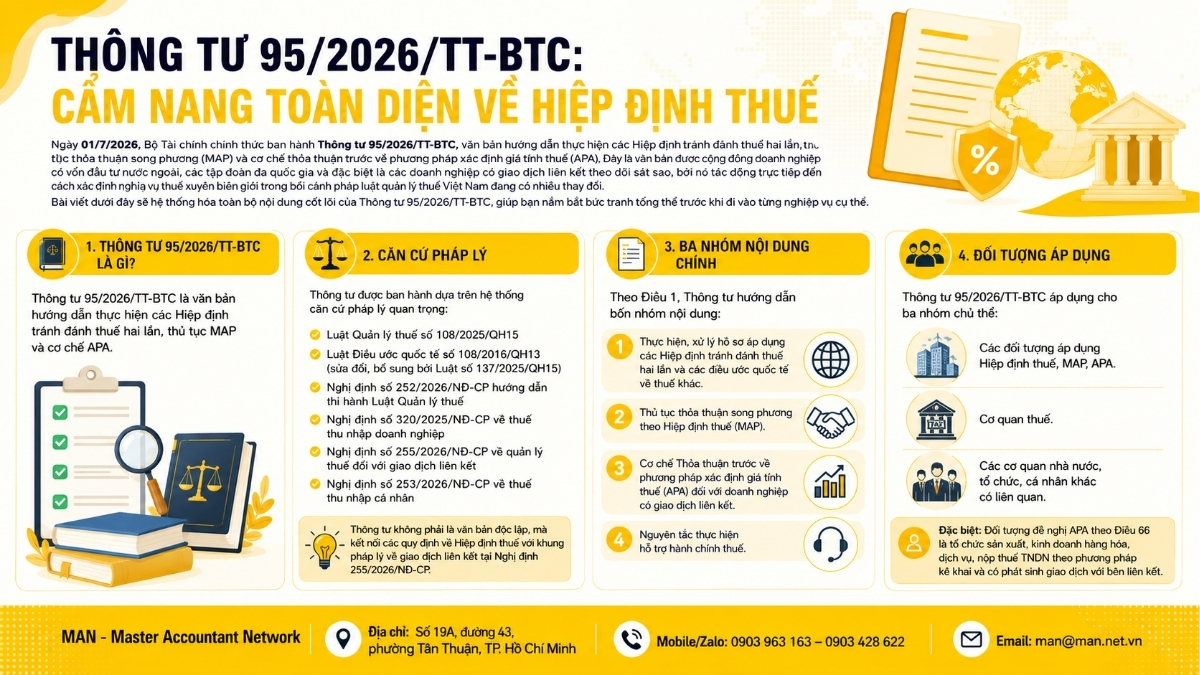
Circular 95/2026/TT-BTC, issued by the Minister of Finance, is based on a rather extensive legal framework, reflecting the interdisciplinary nature of this field: Law on Tax Administration No. 108/2025/QH15, Law on International Treaties No. 108/2016/QH13 (amended and supplemented by Law No. 137/2025/QH15), Decree No. 252/2026/ND-CP Guidelines for the implementation of the Law on Tax Administration, Decree No. 320/2025/ND-CP on corporate income tax, Decree No. 255/2026/ND-CP on tax management for related-party transactions, and Decree No. 253/2026/ND-CP on personal income tax.
The simultaneous reference to multiple decrees shows that Circular 95/2026/TT-BTC is not an independent document, but rather serves to connect the provisions of the tax agreement with the legal framework on related-party transactions already established in Decree 255/2026/ND-CP. This is a point that businesses engaging in related-party transactions need to pay particular attention to.
Circular 95/2026/TT-BTC provides guidance on three main groups of content.
According to Article 1, the scope of Circular 95/2026/TT-BTC includes four groups of contents:
- Implement and process applications related to Double Taxation Avoidance Agreements and other international tax treaties.
- Procedures for bilateral agreements under the Tax Agreement (MAP).
- Advance Pricing Agreements (APAs) for businesses with related-party transactions.
- Principles for providing administrative tax support.
As can be seen, Circular 95/2026/TT-BTC has combined three areas of operations that were previously regulated separately: application of tax agreements, resolution of international tax disputes through MAPs, and negotiation of APAs for related-party transactions.
Scope of application of Circular 95/2026/TT-BTC
Circular 95/2026/TT-BTC applies to three groups of entities:
- The entities to which the tax agreements, MAPs, and APAs apply;
- Tax authorities;
- And other relevant government agencies, organizations, and individuals.
Notably, the entities proposed for APA application under Article 66 are specifically defined as organizations that manufacture and trade goods and services, pay corporate income tax using the declaration method, and have transactions with related parties.
Principles for applying tax agreements as per Circular 95/2026/TT-BTC
Priority should be given to applying tax agreements when there is a conflict with domestic law.
One of the fundamental principles affirmed in Article 4 of Circular 95/2026/TT-BTC is:
When a tax agreement and domestic tax law have different provisions on the same issue, the provisions of the tax agreement shall prevail.
However, this principle comes with an important limitation: tax agreements cannot create new, different, or heavier tax obligations than those under domestic law. In other words, tax agreements can only provide benefits (exemptions, reductions) to taxpayers, but cannot serve as a basis for imposing heavier taxes.
Principles for interpreting terminology according to Circular 95/2026/TT-BTC
When a term is not defined in the Tax Agreement, Circular 95/2026/TT-BTC provides guidance on its application according to Vietnamese law at the time of application; if the term appears in both tax law and other laws with different meanings, the interpretation according to tax law takes precedence. If neither the Tax Agreement nor Vietnamese law provides a definition, the competent Vietnamese authorities will consult and agree on an interpretation with the Contracting Party; this is the premise for the MAP mechanism presented later.
Determining residency status: The foundation for enjoying tax agreement benefits.
Circular 95/2026/TT-BTC dedicates Article 8 to guiding the determination of residency, a prerequisite for an individual or organization to benefit from the tax agreement. For individuals, residency is determined sequentially according to the following criteria: permanent residence, closer economic-personal relationship, more frequent presence, nationality, and finally, bilateral agreement procedures if residency cannot be determined. For organizations, the criteria include place of establishment, head office, and actual operating headquarters.
Reference: How to calculate interest expense according to Decree 255.
Cases where the application of the tax agreement is refused.
Principles for preventing abuse of tax agreements.
This is the content that the team in charge of related-party transactions needs to study most carefully. According to Article 10 of Circular 95/2026/TT-BTC, the Vietnamese tax authorities will refuse to apply a tax agreement if the primary purpose of the contract or agreement is to obtain tax exemptions or reductions, also known as the "Principal Purpose Test" principle, familiar in the framework for combating base erosion (BEPS) that Vietnam has committed to through the multilateral MLI agreement.
Criteria for determining the beneficiary
Circular 95/2026/TT-BTC lists in detail 7 cases in which the person requesting the application of the tax agreement will not be considered the actual owner, including:
- Distribution of income from 50% to third-country residents within a 12-month period;
- There was no (or virtually no) actual business activity;
- The scale of assets and personnel is disproportionate to the income received;
- No control over and no risk to income;
- Being a resident of a country with a tax rate below 10%;
- Or they could be agents or intermediary companies set up solely for the purpose of avoiding taxes.
The principle that substance prevails over form is applied throughout the tax authority's review of the file.
The tax agreement is valid for 3 years.
In addition, Circular 95/2026/TT-BTC clearly stipulates:
Applicants for the tax agreement will be denied if the tax liability has been outstanding for more than three years from the date of submission of the application.
This is a crucial deadline for businesses to remember so they don't miss out on the tax exemptions and reductions under the Agreement.
Circular 95/2026/TT-BTC provides guidance on how to determine permanent residence.
Three conditions that constitute a permanent establishment
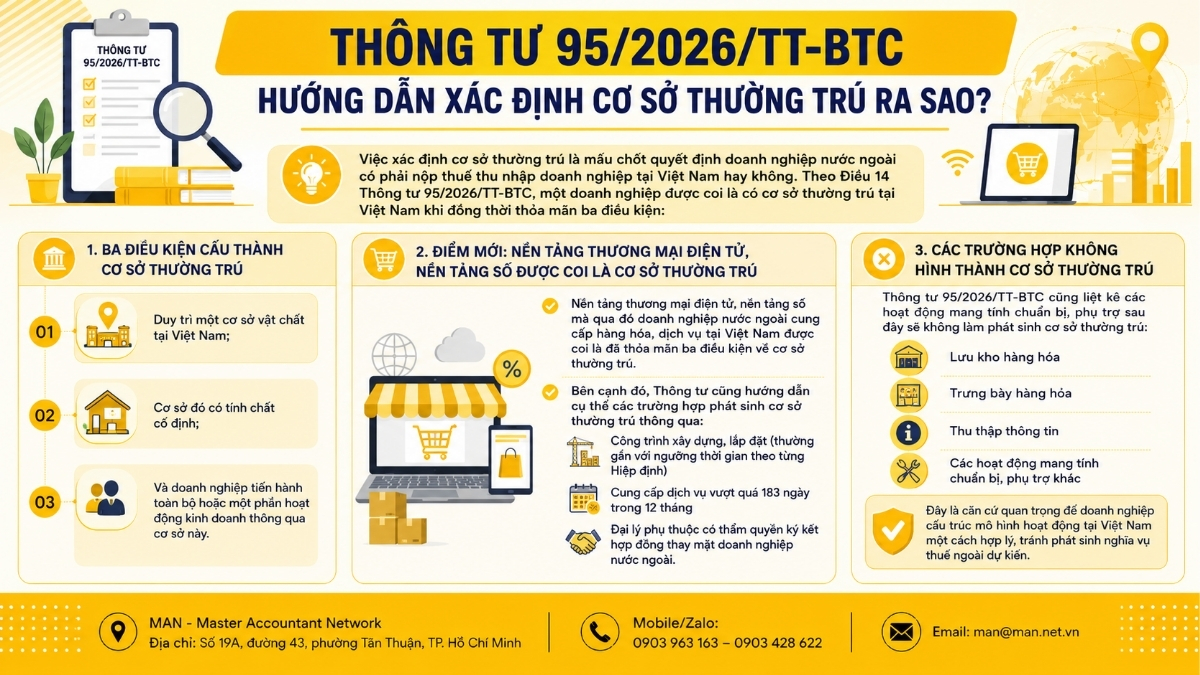
Determining the establishment of a permanent establishment is crucial in deciding whether a foreign enterprise is required to pay corporate income tax in Vietnam. According to Article 14 of Circular 95/2026/TT-BTC, an enterprise is considered to have a permanent establishment in Vietnam when it simultaneously satisfies three conditions:
- Maintain a physical facility in Vietnam;
- That facility is of a fixed nature;
- And the business conducts all or part of its business operations through this facility.
New development: E-commerce platforms and digital platforms are considered permanent establishments.
One of the key aspects of Circular 95/2026/TT-BTC, considered a timely update to the digital economy trends, is its affirmation that e-commerce platforms and digital platforms through which foreign businesses provide goods and services in Vietnam are considered to have met the three conditions for permanent establishment. This regulation significantly expands the scope of cross-border technology and digital platform businesses that can be identified as having tax obligations in Vietnam.
In addition, the Circular also provides specific guidance on cases where permanent establishment arises through construction or installation projects (usually linked to time limits according to each Agreement), provision of services exceeding 183 days in 12 months, or through a subsidiary agent authorized to sign contracts on behalf of the foreign enterprise.
Cases where permanent residence is not established
Conversely, Circular 95/2026/TT-BTC also lists preparatory and auxiliary activities such as warehousing, displaying goods, and gathering information, which will not create a permanent establishment. This is an important basis for businesses to structure their operating model in Vietnam appropriately, avoiding unexpected tax obligations.
Regulations on taxable income under the Agreement
Income from dividends, interest on loans, and royalties.
Circular 95/2026/TT-BTC dedicates several provisions (from Section 6 to Section 9 of Chapter II) to guiding the determination of tax obligations for typical passive income types in cross-border related-party transactions such as dividends, interest on loans, royalties, and technical service fees.
The general principle is that Vietnam has the right to collect taxes on income arising in Vietnam, but the tax rate applied to residents of the Contracting Party shall not exceed the tax rate limit stipulated in each specific tax agreement.
It is worth noting: For each of these income types, Circular 95/2026/TT-BTC stipulates conditions regarding the "actual beneficiary," meaning that only when the recipient of the income is the actual owner, lender, or copyright holder will the preferential tax rate apply. This regulation once again demonstrates the spirit of preventing abuse of the tax agreement throughout the entire document.
Income from technical services and property transfers
Regarding technical service fees, Circular 95/2026/TT-BTC clarifies that these are payments for technical, managerial, or consulting services, excluding labor relations. For income from asset transfers, it is noteworthy that the regulation on indirect capital transfers in enterprises where real estate value accounts for the majority (usually above 50% unless otherwise stipulated in the Agreement) of total assets is particularly important for foreign investors undertaking restructuring and M&A when referring to Circular 95/2026/TT-BTC.
Measures to avoid double taxation in Vietnam
Circular 95/2026/TT-BTC provides guidance on three measures that Vietnam can apply to avoid double taxation for Vietnamese residents with income from abroad:
- Direct tax deduction;
- Deduct any tax amount that is eligible for preferential exemption or reduction in the Contracting Party;
- And an indirect deduction for corporate income tax paid before dividend distribution.
Each measure has its own principles regarding the maximum deduction amount and the timing of tax liability.
Reference: Limitations and regulations of Decree 255/2026/ND-CP.
The bilateral agreement (MAP) procedure is governed by Circular 95/2026/TT-BTC.
When is a business required to implement a MAP?
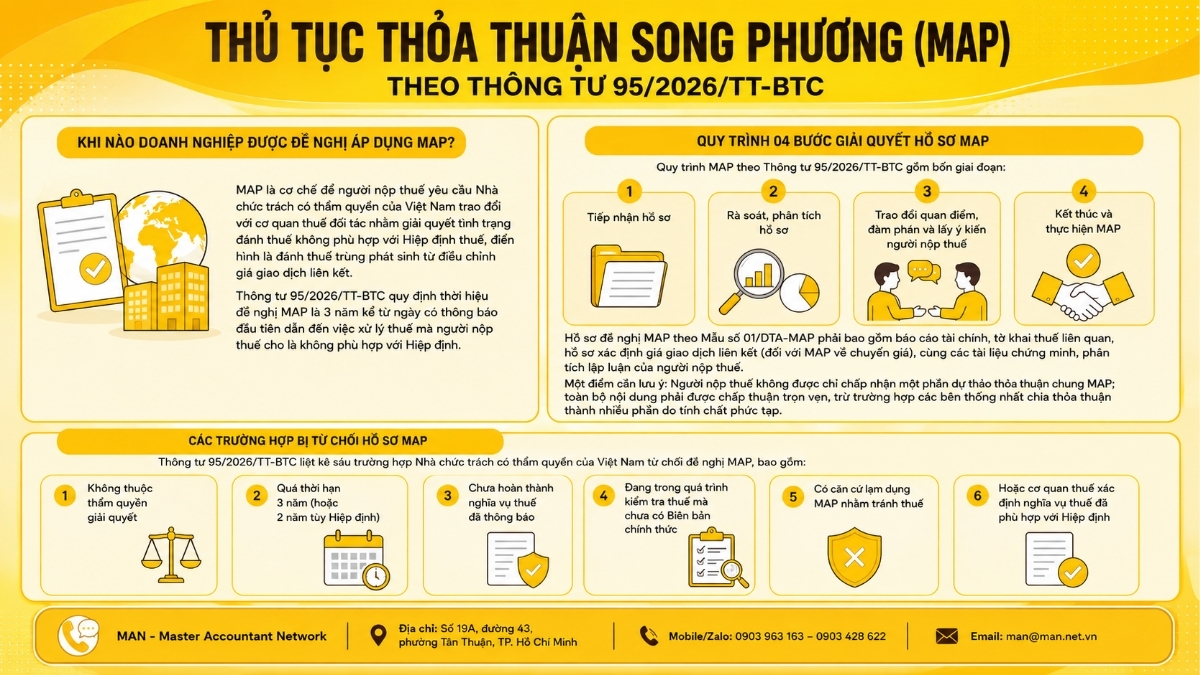
A Tax Approval Mechanism (MAP) is a mechanism for taxpayers to request that the competent authorities of Vietnam engage in dialogue with their partner tax authorities to resolve situations of inconsistent taxation under tax agreements, typically double taxation arising from adjustments to related-party transactions. Circular 95/2026/TT-BTC stipulates that the time limit for requesting a MAP is 3 years from the date of the first notification leading to the tax treatment that the taxpayer considers inconsistent with the Agreement.
The 4-step process for handling MAP applications.
The MAP process according to Circular 95/2026/TT-BTC consists of four stages:
- Step 1: Receiving the application;
- Step 2: Review and analyze the documents;
- Step 3: Exchange views, negotiate, and gather feedback from taxpayers;
- Step 4: Finish and execute the MAP.
The MAP application dossier, using Form No. 01/DTA-MAP, must include financial statements, relevant tax returns, transfer pricing documentation (for MAPs related to transfer pricing), and supporting documents, analysis, and arguments from the taxpayer.
One point to note: Taxpayers may not accept only a portion of the draft MAP agreement; the entire content must be accepted in its entirety, unless the parties agree to divide the agreement into several parts due to its complexity.
Cases where MAP applications are rejected.
Circular 95/2026/TT-BTC lists six cases in which competent Vietnamese authorities reject MAP requests, including:
- Not within our jurisdiction;
- After the 3-year period (or 2 years depending on the Agreement) has expired;
- Tax obligations that were previously notified have not been fulfilled;
- The tax audit is underway, but no official report has been issued yet.;
- There are grounds for abusing MAP to avoid taxes;
- Alternatively, the tax authorities may determine that the tax obligations are in accordance with the Agreement.
APA mechanism: A key highlight for businesses with related-party transactions.
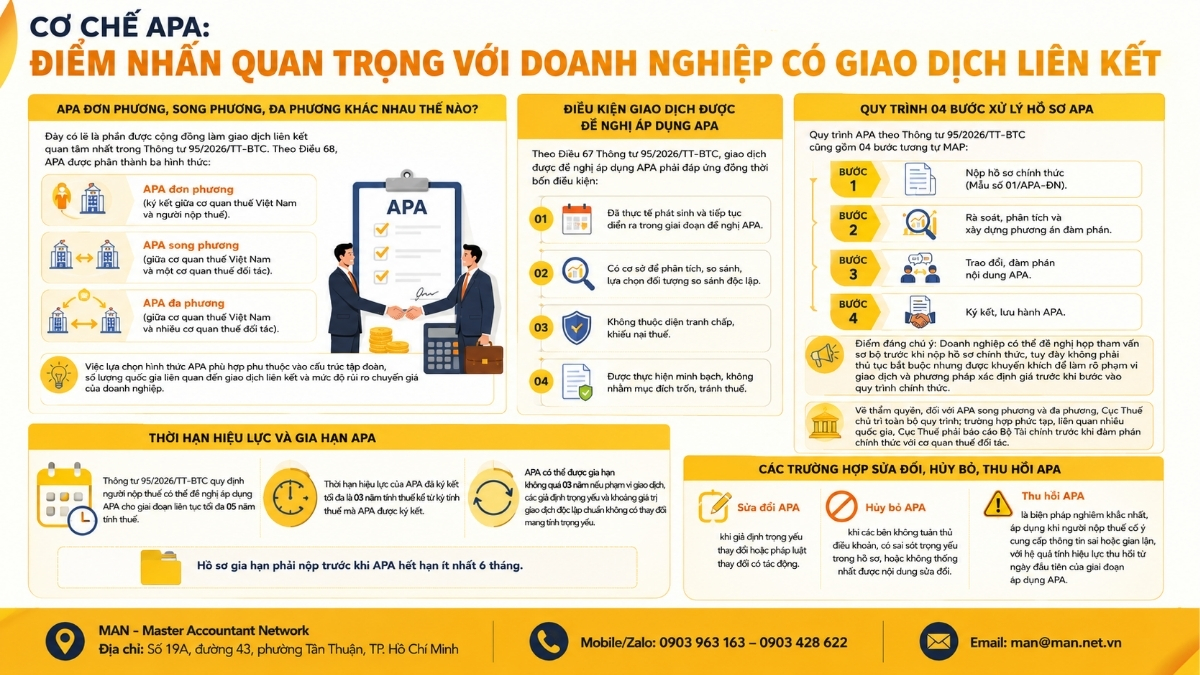
What are the differences between unilateral, bilateral, and multilateral APAs?
This is perhaps the part of Circular 95/2026/TT-BTC that the related-party transaction community is most interested in. According to Article 68, APAs are classified into three forms:
- Unilateral APA (signed between the Vietnamese tax authority and the taxpayer),
- Bilateral APA (between the Vietnamese tax authority and a partner tax authority)
- And multilateral APA (between the Vietnamese tax authority and multiple partner tax authorities).
Choosing the appropriate APA depends on the corporate structure, the number of countries involved in related-party transactions, and the level of transfer pricing risk for the business.
Terms and conditions for transactions are proposed to apply the APA.
According to Article 67 of Circular 95/2026/TT-BTC, a transaction proposed for APA application must simultaneously meet four conditions: it must have actually occurred and continue to occur during the APA proposal period; there must be a basis for analysis, comparison, and selection of an independent comparable entity; it must not be subject to tax disputes or claims; and it must be conducted transparently and not for the purpose of tax evasion or avoidance.
The 4-step process for handling APA applications.
The APA process according to Circular 95/2026/TT-BTC also consists of 4 steps similar to MAP:
- Step 1: Submit the official application (Form No. 01/APA-DN);
- Step 2: Review, analyze, and develop a negotiation strategy;
- Step 3: Discuss and negotiate the APA content.
- Step 4: Sign and circulate the APA.
Key points to note: Businesses can request a preliminary consultation meeting before submitting the formal application. While this is not a mandatory procedure, it is encouraged to clarify the scope of the transaction and the pricing methodology before proceeding with the formal process.
Regarding authority, for bilateral and multilateral APAs, the Tax Department presides over the entire process; in complex cases involving multiple countries, the Tax Department must report to the Ministry of Finance before formally negotiating with the partner tax authority.
APA validity period and renewal
Circular 95/2026/TT-BTC stipulates that taxpayers may request the application of an APA for a continuous period of up to 5 tax years, while the validity period of a signed APA is a maximum of 3 tax years from the tax period in which the APA was signed. An APA may be extended for no more than 3 years if the scope of transactions, material assumptions, and the standard independent transaction value range do not undergo material changes. The extension application must be submitted at least 6 months before the APA expires.
Cases involving modification, cancellation, or revocation of APA.
Circular 95/2026/TT-BTC clearly distinguishes three situations:
- Amend the APA when material assumptions change or changes in legislation have an impact;
- An APA may be terminated if the parties fail to comply with the terms, there are material errors in the documentation, or they cannot agree on the amendments.;
- Revoking an APA is the most severe measure, applied when a taxpayer intentionally provides false or fraudulent information, with the revocation taking effect from the first day of the APA's application period.
What preparations do businesses need to make to comply with Circular 95/2026/TT-BTC?
Review related-party transaction records according to new requirements.
Before Circular 95/2026/TT-BTC officially comes into widespread application, businesses should proactively review all existing transfer pricing documentation, comparing it with the conditions regarding beneficial entities, permanent establishments, and anti-abuse criteria of the tax agreement as outlined in this document. In particular, businesses with digital business models need to reassess the risks associated with establishing a permanent establishment in Vietnam.
If a business lacks sufficient internal resources to conduct its own review, it can refer to other resources. related party transaction documentation service From specialized and experienced units such as MAN – Master Accountant Network, we ensure that the documentation fully meets the requirements before proposing the application of the Tax Agreement, MAP, or APA according to Circular 95/2026/TT-BTC.
Proactively seek expert advice when proposing the implementation of MAP/APA.
The MAP and APA processes under Circular 95/2026/TT-BTC require a significant amount of documentation, comparative data analysis, and complex negotiation skills with tax authorities, especially for bilateral and multilateral PAs. Businesses have the right to hire or utilize independent experts or consulting organizations to assist throughout this process, although the ultimate responsibility still rests with the taxpayer.
This is also why businesses should partner with us. related party transaction advisory services Professionalism is crucial right from the initial consultation phase, aiming to develop a suitable APA negotiation strategy and minimize the risk of the case being halted midway.
Note regarding confidentiality and information provision obligations.
Circular 95/2026/TT-BTC sets quite strict requirements regarding the obligation to provide complete, timely, truthful, and accurate information to the tax authorities throughout the MAP and APA processing process. Businesses also need to retain complete records and documents related to the agreement throughout its lifecycle, as this serves as the basis for the tax authorities to monitor and supervise compliance annually through APA compliance reports.
Conclude
It can be said that Circular 95/2026/TT-BTC is the most comprehensive guidance document to date on the application of Double Taxation Avoidance Agreements, closely integrated with the MAP and APA mechanisms for related-party transactions. From the principle of preventing abuse of tax agreements, criteria for determining permanent establishments in the digital economy, to the detailed APA negotiation process, all demonstrate that Vietnam's international tax management trend is increasingly approaching OECD standards and BEPS commitments.
For businesses engaging in cross-border related-party transactions, proactively researching and complying with Circular 95/2026/TT-BTC not only helps minimize the risk of tax assessment and double taxation, but also provides an opportunity to build a transparent and sustainable mechanism for determining related-party transaction prices through APA. If your business is considering proposing the application of a tax agreement, implementing a MAP, or negotiating an APA, please Contact the affiliate trading expert team. Contact MAN – Master Accountant Network for advice on the most suitable application process tailored to your company's specific needs.
Contact information MAN – Master Accountant Network
- Address: No. 19A, Street 43, Tan Thuan Ward, Ho Chi Minh City
- Mobile/Zalo: 0903 963 163 – 0903 428 622
- E-mail: man@man.net.vn
- Google Business Profile: View MAN – Master Accountant Network's Google Business Profile
- LinkedIn Founder: View expert Le Hoang Tuyen's LinkedIn profile.
Responsible for production and professional content review by: Mr. Le Hoang Tuyen – Founder & CEO of MAN – Master Accountant Network. He is a CPA Vietnam auditor with over 30 years of in-depth experience in accounting, auditing, taxation, and corporate legal consulting.