





Comparing Master Files and Local Files is a crucial step for businesses with related-party transactions to understand the role, scope, and requirements of each type of document according to Decree 132/2020/ND-CP. In practice, many FDI businesses still face difficulties in synchronizing information between these two documents, leading to the risk of being questioned by tax authorities, having transfer pricing adjusted, or having taxes assessed during audits. This article will analyze in detail the differences between Master Files and Local Files, guide how to check the consistency of the documents, and update regulations on deadlines for creation, storage, and exemptions to help businesses enhance compliance and minimize tax risks.
The nature of the Transfer Pricing Documentation
Following the trend of global tax administration integration, particularly the campaign against revenue erosion and profit shifting (BEPS Action 13) of the Organization for Economic Cooperation and Development (OECD), Vietnam has rapidly incorporated international standards into its domestic laws through Decree 132/2020/ND-CP and most recently, new points adjusted by Decree 20/2025/ND-CP.
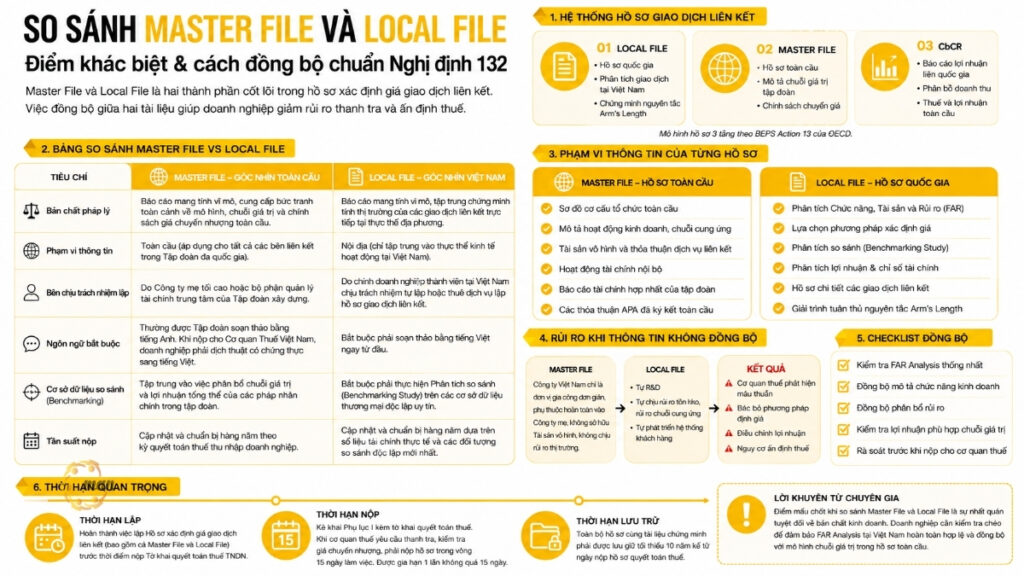
The documentation system for determining transfer pricing under current regulations is designed according to a three-tier model, including:
- National Profile of Related-Party Transactions (Local File): A micro-map that delves into the details of direct economic transactions of entities operating within a given country.
- Master File: The macro map describes the structure, pricing policies, intangible assets, and financial performance of the entire group.
- Country-by-Country Report (CbCR): Provides core financial indicators on the allocation of earnings and taxes paid globally for the corporation.
For chief accountants, chief financial officers (CFOs), or tax professionals, comparing Master Files and Local Files helps businesses clearly identify the complementary roles and logical consistency between these levels of documentation. These two documents are like two converging lenses:
- One side observes from a distance to see the overall picture of global business activity.
- One side zooms in to analyze the legitimacy of each actual transaction occurring in Vietnam.
Detailed comparison table of Master File and Local File according to Decree 132
To help businesses easily systematize the differences, MAN – Master Accountant Network has compiled a summary table to clearly define the core criteria when evaluating and comparing Master Files and Local Files:
| Comparison criteria | Master File | Local File |
| Legal nature | This macro-level report provides a comprehensive overview of the Group's business model, value chain, and global transfer pricing policies. | This report is micro-level, focusing on demonstrating the marketability of direct related-party transactions at the local entity. |
| Scope of information | Global (applies to all affiliated parties within the multinational corporation). | Domestic (focuses only on economic entities operating in Vietnam). |
| Party responsible for preparation | Constructed by the parent company or the central financial management department of the Construction Group. | The member company in Vietnam is responsible for either establishing the facility itself or hiring a contractor. related party transaction filing service. |
| Required language | These documents are usually drafted in English by the corporation. When submitting them to the Vietnamese Tax Authority, businesses must have them translated and certified into Vietnamese. | It is mandatory to draft the document in Vietnamese from the outset. |
| Benchmarking database | Focus on the allocation of the overall value chain and profits of the key entities within the group. | A benchmarking study must be conducted using reputable, independent commercial databases. |
| Submission frequency | Update and prepare annually for the corporate income tax settlement period. | Updated and prepared annually based on the latest actual financial data and independent comparative data. |
Differences in scope and depth when comparing Master Files and Local Files
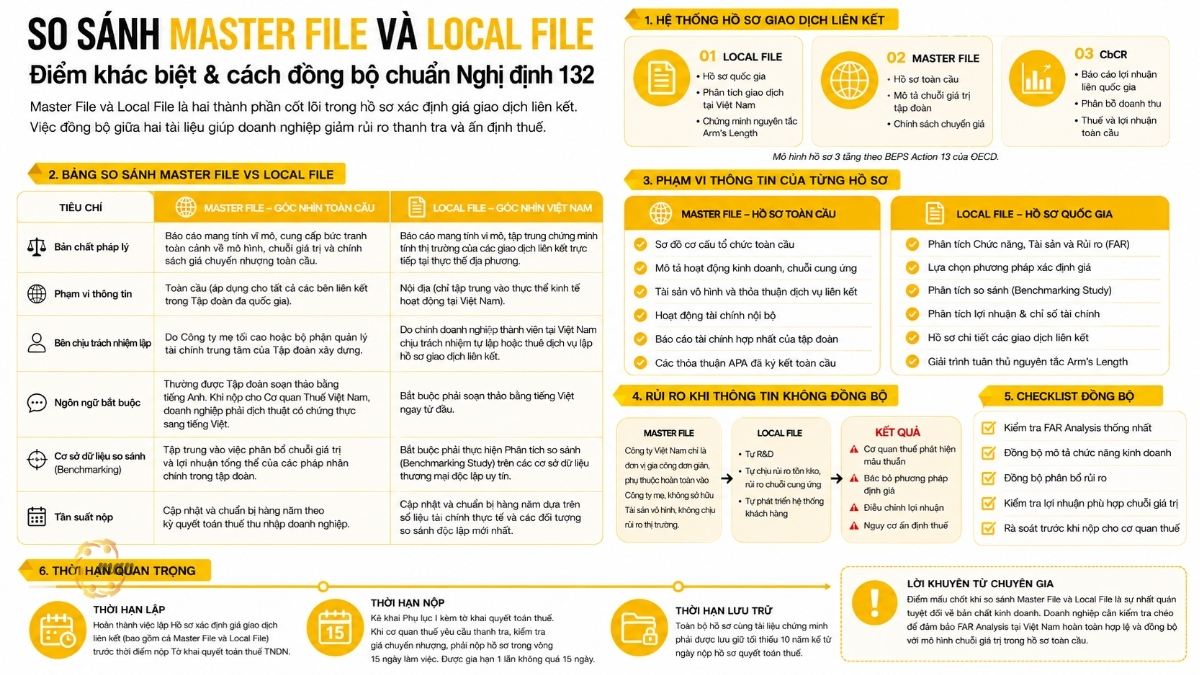
Although both documents serve the purpose of demonstrating transparency in the company's related-party transaction pricing policy, the depth of information in the two documents is defined by two different architectural levels.
Master File
The Master File aims to explain to tax authorities where the corporation generates its value and how that profit is distributed across countries. The core content of the Master File comprises five main sections:
- Organizational structure diagram: Clearly shows the legal ownership structure and geographical location of all member entities worldwide.
- Business operations description: List the drivers of the group's profitability, and describe the supply chain for core products/services (accounting for over 51% of global revenue).
- Intangible assets: Intellectual property allocation maps, related service agreements concerning technology transfer, research and development (R&D).
- Internal financing: Describes how the corporation raises capital, allocates debt cash flows, and has transfer pricing policies for internal financial transactions.
- Financial and Tax Reporting: Consolidated financial statements for the entire group, along with a list of advance pricing agreements (APAs) signed worldwide.
Local File
In contrast to the general nature of the Master File, the Local File delves into a direct analysis of entities operating in Vietnam. This document provides detailed quantitative analyses to demonstrate that the company's related-party transaction prices comply with the Arm's Length Principle. The core components of the Local File include:
- Function, Asset, and Risk Analysis (FAR Analysis): This analysis details the actual tasks performed by Vietnamese businesses, the assets (tangible and intangible) put into operation, and the actual business risks they face (inventory risk, bad debt risk, exchange rate risk, etc.).
- Choosing a pricing method: Provide a sound argument for selecting the most appropriate pricing method from among legally mandated methods such as the Comparable Prices (CUP) method, the Resale Price (RP) method, or the Net Profit Margin (TNMM) method.
- Benchmarking Study: This is the most important part of the Local File. Businesses must search for comparable independent companies in reputable commercial databases. From there, they determine a benchmark range of independent transaction values (usually ranging from the 35th to the 75th percentile) to compare with the business's actual profit margin.
Therefore, comparing Master File and Local File helps businesses clearly identify the complementary nature of the filing systems: one provides a global context for tax authorities to understand the nature of the business, while the other provides accurate quantitative data to directly protect the tax obligations of the entity in Vietnam.
Risk of inconsistencies when comparing Master Files and Local Files

In practice, we accompany and Transfer pricing consultancy For hundreds of large and small FDI businesses in Vietnam, MAN – Master Accountant Network found that the biggest risk lies not in the lack of documentation, but in the logical contradiction when tax authorities compare the Master File and Local File of the same business.
A real-world case study illustrates information inconsistency.
Imagine a very common scenario:
- The Group's Master File for overseas operations states: The subsidiary in Vietnam is merely a simple processing unit, its production activities are entirely dependent on the instructions of the parent company, it does not own any intangible assets and is not subject to market risks.
- However, the Local File submitted in Vietnam states: Businesses in Vietnam conduct their own research and development (R&D), bear significant risks related to supply chain and inventory management, and develop their own domestic customer base.
This conflict arises because the Group's overseas Master File preparation department lacks cross-communication with the chief accountant or tax consultant in Vietnam – those directly responsible for preparing the Local File.
Legal consequences of being audited by the Tax authorities.
When tax inspectors compare a company's Master File and Local File, they will immediately exploit this logical loophole.
- If a business identifies itself as taking significant risk using its Local File to demonstrate substantial losses due to market fluctuations, the tax authorities will cite its Master File to prove that the business is merely a simple processing unit (not allowed to incur losses or only entitled to stable processing profit margins).
- Conversely, if a business is described as having many complex functions but unusually low profit margins, the tax authorities will use this contradiction to reject the business's self-pricing method and proceed with tax assessment.
Advice from MAN – Master Accountant Network: The key point when comparing Master File and Local File is the absolute consistency of the business nature. Before signing and submitting any documents to the tax authorities, businesses are required to perform a cross-check to ensure that the FAR Analysis (Functions, Assets, and Risks) description in Vietnam is fully valid and consistent with the value chain model described in the global corporation's documentation.
Comparing Master File and Local File in terms of creation, storage, and submission deadlines.

To ensure full compliance with tax obligations and avoid unnecessary administrative penalties, businesses need to understand the key timelines detailed below:
- Deadline for preparation: Businesses are obligated to complete the preparation of the Transfer Pricing Documentation (including both the Master File and Local File) before submitting their annual Corporate Income Tax (CIT) return.
- Submission deadline: Businesses are not required to proactively submit the entire set of documents along with the tax return, but only need to declare Appendix I. However, when the tax authorities announce a decision to audit or inspect transfer pricing, businesses must submit the complete set of documents within 15 working days. In case of force majeure, businesses are allowed to apply for an extension once, not exceeding 15 days.
- Retention period: All records and supporting documents must be retained for a minimum of 10 years from the date of filing the tax return.
Frequently Asked Questions when comparing Master Files and Local Files
The Vietnamese Tax Authority only accepts official documents in Vietnamese. Therefore, when requested to provide documents, businesses are required to submit a Vietnamese translation of the Master File (which must be certified or stamped by the legal representative of the business).
When comparing the Master File and the Local File, discrepancies in data may arise due to differences in accounting standards (VAS and IFRS) or exchange rates. In this case, the business needs to prepare a detailed and scientifically structured explanation of the data, attached as an appendix to the Local File, to clearly explain the reasons for the discrepancies to the Tax authorities.
If a business has related-party transactions and domestic related-party transactions exceeding 50 billion VND/year in revenue and a total value of related-party transactions exceeding 30 billion VND, and does not fall under the exemption cases, the business must still prepare a complete set of documents including both Master File and Local File.Is it mandatory for businesses to submit the original English Master File to the Tax Authority?
How to resolve the discrepancy in financial data between the Master File and the Local File?
If a business only has domestic related-party transactions, is it still necessary to create a Master File?
Conclusion regarding the comparison of Master File and Local File
In summary, the Master File and Local File are not two independent documents but rather two inseparable pieces of the overall picture of transfer pricing compliance. Understanding the nature, scope, and establishing a mechanism for regular cross-checking between these two documents will help businesses proactively address tax risk gaps before the annual tax settlement period.
Hopefully, this comparison of Master File and Local File has provided you with valuable practical knowledge to protect the financial health of your business.
Contact MAN – Master Accountant Network For free support and advice!
Contact information MAN – Master Accountant Network
- Address: No. 19A, Street 43, Tan Thuan Ward, Ho Chi Minh City
- Mobile/Zalo: 0903 963 163 – 0903 428 622
- Email: man@man.net.vn
Content production by: Mr. Le Hoang Tuyen – Founder & CEO of MAN – Master Accountant Network, CPA Vietnam auditors with over 30 years of experience in accounting, auditing, and financial consulting.