





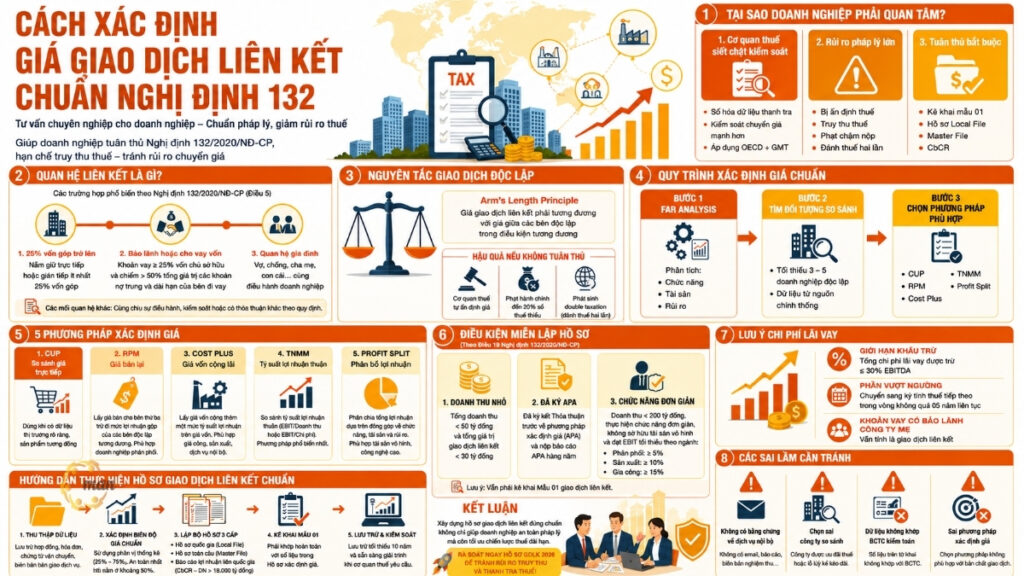
Determining transfer pricing is a crucial area that related-party transactions must be understood by businesses in 2026, especially as tax authorities intensify controls on transfer pricing, digitize audit data, and tighten compliance with OECD and Global Minimum Tax (GMT) regulations. Applying the correct pricing method not only helps businesses comply with regulations. Decree 132/2020/ND-CP Furthermore, it limits the risks of tax assessment, retroactive collection, late payment penalties, and double taxation. This article will help businesses understand 5 methods for determining transfer pricing, conditions for exemption from documentation, limits on interest expense deductions, and common mistakes to avoid in order to build legally sound, safe, and effective transfer pricing documentation in 2026.
The nature and importance of accurately determining transfer pricing.
To properly understand how transfer pricing is determined, businesses first need to identify whether they fall under the scope of the relevant laws.
Partnership relationships as stipulated in Decree 132/2020/ND-CP
According to Article 5, an affiliated relationship is established when one party directly or indirectly participates in the management, control, capital contribution, or investment in the other party. Common examples include:
- The business directly or indirectly holds at least 25% of the owner's equity of the other business.
- A business may guarantee or lend capital to another business in any form, provided that the loan amount is at least 25% of the owner's equity of the borrowing business and accounts for more than 50% of the total value of the borrowing business's medium and long-term debts.
- Family members (spouse, parents, children, etc.) jointly run the business.
See details: Forms of related-party transactions.
Why is it necessary to determine transfer pricing based on the independence principle?
The Arm's Length Principle requires that the value of a related-party transaction be determined to be equivalent to the value of a transaction between independent parties under comparable conditions. Non-compliance will result in:
- Tax assessment: The tax authorities have the right to determine the price and profit margin themselves if the business's records are invalid.
- Administrative penalties and late payment fees: The penalty can be up to 20%, representing the amount of tax owed, plus late payment fees calculated on a daily basis.
- Double Taxation Risk: Businesses may be taxed twice in both Vietnam and the country of their affiliated company if there is no appropriate double taxation avoidance agreement.
How is the transfer pricing determined?
A proper process will help businesses protect their data during audits.
Functional, Asset, and Risk Analysis (FAR Analysis)
In determining transfer pricing, FAR analysis is the heart of the process.
- Function: Lists key activities such as manufacturing, assembly, research and development (R&D), marketing, distribution, and warehousing.
- Assets: Identify tangible assets (factories, machinery) and, in particular, intangible assets (trademarks, technological know-how, customer base).
- Risk: Who bears the market risk, exchange rate fluctuation risk, and inventory risk? Businesses that face higher risks typically have higher expected profit margins.
Search for and select independent comparison objects.
Businesses need to find at least 3-5 independent businesses with similar business operations. Data must be retrieved from official sources such as the General Department of Taxation, or international databases such as Standard & Poor's, Orbis. Using data from unknown sources undermines the credibility of the method for determining transfer pricing.
An in-depth analysis of 5 methods for determining transfer pricing.

Decree 132 stipulates five main methods. Choosing the wrong method is the leading cause of application rejection.
Comparable Uncontrolled Price (CUP) Method
The core principle of this method is the establishment of a direct frame of reference between the internal price and the free market price under similar trading conditions:
- Mechanism: Compare the prices of goods in related-party transactions with the prices in independent transactions.
- Here's a real-world example: Company A sells coffee to its parent company in Singapore. If, at that time, the price of the same type of coffee on the international exchange was $2,500 per ton, then Company A must also sell at a price around that level.
- Condition: There are no differences in product characteristics or trade conditions (shipping, insurance, payment terms).
Resale price methodResale Price Method (RPM)
To accurately reflect the economic nature of intermediaries in the supply chain, this method is implemented based on the following specific principles and calculation mechanisms:
- Mechanism: Subtract the gross profit margin of equivalent independent parties from the selling price to third parties.
- Example: Company B imports cosmetics from an affiliated company and sells them independently at a price of 100 VND. Other independent cosmetics distributors have a gross profit margin of 20%. Therefore, the reasonable purchase price from the affiliated company would be: 100 x (1 – 20%) = 80 VND.
- Applications: Suitable for distribution, wholesale, or purely retail sales.
Cost Plus Method
For entities acting as internal manufacturers or service providers, this is how to determine transfer pricing to ensure cost recovery and maintain a reasonable profit margin, specifically implemented as follows:
- Mechanism: Take the cost price and add a profit margin to the cost price.
- Example: A garment manufacturing company has a cost of goods sold of $1 million USD. The average profit margin on the cost of goods sold in the manufacturing industry is 10%. The selling price to the affiliated company must be: 1 x (1 + 10%) = $1.1 million USD.
- Applications: Businesses that manufacture products to order, process orders, or provide internal services.
The Net Profit Margin (NPRI) Comparison Method
This is the most common method for determining transfer pricing in Vietnam.
- Mechanism: Comparison of net profit margin (EBIT/Revenue or EBIT/Cost) instead of product price.
- Advantages: Less affected by product characteristic differences than the CUP method, focusing on the economic nature of the entire business.
Profit Split Method
In cases where transactions are highly specific or deeply integrated into the group's value chain and the business cannot find comparable independent entities, this method is applied to determine profit based on actual contribution:
- Mechanism: This mechanism involves distributing the consolidated total profit of related parties from a transaction or a series of transactions based on criteria such as functional contribution, assets used, and risks borne.
- For example: Two subsidiary companies jointly develop a proprietary AI software. Company A contributes data and algorithms, while Company B contributes server infrastructure and customer base. The total profit from the software will be divided proportionally based on each party's contribution of costs and intangible assets.
- Applications: Suitable for high-tech research projects, intangible asset development, or highly secure closed-loop supply chains.
Exemptions from documentation requirements in determining transfer pricing.
Understanding the exemption conditions helps businesses save significant compliance costs. According to Article 19 of Decree 132, businesses are exempt from preparing the Transfer Pricing Documentation (but must still declare Form 01) in the following cases:
- Small revenue: Total revenue under VND 50 billion and total value of related-party transactions under VND 30 billion.
- Signing of APA: An Advance Pricing Agreement (APA) has been signed and an annual APA report has been submitted.
- Simple function: Revenue under VND 200 billion, performing a simple function, not owning intangible assets, and achieving a minimum net profit margin (EBIT/Revenue) similar to distribution (5%), manufacturing (10%), and processing (15%).
See details: No related-party transaction documentation is required.
Instructions on how to determine standard transfer pricing.

By 2026, this process will need to integrate additional risk control tools derived from big data.
- Data collection: Archiving contracts, invoices, shipping documents, and internal service handover records.
- Determining the benchmark price range: Use statistical methods to determine the range of values from the 25th to the 75th percentile (Interquartile Range). Businesses are safest when they fall within the median of 50.
- Prepare a three-tiered portfolio: a national portfolio detailing business information in Vietnam, a global portfolio providing general information about the entire group's value chain, and a Country-by-Country Profit Report (CbCR) for groups with consolidated revenue exceeding VND 18 trillion.
- The declaration form 01 must completely match the data in the Price Determination File.
Note the use of interest expense in determining transfer pricing.

A major bottleneck that many businesses face is the regulation regarding deductible interest expenses.
- Limit: The total deductible interest expense shall not exceed 30% of the total net profit from business operations plus interest expense and depreciation expense (EBITDA).
- Handling of excess amounts: The portion of interest expense that is not deductible will be carried forward to the next tax period for no more than 5 consecutive years.
- Related party transaction: If a business borrows from a bank but has a guarantee from its parent company, this loan is also considered a related party transaction.
Mistakes to avoid when determining transfer pricing.
Here are some common loopholes that tax authorities exploit during audits:
- Lack of evidence of internal services: Businesses pay billions of dong in corporate management fees but lack emails, work reports, or acceptance documents to prove that the service actually delivered benefits.
- Choosing the wrong comparable company: Selecting a comparable company that is enjoying tax advantages or has a long-standing accumulated loss.
- Inconsistent data: The figures on the related-party transaction declaration do not match the audited financial statements.
Conclude
Properly determining transfer pricing not only helps businesses meet compliance requirements under Decree 132/2020/ND-CP but also serves as a crucial foundation for controlling tax risks, optimizing financial efficiency, and enhancing transparency in corporate governance. In the context of 2026, when tax authorities intensify digital inspections, apply big data, and strengthen monitoring of cross-border transactions, proactively building transfer pricing documentation at the beginning of the fiscal year will significantly reduce the risk of tax arrears, tax assessments, or international tax disputes.
In particular, for businesses with large internal transactions, multinational operations, or those subject to the Global Minimum Tax (GMT), choosing the right pricing method and standardizing Local File, Master File, and CbCR documentation is no longer an option but a mandatory requirement.
If your business needs to review related-party transaction records, assess tax risks, or develop a compliance plan in accordance with the latest regulations, consultation is recommended. related party transaction advisory services Choosing reputable and experienced affiliate marketing partners like MAN – Master Accountant Network will be the safest and most effective solution. A sound strategy from the start is always far more cost-effective than dealing with errors later on.
Contact MAN – Master Accountant Network for free support and advice!
Contact information MAN – Master Accountant Network
- Address: No. 19A, Street 43, Tan Thuan Ward, Ho Chi Minh City
- Mobile/Zalo: 0903 963 163 – 0903 428 622
- Email: man@man.net.vn
Content is moderated by: Mr. Le Hoang Tuyen – Founder & CEO of Man, CPA Vietnam Auditor with over 30 years of experience in Accounting, Auditing and Financial Consulting.