





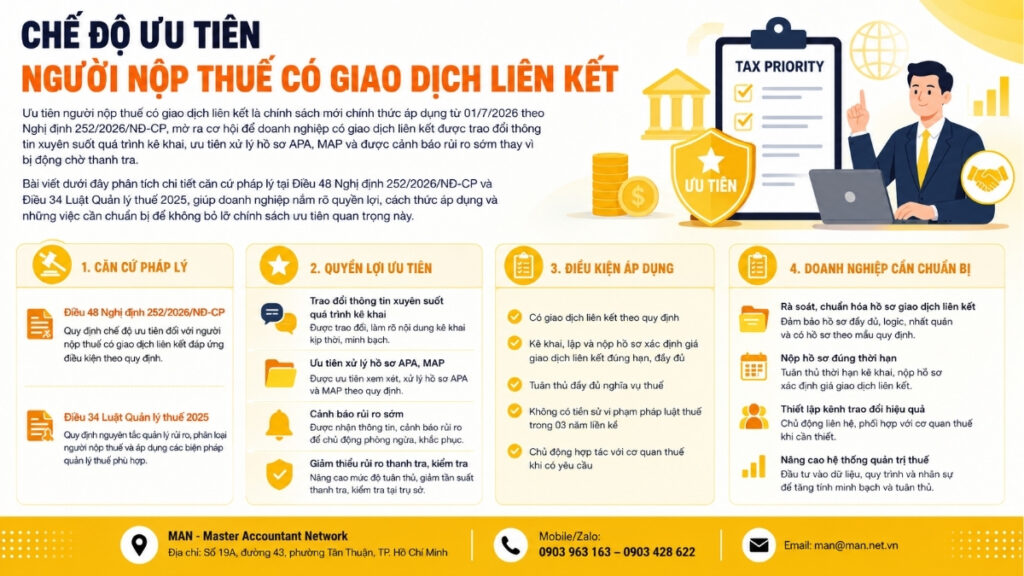
Prioritizing taxpayers with related-party transactions is a new policy officially effective from July 1, 2026. Decree 252/2026/ND-CP, This opens up opportunities for businesses with related-party transactions to exchange information throughout the declaration process, prioritize the processing of APA and MAP documents, and receive early risk warnings instead of passively waiting for inspections. The article below analyzes in detail the legal basis in Article 48 of Decree 252/2026/ND-CP and Article 34 of the 2025 Law on Tax Administration, This helps businesses understand their rights, how to apply, and what they need to prepare so they don't miss out on this important priority policy.
What types of taxpayers with related-party transactions are prioritized?
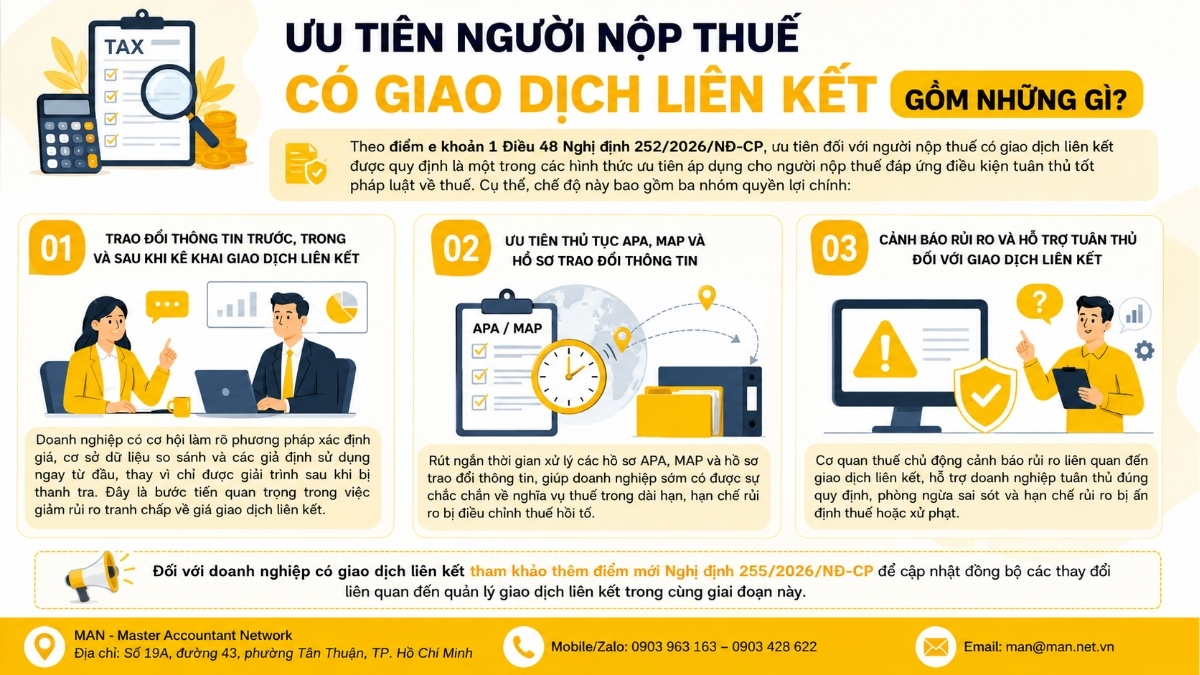
According to point e, clause 1, Article 48 of Decree 252/2026/ND-CP, preferential treatment for taxpayers with related-party transactions is stipulated as one of the preferential treatments applied to taxpayers who meet the conditions of good compliance with tax laws. Specifically, this regime includes three main groups of benefits:
- Information exchange is permitted before, during, and after filing tax returns for related-party transactions with the tax authorities.;
- Priority is given to the processing of applications for Approval of Pricing Agreements (APAs), Manifesto Agreements (MAPs), and information exchange documents;
- Receive risk warnings and compliance support for related-party transactions.
This is the core content and the part that businesses need to understand most clearly before considering applying for the program.
Information exchange before, during, and after filing related-party transactions.
One of the biggest challenges for businesses with related-party transactions is the uncertainty in how tax authorities assess the reasonableness of transfer pricing after the filing has been completed. With priority access to information throughout all three stages, businesses have the opportunity to clarify pricing methods, comparative databases, and assumptions used from the outset, rather than only being able to explain them after an audit. This is a significant step forward in reducing the risk of transfer pricing disputes.
Prioritize APA, MAP procedures and Information Exchange Documents.
Advance Pricing Agreements (APAs) and Manifesto Measures (MAPs) are two mechanisms of interest to many businesses with large-scale related-party transactions, as both help establish a pre-determined method for calculating related-party transaction prices that is recognized by the tax authorities, limiting the risk of retroactive tax adjustments. However, in practice, the processing time for these documents is often lengthy due to the large volume of assessment work. A preferential policy for taxpayers with related-party transactions allows for a reduction in the processing time of APA, MAP, and information exchange documents, helping businesses gain certainty about their long-term tax obligations sooner.
Risk warnings and compliance support for related-party transactions.
In addition to the two benefits mentioned above, priority businesses also receive proactive warnings from the tax authorities about risks related to related-party transactions, instead of waiting for the businesses to discover errors themselves after taxes have been assessed or penalties imposed. This is a proactive preventative approach, consistent with the modern compliance management trend that many countries are applying to related-party transactions.
For businesses with related-party transactions, please refer to the following information. New points in Decree 255/2026/ND-CP To ensure that changes related to affiliate transaction management are synchronized during this period.
The priority position for related-party transactions within the overall taxpayer preference regime.
To fully understand the value of this policy, it is necessary to prioritize taxpayers with related-party transactions within the overall picture of preferential treatment as stipulated in Clause 1, Article 48 of Decree 252/2026/ND-CP. Accordingly, taxpayers who comply well with tax laws may simultaneously enjoy multiple different preferential treatment groups:
Priorities regarding inspection and monitoring methods
Priority taxpayers can be remotely inspected and monitored based on electronic databases, and are not included in on-site inspection plans unless the tax authorities detect high-risk indicators. This helps reduce the pressure of direct inspections for businesses.
Priorities when ranking compliance
This policy also gives businesses an advantage by being considered for compliance rankings in relation to relevant agencies and organizations, contributing to enhancing their reputation in the market.
Prioritize the implementation of programs to enhance voluntary compliance.
Finally, priority taxpayers also have early access to voluntary compliance enhancement programs implemented by the tax authorities.
In this overall context, it can be seen that prioritizing taxpayers with related-party transactions is a unique benefit group, applicable only to taxpayers who have related-party transactions, an area considered sensitive and complex in current tax management.
How is the preferential treatment for taxpayers with related-party transactions applied?
Beyond simply listing benefits, Clause 4 of Article 48 of Decree 252/2026/ND-CP also clearly stipulates how tax authorities organize the application of preferential treatment for taxpayers in practice.
Automatic recognition, renewal, suspension, and revocation on the Tax Department's information system.
The entire process of recognizing, renewing, suspending, revoking, and re-issuing preferential treatment is carried out automatically on the tax authority's information technology system. Digitizing this process minimizes manual intervention while increasing transparency in the review process.
Decision-making authority
The head of the tax authority is the person authorized to decide on the recognition, extension, suspension, revocation, and re-issuance of preferential treatment for taxpayers who meet the conditions stipulated in Clause 3, Article 48 of Decree 252/2026/ND-CP.
This decision is made based on the results of an automated compliance assessment and risk classification on the tax management information technology system, following the guidance of the Ministry of Finance, and then sent to the taxpayer's electronic tax transaction account through the Tax Management Information System.
The responsibility for review and supervision lies with the directly managing tax authority.
The tax authority directly managing the taxpayer is responsible for reviewing and confirming compliance with the preferential treatment conditions, organizing implementation, monitoring compliance levels, and supporting and supervising the maintenance of these conditions as prescribed. This means that the preferential treatment for taxpayers with related-party transactions is not a fixed title, but requires businesses to continuously maintain a level of compliance to avoid suspension or revocation.
A system for connecting and sharing electronic data in real time.
The tax authorities are also responsible for establishing and operating an electronic data sharing system between the tax authorities and priority taxpayers to serve compliance management, risk assessment, and early warning systems in near real-time. This is a point that businesses need to pay special attention to: to obtain and maintain priority status, the company's internal electronic data infrastructure, especially data related to related-party transactions, must meet the connectivity and sharing requirements of the tax authorities.
Legal basis
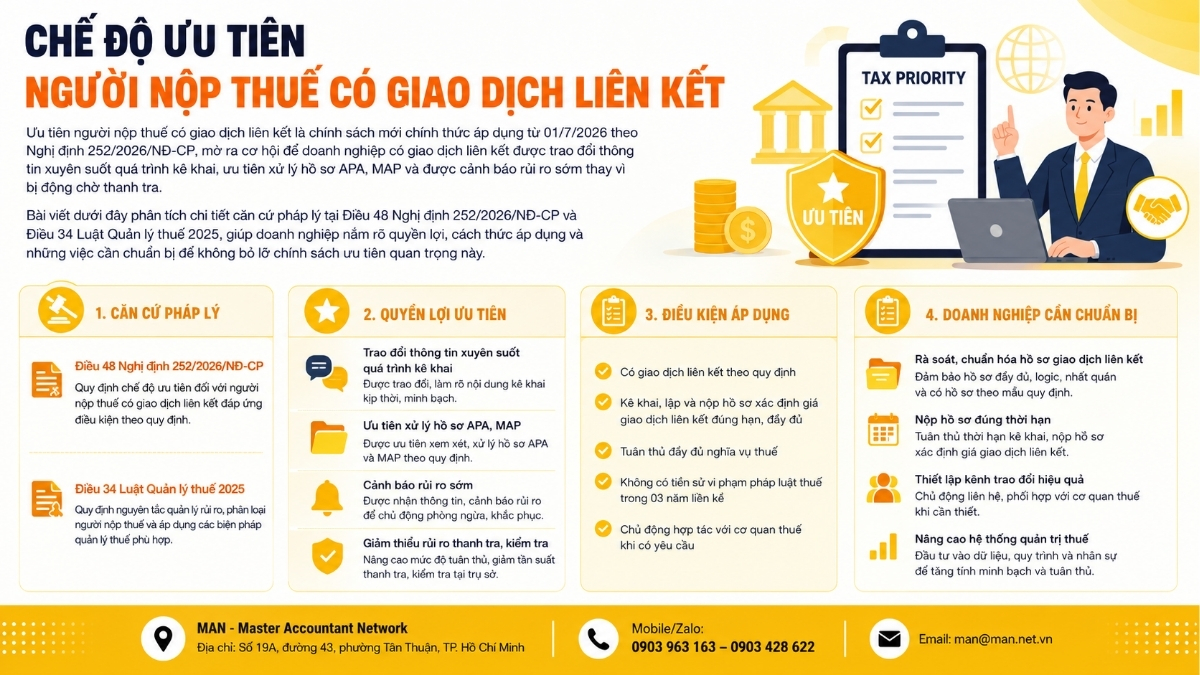
The policy prioritizing taxpayers with related-party transactions in Decree 252/2026/ND-CP is not an independent regulation, but is built upon the foundation of Article 34 of the 2025 Tax Administration Law on compliance management in tax administration.
Compliance management objectives
According to Article 34, tax authorities implement compliance management to allocate resources efficiently, encourage voluntary compliance, and create a fair business environment for all taxpayers.
System for evaluating and classifying compliance levels and electronic taxpayer records.
The tax authorities establish a system for evaluating and classifying the level of compliance with tax laws, while maintaining electronic records for each taxpayer. This includes information on the frequency of violations, the nature and severity of violations, the level of cooperation with tax authorities in carrying out tax procedures, inspections, compliance with violation handling decisions, and other information related to tax obligations. This database forms the basis for determining whether a business is eligible for preferential treatment.
Why should businesses with related-party transactions proactively learn about this preferential treatment?
For businesses with related-party transactions, especially foreign-invested enterprises, multinational corporations, or businesses with domestic related parties, proactively understanding and pursuing preferential treatment for taxpayers with related-party transactions offers many strategic benefits.
Minimize the risk of surprise inspections and audits.
When businesses are prioritized, they are not included in on-site inspection plans unless there are signs of high risk, and they are subject to remote inspection and monitoring via electronic databases. This significantly saves businesses time and resources that would otherwise be spent on receiving in-person inspection teams.
Reduce APA and MAP processing time.
For businesses with high-value related-party transactions, priority processing of APA and MAP documents helps establish an approved method for calculating related-party transaction prices early on, thereby avoiding the risk of tax adjustments and late payment penalties in the future.
Improve your reputation and compliance rating with the tax authorities.
Being recognized as a priority company also means that the business has a good compliance record, which indirectly enhances its reputation when working with partners, banks, investors, and other regulatory agencies.
However, to qualify for preferential treatment, businesses need to fully meet the conditions stipulated in Clause 3, Article 48 of Decree 252/2026/ND-CP, as well as maintain the ability to connect and share electronic data with the tax authorities in near real-time.
If a specific assessment of the extent to which eligibility is met or assistance in developing a suitable compliance roadmap is needed, related party transaction advisory services MAN – Master Accountant Network will help businesses find a clear direction.
Conclude
Prioritizing taxpayers with related-party transactions under Article 48 of Decree 252/2026/ND-CP, effective from July 1, 2026, is summarized in three core benefits:
- Information exchange throughout the process of declaring related-party transactions;
- Prioritize processing APA and MAP applications;
- And the information exchange system, along with the risk warning mechanism, supports proactive compliance from the tax authorities.
This is not a fixed privilege, but rather the result of a continuous compliance assessment process based on electronic data, in line with the spirit of compliance management as stipulated in Article 34 of the 2025 Tax Administration Law.
For businesses with related-party transactions, understanding and proactively pursuing this priority status is the most practical way to reduce audit risks.
If you have any questions regarding your company's related-party transaction records, please don't hesitate to ask. Contact MAN – Master Accountant Network For detailed support and advice.
Contact information MAN – Master Accountant Network
- Address: No. 19A, Street 43, Tan Thuan Ward, Ho Chi Minh City
- Mobile/Zalo: 0903 963 163 – 0903 428 622
- E-mail: man@man.net.vn
- Google Business Profile: View MAN – Master Accountant Network's Google Business Profile
- LinkedIn Founder: View expert Le Hoang Tuyen's LinkedIn profile.
Responsible for production and professional content review by: Mr. Le Hoang Tuyen – Founder & CEO of MAN – Master Accountant Network. He is a CPA Vietnam auditor with over 30 years of in-depth experience in accounting, auditing, taxation, and corporate legal consulting.