





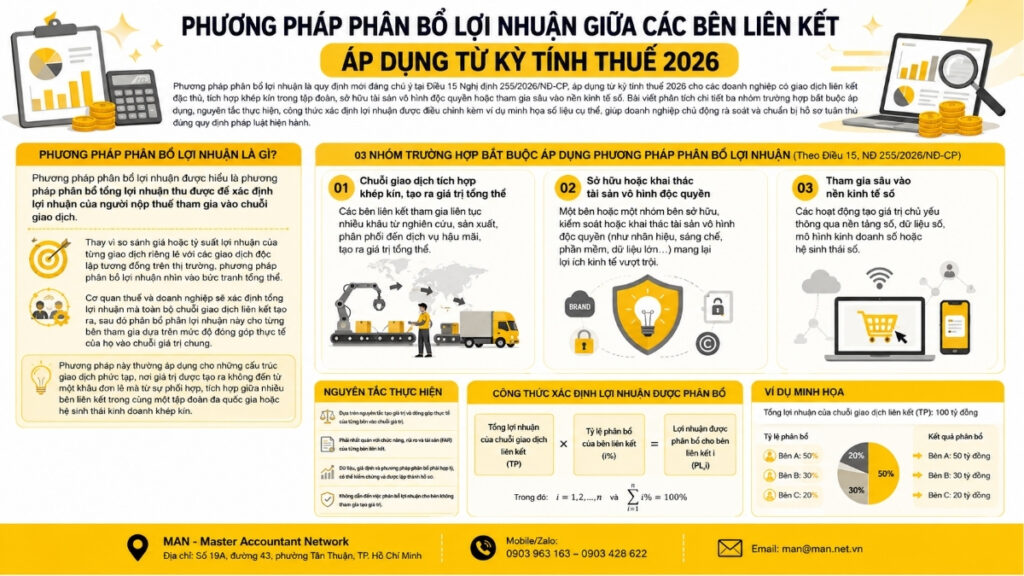
The profit allocation method is a notable new regulation at Article 15 of Decree 255/2026/ND-CP, This regulation, applicable from the 2026 tax year, applies to businesses with specific related-party transactions, integrated within a group, owning exclusive intangible assets, or deeply involved in the digital economy. The article provides a detailed analysis of three mandatory application groups, implementation principles, and formulas for determining adjusted profit, along with illustrative examples and specific data. This helps businesses proactively review and prepare documentation to comply with current legal regulations.
What is the profit allocation method?
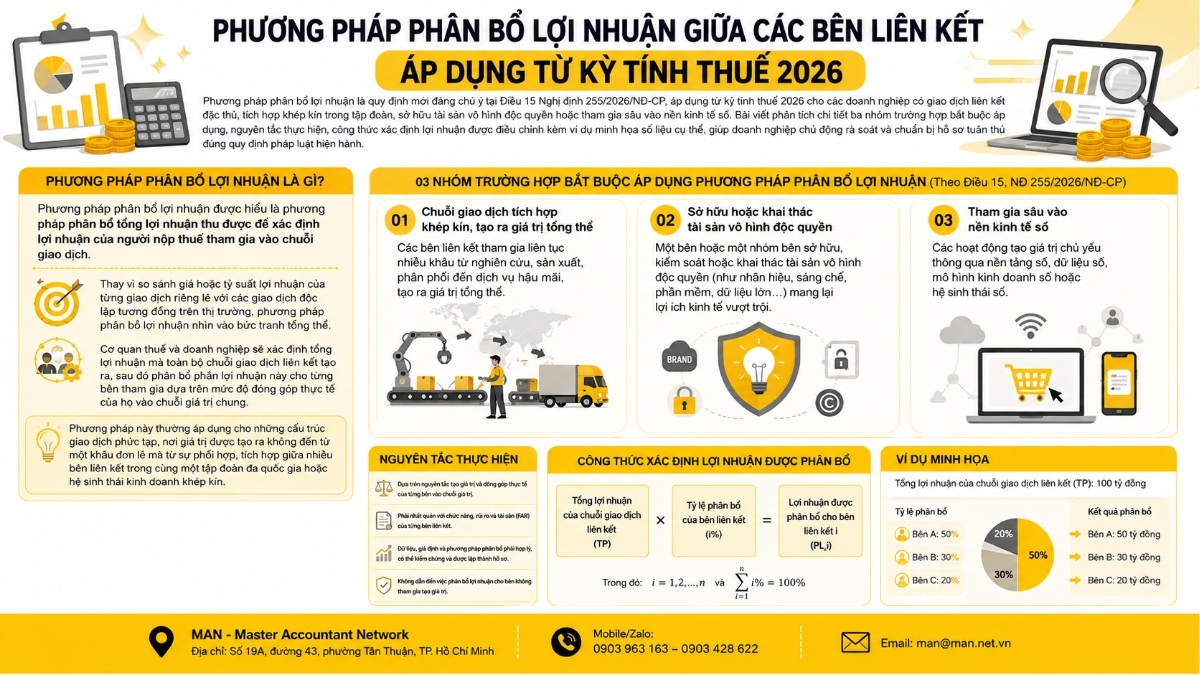
Profit allocation is understood as a method of allocating the total profit earned to determine the profit of taxpayers participating in the transaction chain.
To put it simply, instead of comparing the price or profit margin of each individual transaction to comparable independent transactions in the market, the profit allocation method looks at the big picture. Tax authorities and businesses will determine the total profit generated by the entire chain of related transactions, and then allocate this profit to each participating party based on their actual contribution to the overall value chain.
This is why this method is often applied to complex transaction structures, where value is created not from a single step but from the coordination and integration of multiple parties within the same multinational corporation or closed business ecosystem.
Cases where profit allocation methods are mandatory or applicable.
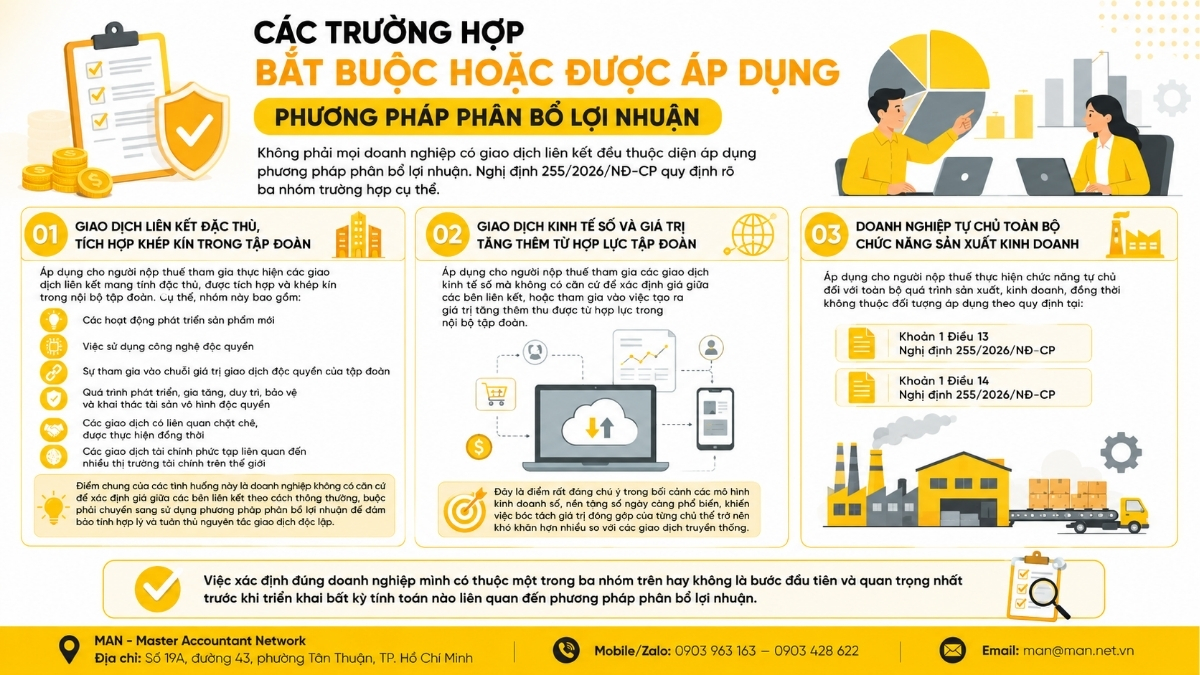
Not all businesses with related-party transactions are subject to the profit allocation method. Decree 255/2026/ND-CP clearly specifies three groups of cases.
This is a unique, integrated, and closed-loop transaction within the group.
The first case applies to taxpayers involved in specific, integrated, and closed-loop related-party transactions within a group. Specifically, this group includes:
- New product development activities;
- The use of proprietary technology;
- Participation in the corporation's proprietary trading value chain;
- The process of developing, increasing, maintaining, protecting, and exploiting exclusive intangible assets;
- The transactions are closely related and executed simultaneously;
- Complex financial transactions involve multiple financial markets around the world.
The common thread in these situations is that businesses lack the basis to determine prices between related parties in the usual way, forcing them to resort to profit allocation methods to ensure fairness and compliance with the arm's-length principle.
Digital economic transactions and added value from corporate synergies.
The second case applies to taxpayers participating in digital economic transactions where there is no basis for determining the price between related parties, or participating in the creation of added value obtained from synergies within a corporation. This is a particularly noteworthy point in the context of increasingly popular digital business models and platforms, making it much more difficult to separate the value contribution of each entity compared to traditional transactions.
The enterprise has full autonomy over all production and business functions.
The third case applies to taxpayers who perform autonomous functions over the entire production and business process, and who are not subject to the provisions of Clause 1, Article 13 and Clause 1, Article 14 of Decree 255/2026/ND-CP.
Determining whether your business belongs to one of the three groups above is the first and most important step before implementing any calculations related to profit allocation methods.
See also: New points in Decree 255/2026/ND-CP regarding related-party transactions.
Principles for applying the profit allocation method according to Decree 255/2026/ND-CP

Once businesses are determined to be subject to these regulations, they must adhere to two core principles set forth in Decree 255/2026/ND-CP.
- The profit allocation method should only be applied to the total actual and potential profits earned, and these figures must be determined using financial data based on valid and legitimate documentation. This is a mandatory requirement to ensure the transparency and verifiability of the entire allocation process, avoiding unfounded estimates.
- The value and profit of a transaction must be determined using the same accounting method throughout the entire period for which the profit allocation method is applied. This principle of consistency helps ensure that data across tax periods is comparable, preventing businesses from changing their accounting methods midway to gain an advantage in calculating allocated profits.
These two principles may seem simple, but they form the foundation that determines the validity of the entire transfer pricing documentation when a business chooses this method.
How to determine the method, formula, and components.
This is a crucial aspect that any business applying a profit allocation method needs to thoroughly understand, as it directly determines the amount of corporate income tax payable.
Overall structure: Adjusted earnings
According to regulations, the adjusted profit of the taxpayer is allocated to the total profit earned, including the actual and potential profits of the parties involved in the transaction chain.
The adjusted profit of a taxpayer consists of two parts:
Adjusted profit = Base profit + Surplus profit |
This is the core formula of the entire profit allocation method under Decree 255/2026/ND-CP.
Basic profit: Determined using the profit margin comparison method.
The basic profit margin is determined by comparing profit margins as stipulated in Article 14 of Decree 255/2026/ND-CP. Essentially, this is the benchmark profit level that a business performing similar functions, under comparable conditions, could achieve if it transacted with an independent party, as determined by comparing profit margins with independent businesses performing equivalent functions.
Excess profit: Allocated proportionally based on contributing factors.
Extra profit is the added value exceeding the basic profit, often arising from unique contributions that are difficult to quantify using conventional comparative methods (such as proprietary intangible assets, corporate synergies, digital economic transactions, etc.). This extra profit is determined by allocation based on one or more factors such as revenue, costs, assets, and human resources of the related parties involved in the transaction, while also adhering to the arm's-length principle. The choice of allocation factors (revenue, costs, assets, or human resources) depends on the nature of the transaction chain and the actual contribution of each party to the creation of shared value.
In cases where there is insufficient information or data for allocation...
Decree 255/2026/ND-CP also anticipates the practical situation where a business lacks sufficient information and data to allocate profits adjusted according to the basic total profit and excess profit mechanism mentioned above. Allocation can still be made based on one or more factors such as revenue, expenses, assets, or human resources of related parties involved in the transaction, provided it is consistent with the arm's-length principle.
This flexible regulation allows the method to be applied even when data is incomplete, preventing businesses from lacking data to determine their tax obligations simply because of a lack of detailed figures according to standard mechanisms.
In this case, the business should consider consulting... related party transaction advisory services To receive specific support tailored to your business's particular situation.
An example illustrating how to determine the profit allocation method.
Context: Company A in Vietnam and Company B abroad are affiliated parties within the same group, jointly developing a new technology product based on the group's proprietary intangible assets. Due to the integrated and closed nature of this transaction, the company has no basis to determine the individual prices between the two parties, and therefore must apply the profit allocation method as stipulated in Article 15 of Decree 255/2026/ND-CP.
Assume the total actual profit earned from the entire series of transactions of both Company A and Company B during the tax period is 100 billion VND.
Determine the basic profit margin for each party:
| Indicators | Company A (Vietnam) | Company B (Foreign) |
| Operating expenses | 300 billion VND | 150 billion VND |
| Profit margin on costs | 10% | 10% |
| Basic profit | 300 x 10% = 30 billion VND | 150 x 10% = 15 billion VND |
At that time, the combined basic profit of both parties was 45 billion VND.
Additional profit:
Additional profit = Total profit of the entire chain – Total basic profit = 55 billion VND |
This additional profit is linked to the contribution to the development of the proprietary intangible asset and should be allocated according to the research and development (R&D) costs incurred by each party. This factor most accurately reflects the level of contribution to creating added value, in accordance with the arm's-length principle.
| Indicators | Company A | Company B | Total |
| R&D expenses incurred | 40 billion VND | 60 billion VND | 100 billion VND |
| Contribution rate | 40% | 60% | 100% |
| The surplus profit is allocated. | 55 x 40% = 22 billion VND | 55 x 60% = 33 billion VND | 55 billion VND |
Aggregate adjusted profit:
| Indicators | Company A | Company B |
| Basic profit | 30 billion VND | 15 billion VND |
| Surplus profit | 22 billion VND | 33 billion VND |
| Adjusted earnings | 52 billion VND | 48 billion VND |
The adjusted total profit of both parties matches the actual total profit of the entire original transaction chain. This is the essence of the profit allocation method: it does not create or diminish value, but simply redistributes the generated profit according to the actual contribution of each affiliated party.
Significance in relation to tax obligations: In the example above, Company A in Vietnam would have to declare taxable income based on an adjusted profit of VND 52 billion, even though the company may have previously recorded a lower book profit due to internal cost allocation within the group. This demonstrates the principle mentioned earlier. Applying the profit allocation method does not reduce the tax liability to the state budget; on the contrary, it often helps to more accurately and fully reflect the actual profit generated in Vietnam.
Legal consequences of determining adjusted profits
One point that businesses need to pay special attention to: the results of profit adjustment determined through the profit allocation method are not just for reference. They are the direct basis for determining taxable income and the amount of corporate income tax payable.
In particular, Decree 255/2026/ND-CP clearly emphasizes:
This result does not reduce the taxpayer's tax obligations to the state budget. In other words, the profit allocation method is not a tool to optimize or reduce tax obligations, but merely a technical mechanism to accurately and fully determine the actual profit generated in Vietnam by enterprises with specific related-party transactions.
What preparations do businesses need to make to properly implement profit allocation methods starting in 2026?
Given the changes and stringent requirements mentioned above, businesses with related-party transactions, especially corporations with integrated, closed-loop structures, owning proprietary intangible assets, or operating in the digital economy, should proactively take the following steps:
- Review all related-party transactions. There is currently a way to determine whether a business falls into one of three mandatory/applicable categories. profit allocation method Is this in accordance with Article 15 of Decree 255/2026/ND-CP?.
- Prepare all necessary and valid financial documents and records. From the beginning of the 2026 tax year, ensure that the figures for actual and potential profits can be verified and compared.
- Build a database of allocation factors. (Revenue, expenses, assets, human resources) of each affiliated party participating in the transaction chain, as a basis for allocating surplus profit.
- Ensure consistency in accounting methods. Throughout the implementation period, avoid making changes midway through, as this could jeopardize compliance.
- Consult with experts or specialized consulting firms regarding related-party transactions. To properly assess the applicable case, build a suitable pricing dossier, and minimize the risk of tax authorities adjusting or reassessing tax obligations.
To ensure that all data and documents regarding actual and potential profits are presented correctly, reasonably, and validly as required by the tax authorities, businesses can refer to the following: related party transaction documentation service From specialized and experienced organizations like MAN – Master Accountant Network, you can receive support in building a professional and compliant application package.
Conclude
As can be seen, profit allocation is not simply a calculation technique, but a rigorous system of legally codified principles to ensure that profits arising from specific, integrated, and closed-loop related-party transactions are recorded correctly, reflecting the true nature and extent of each party's contribution. From correctly identifying applicable cases and adhering to principles of data accuracy and accounting consistency, to accurately calculating basic and additional profits, each step requires thorough preparation and a transparent, verifiable financial data base.
For businesses with complex related-party transaction structures, proprietary intangible assets, or operating in the digital economy, the 2026 tax year will be a pivotal time to review all related-party transaction pricing documentation. Proactively learning about the methodology now will not only help businesses comply with the regulations in Article 15 of Decree 255/2026/ND-CP, but also minimize the risk of tax authorities adjusting or reassessing their tax obligations later.
If your business is in the process of reviewing related-party transactions and is unsure whether it falls under the category requiring a specific profit allocation method, or needs assistance in developing a pricing strategy compliant with the new regulations, please contact us. Contact MAN – Master Accountant Network now To receive specific advice tailored to your business's transaction characteristics, early preparation is always the best way to enter the 2026 tax year proactively and safely.
Contact information MAN – Master Accountant Network
- Address: No. 19A, Street 43, Tan Thuan Ward, Ho Chi Minh City
- Mobile/Zalo: 0903 963 163 – 0903 428 622
- E-mail: man@man.net.vn
- Google Business Profile: View MAN – Master Accountant Network's Google Business Profile
- LinkedIn Founder: View expert Le Hoang Tuyen's LinkedIn profile.
Responsible for production and professional content review by: Mr. Le Hoang Tuyen – Founder & CEO of MAN – Master Accountant Network. He is a CPA Vietnam auditor with over 30 years of in-depth experience in accounting, auditing, taxation, and corporate legal consulting.
Frequently Asked Questions about Profit Allocation Methods
How does the profit allocation method differ from other methods for determining transfer pricing?
Unlike methods that compare prices of independent transactions or profit margins, which compare each transaction or party individually with independent market data, the profit allocation method takes a holistic approach. It determines the total profit of the entire chain of related transactions and then allocates it to each party based on their actual contribution. This method is often used when transactions are highly specific, integrated, and closed-loop, making individual comparisons of each party impossible.
Are businesses with typical related-party transactions required to apply a profit allocation method?
No. According to Article 15 of Decree 255/2026/ND-CP, the profit allocation method only applies to three specific groups of cases: specific/closed-loop integrated related-party transactions within a group (involving proprietary intangible assets, proprietary technology, complex multi-market financial transactions, etc.); digital economic transactions without a basis for price determination; and enterprises that are fully autonomous in all production and business functions but do not fall under the scope of Clause 1, Article 13 and Clause 1, Article 14. If not falling under these groups, enterprises can still apply other appropriate pricing methods as prescribed by current regulations.
How are basic profit and additional profit calculated?
Basic profit is determined using the profit margin comparison method stipulated in Article 14 of Decree 255/2026/ND-CP, i.e., the profit level corresponding to the normal functions performed by the enterprise. Additional profit is the difference remaining after deducting the total basic profit of each party from the total profit of the entire chain, allocated proportionally based on one or more factors such as revenue, expenses, assets, or human resources, in accordance with the arm's-length principle.
What happens if a business doesn't have enough data to calculate basic profit and additional profit?
In cases where there is insufficient information or data to allocate according to the basic total profit and excess profit mechanism, Decree 255/2026/ND-CP allows enterprises to allocate based on one or more factors such as revenue, expenses, assets, or human resources of related parties, provided that it is consistent with the arm's-length principle.
When should profit allocation methods be implemented, and what preparations should businesses make before then?
The regulations in Article 15 of Decree 255/2026/ND-CP will take effect from the 2026 tax year. Businesses subject to these regulations should proactively review existing related-party transactions, prepare complete and valid financial documents, build data on allocation factors (revenue, expenses, assets, human resources), and ensure consistency in accounting methods throughout the application period to avoid risks during tax settlement.