





The exemption from preparing a Transfer Pricing Documentation is a regulation that any business with related-party transactions needs to be aware of before each corporate income tax settlement period. Article 20 of Decree 255/2026/ND-CP, According to the official document replacing Decree 132/2020/ND-CP from July 1, 2026, businesses can fall into one of two groups: exempt from both declaration and documentation, or still required to declare but exempt from preparing the Transfer Pricing Documentation if they meet the conditions regarding revenue, value of related-party transactions, Advance Pricing Agreement (APA), or net profit margin for each sector. This article comprehensively and accurately systematizes the cases exempt from preparing Transfer Pricing Documentation according to the latest regulations in 2026, along with a comparison table. Decree 132/2020/ND-CP, This helps businesses apply the correct tax regulations and avoid the risk of being subject to tax arrears or tax assessments during inspections and audits.
What does it mean to be exempt from filing transfer pricing documentation?
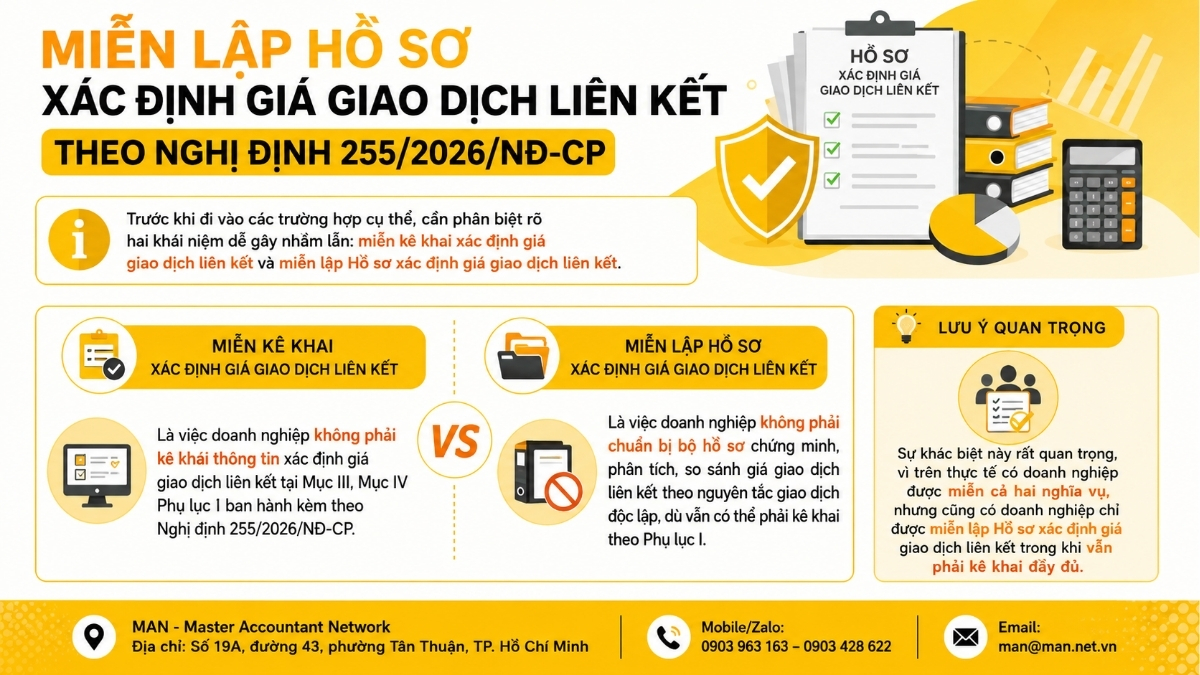
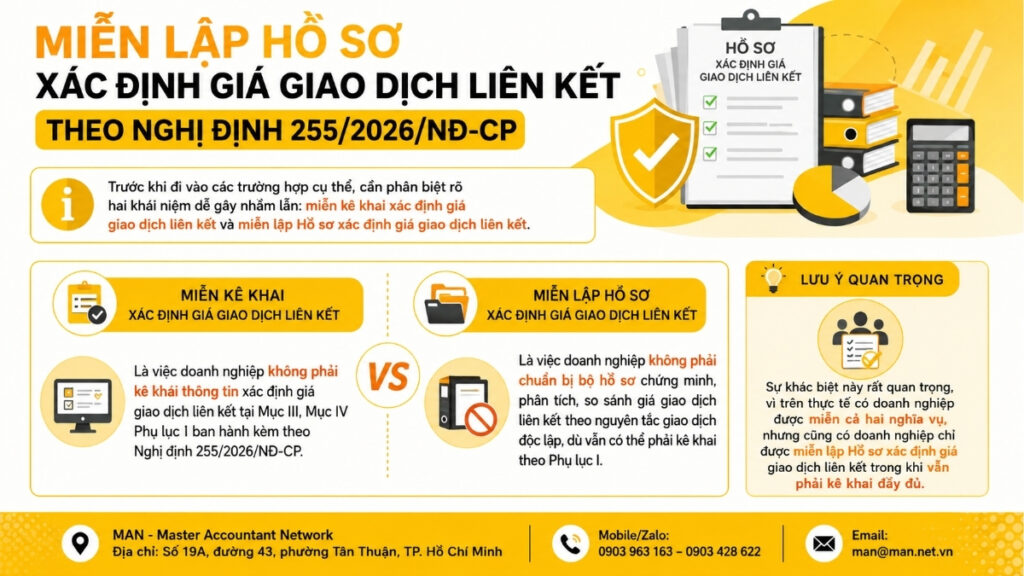
Before delving into specific cases, it's necessary to clearly distinguish between two easily confused concepts: exemption from declaring transfer pricing and exemption from preparing transfer pricing documentation.
- Exemption from declaration: This means that businesses are not required to declare information determining transfer pricing in Sections III and IV of Appendix I issued with Decree 255/2026/ND-CP.
- Exemption from preparing a Price Determination File: This means that businesses are not required to prepare a set of documents proving, analyzing, and comparing the prices of related-party transactions according to the arm's length principle, although they may still need to declare them according to Appendix I.
This distinction is crucial because, in practice, some businesses are exempt from both obligations, while others are only exempt from preparing Transfer Pricing Documentation while still being required to declare all relevant information.
According to Article 20 of Decree 255/2026/ND-CP, the regulations on exemption from preparing transfer pricing documentation are divided into two groups of cases, with different application conditions. The following section will delve into each group.
Cases exempt from preparing Transfer Pricing Documentation under Decree 255
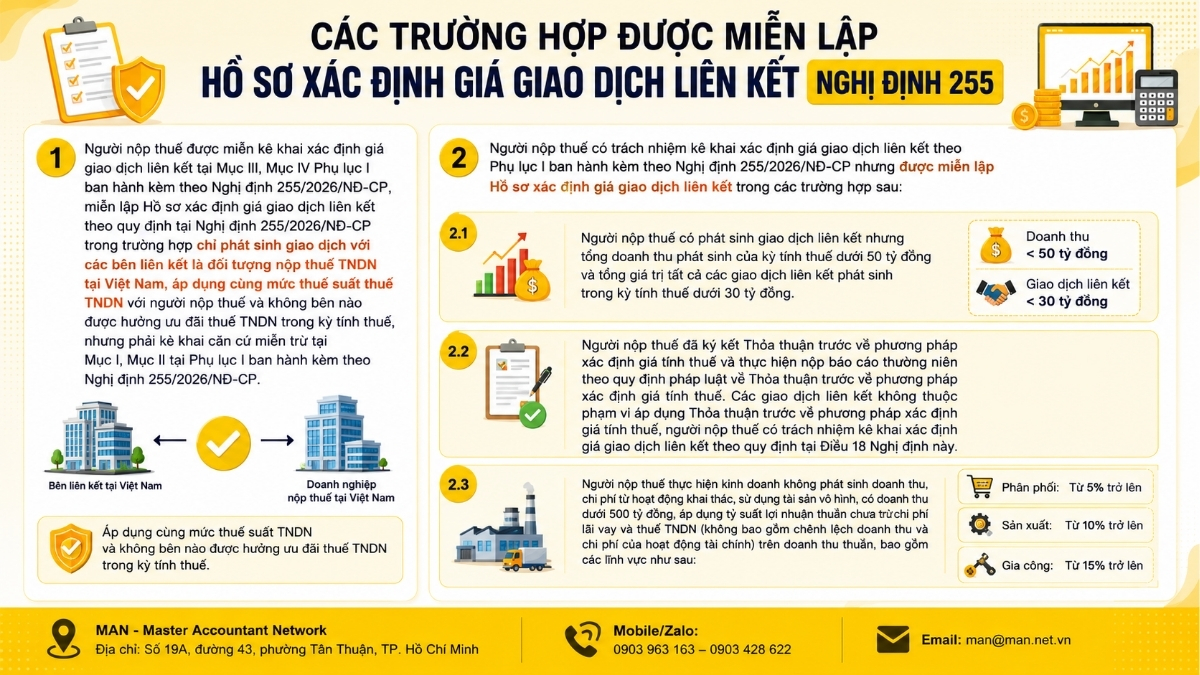
Cases where both declaration and preparation of Transfer Pricing Documentation are waived.
The first group applies to taxpayers who are already exempt from declaring transfer pricing under Sections III and IV of Appendix I issued with Decree 255/2026/ND-CP. For this group, businesses are also exempt from preparing transfer pricing documentation if they meet all three of the following conditions within the same tax period:
- Transactions only occur with related parties that are subject to corporate income tax in Vietnam;
- Related parties apply the same corporate income tax rate as taxpayers;
- Neither party to the transaction is entitled to corporate income tax incentives during that tax period.
This condition is typically suitable for businesses within the same group or domestic corporation, without cross-border transfer pricing and without tax rate differentials between related parties, which is a common incentive for tax authorities to closely monitor related-party transactions.
However, it should be noted that even though exempted from preparing a Transfer Pricing Documentation in this case, the enterprise must still declare the grounds for exemption as specified in Sections I and II of Appendix I issued with Decree 255/2026/ND-CP. In other words, exemption from preparing the documentation does not mean that the enterprise is completely exempt from the obligation to declare related to related-party transactions.
Cases where declaration is required but the preparation of a Transfer Pricing Documentation File is waived.
Unlike the group above, the second group consists of businesses that are still responsible for declaring and determining transfer pricing according to Appendix I issued with Decree 255/2026/ND-CP, but are exempt from preparing transfer pricing documentation if they fall into one of the three specific cases below.
- Businesses that have related-party transactions but operate on a small scale, specifically: total revenue generated during the tax period is less than VND 50 billion, and the total value of all related-party transactions during the tax period is less than VND 30 billion.
- Businesses that have signed Advance Pricing Agreements (APAs) and submitted annual reports in accordance with the law on Advance Pricing Agreements are still responsible for declaring and determining the transfer pricing of related-party transactions that fall outside the scope of the signed APA. This means that the exemption from preparing Transfer Pricing Documentation only applies to the portion of transactions covered by the APA, and not to all related-party transactions arising during the period.
- Businesses that conduct business without generating revenue or expenses from the exploitation or use of intangible assets, have revenue under VND 500 billion, and apply a net profit margin (excluding interest expenses and corporate income tax) on net revenue at the following minimum thresholds: Distribution industry: 5% or higher; Manufacturing industry: 10% or higher; Processing industry: 15% or higher.
This is the most complex case among those exempt from preparing Transfer Pricing Documentation, requiring businesses to closely monitor actual profit margins for each business segment.
See also: New points in Decree 255/2026/ND-CP regarding related-party transactions.
Determining the net profit margin to be exempt from preparing a valuation report.
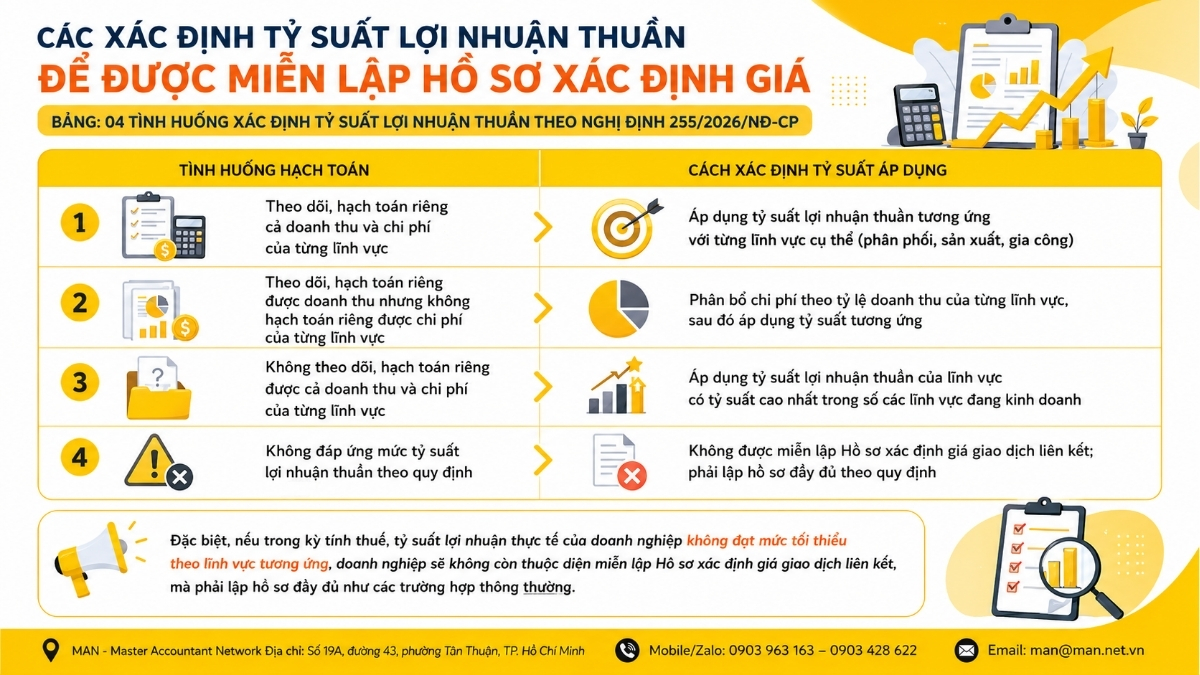
Not all businesses operate in a single sector, and the way revenue and expenses are accounted for in each sector directly affects the determination of the net profit margin, thereby determining whether the business is eligible for exemption from preparing a Transfer Pricing Documentation. Decree 255/2026/ND-CP stipulates four situations as follows:
| Accounting situation | How to determine the applicable rate |
| Track and account for both revenue and expenses separately for each area. | Apply the appropriate net profit margin for each specific sector (distribution, manufacturing, processing). |
| Revenue can be tracked and accounted for separately, but expenses for each area cannot be accounted for separately. | Allocate costs based on the revenue share of each segment, then apply the corresponding rate of return. |
| It is not possible to track and account for both revenue and expenses separately for each area. | Apply the net profit margin of the sector with the highest profit margin among the business sectors. |
| Failed to meet the required net profit margin. | No exemption is granted for preparing a Transfer Pricing Documentation; a complete dossier must be prepared in accordance with regulations. |
Specifically, if, during the tax period, the actual profit margin of the enterprise does not reach the minimum level for the corresponding sector, the enterprise will no longer be exempt from preparing Transfer Pricing Documentation, but must prepare complete documentation as in normal cases.
In this situation, businesses should consider using Transfer pricing documentation services We rely on professional and experienced organizations like MAN – Master Accountant Network to ensure that your tax return is properly prepared, well-founded, and minimizes risks during tax audits and inspections.
Comparison table of cases exempt from preparing identification documents between Decree 132 and Decree 255
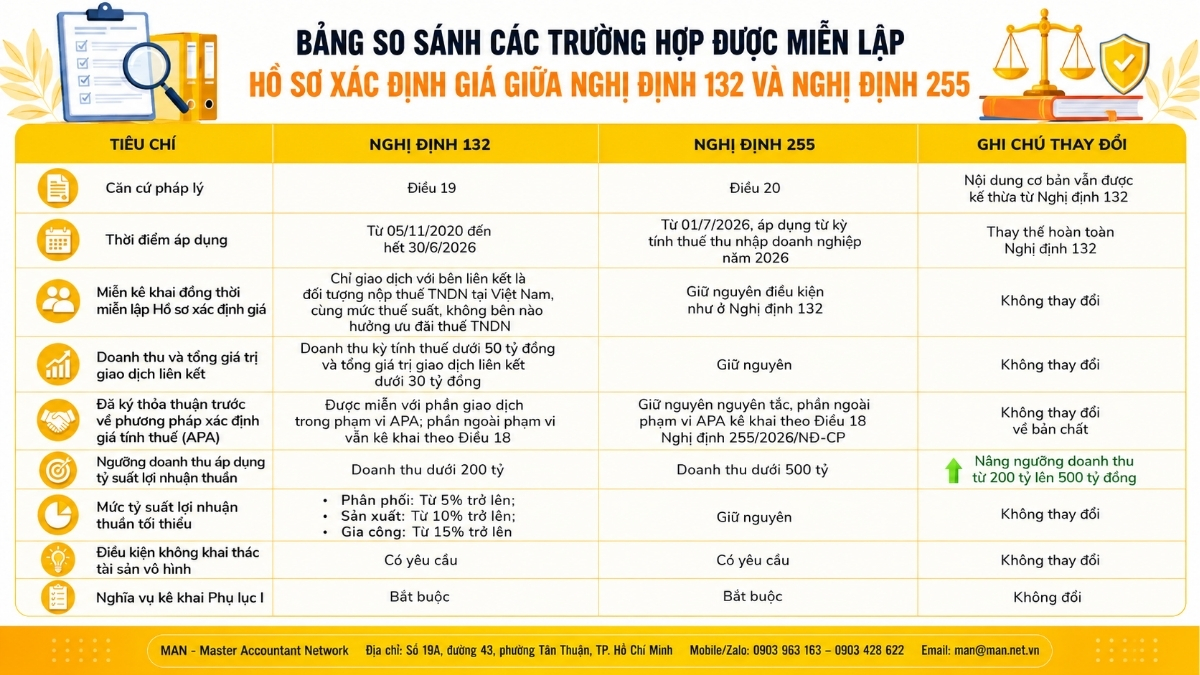
Essentially, the cases exempted from preparing Transfer Pricing Documentation under Decree 255/2026/ND-CP inherit almost entirely the structure of Decree 132/2020/ND-CP, with only adjustments to some quantitative thresholds. The table below summarizes the main similarities and differences:
| Criteria | Decree 132 | Decree 255 | Change notes |
| Legal basis | Article 19 | Article 20 | The basic content remains the same as Decree 132. |
| Time of application | From November 5, 2020 to June 30, 2026 | Effective from July 1, 2026, this will apply to the corporate income tax period of 2026. | Completely replace Decree 132. |
| Exemption from declaration and exemption from preparing price determination documents. | Transactions are conducted only with related parties that are subject to corporate income tax in Vietnam, at the same tax rate; no party enjoys corporate income tax incentives. | The conditions remain the same as in Decree 132. | Constant |
| Revenue and total value of related-party transactions | Taxable revenue is less than VND 50 billion and total value of related-party transactions is less than VND 30 billion. | Keep it as is. | Constant |
| A pre-emptive pricing agreement (APA) has been signed. | Exempt for transactions within the scope of the APA; transactions outside the scope must still be declared according to Article 18. | The principle remains unchanged: any portion outside the scope of the APA is declared according to Article 18 of Decree 255/2026/ND-CP. | Unchanged in nature |
| Revenue threshold for applying net profit margin | Revenue under 200 billion | Revenue under 500 billion | Raising the revenue threshold from 200 billion to 500 billion VND. |
| Minimum net profit margin | Distribution: From 5% onwards; Production: From 10% onwards; Processing: From 15% onwards | Keep it as is. | Constant |
| Conditions for not exploiting intangible assets. | There is a request. | There is a request. | Constant |
| Obligation to declare Appendix I | Obligatory | Obligatory | Unchanged |
The exemption from filing based on net profit margin depends on the degree of separation of accounting practices within the enterprise: the clearer the separation by business sector, the closer the applicable margin will be to reality; if separation is not possible, the highest margin must be applied. Importantly, simply failing to meet the minimum margin requirement during the tax period will result in the loss of the exemption from filing.
Early review together related party transaction advisory services MAN's guidelines will help businesses correctly identify the applicable exemption group, thereby avoiding the risk of being subject to back taxes or tax assessments during final settlement.
Conclude
Because revenue thresholds, transaction values, and profit margins are all assessed on a per-tax basis, misidentifying eligibility can lead to back taxes or tax assessments during audits. If your business has related-party transactions and you are unsure whether you are exempt from preparing a Transfer Pricing Documentation, proactively review the situation now. Contact MAN – Master Accountant Network To receive support from our team of experts for accurate review and verification on a case-by-case basis before the upcoming settlement period.
Contact information MAN – Master Accountant Network
- Address: No. 19A, Street 43, Tan Thuan Ward, Ho Chi Minh City
- Mobile/Zalo: 0903 963 163 – 0903 428 622
- E-mail: man@man.net.vn
- Google Business Profile: View MAN – Master Accountant Network's Google Business Profile
- LinkedIn Founder: View expert Le Hoang Tuyen's LinkedIn profile.
Responsible for production and professional content review by: Mr. Le Hoang Tuyen – Founder & CEO of MAN – Master Accountant Network. He is a CPA Vietnam auditor with over 30 years of in-depth experience in accounting, auditing, taxation, and corporate legal consulting.
Frequently Asked Questions about Exemption from Relational Transfer Pricing Documentation
Which cases are exempt from submitting documents if the revenue threshold is below 500 billion VND?
This threshold applies to cases where businesses do not generate revenue or expenses from the exploitation of intangible assets and apply the correct minimum net profit margin according to the sector (distribution, production, processing) as stipulated in point c, clause 2, Article 20 of Decree 255/2026/ND-CP.
Are businesses with APAs completely exempt from submitting Transfer Pricing Documentation?
Not entirely. Businesses that have signed an APA and submitted annual reports are only exempt from filing for the portion of transactions that fall within the scope of the APA. Related-party transactions outside the scope of the APA must still be declared and price determined according to Article 18 of Decree 255/2026/ND-CP.
What happens if a business fails to meet the minimum net profit margin requirement?
Businesses are no longer eligible for exemption from filing based on profit margin, but must now prepare a complete Transfer Pricing Documentation file as required during that tax period.
If a business is eligible for exemption but fails to declare Appendix I, will it be considered in violation?
Yes, because the exemption from preparing a Price Determination File does not replace the obligation to declare. Omitting the declaration of Appendix I may result in the business being considered as not fully complying with its tax declaration obligations related to related-party transactions.