





Whether or not the guaranteeing company is affiliated is a question that many chief accountants only ask when the tax inspection team is already sitting in front of them, whereas it should have been answered from the day the guarantee contract was signed. Decree 255/2026/ND-CP While retaining the controlling spirit of the old legal framework, the article clarifies both the conditions for establishment and the exclusion cases. The article below dissects point d, clause 2, Article 5 verbatim, the two mandatory quantitative conditions that must be simultaneously satisfied, the three exclusion cases, and the five-step self-checking process before closing the books for the 2026 tax period.
Related parties providing guarantees are becoming a hot topic in the 2026 tax year.
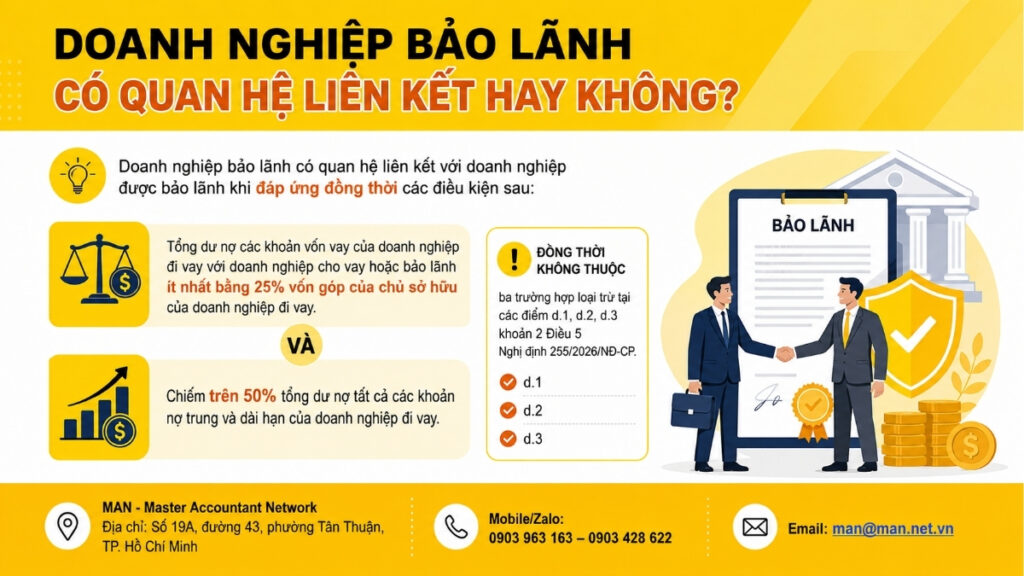
A guaranteeing enterprise is considered affiliated with the guaranteed enterprise when the total outstanding debt of the borrowing enterprise to the lending or guaranteeing enterprise is at least equal to 25% of the owner's equity of the borrowing enterprise and accounts for more than 50% of the total outstanding debt of all medium and long-term debts of the borrowing enterprise.
Decree 255/2026/ND-CP and the Affiliate Partner Identification Framework
Decree 255/2026/ND-CP on tax management for enterprises with related-party transactions replaces Decree 132/2020/ND-CP and Decree 20/2025/ND-CP. Article 5 of the Decree lists the cases identified as related parties, with point d, clause 2 specifically for relationships arising from guarantee and lending activities.
A key point for professionals is the broad scope of the wording. The clause not only refers to direct loans between two businesses, but explicitly states "in any form," including loans from third parties secured by related-party financing and similar financial transactions. Therefore, when assessing whether a guaranteeing business is related, the scope of review must be broader than simply reviewing the credit agreement.
In our consulting practice, MAN – Master Accountant Network has identified the following common types of businesses:
- The corporation has cross-guarantees between its subsidiaries;
- FDI enterprises borrow from domestic banks but have a guarantee letter from their parent company abroad;
- And businesses borrow from banks using margin lending structures, pledging deposits from related parties.
Legal basis for determining whether a guaranteeing enterprise has an affiliated relationship.

The full content regarding the determination of whether a guaranteeing enterprise has an affiliated relationship is found in Article 5 of Decree 255/2026/ND-CP.
Based on Point d, Clause 2, Article 5 of Decree 255/2026/ND-CP:
An enterprise guarantees or lends capital to another enterprise in any form (including third-party loans secured by related-party financing and similar financial transactions) provided that the total outstanding debt of the borrowing enterprise to the lending or guaranteeing enterprise is at least equal to 25% of the owner's equity of the borrowing enterprise and accounts for more than 50% of the total outstanding debt of all medium and long-term debts of the borrowing enterprise.
See also: New points in Decree 255/2026/ND-CP regarding related-party transactions.
Three exclusion cases that prevent the guaranteeing company from having an affiliated relationship.

Point d, Clause 2, Article 5 states that the provisions in this point do not apply to three cases. Specifically, these are as follows:
Credit institutions do not participate in management, control, capital contribution, or investment.
The guarantor or lender is an economic organization operating in accordance with the regulations of Law on Credit Institutions No. 32/2024/QH15 (as amended and supplemented by Law No. 96/2025/QH15) shall not directly or indirectly participate in the management, control, capital contribution, or investment in the borrowing enterprise or the guaranteed enterprise as stipulated in points a, c, d, e, g, h, k, l, and m of this clause.
The key point: This is a conditional exception, not an automatic exception based on the entity's status. A bank can still be considered an affiliated party if it simultaneously holds capital or participates in the management and control of the borrowing enterprise. When determining whether a guaranteeing enterprise has an affiliated relationship in cases where the guarantor is a credit institution, the documentation must prove the "non-participation" aspect with specific evidence such as shareholder registers, lists of managers, and meeting minutes.
Not subject to the control of another party.
The guarantor or lender is an economic organization operating in accordance with the Law on Credit Institutions No. 32/2024/QH15 (amended and supplemented by Law No. 96/2025/QH15), and the borrowing or guaranteed enterprise is not directly or indirectly under the management, control, capital contribution, or investment of another party as stipulated in points b, e, and i of this clause.
In this case, the two parties do not own each other but are both under the control of a single entity. If another party exists, the exception is no longer valid.
Organization for buying, selling, and handling state-owned debt 100%
Creditors and guarantors are state-owned organizations with charter capital that function to buy, sell, and process debt, but do not directly or indirectly participate in the management, control, capital contribution, or investment in the debtor enterprise or the guaranteed enterprise as stipulated in points a and c of this clause.
This exception removes obstacles for businesses undergoing debt restructuring, preventing the debt trading transaction itself from creating a new relationship.
The process and steps for verifying whether a guaranteeing company is affiliated with another company.
Here are five steps businesses can take to determine if they fall under the category of related parties in the form of loans, lending, or guarantees.
- Step 1 – Compile a complete list of financing relationships: Not only loan agreements, but also guarantee letters, guarantee commitments, standby letters of credit, third-party loans secured by related-party financing, and other similar financial transactions. Data should be sourced from three places: accounting records, legal documents, and the financial statement notes regarding commitments and guarantees.
- Step 2 – Determine the owner's equity: Obtain the owner's equity figure from the audited financial statements and compare it with the business registration certificate and the shareholder or member register. Do not mistakenly use the total owner's equity amount.
- Step 3 – Classify all debts by maturity: Create a table classifying all debts by maturity, separating them into medium- and long-term groups, referencing the maturity terms of each contract. Clearly state the time and method used to determine the outstanding balance to ensure the data is accurate during explanations.
- Step 4 – Calculate and compare the percentage thresholds stipulated in Article 5: Only when both conditions are met simultaneously will the business be formed. affiliated relationship
- Step 5 – Check for exclusions: verify the legal status of the lender/guarantor and their ownership and management relationship with your business, in accordance with the points referenced in d.1, d.2, and d.3. The final conclusion must be documented in writing, signed by an authorized person, and accompanied by supporting evidence.
4 practical scenarios for determining whether a guaranteeing company has an affiliated relationship.

Assume Company B has owner's equity of VND 200 billion and total medium and long-term debt of VND 300 billion.
Case 1: Both conditions are met simultaneously.
Company C (a trading company, not a credit institution) guarantees a medium-term loan of 180 billion VND for Company B.
| Criteria | Result | Evaluate |
| Owner's equity contribution | (180/200) x 100 = 90% | Achieved (at least 25%) |
| Total outstanding medium and long-term debt | (180/300) x 100 = 60% | Dat (on 50%) |
Conclude: The guaranteeing enterprise has an affiliated relationship with Company B. If any related-party transactions occur between the two parties during the period, Company B falls within the scope of Decree 255/2026/ND-CP.
Case 2: Only one condition is met.
Company D guaranteed a loan of 120 billion VND for Company B.
| Criteria | Result | Evaluate |
| Owner's equity contribution | (120/200) x 100 = 60% | Achieved (at least 25%) |
| Total outstanding medium and long-term debt | (120/300) x 100 = 40% | Failed to pass 50% |
Conclude: Not eligible under point d, because both thresholds must be met simultaneously.
Case 3: The bank both provides loans and invests capital.
Bank E provided Company B with a medium- and long-term loan of 200 billion VND, while also holding 30% of Company B's contributed capital.
- Owner's capital contribution 100%
- Total outstanding medium and long-term loans: 66.7%
- Bank E operates under the Law on Credit Institutions, but it has invested capital in the borrowing enterprise, thus failing to meet the criterion of "not directly or indirectly participating in the management, control, capital contribution, or investment" of point d.1.
Result: No exclusion is granted, meaning the guaranteeing company has an affiliated relationship with Company B.
Case 4: The parent company provides collateral to enable the subsidiary to borrow from the bank.
Company B borrowed 180 billion VND from an independent bank. The bank did not contribute capital or participate in management. However, the loan was secured by the parent company's deposit balance at that same bank.
Considering the relationship with the bank specifically: this falls under the exclusion clause d.1. However, point d includes "third-party loans secured by the financing of an affiliated company." This means the relationship under consideration here is not between Company B and the bank, but between Company B and its parent company, which used its own financial resources to secure the loan.
- Owner's equity contribution = (180/200) x 100 = 90% (achieved);
- Total outstanding medium and long-term debt = (180/300) x 100 = 60% (achieved).
Result: A related party relationship with the parent company arises. This is the most overlooked situation in practice, as accountants only look at the party named on the credit agreement.
Conclude
Three most memorable things from the entire article:
- A guaranteeing enterprise is considered affiliated only if both thresholds reach at least 25% of owner's equity and over 50% of total outstanding medium and long-term debt of the borrowing enterprise.
- The three exclusions in d.1, d.2, and d.3 are conditional exceptions.
- The scope of the review must encompass both guarantees and similar financing structures, not just named credit agreements.
If your company's financing structure includes internal guarantees, cross-guarantees, or loans secured by affiliated financing sources, consider consulting with a partner. related party transaction advisory services This will allow MAN – Master Accountant Network's team of related party transaction experts to provide in-depth support when Decree 255 officially comes into effect for the 2026 corporate income tax period.
Contact us For free support and advice!
Contact information MAN – Master Accountant Network
- Address: No. 19A, Street 43, Tan Thuan Ward, Ho Chi Minh City
- Mobile/Zalo: 0903 963 163 – 0903 428 622
- E-mail: man@man.net.vn
- Google Business Profile: View MAN – Master Accountant Network's Google Business Profile
- LinkedIn Founder: View expert Le Hoang Tuyen's LinkedIn profile.
Responsible for production and professional content review by: Mr. Le Hoang Tuyen – Founder & CEO of MAN – Master Accountant Network. He is a CPA Vietnam auditor with over 30 years of in-depth experience in accounting, auditing, taxation, and corporate legal consulting.
Frequently Asked Questions about whether a Guaranteeing Company is Related to another Company
Does the guaranteeing company have an affiliated relationship with the guaranteed company in all cases?
No. According to point d, clause 2, Article 5 of Decree 255/2026/ND-CP, a related party relationship only arises when the total outstanding debt of the borrowing enterprise with the lending or guaranteeing enterprise is at least equal to 25% of the owner's equity of the borrowing enterprise and accounts for more than 50% of the total outstanding debt of all medium and long-term debts of the borrowing enterprise, and does not fall under the exclusion cases d.1, d.2, and d.3.
If only one of the two thresholds is met, can we conclude that the guaranteeing company has an affiliated relationship?
No. Both conditions must be met simultaneously for a business to be considered to have an affiliated relationship.
When borrowing from a commercial bank, does the guaranteeing company have a related-party relationship with the bank?
It depends on the case. If the lender or guarantor is an economic organization operating under the Law on Credit Institutions No. 32/2024/QH15 (amended and supplemented by Law No. 96/2025/QH15) and does not directly or indirectly participate in the management, control, capital contribution, or investment in the borrowing enterprise or the guaranteed enterprise, then it falls under the exclusion in d.1. Conversely, a bank that both lends and contributes capital is not entitled to this exception.
How is a bank loan accounted for if the parent company uses its deposits as collateral?
Point d specifies that the scope includes third-party loans secured by related-party financing and financial transactions of a similar nature.