





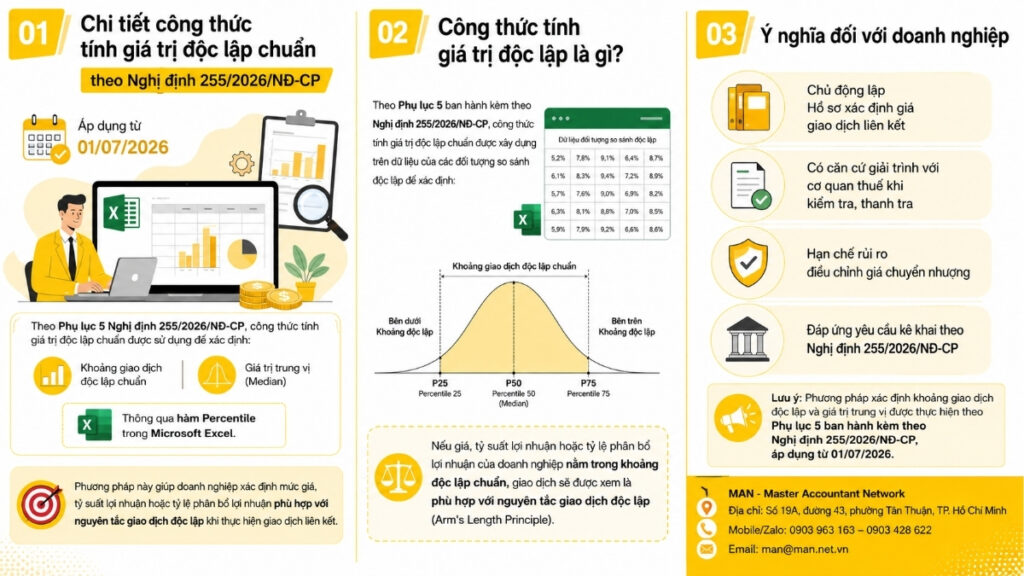
The formula for calculating the official standard independent value is specified in Appendix 5 issued herewith. Decree 255/2026/ND-CP, Effective from July 1, 2026, this method uses the familiar Percentile function in Excel to determine the independent transaction range and median value. The article provides a detailed analysis of the four-step calculation process, with specific illustrative examples, and clarifies the declaration and documentation requirements for determining transfer pricing that businesses must adhere to in order to avoid risks during tax audits.
What is the formula for calculating independent values?

Before going into detail about the calculation method, it's necessary to understand the nature of this concept. According to Appendix 5 issued with Decree 255/2026/ND-CP, the formula for calculating the standard independent value is a method for determining the standard independent transaction range and median value, implemented based on the Percentile function in Microsoft Excel.
Simply put, this is a tool that helps businesses determine a reasonable value range (based on data from independent comparable entities) to compare against the price, profit margin, or profit allocation ratio in their related-party transactions. If the value of a related-party transaction falls within this standard independent range, the transaction is considered to comply with the arm's length principle.
Mastering the calculation formula not only helps businesses proactively prepare documentation for determining transfer pricing, but also serves as an important basis for explaining to tax authorities when audits or inspections are required.
General principles when applying the independent value formula
The application of the calculation formula is inseparable from the arm's-length principle, the overarching foundation of the entire regulation on transfer pricing in Vietnam.
According to Point d, Clause 1, Article 22 of the 2025 Law on Tax Administration:
“"Tax audits of related-party transaction prices for taxpayers must be conducted according to the arm's length principle and the economic nature of the activity or transaction. The tax liability must be determined in proportion to the value generated from the actual economic nature of the taxpayer's business activity or transaction."”
Specifically, tax authorities will not recognize related-party transactions that do not comply with the arm's length principle if this reduces the company's tax liability.
This means that even if a business applies the correct independent valuation formula, if the nature of the transaction does not accurately reflect the actual economic situation, the calculation results may still be rejected by the tax authorities. Therefore, this formula should be used as a supporting tool, accompanying a thorough and honest analysis of the functions, assets, and risks of related-party transactions.
See also: New points in Decree 255/2026/ND-CP on related-party transactions.
Percentile function: An important tool in formulas

A distinctive feature of the standard independent value calculation formula according to Decree 255/2026/ND-CP is the direct use of the Percentile function available in Microsoft Excel, a familiar tool easily accessible to most accounting and finance departments in businesses.
How to create a data range in Excel
The first step in applying the independent value calculation formula is to create a data range in Excel. This data range consists of cells containing values for price levels, profit margins, or profit allocation ratios, determined from independent comparison objects selected by the business. The data can be arranged in a column or a row, as long as consistency is ensured when inputting it into the calculation function.
Percentile function syntax
After obtaining the data range, the calculator moves the cursor to another cell outside the data range and executes the Percentile command to find the corresponding percentile values. The syntax of the formula for calculating the independent values using the Percentile function is as follows:
Percentile (Data range, parameter) |
In there:
- Data area: This is the area containing the price levels, profit margins, or profit allocation ratios established in the previous step.
- Parameters: Receive corresponding values from 0.35 to 0.75.
The significance of percentile markers is the most important part of the standard independent value calculation formula, as it determines the final range of values used for comparison:
- 35th percentile: This is the value of the Percentile function with the parameter equal to 0.35.
- 50th percentile (median): This is the value of the Percentile function with the parameter equal to 0.5.
- 75th percentile: This is the value of the Percentile function with the parameter equal to 0.75.
Based on the three points above, the standard independent transaction value range is determined to be between the 35th and 75th percentiles. This is the reference frame that businesses will use to compare with their actual related-party transaction values.
Step-by-step instructions for calculating independent values using the formula.
To help businesses easily understand and apply the standard formula, the implementation process can be summarized in the following four steps:
Step 1 – Identify the region of independent data for comparison.
Businesses select appropriate independent comparable entities (based on functional analysis, industry, size, etc.) and gather data on prices, profit margins, or profit allocation ratios of these entities into a data range in Excel.
Step 2 – Apply the Percentile function with the parameter 0.35
Use the formula:
Percentile (data range, 0.35) |
Use the formula to determine the lower limit of the standard independent range.
Step 3 – Determine the median value with a parameter of 0.5
Recipe:
Percentile (data range, 0.5) |
Use the formula to find the median value, the central reference level, often used when adjusting related-party transaction prices to a specific value point.
Step 4 – Determine the 75th percentile with parameter 0.75
Recipe:
Percentile (data range, 0.75) |
Use the formula to determine the upper limit of the standard independent range.
The result of the four steps above is the standard independent transaction value range, spanning from the 35th percentile to the 75th percentile, with the median in the middle. This is the final result that the independent value calculation formula aims for.
An example illustrating the formula for calculating independent value according to Decree 255/2026/ND-CP.

To further clarify how to apply the formula, Appendix 5 issued with Decree 255/2026/ND-CP provides the following specific illustrative example:
In 202x, company A selected independent companies for comparison, with the following net return on assets figures: 1.0; 1.25; 1.25; 1.5; 1.5; 1.75; 2.0; 2.0; 2.15; 2.25; 2.5; 2.75; 3.0.
Applying the Percentile function in Excel to calculate independent values, the results are shown in the table below:
| Percentile milestone | Excel formulas | Return value |
| 35th percentile | Percentile (data range, 0.35) | 1.55 |
| Median | Percentile (data range, 0.5) | 2.0 |
| 75th percentile | Percentile (data range, 0.75) | 2.25 |
Thus, after applying the independent valuation formula, the standard independent transaction value range for company A is determined to be from 1.55 to 2.25, with a median value of 2.0. If the net return on actual assets in company A's related-party transactions falls within the range of 1.55 to 2.25, the transaction is considered compliant with the independent valuation principle. Conversely, if it falls outside this range, the company may need to make adjustments, usually adjustments to the median value.
Taxpayer obligations
Applying the correct formula for calculating independent value is only one part of the overall obligation to declare and determine the transfer pricing of enterprises. According to Clause 2, Article 18 of Decree 255/2026/ND-CP, the taxpayer's obligation to declare and determine transfer pricing is carried out in accordance with Clause 2, Article 37 of the 2025 Tax Administration Law and the following specific regulations:
- Declaring and determining transfer pricing does not reduce the corporate income tax liability payable in Vietnam. This is a consistent principle, ensuring that the application of the calculation formula is not exploited for transfer pricing or tax evasion.
- Demonstrate the process of analyzing, comparing, and selecting the method for determining transfer pricing. Businesses not only need to provide the calculation results from the independent valuation formula, but also documentation demonstrating the analysis and comparison process and the rationale for choosing the appropriate method.
- Declare information on related party relationships and related party transactions according to Appendix I, Appendix II, and Appendix III issued with Decree 255/2026/ND-CP and submit them together with the Corporate Income Tax Final Settlement Declaration.
- Establish, maintain, and provide records of transfer pricing.
In cases where businesses require comprehensive support, from data review to completion of documents for submission to tax authorities, related party transaction documentation service With expertise and experience from specialized units like MAN – Master Accountant Network, businesses can save time and minimize risks before tax season.
Why do businesses need to master the formula for calculating independent value?
In the context of tax authorities increasingly tightening inspections of related-party transaction pricing under Article 22 of the 2025 Tax Administration Law, mastering and correctly applying the formula for calculating independent value brings many practical benefits to businesses:
- Firstly, it helps businesses proactively review and assess the appropriateness of their related-party transaction prices before filing tax returns, instead of passively waiting for the tax authorities to inspect and reassess them.
- Secondly, this is an important basis for explanation when tax authorities conduct audits based on the principle of the arm's length and the economic nature of the activities and transactions as stipulated in Article 22 of the 2025 Law on Tax Administration.
- Thirdly, incorrect calculations or failure to apply the correct independent value calculation formula can lead to the risk of the tax authorities not recognizing the related-party transaction, resulting in a reassessment of tax obligations, along with late payment penalties and other administrative tax violation sanctions.
- Fourth, this also serves as a basis for businesses to prepare national and global dossiers in accordance with the list of information and documents stipulated in Appendix II and Appendix III of Decree 255/2026/ND-CP, avoiding situations where dossiers lack sufficient basis or persuasiveness during inspections and audits.
What should businesses do to correctly apply the independent valuation formula?
To effectively apply the standard independent value calculation formula according to Decree 255/2026/ND-CP, businesses should follow these steps:
- Review all independent comparative data currently in use, ensuring they are representative and relevant to the company's industry, function, and scale.
- Update the calculation process in Excel to correctly use the Percentile function syntax and the parameter values of 0.35, 0.5, and 0.75 as stipulated in Appendix 5 of Decree 255/2026/ND-CP.
- Compare the calculated results with the actual value of related-party transactions that occurred during the period to determine if they fall within the standard independent value range.
- Prepare complete documentation for determining transfer pricing according to Appendices I, II, III, and IV, ensuring consistency between the calculation results and supporting documents.
- Proactively consult with experts in the field of related-party transactions if your business has a complex transaction structure, cross-border transactions, or is applying new regulations for the first time.
If your business requires in-depth advice on how to apply the standalone value formula to each specific type of related-party transaction, MAN's team of experts is ready to assist you through related party transaction advisory services.
Conclude
The standard independent valuation formula in Appendix 5 issued with Decree 255/2026/ND-CP is an important legal tool, effective from July 1, 2026, that helps businesses determine the range of independent transaction values. Understanding the nature and application of this formula correctly, along with full compliance with the declaration and documentation obligations for determining transfer pricing under the 2025 Tax Administration Law and Decree 255/2026/ND-CP, will help businesses be more proactive in tax matters and minimize risks during audits and inspections.
If your business needs in-depth advice on specific types of related-party transactions, or assistance in reviewing and preparing Transfer Pricing Documentation in accordance with the latest regulations, please do not hesitate to contact us. contact Contact the expert team at MAN – Master Accountant Network for timely support.
Contact information MAN – Master Accountant Network
- Address: No. 19A, Street 43, Tan Thuan Ward, Ho Chi Minh City
- Mobile/Zalo: 0903 963 163 – 0903 428 622
- E-mail: man@man.net.vn
- Google Business Profile: View MAN – Master Accountant Network's Google Business Profile
- LinkedIn Founder: View expert Le Hoang Tuyen's LinkedIn profile.
Responsible for production and professional content review by: Mr. Le Hoang Tuyen – Founder & CEO of MAN – Master Accountant Network. He is a CPA Vietnam auditor with over 30 years of in-depth experience in accounting, auditing, taxation, and corporate legal consulting.
Frequently Asked Questions about the Independent Values Formula
Where is the standard range of independent transaction values defined?
According to the independent value calculation formula stipulated in Appendix 5 of Decree 255/2026/ND-CP, the standard independent transaction value range is from the 35th percentile to the 75th percentile. The median value (50th percentile) lies between this range.
What happens if the transfer pricing falls outside the standard independent value range?
The legal text stipulating the principles of inspection in Article 22 of the 2025 Law on Tax Administration clearly states: the inspection of related-party transactions must follow the arm's-length principle and the economic nature of the activities and transactions arising; the tax authorities will not recognize related-party transactions that do not follow the arm's-length principle if they reduce the tax liability of the enterprise. If the actual transaction value falls outside the standard arm's-length range, a median value is usually referenced for self-adjustment before being assessed.
What data range is used in the independent value calculation formula?
The data range created in Excel consists of cells containing values related to price levels, profit margins, or profit allocation ratios, determined from independent comparable objects selected by the business based on functional, asset, and risk analysis.
Which indicators will be included in the standard independent value calculation formula from July 1, 2026?
The independent valuation formula can be applied to three groups of indicators: price level, profit margin, or profit allocation ratio. This depends on the method chosen by the enterprise to determine the transfer pricing of related-party transactions and the nature of the transactions being compared or contrasted.
In which document is the formula for calculating the standard independent value specified?
The formula for calculating the standard independent value is stipulated in Appendix 5 issued with Decree 255/2026/ND-CP, effective from July 1, 2026.