





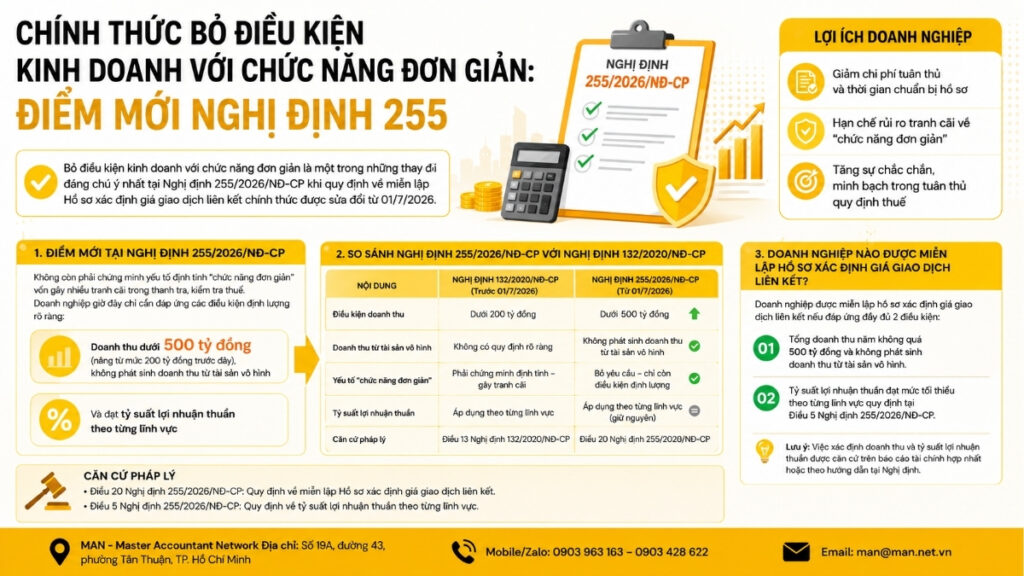
Removing business conditions for simpler functions is one of the most notable changes at Decree 255/2026/ND-CP When the regulations on exemption from preparing Transfer Pricing Documentation are officially amended from July 1, 2026, businesses will no longer have to prove the qualitative element of "simple function," which caused much controversy in tax audits and inspections throughout the period of application of Decree 132/2020/ND-CP. Now, they only need to meet clear quantitative conditions:
- Revenue below VND 500 billion (up from the previous VND 200 billion), with no revenue generated from intangible assets.
- And achieve a net profit margin in each sector.
This article, compiled based on the legal grounds in Articles 20 and 5 of Decree 255/2026/ND-CP, will help you fully understand the new regulations, compare them in detail with Decree 132/2020/ND-CP, and accurately determine whether your business is exempt from filing the required documents.
What is a simple function business?
Simple function businesses refer to enterprises engaged in production, processing, or distribution activities with low added value, low risk, and no use of intangible assets.
Why is removing business conditions, which serve a simple function, considered a significant change?
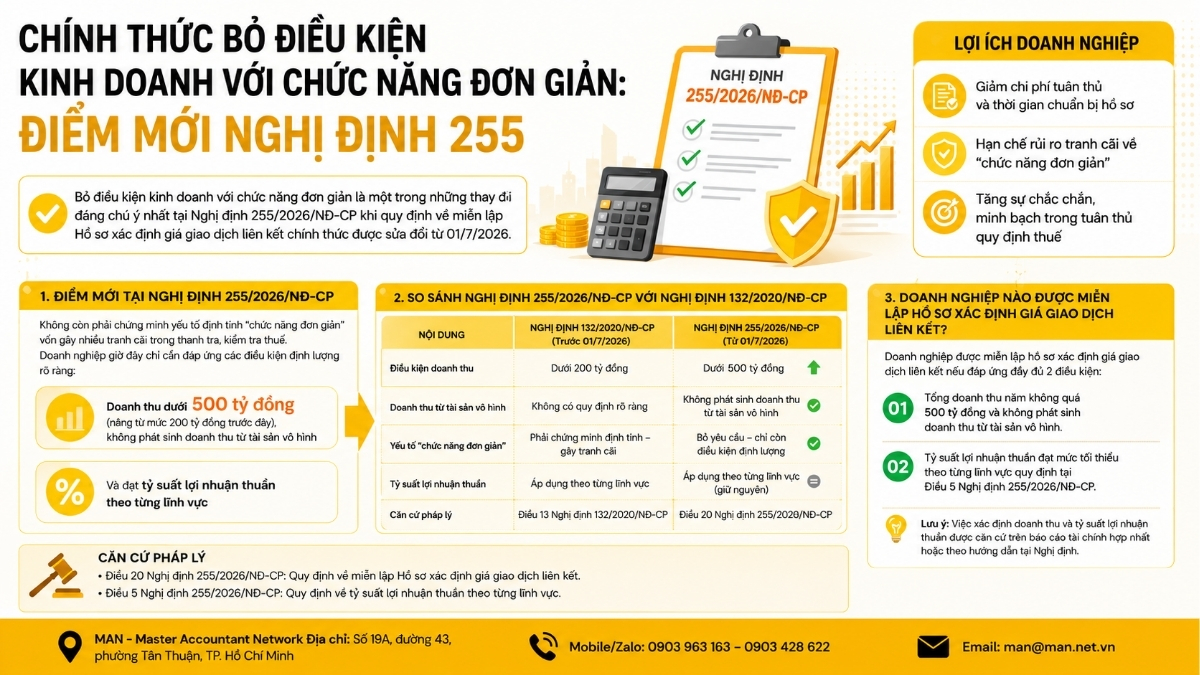
For any business that engages in transactions with related parties, whether parent-subsidiary companies, entities within the same group, or partners with equity ownership or loan guarantees, the first question each corporate income tax settlement period is always:
“"Is the company required to prepare a Transfer Pricing Documentation or is it exempt?"”
According to previous regulations, to be exempt from filing documents, businesses had to meet several conditions simultaneously, one of which was qualitative and the most controversial in practice: the business had to operate with a simple function. The problem was that previous tax laws did not provide clear quantitative criteria to define what constituted a "simple function," leading to differing interpretations between businesses and tax authorities during audits and inspections.
Therefore, the decision of Decree 255/2026/ND-CP to remove the business condition for simple functions is considered an important adjustment, helping to regulate... Exemption from preparing documentation for determining transfer pricing. The aim is to make the regulations more transparent, easier to apply, and to minimize the risk of disputes between businesses and tax authorities. This article will analyze this in depth, clarifying other accompanying changes in the new regulations.
What were the regulations for businesses with previously simple functions?
To understand the significance of removing the business condition requirement for a simplified function, we first need to look back at the old regulations. According to Clause 2, Article 19 of Decree 132/2020/ND-CP, enterprises wishing to be exempted from preparing a Transfer Pricing Documentation must simultaneously meet the following conditions:
- Conduct business with simple functions;
- No revenue or expenses are generated from the exploitation or use of intangible assets;
- Having revenue below 200 billion VND;
- Apply the net profit margin (excluding interest expenses and corporate income tax) to net revenue for each sector, specifically: Distribution (5% or more), Manufacturing (10% or more), and Processing (15% or more).
The biggest shortcoming of the old regulations lay in the first condition. The concept of "simple function" was not specifically defined by quantitative criteria, making its application heavily dependent on subjective assessments during tax audits and inspections. In reality, many businesses, even those meeting all the conditions regarding revenue and profit margin, were still excluded from the exemption from filing requirements simply because the tax authorities considered the business function to be "not simple" in their own interpretation. This is precisely why the condition of "simple function" was removed, an adjustment that clarifies the criteria for exemption from filing requirements.
Remove the business activity with simple functions as stipulated in Decree 255/2026/ND-CP.
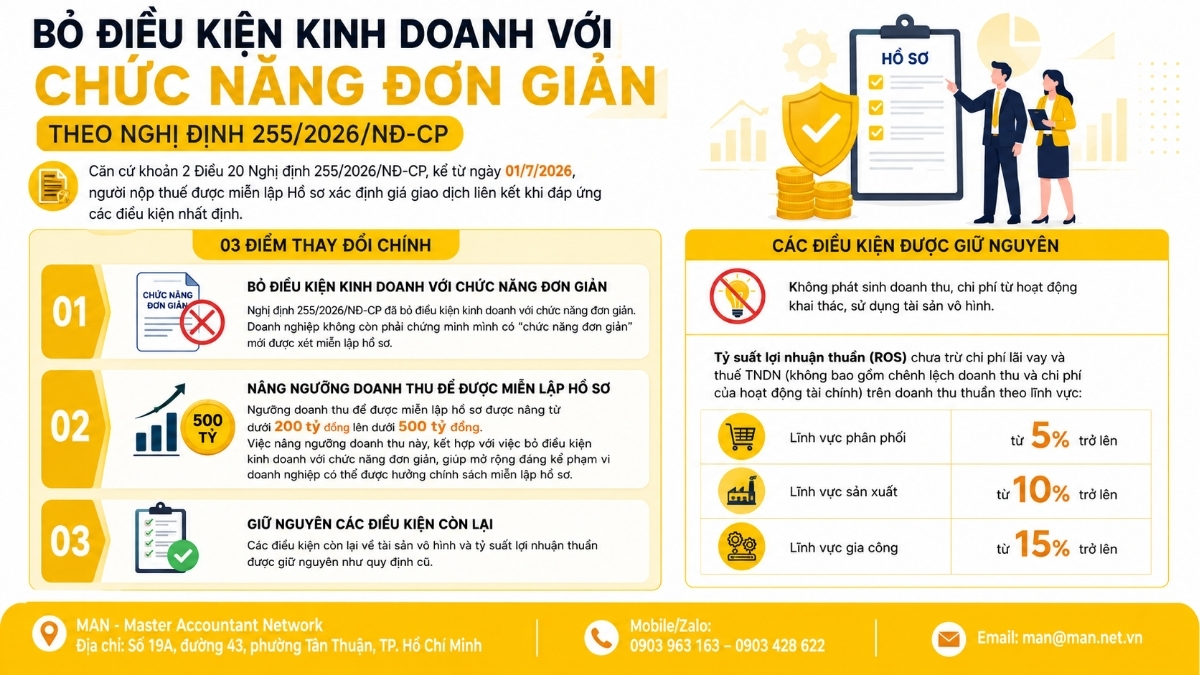
Based on Clause 2, Article 20 of Decree 255/2026/ND-CP, effective from July 1, 2026, the regulations on exemption from preparing transfer pricing documentation have undergone significant adjustments. Accordingly, taxpayers are exempt from preparing documentation when conducting business without generating revenue or expenses from the exploitation or use of intangible assets, with revenue below VND 500 billion, and applying the net profit margin before deducting interest expenses and corporate income tax (excluding the difference between revenue and expenses of financial activities) on net revenue for each sector.
Compared to the old regulations, there are three main changes to note:
- Decree 255/2026/ND-CP has removed the business condition for simple functions. Businesses no longer have to prove they have "simple functions" to be considered for exemption from filing, but only need to meet the remaining quantitative conditions.
- The revenue threshold for exemption from filing requirements has been raised from under 200 billion VND to under 500 billion VND. This increase, combined with the removal of the business condition for simplified functions, significantly expands the scope of businesses that can benefit from the filing exemption policy.
- The remaining conditions regarding intangible assets and net profit margin remain unchanged from the previous regulations, specifically: no revenue or expenses are generated from the exploitation or use of intangible assets; the net profit margin for the distribution sector is 5% or higher, for manufacturing is 10% or higher, and for processing is 15% or higher.
See also: New points in Decree 255/2026/ND-CP regarding related-party transactions.
Comparison table between Decree 132/2020 and Decree 255/2026 regarding conditions for exemption from document preparation.
To help businesses visualize the extent of the changes, here is a detailed comparison table between the old and new regulations related to the removal of business conditions with simplified functions:
| Criteria | Decree 132/2020 | Decree 255/2026 |
| Legal basis | Clause 2, Article 19 | Clause 2, Article 20 |
| Conditions regarding business functions | It is mandatory to conduct business with simple functions. | The business conditions for simple functions have been removed. |
| Conditions regarding intangible assets | No revenue or expenses are generated from the exploitation or use of intangible assets. | Keep it as is. |
| Revenue threshold | Under 200 billion VND | Under 500 billion VND |
| Net profit margin of the distribution group | From 5% onwards | Keep it as is. |
| Net profit margin of the manufacturing group | From 10% onwards | Keep it as is. |
| Net profit margin of the outsourcing group | From 15% onwards | Keep it as is. |
Looking at the comparison table above, it can be seen that Decree 255/2026/ND-CP abolishes business conditions with simplified functions and broadens the revenue threshold, which is a positive point for businesses in determining eligibility for exemption from preparing transfer pricing documentation.
How will removing business conditions with simple functions affect businesses?
From the perspective of MAN – Master Accountant Network's (MAN) related-party transaction advisory services, removing the business condition for simple functions brings about several notable impacts:
Expanding the scope of businesses eligible for exemption from filing requirements.
Previously, many businesses with relatively complex organizational structures, while still meeting revenue and profit margin targets, were not guaranteed exemption from filing due to the "simple business function" criterion. With the removal of this requirement, businesses can now self-assess and determine their eligibility, provided they meet all other criteria as stipulated.
Combined with raising the revenue threshold, the scope of exemptions has been significantly expanded.
The removal of the business condition for simple functions coincided with raising the revenue threshold from under 200 billion VND to under 500 billion VND, meaning that medium-sized enterprises now also have the opportunity to be considered for exemption from filing if they meet the remaining conditions.
Reducing the risk of disputes during tax audits and inspections.
Since the qualitative factor of "simple function" is no longer considered, determining whether a business is exempt from filing tax returns will rely entirely on clearly verifiable quantitative data regarding revenue, net profit margin, and whether or not revenue and expenses are generated from intangible assets. This provides both businesses and tax authorities with a more consistent basis for application.
However, it should be noted that even after removing the requirement for simplified business functions, businesses must still meet the remaining conditions to be exempt from filing, including:
- No revenue or expenses are generated from the exploitation or use of intangible assets;
- Revenue below 500 billion VND;
- And achieve a net profit margin that meets the prescribed threshold for each business sector.
If your business is still unsure whether you are exempt from filing transfer pricing documentation or need assistance reviewing your transfer pricing documentation for fiscal year 2026, related party transaction advisory services Our team of experts is always ready to support and provide specific advice tailored to each individual case.
Effective date and time of application
According to Article 23 of Decree 255/2026/ND-CP, this Decree takes effect from July 1, 2026 and applies from the corporate income tax period of 2026. Simultaneously, Decree 132/2020/ND-CP and Decree 20/2025/ND-CP cease to be effective from July 1, 2026.
This means that the regulation removing the business condition for simplified functions will be applied immediately from the 2026 corporate income tax settlement period, rather than waiting until subsequent tax periods. Businesses need to pay special attention to this timeframe when reviewing their obligation to prepare Transfer Pricing Documentation for the 2026 fiscal year.
What should businesses do in light of the changes in Decree 255?
In light of the significant changes mentioned above, businesses with related-party transactions should proactively take the following steps to fully and properly utilize the policy:
- Review revenue and net profit margins for each business segment to compare them against the new threshold of below VND 500 billion and the corresponding net profit margin levels.
- Verify whether any revenue or expenses are generated from the exploitation or use of intangible assets, as this remains a mandatory requirement.
- Compare the related parties according to Article 5 of Decree 255/2026/ND-CP to accurately determine the scope of related-party transactions arising during the tax period.
- Update internal procedures for preparing or waiving Transfer Pricing Documentation starting from the 2026 corporate income tax period to avoid errors during tax settlement. For businesses that do not have sufficient internal resources to review and prepare the documentation according to the new requirements, they may consider using a third-party service. related party transaction documentation service We rely on specialized and experienced units like MAN – Master Accountant Network to ensure compliance with deadlines and legal regulations.
Removing the business condition requirement, which serves a simple function, is a positive change, making the regulations on exemption from reporting transfer pricing clearer.
Conclude
Removing the business condition with a simplified function does not change the nature of the policy on exemption from preparing Transfer Pricing Documentation, but makes the criteria for exemption clearer and easier to quantify. This is the right time for businesses to review their revenue, profit margins, and related parties in accordance with the regulations in Decree 255/2026/ND-CP, instead of waiting until the last minute to address the issue. If your business is still unsure whether you are eligible for exemption or needs support in reviewing Transfer Pricing Documentation for the 2026 fiscal year, let the transfer pricing experts at MAN – Master Accountant Network accompany you.
Contact us For timely advice and support!
Contact information MAN – Master Accountant Network
- Address: No. 19A, Street 43, Tan Thuan Ward, Ho Chi Minh City
- Mobile/Zalo: 0903 963 163 – 0903 428 622
- E-mail: man@man.net.vn
- Google Business Profile: View MAN – Master Accountant Network's Google Business Profile
- LinkedIn Founder: View expert Le Hoang Tuyen's LinkedIn profile.
Responsible for production and professional content review by: Mr. Le Hoang Tuyen – Founder & CEO of MAN – Master Accountant Network. He is a CPA Vietnam auditor with over 30 years of in-depth experience in accounting, auditing, taxation, and corporate legal consulting.
Frequently Asked Questions about Discarding a Business with Simple Functionality
What is the revenue threshold for exempting the company from filing transfer pricing documents?
According to the new regulations, the revenue threshold for exemption from filing requirements has been raised from under 200 billion VND (according to Decree 132/2020/ND-CP) to under 500 billion VND (according to Decree 255/2026/ND-CP).
My business operates in the manufacturing sector, meeting the revenue and net profit margin requirements, but it generates revenue from the use of intangible assets. In this case, am I exempt from preparing the necessary documentation?
No. Although the revenue and net profit margin requirements have been met, Decree 255 clearly stipulates that all three conditions must be met simultaneously to be exempt from filing the application.
Has the net profit margin required for exemption from filing under Decree 255/2026/ND-CP changed compared to before?
No change. Decree 255/2026/ND-CP maintains the net profit margin levels already applied under Decree 132/2020/ND-CP.