





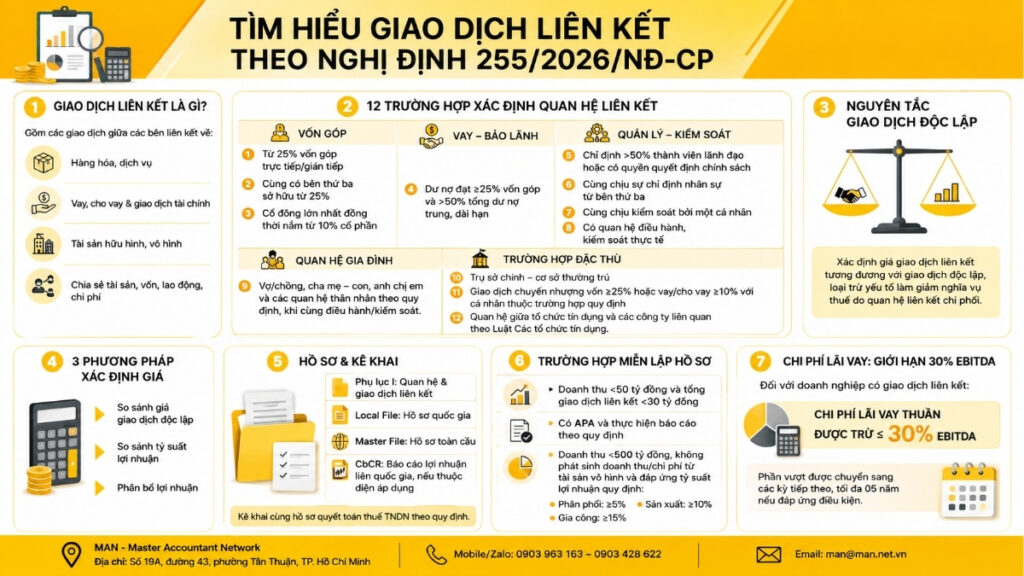
Learn about affiliate transactions This is the first step that any chief accountant, CFO, or business owner needs to complete before entering the corporate income tax season, especially when Decree 255/2026/ND-CP officially replace Decree 132/2020/ND-CP and Decree 20/2025/ND-CP effective from July 1, 2026. Many businesses still believe they "have no related-party transactions" simply because they don't have a parent company abroad, while in reality, a loan from a shareholder, a lease agreement with a company run by a relative, or a loan guarantee relationship is enough to bring the business under the scrutiny of the tax authorities. This article systematizes the entire concept, legal basis, and compliance obligations, helping businesses understand related-party transactions fully and accurately before preparing their tax returns.
Why do all businesses need to understand related-party transactions before the 2026 tax year?
Understanding related-party transactions is no longer a concern exclusive to multinational corporations. With the expanded and clearer definition of related-party relationships in Decree 255/2026/ND-CP, a significant number of domestic businesses, including family businesses and SMEs with shareholder loans, are now potentially subject to declaration requirements.
Decree 255/2026/ND-CP replaces the old legal framework from July 1, 2026.
Decree 255/2026/ND-CP, issued by the Government on June 30, 2026, regulates tax management for related-party transactions of enterprises with related-party relationships. It takes effect from July 1, 2026, and applies from the corporate income tax period of 2026, simultaneously replacing Decree 132/2020/ND-CP and Decree 20/2025/ND-CP. This document is issued on the basis of... Law on Tax Administration No. 108/2025/QH15 and the Corporate Income Tax Law No. 67/2025/QH15 – two new laws that came into effect simultaneously, requiring the entire system of terminology and legal basis regarding related-party transactions to be updated.
The most important point for businesses to consider when understanding related-party transactions during this transitional period, as well as identifying related-party criteria in Article 5, is the more detailed wording, especially in the loan-guarantee and operating relationship groups. This makes a thorough review of the entire ownership structure and internal contracts mandatory rather than optional.
What are related-party transactions? Definition according to Article 4 of Decree 255/2026/ND-CP

Based on Article 4 of Decree 255/2026/ND-CP:
Related-party transactions are transactions involving the purchase, sale, exchange, lease, rental, borrowing, lending, transfer, and assignment of goods; provision of services; borrowing, lending, financial services, financial guarantees, and other financial instruments; the purchase, sale, exchange, lease, rental, borrowing, lending, transfer, and assignment of tangible and intangible assets; and agreements for the purchase, sale, and shared use of resources such as assets, capital, labor, and cost sharing between related parties.
In short, when understanding related-party transactions, businesses need to visualize four main types of transactions:
- Trading in goods and servicesBuying, selling, exchanging, renting, borrowing, or transferring goods or providing services between related parties.
- Financial transactionsBorrowing, lending, financial services, financial guarantees, and other financial instruments.
- Transactions involving tangible and intangible assets.From machinery and equipment to copyrights, trademarks, and trade secrets.
- Shared resource utilization agreementSharing assets, capital, labor, or expenses between affiliated parties.
Cases not within the scope of related-party transactions.
Excluding business transactions involving goods and services subject to state price regulation, which are governed by the law on pricing. This is a point easily overlooked when businesses conduct self-assessments; not every transaction between two related parties is automatically considered a related-party transaction under this Decree if the price is already regulated by the State.
Identify related parties according to Article 5 of Decree 255/2026/ND-CP

According to Clause 2, Article 5 of Decree 255/2026/ND-CP, two enterprises (or one enterprise with another individual or organization) are considered to have an affiliated relationship if they fall under one of the following 12 cases.
Group 1: Relationships based on ownership of capital contributions
Specifically, what does this Group 1 regulation stipulate?
- (1) An enterprise directly or indirectly holds at least 25% of the owner's capital contribution of the other enterprise.
- (2) Both businesses have at least 25% owner's equity held directly or indirectly by a third party.
- (3) An enterprise is the largest shareholder in terms of owner's equity and holds directly or indirectly at least 10% of the total shares of the other enterprise.
Group 2: Links through guarantees and loans
(4) An enterprise guarantees or lends capital to another enterprise in any form (including third-party loans secured by related-party financing and similar financial transactions), provided that the total outstanding debt of the borrowing enterprise to the lending or guaranteeing enterprise is at least 25% of the owner's equity of the borrowing enterprise and accounts for more than 50% of the total outstanding debt of all medium and long-term debts of the borrowing enterprise.
Important Note: The provisions in form (4) do not apply in the following three cases, mainly related to credit institutions:
- The guarantor or lender is an economic organization operating under the Law on Credit Institutions No. 32/2024/QH15 (amended and supplemented by Law No. 96/2025/QH15), which does not directly or indirectly participate in managing, controlling, contributing capital, or investing in the borrowing enterprise or the guaranteed enterprise in the forms (1), (3), (5), (6), (7), (8), (10), (11) and (12).
- The guarantor or lender is an economic organization operating under the Law on Credit Institutions mentioned above, and the borrowing or guaranteed enterprise is not directly or indirectly under the management, control, capital contribution, or investment of another party in the forms (2), (6) and (9).
- Creditors and guarantors are organizations owned by the State with charter capital 100% that have the function of buying, selling, and handling debts, and do not directly or indirectly participate in managing, controlling, contributing capital, or investing in debtor enterprises or guaranteed enterprises in the form of (1) and (3).
Group 3: Links through management, administration, and control.
Specifically in group 3:
- (5) An enterprise may appoint members to the executive or controlling board of another enterprise, provided that the number of members appointed by the first enterprise exceeds 50% of the total number of executive or controlling board members of the second enterprise; or that a member appointed by the first enterprise has the authority to decide on the financial or operational policies of the second enterprise.
- (6) Two companies may have more than one 50% board member, or both may have a board member with the authority to make decisions on financial or operational policies, appointed by a third party.
- (9) Businesses are controlled by an individual through that individual's capital contribution to the business, or through direct participation in the business's management.
- (10) Other cases in which an enterprise (including an independent accounting branch that declares and pays corporate income tax) is subject to the actual management, control, and decision-making on the production and business activities of the other enterprise.
Group 4: Connections through family relationships
(7) Two businesses are managed or controlled in terms of personnel, finance, and business operations by individuals who have one of the following relationships: spouse; biological parents, adoptive parents, stepfather, stepmother, parents-in-law; biological children, adopted children, stepchildren of the spouse, daughter-in-law, son-in-law; siblings with the same parents, half-siblings, half-siblings; brother-in-law, sister-in-law, daughter-in-law; paternal grandparents; grandchildren; aunts, uncles, and nieces/nephews.
Please note: This is a point that many family businesses and businesses with many relatives involved in management need to pay special attention to. Two companies managed and controlled jointly by spouses, siblings, or aunts and uncles in terms of personnel and finances can be considered affiliated, even without any capital contribution.
Group 5: Other Specific Forms of Linkage
(8) The two businesses have a head office and permanent establishment relationship, or both are permanent establishments of a foreign organization or individual.
(11) Businesses that have transactions involving the transfer or receipt of capital contributions of at least 25% of the owner's capital contribution of the business in the tax period; or borrowing, lending, borrowing, or lending of at least 10% of the owner's capital contribution at the time of the transaction in the tax period with individuals managing or controlling the business, or with individuals belonging to one of the personal relationships mentioned in form (7).
(12) Credit institutions with their subsidiaries, controlling companies, or affiliated companies as stipulated in the Law on Credit Institutions No. 32/2024/QH15 (amended and supplemented by Law No. 96/2025/QH15).
It can be seen that form (11) is a noteworthy new point, because it does not determine the related relationship based on ownership or regular management, but based on the transactions occurring in the tax period. In other words, as long as in a tax period, the enterprise has capital transfer or loan-lending transactions reaching the prescribed threshold with the managing individual or their relatives, the related relationship is established for that tax period.
A quick summary of 12 forms of association relationships according to Decree 255/2026/ND-CP
For easy reference, below is a summary table of the thresholds and application conditions for each method analyzed above.
| No. | Form | Terms and conditions apply |
| 1 | Direct/Indirect ownership | From 25% capital contribution |
| 2 | Both have third-party ownership. | Each side contributes 25% of capital. |
| 3 | Shareholders | ≥ 10% total number of shares |
| 4 | Guarantees, loans – lending | Outstanding debt ≥ 25% contributed capital and > 50% total outstanding medium and long-term debt |
| 5 | Appointing a leadership member | More than 50% members or those with policy decision-making authority |
| 6 | Both are subject to personnel appointments from a third party. | Over 50% Joint Leadership Team |
| 7 | Family relationships | Jointly manage and control personnel and finances. |
| 8 | Head office, permanent establishment | Same organization, foreign individual |
| 9 | Controlled by an individual | Through capital contribution or direct management. |
| 10 | Branch | This includes independently accounting branches. |
| 11 | Capital transfer and lending transactions. | From 25% capital transfer or from 10% borrowing or lending during the period |
| 12 | Credit institutions | According to the Law on Credit Institutions No. 32/2024/QH15 |
The Independent Transaction Principle: A Guiding Principle When Understanding Related-Party Transactions
The entire regulatory system regarding related-party transactions revolves around a fundamental principle in Article 3 of Decree 255/2026/ND-CP:
Taxpayers with related-party transactions must exclude factors that reduce tax liability due to the influence or impact of the related-party relationship, in order to declare and determine tax liability for related-party transactions equivalent to independent transactions under the same conditions.
This is known as the Arm's Length Principle, the theoretical foundation for all pricing methods discussed later.
Simultaneously, the tax authorities manage and inspect the related-party transaction prices of taxpayers according to the risk management principles and tax inspection principles stipulated in the Law on Tax Administration No. 108/2025/QH15.
Overview of 3 methods for determining transfer pricing.
After identifying the related party and the related-party transaction, the next step in understanding related-party transactions is choosing the right pricing method and tools to demonstrate that the related-party transaction price complies with the arm's length principle.
Independent transaction price comparison method
This applies when a business engages in transactions involving goods, tangible assets, or services that are readily available on the market or whose prices are publicly listed on exchanges, including transactions for royalty payments and interest payments. The related-party transaction price is adjusted according to the price of the comparable independent transaction or within a standard independent transaction value range.
Profitability comparison method
It comprises three sub-techniques: the resale price method (comparing gross profit margin to revenue, for distribution businesses that do not own intangible assets), the cost-plus method (comparing gross profit margin to cost of goods sold, for contract manufacturing businesses), and the net profit margin comparison method (applied when there is insufficient data to use the above two methods).
Methods for allocating profits among affiliated parties.
This applies to specific, integrated, and closed-loop transactions within a group, such as new product development, exploitation of proprietary intangible assets, and digital economy transactions, where there is no basis for determining individual prices between related parties. The adjusted profit of the enterprise is calculated as the sum of basic profit (determined using the profit margin method) plus excess profit (allocated based on revenue, expenses, assets, or human resources contributions).
Documents and obligations required for declaring related-party transactions.

According to Article 18 of Decree 255/2026/ND-CP, enterprises are obligated to declare information on related-party relationships and related-party transactions according to Appendix I, submitting it along with the corporate income tax return. In addition, enterprises must prepare, maintain, and provide documentation on the determination of related-party transaction prices, including:
- Information on related party relationships and related-party transactions is provided in Appendix I.
- Local File: Information on related-party transactions, pricing policies, and methods used by the company in Vietnam, as per Appendix II.
- Master File: Information on the business operations, pricing policies, and revenue distribution of the entire multinational corporation, as per Appendix III.
- Country-by-Country Report (CbCR) of the ultimate parent company (if required under Article 19), as per Appendix IV.
Please note the deadlines for filing and submitting documents:
- Prepare the related-party transaction declaration form according to Appendix I, Appendix II, and Appendix III and submit it together with the corporate income tax return, no later than the last day of the third month from the end of the fiscal year (usually March 31).
- The creation, maintenance, and provision of Transfer Pricing Documentation (National Documentation, Global Documentation) must be complete and timely as required by the tax authorities during an audit, or no later than 30 days (with a maximum extension of 15 days) during the pre-audit consultation process.
- For the Country-by-Country Report, the deadline for submission is within 12 months of the end of the fiscal year of the ultimate parent company, if applicable. Notification of the entity required to submit the Country-by-Country Report must be submitted no later than the end of the fiscal year of the ultimate parent company for the reporting year.
Cases where declaration and documentation for determining transfer pricing are waived.
Not all businesses with related-party transactions are required to prepare complete documentation. Article 20 of Decree 255/2026/ND-CP stipulates three groups of cases:
Sections III and IV are exempt from declaration and all documentation is waived.
Businesses that only conduct transactions with related parties that are subject to corporate income tax in Vietnam, applying the same tax rate, and where no party enjoys tax incentives during the tax period (still must declare the grounds for exemption as specified in Sections I and II).
No need to file a report, but you still have to provide complete information.
This applies to three cases:
- Total revenue during the period was less than VND 50 billion and total value of related-party transactions was less than VND 30 billion;
- The company has signed an Advance Pricing Agreement (APA) and submitted annual reports as required;
- Businesses that do not generate revenue or expenses from the exploitation of intangible assets, have revenue below VND 500 billion, and apply the minimum net profit margin according to the industry (distribution from VND 5%, manufacturing from VND 10%, processing from VND 15%).
Important Note: Even if exempt from declaration or documentation under the two groups above, the determination of total deductible interest expense when calculating corporate income tax must still be carried out according to Clause 3, Article 16, meaning that the limit on deductible interest expense cannot be applied under these documentation exemption conditions.
Key intersection points to note: Related party transactions and interest expense cap thresholds 30% EBITDA
One of the most direct and common consequences of having related parties is the threshold for deductible interest expenses as stipulated in Clause 3, Article 16 of Decree 255/2026/ND-CP:
The total interest expense, after deducting interest on deposits and loans incurred during the period, shall not exceed 30% of the total net profit from business operations plus net interest expense plus depreciation expense during the period.
The amount exceeding the threshold is excluded from deductible expenses, but may be carried forward to subsequent tax periods for a continuous period not exceeding 5 years, provided that related-party transactions continue to occur in the receiving period.
This regulation applies only to businesses with related-party transactions that occur during the period. In other words, understanding related-party transactions and correctly identifying the related party according to Article 5 is a prerequisite for determining whether a business is subject to the 30% EBITDA threshold. Businesses wishing to learn more about the calculation formula, how to offset interest expenses, and the transition process can refer to the in-depth article on handling interest expense exceeding the 30% EBITDA threshold.
See also: How to calculate EBITDA.
Conclude
Understanding related-party transactions is not a single administrative procedure, but a fundamental step that determines how businesses will declare corporate income tax in the coming years. Three key points to remember: related-party transactions are defined very broadly, encompassing transactions in goods, services, finance, and resource-sharing agreements; related parties are identified through 13 criteria in Article 5, with loan-guarantee relationships and personal relationships being the most easily overlooked by SMEs; and exemption from preparing price determination documentation does not mean exemption from all obligations related to related-party transactions, especially the limit on interest expense deductions.
Businesses that begin researching related-party transactions early on, right from the capital structure stage and when signing internal loan agreements, will have more room to prepare documentation on time and avoid the risk of being assessed for tax purposes.
If your business is still unsure about identifying related parties, choosing pricing methods, or eligibility for tax exemptions, MAN – Master Accountant Network's team of related-party transaction experts is ready to review everything with you before the tax season begins. An initial consultation is always easier than facing a tax assessment.
Contact MAN – Master Accountant Network For free support and advice!
Contact information MAN – Master Accountant Network
- Address: No. 19A, Street 43, Tan Thuan Ward, Ho Chi Minh City
- Mobile/Zalo: 0903 963 163 – 0903 428 622
- E-mail: man@man.net.vn
- Google Business Profile: View MAN – Master Accountant Network's Google Business Profile
- LinkedIn Founder: View expert Le Hoang Tuyen's LinkedIn profile.
Responsible for production and professional content review by: Mr. Le Hoang Tuyen – Founder & CEO of MAN – Master Accountant Network. He is a CPA Vietnam auditor with over 30 years of in-depth experience in accounting, auditing, taxation, and corporate legal consulting.