





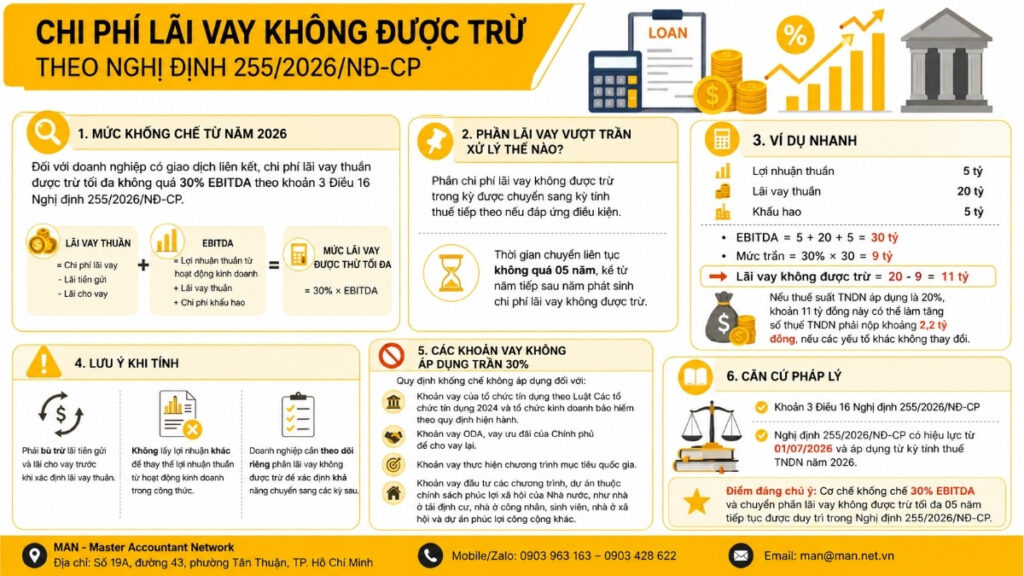
Non-deductible interest expenses are the most damaging item on the tax return of businesses with related-party transactions. For example, a VND 11 billion interest expense being disallowed as a deductible expense means an additional VND 2.2 billion in corporate income tax (CIT) is incurred, even though that interest has already been paid to the bank. From the 2026 corporate income tax period, this entire control mechanism will operate under a new legal framework. Decree 255/2026/ND-CP. This article breaks down the formula for determining the deduction, the 5-year transition mechanism, the excluded loans, and the technical errors that cause interest expenses to be unfairly disallowed during the final accounting process.
What are non-deductible interest expenses and why does Decree 255/2026/ND-CP continue to restrict this item?
In essence, this is the portion of interest expense that the business has legitimately accounted for as financial expense according to accounting standards, but is excluded when determining taxable income for corporate income tax purposes. The direct consequence is that accountants must adjust the taxable profit on the tax return upwards, increasing the amount of tax payable while the accounting profit remains unchanged.
Essentially, this policy is a tool to combat thin capitalization, preventing businesses from using high-interest internal loans instead of contributing capital, thereby eroding the tax base in Vietnam. This approach is consistent with international OECD standards and has been maintained throughout from Decree 20/2017/ND-CP to the present.
On June 30, 2026, the Government issued Decree 255/2026/ND-CP regulating tax management for related-party transactions of enterprises with related-party relationships. The Decree takes effect from July 1, 2026 and applies from the corporate income tax period of 2026, replacing Decree 132/2020/ND-CP and Decree 20/2025/ND-CP.
Which businesses are covered by this regulation?
The entities subject to control are corporate income taxpayers who have transactions with parties involved. affiliated relationship According to Article 5 of Decree 255/2026/ND-CP, there are two groups that are easily encountered in practice during the review process:
- Related party relationship through loans: One enterprise guarantees or lends capital to another enterprise in any form, provided that the total outstanding loan balance is at least 25% of the owner's equity of the borrowing enterprise and accounts for over 50% of the total outstanding medium and long-term debt of the borrowing enterprise (point d, clause 2, Article 5). This is why a purely bank loan can still include an enterprise in the scope of related party transactions, unless it falls under the exclusion cases for credit institutions.
- Personal relationships: Businesses that engage in borrowing, lending, or lending transactions involving at least 10% of the owner's contributed capital at the time of the transaction during the tax period with individuals managing or controlling the business, or with individuals belonging to the family relationship group as stipulated in Clause 2, Article 5. Including the act of "borrowing and lending" under regulation is a point that requires special attention, especially for family businesses that habitually provide interest-free advances or financial support to directors or relatives.
Conversely, businesses that do not have related-party transactions during the period are not subject to the 30% EBITDA ceiling; interest expenses are deductible according to the general principles of corporate income tax law if there are sufficient invoices and documents and they are related to production and business activities.
The legal basis for determining that interest expenses are not deductible is found in Clause 3, Article 16.

Point a, Clause 3, Article 16 of Decree 255/2026/ND-CP stipulates:
The total interest expense after deducting interest on deposits and loans incurred during the period of the taxpayer is deductible when determining taxable income for corporate income tax purposes, provided it does not exceed 30% of the total net profit from business operations during the period plus interest expense after deducting interest on deposits and loans incurred during the period plus depreciation expense incurred during the period of the taxpayer.
The three components of taxable EBITDA as stipulated above are:
- Total net profit from business operations during the period;
- Interest expense after deducting interest on deposits and loans incurred during the period;
- Depreciation expense incurred during the period.
Three key technical considerations determine the accuracy of the final figure:
- Only net profit from business operations is considered: Other profits, other income, or results from activities of a different nature are not included. Items that are not in the nature of interest expense or interest on deposits or loans are not included in the calculation.
- Depreciation expense: Based on the amount incurred during the period, determined from the cash flow statement data, not from internal management calculations.
- Interest expense is net interest expense: Interest on deposits and interest on loans must be offset. If interest on deposits and interest on loans exceeds the total interest expense incurred during the period, the business has no interest expense and is not allowed to deduct it under this limitation mechanism.
Forgetting the offsetting step in the third note is the number one reason businesses overcalculate the disallowed interest expense and overpay taxes.
What changes did Decree 255/2026/ND-CP bring compared to Decree 132/2020/ND-CP?
Does the new legal framework change the applicable obligations? The table below compares each key criterion of the control mechanism between the two decrees, so that the accounting department knows exactly which content remains unchanged and which content needs to be updated in the records.
| Criteria | Decree 132/2020 | Decree 255/2026 |
| Control ceiling | 30% EBITDA | Constant |
| Forwarding the section exceeding the ceiling. | Maximum of 05 consecutive years | Constant |
| Excluded loan categories | ODA, preferential government loans, national target programs, social housing… | Constant |
| Reference | Law on Credit Institutions 2010; Law on Insurance Business 2022 | Updated according to the Law on Credit Institutions 2024; amended Law on Insurance Business 2025 |
| Clause location | Clause 3, Article 16 | Clause 3, Article 16 |
| Declaration form | Appendix I issued with Decree 132 | Appendix I issued with Decree 255 |
The policy regarding non-deductible interest expenses remains essentially unchanged; the main changes lie in updating the legal basis to align with the current legal system and with Law No. 108/2025/QH15 on Tax Administration, with the obligation arising from the 2026 corporate income tax period.
See also: New points in Decree 255/2026/ND-CP regarding related-party transactions.
How to determine non-deductible interest expense in 4 steps

Here's how to determine which interest expenses are not deductible, specifically the following steps:
Step 1: Determine net interest expense.
Net interest expense is determined by the formula:
Net interest expense = Total interest expense incurred during the period – (Interest on deposits + Interest on loans) |
Step 2: Calculate EBITDA
EBITDA is defined as follows:
EBITDA = Net profit from operations + Net interest expense + Depreciation expense |
Step 3: Calculate the ceiling.
To determine the ceiling:
Maximum deductible interest expense = 30% x EBITDA |
Step 4: Compare and determine the classification
The portion of net interest income exceeding the ceiling is considered non-deductible interest expense for the tax period.
Example: Assume company A has a net profit from business operations of 20 billion VND; total interest expense of 12 billion VND; interest on deposits of 2 billion VND; and depreciation expense of 6 billion VND.
- Net interest expense = 12 – 2 = 10 billion VND
- EBITDA = 20 + 10 + 6 = 36 billion VND
- The ceiling amount = 30% x 36 = 10.8 billion VND
Result: Net interest expense (VND 10 billion) is less than the ceiling (VND 10.8 billion), resulting in all interest expense being deductible, while non-deductible interest expense is zero.
Example 2: Assume company B has a net profit from business operations of 5 billion VND; net interest expense of 20 billion VND; and depreciation expense of 5 billion VND.
- EBITDA = 5 + 20 + 5 = 30 billion VND
- The ceiling amount = 30% x 30 = 9 billion VND
- Excess amount = 20 – 9 = 11 billion VND (disqualified)
Result: Taxable income increased by 11 billion VND, resulting in an additional corporate income tax liability of approximately 2.2 billion VND.
These two examples demonstrate that, given the same level of debt, businesses with thin profit margins will be impacted far more severely.
Can interest expenses that are not deductible be carried forward to the next period?
Yes, and this is an important mechanism. Point b, Clause 3, Article 16 of Decree 255/2026/ND-CP stipulates:
The portion of interest expense not deductible under point (a) of this clause shall be carried forward to the next tax period when determining the total deductible interest expense, provided that the total deductible interest expense incurred in the next tax period is lower than the amount stipulated in point (a) of this clause. The carry-forward period for interest expense shall not exceed 5 years from the year following the year in which the non-deductible interest expense was incurred.
In other words, the excess amount can only be reused if there is still room below the 30% ceiling in the following tax period. If the business continues to reach the ceiling in the following year, the carry-over amount must remain pending and continue to count down for a period of 5 years.
Important Note: If the enterprise does not have any related-party transactions in the subsequent tax period, the mechanism for determining the total deductible interest expense under Article 16 will not be activated, and therefore there is no basis to carry forward the disallowed interest expense from the previous period. Enterprises with large carry-forward balances should consider this factor before restructuring internal loans.
To accurately identify and track carry-forward interest expense, businesses should consider the following: related party transaction advisory services Receive in-depth monitoring and support from specialized, experienced units like MAN – Master Accountant Network.
How is interest expense determined if EBITDA is negative?

When the sum of net operating profit, net interest expense, and depreciation expense for the period is negative, the 30% ceiling becomes meaningless. The entire net interest expense for that period becomes non-deductible interest expense. If the business has interest income from deposits or loans, the disallowed amount is determined after offsetting these items.
If EBITDA < 0, non-deductible interest expense is determined as follows:
Non-deductible expenses = Interest expense – Interest on deposits and loans |
The business falls into this situation. Negative EBITDA This item should be tracked separately in the tax management ledger in all cases, and a written inquiry should be sent to the directly supervising tax authority before finalizing the settlement figures.
Important Note: Interest expense that is not deductible should be declared under item B7 (temporary difference). The portion of interest expense from the previous period should be carried over and declared under item B11.
Loans not subject to the 30% EBITDA cap
According to point c, clause 3, Article 16 of Decree 255/2026/ND-CP, the above-mentioned limitation does not apply to:
- Loans of taxpayers that are credit institutions under the Law on Credit Institutions 2024; and insurance businesses under the Law on Insurance Business 2022, as amended and supplemented by the Law on Insurance Business 2025.
- Official development assistance (ODA) loans and preferential loans from the Government are implemented in the form of the Government borrowing from foreign countries and re-lending to businesses.
- Loans for implementing national target programs (new rural development program and sustainable poverty reduction program).
- Loans for investment in programs and projects implementing the State's social welfare policies (resettlement housing, housing for workers and students, social housing, and other public welfare projects).
Businesses in these categories do not incur non-deductible interest expenses due to exceeding the ceiling, but must still prove the loan is legitimate through contracts and disbursement documents.
Conclude
Decree 255/2026/ND-CP neither loosens nor tightens the ceiling, but the scope of identifying related parties has been broadened and the system of forms and reference bases has changed. For businesses with high financial leverage, the cost of a pre-tax audit is always many times smaller than the amount of tax arrears plus late payment penalties after the audit.
Contact MAN – Master Accountant Network For free support and advice!
Contact information MAN – Master Accountant Network
- Address: No. 19A, Street 43, Tan Thuan Ward, Ho Chi Minh City
- Mobile/Zalo: 0903 963 163 – 0903 428 622
- E-mail: man@man.net.vn
- Google Business Profile: View MAN – Master Accountant Network's Google Business Profile
- LinkedIn Founder: View expert Le Hoang Tuyen's LinkedIn profile.
Responsible for production and professional content review by: Mr. Le Hoang Tuyen – Founder & CEO of MAN – Master Accountant Network. He is a CPA Vietnam auditor with over 30 years of in-depth experience in accounting, auditing, taxation, and corporate legal consulting.
Frequently Asked Questions about Non-Deductible Interest Expense
Are businesses with no related-party transactions subject to the 30% EBITDA restriction?
No. The control mechanism in Clause 3, Article 16 only applies to taxpayers who have transactions with related parties. Businesses without related-party transactions are still allowed to deduct interest expenses according to general regulations if they can prove their reasonableness and validity.
Does a regular bank loan result in non-deductible interest expenses?
It is possible if the outstanding debt with the bank simultaneously reaches two thresholds: 25% of equity capital and over 50% of total medium- and long-term debt. However, this regulation does not apply when the lender is a credit institution that does not directly or indirectly participate in the management, control, capital contribution, or investment in the borrowing enterprise.
What are the consequences if interest rates on loans from related parties are higher than those from independent transactions?
These are two independent layers of control. Even if the interest expense ratio remains below the 30% EBITDA ceiling, the tax authorities still have the right to adjust the interest rate difference exceeding the independent transaction amount according to the principles for determining transfer pricing.
From which tax period does Decree 255/2026/ND-CP apply?
The Decree takes effect from July 1, 2026 and applies from the corporate income tax period of 2026.
If the loan interest is disallowed for 5 years but not fully utilized, will it be lost?
Yes. The carry-forward period shall not exceed 5 years from the year following the year of occurrence; beyond this period, any unused portion of the non-deductible interest expense will be permanently excluded from deductible expenses.