






In the context of increasing scrutiny by tax authorities over transactions between related-party enterprises, the full and accurate declaration of related-party transaction information has become a crucial requirement for many businesses. The 2026 Related-Party Transaction Declaration Form is a template that helps taxpayers provide information about related-party relationships, transactions arising with related parties, and methods for determining related-party transaction prices in accordance with the law.
According to the provisions of Decree 20/2025/ND-CP, The updated related-party transaction declaration form in Appendix I is intended to better suit the tax management requirements in the new phase. Businesses with related-party transactions need to understand the form's content, how to declare it, and the methods for determining profit to minimize risks during tax audits and inspections.
This article will provide detailed information on the latest 2026 related-party transaction declaration form, instructions on how to fill it out, and an analysis of the profit allocation method among related parties according to current regulations.
What is a related-party transaction declaration form?
The 2026 Related-Party Transaction Declaration Form is a form used by businesses to declare information about related-party relationships and related-party transactions arising during the tax period. This is an important part of the documentation system for determining related-party transaction prices, helping tax authorities assess the appropriateness of transactions between related parties.
According to the regulations in Appendix I of Decree 20/2025/ND-CP, enterprises required to declare related-party transactions must fully declare all relevant information such as:
- Taxpayer identification information.
- Information about related parties.
- Type of relationship.
- Related-party transactions arising during the period.
- The chosen method for determining transfer pricing.
- Information related to determining corporate income tax obligations.
Preparing the related-party transaction declaration form is not only to meet tax declaration requirements but also serves as a basis for businesses to prove the independence and reasonableness of transactions in case the tax authorities conduct an audit.
Download the latest 2026 related-party transaction declaration form.
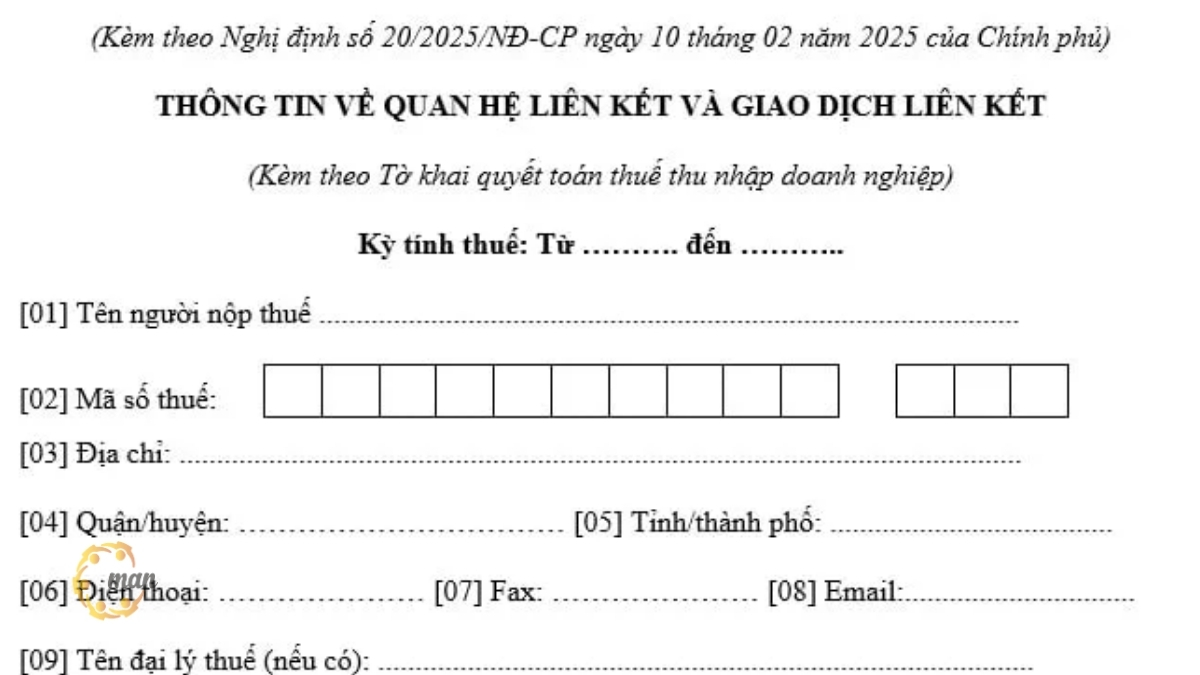
The 2026 Related Party Transaction Declaration Form is a form for providing information on related party relationships and related party transactions as stipulated in Appendix I. Decree 20/2025/ND-CP.
Download the latest 2026 related-party transaction declaration form below:
Download the latest 2026 related-party transaction declaration form. |
Which entities are required to complete the 2026 related-party transaction declaration form?

Not all businesses are required to file a related-party transaction declaration. Businesses only need to do so if they simultaneously have a related-party relationship and the transactions fall within the scope of regulation.
Some common situations that may give rise to declaration obligations include:
- The parent company and its subsidiary engage in transactions involving the buying and selling of goods and services.
- The businesses are controlled by the same organization or individual.
- Businesses that borrow, lend, or provide financial guarantees to related parties.
- Transactions involving the transfer of technology and intangible assets between related parties.
Relationships can arise through:
- Ownership relations.
- Direct or indirect control relationships.
- The relationship involves managing and controlling business operations.
Therefore, before preparing the 2026 related-party transaction declaration form, businesses need to review all transactions that occurred during the year to determine the correct declaration obligations.
Not all businesses are required to complete the 2026 related-party transaction declaration form. Businesses only have the obligation to declare if they are related parties and have transactions with related parties as stipulated by law. Therefore, before making the declaration, businesses need to accurately determine their obligations. Cases where related-party transactions must be declared. To avoid neglecting obligations or failing to comply with regulations.
Instructions on how to fill out the 2026 related-party transaction declaration form.
Providing complete and accurate information on the related-party transaction declaration form plays a crucial role in ensuring businesses comply with tax regulations. When making the declaration, businesses need to review each group of information, from general taxpayer information and related-party relationships to transactions arising during the period, to ensure that the data is consistent with accounting records and related-party transaction pricing records. Below is a detailed guide to each section of the declaration form that businesses need to pay attention to.
General information declaration for taxpayers
The first part of the related-party transaction declaration form requires businesses to provide basic information, including:
- Business name.
- Tax identification number.
- Tax period.
- Information about the legal representative.
This information must be accurate and consistent with tax registration records, financial statements, and corporate tax returns.
Declare information on related party relationships.
This is an important part of the related-party transaction declaration form, used to identify which parties the business has a relationship with.
Businesses need to declare:
- Affiliate name.
- Tax identification number or identification information.
- Forms of association.
For example:
- Parent company-subsidiary relationship.
- The relationship involves mutual control by a single organization.
- Relationships established through loan or guarantee transactions.
Accurately identifying related-party relationships helps businesses choose the appropriate method for determining transfer pricing.
Declare any related-party transactions that arise.
Transactions that need to be declared may include:
- Buying and selling goods.
- Providing services.
- Borrowing and lending finance.
- Transfer of intangible assets.
- Other financial transactions.
Businesses need to ensure that the data on the 2026 related-party transaction declaration form is consistent with:
- Accounting ledger.
- Financial report.
- Transfer pricing determination dossier.
The method of allocating profits among affiliated parties is governed by regulations.
Besides completing the 2026 related-party transaction declaration form, businesses need to determine an appropriate method for determining transfer pricing. One method applied in specific cases is the profit allocation method.
According to Article 15 of Decree 132/2020/ND-CP, Profit allocation methods are applied in certain cases when businesses are involved in complex transaction chains and there is insufficient basis to determine the transaction price independently.
Cases where the profit allocation method is applied.
This method can be applied when:
- The company participates in integrated, closed-loop business operations within the group.
- The company develops new products.
- The company uses proprietary technology.
- Businesses that exploit intangible assets have a monopoly.
- Transactions involving multiple financial markets or multiple countries.
In addition, this method is also considered for:
- Businesses participate in digital economic transactions.
- Value-added activities are created through collaboration among members of the group.
- This applies to businesses that operate with full autonomy over the entire production and business process.
Principles for applying profit allocation methods
The profit allocation method is based on the total actual and potential profits of the parties involved in the transaction.
The key principles include:
- The data used must be based on valid and legitimate documentation.
- The parties must adopt a consistent accounting method.
- The allocation must be consistent with the arm's length principle.
The goal of this method is to determine the appropriate share of profit that each party is entitled to based on their actual functions, assets, and risks involved in the transaction.
How to determine profit distribution among affiliated parties
The taxpayer's adjusted profit includes:
- Basic Profit: Basic profit is determined by comparing profit margins as stipulated. This determination is based on the function performed, assets used, or risks incurred.
- Surplus profit: Surplus profit is allocated based on one or more factors such as revenue, expenses, assets, and human resources.
These factors must reflect the actual contribution of each party in the transaction chain.
In cases where there is insufficient data to determine the details, the business may use one or more of the above criteria to make an allocation consistent with the arm's-length principle.
The significance of the adjusted profit determination results.
The results of the adjusted profit determination serve as the basis for:
- Determine taxable income.
- Determine the amount of corporate income tax payable.
However, the application of profit allocation methods should not be used to reduce the tax obligations payable to the state budget.
4 new points in Decree 20/2025 on related-party transactions that you need to know.

The update Decree 20 on related-party transactions This brings about several notable changes in the declaration, information management, and determination of tax obligations for businesses with related-party transactions. These new points require businesses to proactively review their declaration processes, supporting documents, and methods for determining transfer pricing to ensure compliance with current regulations. Below are four important points that businesses need to pay special attention to:
Update the related party transaction declaration form according to the new regulations.
Decree 20/2025/ND-CP updates the information requirements for tax declarations to better align with current tax management practices.
Businesses need to review the forms they are currently using to ensure compliance with regulations.
Increased demands for transparency in related-party transactions.
Businesses with related-party transactions need to prepare sufficient supporting data:
- The nature of the transaction.
- Transaction value.
- Pricing methods.
Clarify the determination of profits among related parties.
The new regulations help businesses better understand how to apply profit allocation methods in complex transactions.
Enhance the requirements for managing related-party transaction records.
Businesses need to keep complete records:
- Documents for determining transfer pricing.
- Documentation demonstrating the applied method.
- Relevant financial data.
The preparation of the related-party transaction declaration form should be based on correctly identifying the related-party relationship, the nature of the transaction, and the appropriate pricing method. For businesses with many complex transactions or those lacking sufficient basis for assessing tax risks, it is advisable to seek expert advice from a unit with experience in the field. related party transaction advisory This will help businesses build appropriate documentation and minimize errors during the tax declaration and settlement process.
Notes on preparing the 2026 related-party transaction declaration form.
To mitigate tax risks, businesses should:
- Verify the exact relationship between the parties before filing the declaration.
- Compare the figures with the financial statements.
- Choose the appropriate pricing method.
- Maintain complete supporting documentation.
- Stay informed about legal updates regarding related-party transactions.
Frequently Asked Questions about the 2026 Related Party Transaction Declaration Form
The form is prescribed in Appendix I of Decree 20/2025/ND-CP on tax management for enterprises with related-party transactions.
This method is often applied when transactions are highly integrated, when there is insufficient data to determine the price independently, or when there are many factors that create shared value between the parties.
When preparing the 2026 related-party transaction declaration form, businesses should note the following: Accurately verify the information of related parties; fully declare all transactions that have occurred; ensure that the data matches the accounting records and financial statements; correctly determine the method for determining the price of related-party transactions; and maintain records proving the chosen method. Discrepancies between the declaration and actual records may require the business to provide explanations or adjust its tax obligations during a tax audit.
According to regulations, the adjusted profit of a taxpayer may include: basic profit determined using the comparative profit margin method and excess profit determined based on factors reflecting the contribution level such as revenue, expenses, assets or human resources.Where is the 2026 related-party transaction declaration form specified?
When should profit allocation be applied?
What should I keep in mind when filling out the 2026 related-party transaction declaration form?
How is profit determined when applying the profit allocation method?
Conclude
The related-party transaction declaration form is a crucial document that helps businesses fulfill their declaration obligations when transactions with related parties occur. Understanding how to prepare the form, choose the correct pricing method, and apply the regulations on profit allocation will help businesses proactively control tax risks.
During the process, businesses should regularly review related-party transactions, update new regulations, and prepare complete documentation to ensure transparency and compliance with tax laws.
Contact MAN – Master Accountant Network For free support and advice!
Contact information MAN – Master Accountant Network
- Address: No. 19A, Street 43, Tan Thuan Ward, Ho Chi Minh City
- Mobile/Zalo: 0903 963 163 – 0903 428 622
- E-mail: man@man.net.vn
- Google Business Profile: View MAN – Master Accountant Network's Google Business Profile
- LinkedIn Founder: View expert Le Hoang Tuyen's LinkedIn profile.
Responsible for production and professional content review by: Mr. Le Hoang Tuyen – Founder & CEO of MAN – Master Accountant Network. He is a CPA Vietnam auditor with over 30 years of in-depth experience in accounting, auditing, taxation, and corporate legal consulting.