





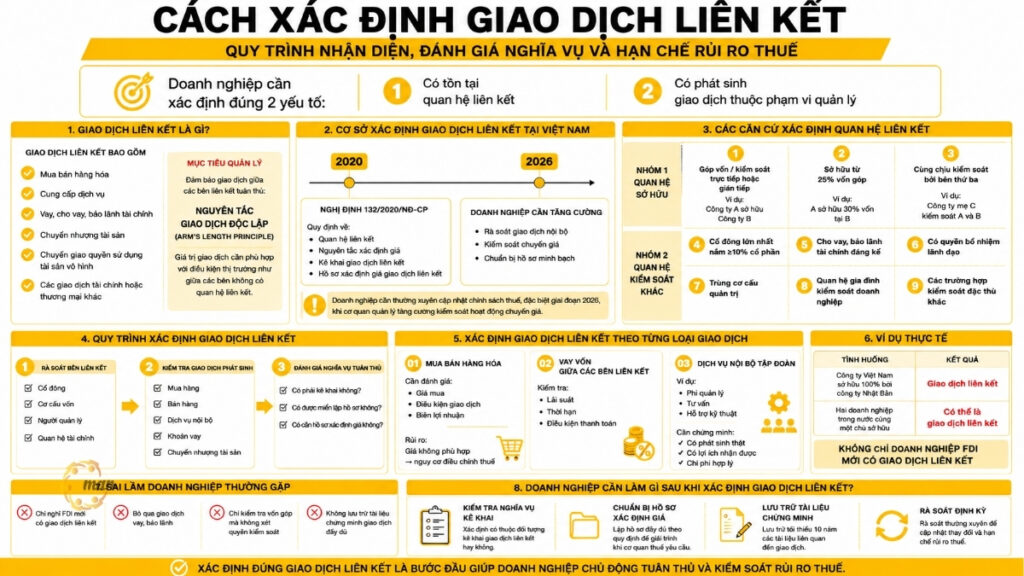
In the context of tax authorities increasingly strengthening the management of transfer pricing activities and increasing transparency of tax obligations, correctly understanding how to identify related-party transactions has become a crucial requirement for many businesses, especially foreign-invested enterprises (FDI), multinational corporations, or businesses with ownership or control relationships with other organizations or individuals.
In reality, many businesses still mistakenly believe that only transactions between a parent company abroad and its subsidiary in Vietnam are considered related-party transactions. However, according to current regulations, the scope of related-party transactions is much broader, including transactions between domestic businesses if they meet the conditions for related-party relationships.
Accurately identifying related-party transactions helps businesses fulfill their declaration obligations correctly, assess the requirements for preparing transfer pricing documentation, and mitigate the risk of tax authorities adjusting transaction prices, collecting back taxes, or imposing administrative penalties.
How are related-party transactions identified?
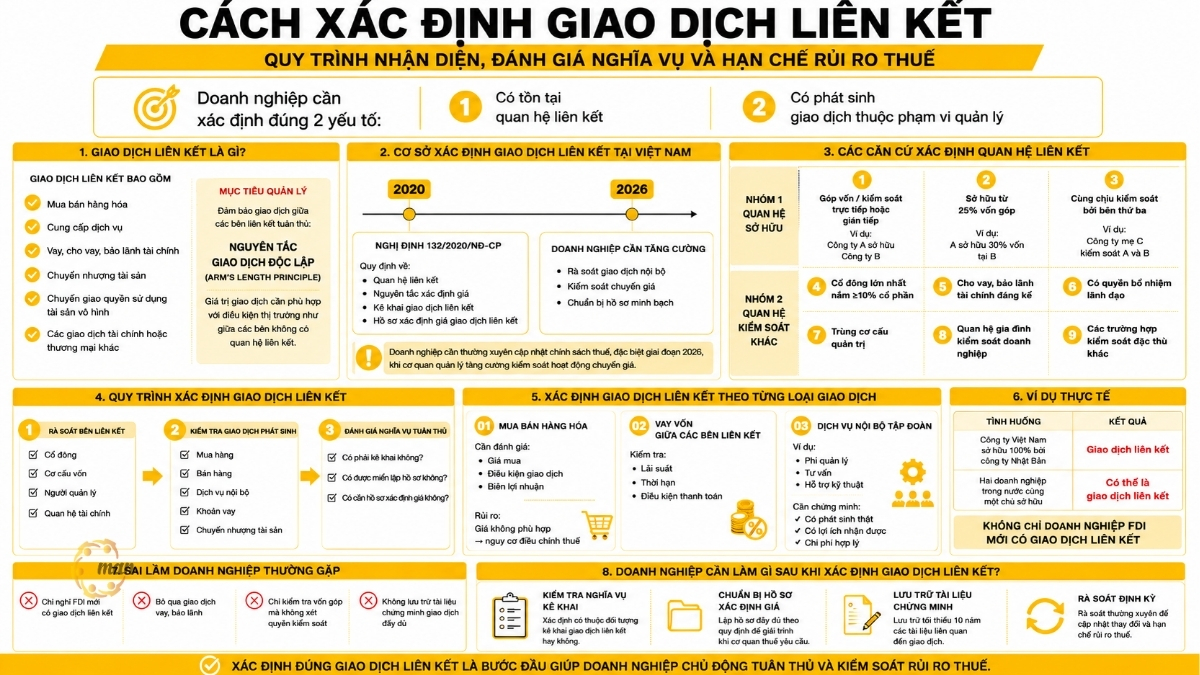
Determining related-party transactions is the process by which a business reviews, evaluates, and concludes whether the transactions involved fall within the scope of related-party transaction management as stipulated by tax laws.
As a general principle, to determine whether a transaction is a related-party transaction, a business needs to consider two factors simultaneously:
- Do the parties involved in the transaction have a related-party relationship?.
- Whether or not transactions falling within the scope of regulation occurred between those parties.
Related party transactions can include various activities such as:
- Buying and selling goods.
- Providing services.
- Borrowing, lending, or providing financial guarantees.
- Transfer of assets.
- Transfer of the right to use intangible assets.
- Other financial or commercial transactions.
The goal of managing related-party transactions is to ensure that transactions between related parties are conducted according to the Arm's Length Principle, meaning that the transaction value should be consistent with market conditions as if the transactions were between unrelated parties.
Correctly identifying related-party transactions from the outset helps businesses proactively manage the declaration process, assess their documentation obligations, and mitigate tax-related risks. However, due to the complexity of regulations regarding related-party relationships and related-party transactions, businesses may need further assistance. related party transaction advisory services In-depth consultation is needed to receive support in reviewing, analyzing, and developing appropriate compliance solutions.
Legal basis for determining related-party transactions in Vietnam

Currently, the determination of related-party transactions in Vietnam is mainly carried out according to the regulations in Decree 132/2020/ND-CP Government regulations on tax management for businesses with related-party transactions.
This decree stipulates:
- Applicable objects.
- Cases that determine the relationship between the parties.
- Principles for determining transfer pricing.
- Obligation to declare related-party transactions.
- Documents for determining transfer pricing.
In addition, businesses need to regularly update themselves on changes in tax policies related to related-party transactions in the period leading up to 2026, as regulatory authorities continue to strengthen control over transfer pricing activities, especially for businesses with cross-border transactions.
How to identify related-party transactions based on the relationship between the parties.

To properly identify related-party transactions, businesses need to determine beforehand whether the parties involved in the transaction are related parties as defined by tax laws. This is a crucial step because only when a related-party relationship exists between the parties and a transaction occurs can the business determine its obligation to declare and document the transfer pricing of the transaction.
According to Article 5 of Decree 132/2020/ND-CP, parties are considered to have an affiliated relationship when they fall into one of the following cases:
One party is directly or indirectly involved in the management, control, capital contribution, or investment in the other party.
This is a common situation where one business has significant control or influence over the operations of another business.
For example: Company A contributes capital to establish Company B, or Company A has the right to participate in making decisions on important matters in Company B's business operations.
In that case, transactions arising between Company A and Company B could be considered related-party transactions.
Parties that are directly or indirectly subject to the same management, control, capital contribution, or investment by another party.
This situation is common in corporate or business models with a single owner.
For example: Company A and Company B are both owned or controlled by Company C. The two businesses operate independently but are under the same management organization.
When a transaction occurs between Company A and Company B, this could be a transaction between related parties.
One business directly or indirectly holds at least 25% of the owner's equity of the other business.
This is one of the most important criteria in determining related-party transactions.
For example:
- Company A owns 30% of contributed capital in Company B.
- Company A and Company B engage in a transaction involving the purchase and sale of goods.
Two businesses can be identified as related parties if they meet the ownership ratio requirements.
Both businesses have a third party that directly or indirectly holds at least 25% of the owner's equity.
This situation commonly occurs within groups of companies that share a common parent company.
For example:
- Company M owns 40% of capital in Company A.
- Company M also owns 40% capital in Company B.
Company A and Company B are affiliated with each other.
One business is the largest shareholder and directly or indirectly holds at least 10% of the total shares of the other business.
This applies to businesses operating under the joint-stock company model.
If a shareholder holds the largest ownership stake and also meets the regulatory requirements, the company needs to consider the related-party relationship when a transaction occurs.
A business that guarantees or lends capital to another business in the form of a loan that represents a significant proportion of its equity or total assets.
The relationship between the two parties is not only defined by capital contributions but can also arise from financial relationships.
For example:
- The parent company provides a large loan to its subsidiary.
- Company A acted as a guarantor for Company B's loan.
Loan, lending, and guarantee transactions need to be reviewed when determining related-party transactions.
One business appoints members to the board of directors or controls the operations of the other business.
This case focuses on the element of governance control.
For example:
- Company A has the right to appoint the CEO or members of the Board of Directors of Company B.
- Company A has the right to decide on important business policies for Company B.
The two businesses can be considered to be related.
Two companies have more than 50% board members or executive board members appointed by the same individual or organization.
This is a case involving duplication in the governance structure.
For example: An individual holds controlling interest in two businesses and makes key management decisions for both.
The two companies have the same individual as a member of the board of directors or executive board, and this individual has the authority to make decisions on financial and business policies.
It's not just about having the same management personnel, but also about considering the actual decision-making power.
For example, a CEO simultaneously manages two companies and has the authority to make decisions regarding the financial and business operations of both businesses.
The two businesses are controlled in terms of personnel, finances, or business operations by individuals who are related.
Related relationships can arise through relationships between individuals who control a business.
The relationships to be aware of include:
- Couple.
- Parents, children.
- Siblings.
- Other family relationships as stipulated.
For example: Two businesses controlled by two individuals from the same family and trading with each other may fall under the category requiring consideration of related-party transactions.
Other cases of business relationships as prescribed by law.
In addition to the common cases mentioned above, businesses need to review specific situations that may give rise to control, influence, or dependence relationships during operations.
In particular, for businesses belonging to multinational corporations, FDI enterprises, or businesses with many internal transactions, the assessment of related-party relationships needs to consider a comprehensive approach rather than solely based on ownership.
Steps to take in identifying related-party transactions
To ensure accuracy, businesses can follow these steps to identify related-party transactions:
Step 1: Review potential affiliates
Businesses need to check:
- List of shareholders.
- Capital ownership structure.
- Legal representative.
- Management member.
- Financial relationship.
The goal is to determine whether the business has a controlling, dominant, or dependent relationship with another organization or individual.
Step 2: Review transactions made with affiliate partners.
After identifying the related party, the business needs to review all transactions that have occurred. This includes:
- Purchase transaction.
- Sales transaction.
- Management services.
- Technical support services.
- The loan.
- Transfer of assets.
One should not focus solely on the buying and selling of goods, as service fees or financial transactions may also fall under the scope of related-party transactions.
Step 3: Assess declaration obligations and prepare documentation.
After completing the identification of related-party transactions, businesses need to evaluate:
- Does this fall under the category requiring declaration of related-party transactions?.
- Does this qualify for exemption from filing requirements?.
- Is it necessary to prepare documentation to determine transfer pricing?.
After completing the process of identifying related-party transactions, businesses need to further assess their documentation obligations under current regulations. For cases requiring documentation, businesses must prepare complete documentation demonstrating the methodology used to determine transfer pricing, comparative analysis, and other relevant information during the process. lFile related party transaction records To ensure transparency during tax audits.
How to identify linked transactions based on common transaction types.

After determining whether the parties are related parties, businesses need to further assess the nature of each transaction to accurately determine its scope of application. In practice, related-party transactions are not limited to the buying and selling of goods but also include many transactions related to finance, services, assets, and the right to use assets. Each type of transaction will have its own characteristics in the process of assessing independence, transaction value, and compliance with tax regulations. Below are common cases that businesses need to consider when determining related-party transactions.
For transactions involving the buying and selling of goods
This is the most common transaction in related-party businesses.
For example: A Vietnamese company imports raw materials from its parent company abroad.
In that case, businesses need to consider:
- Is the purchase price in line with market rates?.
- Are the terms and conditions of the transaction equivalent to those of an independent transaction?.
- Is the company's profit margin appropriate?.
If the purchase price is improperly adjusted to reduce taxable profit in Vietnam, the business may face tax risks.
For loan transactions between related parties
Factors to be evaluated:
- Loan interest rate.
- Loan term.
- Payment terms.
- Comparable to a standalone loan.
For example: A subsidiary borrowing long-term funds from its parent company at unusually high interest rates can increase its financing costs and affect its tax obligations.
For intercompany service transactions
Some common services include:
- Management fee.
- Consultation fee.
- Technology support fees.
- Research and development costs.
Businesses need to demonstrate:
- The actual service is provided.
- Businesses benefit from the service.
- The costs are commensurate with the nature of the transaction.
A practical example of how to identify related party transactions.
In practice, identifying related-party transactions should not be based solely on a single factor such as ownership percentage, but rather on considering the overall relationship between the parties, the nature of the transactions, and the ability to control or influence the business operations. Below are some practical scenarios to help businesses easily understand how to identify related-party transactions in specific cases.
Case 1: Foreign parent company and Vietnamese subsidiary
Company A in Vietnam has 100% capital belonging to Company B in Japan.
Both companies engaged in transactions involving the purchase of raw materials.
Analysis:
- There is a capital ownership relationship.
- A transaction has occurred between the two parties.
Conclusion: This is a related-party transaction, and the business needs to fulfill its related obligations as required by law.
Case 2: Two domestic businesses
Let's assume: Company X and Company Y are both owned and operated by the same individual. The two companies engage in service transactions.
Result: Even without foreign involvement, the two businesses could still be considered related.
Common mistakes when identifying related party transactions.

Although regulations on related-party transactions have been quite specifically guided in Decree 132/2020/ND-CP, in practice, many businesses still fail to fully or accurately identify cases of related-party relationships and related-party transactions. These errors not only increase the risk of underreporting but can also lead to tax authorities imposing tax liabilities, collecting back taxes, and imposing administrative penalties. Below are some common mistakes that businesses need to pay special attention to when determining related-party transactions.
It is only assumed that FDI enterprises have related-party transactions.
This view is inaccurate. Domestic businesses can absolutely engage in related-party transactions if they meet the conditions for related-party relationships.
Omitting financial transactions
Many businesses only check the goods purchase and sale transactions and overlook:
- The loan.
- Lending capital.
- Financial guarantee.
This could lead to omissions in the declaration.
The control relationship was not fully assessed.
Some businesses only examine the ownership percentage without considering governance and management factors. Meanwhile, actual control is also an important basis when determining related-party transactions.
What should a business do after identifying a related-party transaction?
After completing the identification of related-party transactions, businesses need to:
- Check the obligation to disclose information on related-party transactions.
- Prepare documentation to determine transfer pricing if applicable.
- Prepare documentation to demonstrate the legitimacy of the transaction.
- Maintaining records for tax audits and inspections.
In particular, businesses should conduct periodic reviews instead of only checking when requested by the tax authorities.
Not all businesses with related-party transactions are required to create a related-party record. related-party transaction pricing documentation. After reviewing the transactions, businesses need to check the applicable conditions. Exemption from filing related-party transaction records. According to regulations, this is to correctly determine compliance obligations and avoid performing unnecessary or incomplete procedures.
Frequently Asked Questions about How to Identify Affiliate Transactions
Businesses need to rely on two main factors: the relationship between the parties and the actual transactions that occur between those parties.
Not all businesses are required to file a record. Businesses should check the conditions for exemption from filing a record according to current regulations.
Businesses may face risks such as incorrect declarations, price adjustments, tax arrears, or administrative penalties.What factors are used to identify related-party transactions?
Is it mandatory to create documentation to determine the transfer pricing of related-party transactions?
What are the risks associated with misidentifying related-party transactions?
Conclude
Understanding how to identify related-party transactions is crucial for businesses to fulfill their tax obligations and control business risks. Beyond simply identifying ownership relationships, businesses need to comprehensively assess factors related to capital, management, finance, and the nature of the transactions involved.
With tax authorities increasingly focusing on controlling transfer pricing activities, businesses should proactively review related-party transactions, update new regulations, and prepare appropriate documentation to ensure transparency, compliance, and sustainable development.
Contact MAN – Master Accountant Network For free support and advice!
Contact information MAN – Master Accountant Network
- Address: No. 19A, Street 43, Tan Thuan Ward, Ho Chi Minh City
- Mobile/Zalo: 0903 963 163 – 0903 428 622
- E-mail: man@man.net.vn
- Google Business Profile: View MAN – Master Accountant Network's Google Business Profile
- LinkedIn Founder: View expert Le Hoang Tuyen's LinkedIn profile.
Responsible for production and professional content review by: Grandfather Le Hoang Tuyen – Founder & CEO of MAN – Master Accountant Network. He is a CPA Vietnam auditor with over 30 years of in-depth experience in accounting, auditing, taxation, and corporate legal consulting.